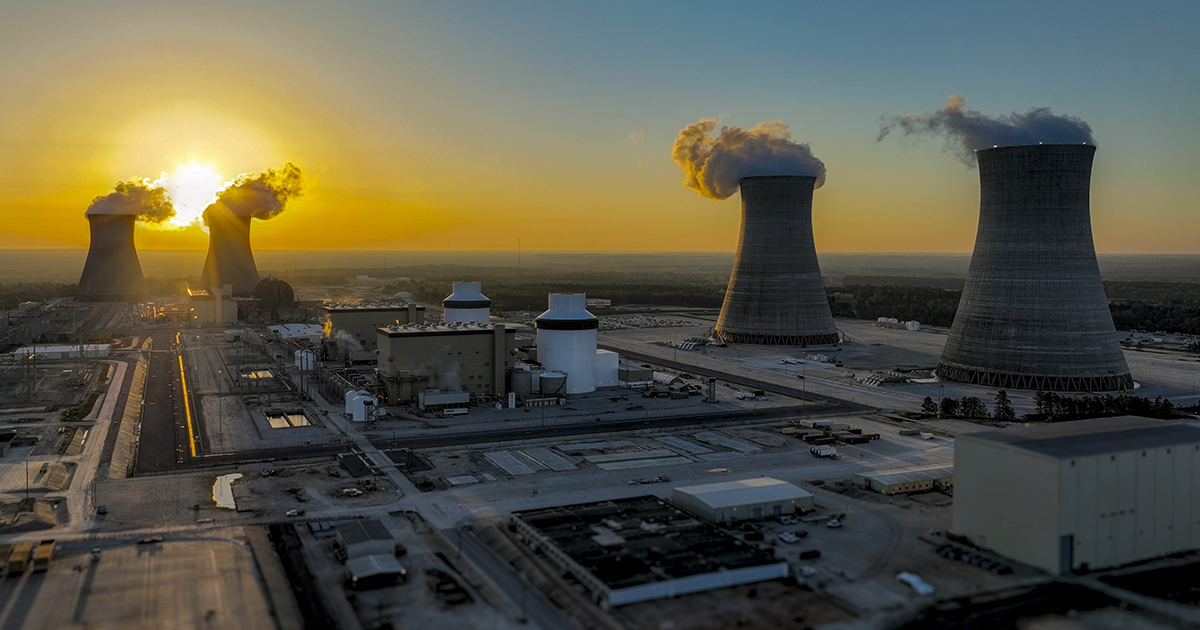
U.S. Sets Targets to Triple Nuclear Energy Capacity by 2050
U.S. targets map out 200 GW of new nuclear capacity by 2050.
Energy.gov
102 points · by chickenbig · 2y ago · 223 comments
https://www.bloomberg.com/news/articles/2024-08-20/china-app...
China Added More Solar Panels in 2023 Than US Did In Its Entire History
https://www.bloomberg.com/news/articles/2024-01-26/china-add...
It should be clear from these three examples that some regulatory environments are more conducive to rapidly building infrastructure than others.
It’s not about the “regulatory environment”, which is almost irrelevant when talking about China. What’s driving this is state-led development with clear goals, like reaching peak carbon by 2030, a claim which they can actually back up with developments like these.
A couple of years ago in China it was cloudy, non-windy, and dry at the same time for an extended period of time.
The energy transition isn't as simple as "build more solar, shut down coal".
That's about a decade and a half too late. We need to be reducing our carbon footprint right now, and we have that ability: wind and solar. Low initial impact, fast to net carbon negative.
Nukes take decades to dig themselves out of their carbon positive holes, if they ever do so at all (the nuclear industry does not account for most of the CO2 generated from supply and operations.)
Then nuke is much better for low co2 energy mix, cf France vs Germany
https://www.governing.com/infrastructure/5b-for-ev-infrastru...
If you can declare that a failure before most projects have a spade in the ground then this newly announced nuclear plan has already failed.
Vogtle 3 and 4 were completed in the last couple of years, plus Watts Bar Unit 2 8 years ago.
Also let's not forget the work to maintain and upgrade units so they can run beyond the 40 year initial license.
Regardless of those plans and whether they are cancelled or not, renewables are going full steam ahead in most of the world and will likely add essentially all of the planned nuclear capacity in a matter of years. And then some.
At this point renewables are, by far, the most cost effective way to generate power. Wind, solar, and battery storage are growing at a ridiculous rate. That's actually causing headaches for plans made years ago for e.g. gas plants and indeed nuclear plants. Some gas plants that opened fairly recently are actually facing early closures because they are no longer price competitive.
Since they were built with the idea of supplying gas for a few decades and will be obsolete before that planned date, they're started to raise the rates they charge to ensure it gets paid off in time. This then accelerates the pace of people moving off gas.
A diverse and robust energy grid is composed of various generation sources that differ in capacity factors, environmental impact, stability, availability, etc.
If you look at UAE building South Korean plants, they were finishing plants pretty rapidly and if they had simply continued, they could have turned 100% green in just a few more years at quite a low cost overall.
It also depends on your energy market and financing. If you have a lot of solar, that simply destroys the market during certain periods, nuclear isn't gone be that profitable. But if you don't have a bunch of wind/solar and you actually value stable energy production. Then its much more reasonable.
A nuclear plant can run for 80+ years. So it depends on interest rates you use.
The battery industry is expected to grow a maddening percentage in the coming decade. Germany moving their renewable goal from 60-80% by (I’m not sure about the year but I think it’s 2030), alone increased the expected economic growth for supplying battery storage by 800%. There is nowhere near enough storage to make nuclear and fossil fuels obsolete yet however. Especially not if we also increase the EV market share.
Solar isn’t optimal in very hot regions, however, as the efficiency goes down 0.3-0.5% in efficiency for every degree Celsius above 0 degrees Celsius. So in some regions nuclear is going to be a good option. I’m not personally a fan of nuclear because its safety depends on governments being willing to regulate the safety, but there is no denying that it’s still a much, much, better alternative to fossil fuels as far as delivering power on demand.
This is how it looks in Europe. I have no idea how it looks in the US.
There seems a general pattern that if you need to build it outside of china, be that batteries, nuclear power plants or solar panels, it becomes too expensive.
There is also still a couple of years until the European battery factories that are under construction will actually be operational.
Unless the economy picks up I suspect we’ll see a lot of bankruptcies in the coming five years. Currently it’s not just the price of solar panel production that is an issue, it’s also that you make equal and safer money on other investments. Back when the interest rates were basically 0% the 3-7% returns on solar were very attractive but now that is just not the case. This is why you see Japan picking up as an attractive place for solar these years, because in Japan a 3-7% return is still very good.
Energy prices are set by the government and don't reflect the actual cost. French tax payers pay for the difference and have done so for years. The cost price probably excludes quite a bit that tax payers are also paying for.
The sad reality with nuclear is that it's a very unprofitable business unless you get governments to sponsor construction, waste disposal, security, etc. and then bail out failing nuclear companies when they fail anyway. All of these things have happened in France. France has nuclear reactors because it regards being a nuclear power as strategically important. Not because it's particularly cheap. It never was.
As of now, that somewhat artificial cost of 8 cents per kwh is actually on the high side for renewables. There are cheaper ways to get power these days.
Really? Aren't they getting life-extended past 40 years? https://en.wikipedia.org/wiki/Fessenheim_Nuclear_Power_Plant was closed down due to Swiss/German objections, but are any of the other PWRs planned to be closed down?
> French tax payers pay for the difference and have done so for years.
Social tariffs are a thing, as is redistribution of wealth.
> that somewhat artificial cost of 8 cents per kwh is actually on the high side for renewables
Let us not conflate the price paid to a generator with the cost to the consumer. Also why do renewables need subsidies in France? https://ec.europa.eu/commission/presscorner/api/files/docume...
https://www.enerdata.net/publications/daily-energy-news/fran...
> The full cost of existing nuclear power calculated by the CRE amounts to respectively €60.7/MWh over the period 2026-2030
And the first hit for "wind power cost europe mwhr" shows just how subsidized nuclear is:
https://windeurope.org/policy/topics/economics/
At its cheapest wind is half the cost of nuclear and at its worst is the same cost as nuclear - with none of the massive headaches.
Assuming that price is with a 77% capacity factor there is an easy way to reduce the cost per MWh; get them to run with a higher capacity factor. Finland has achieved 94% over the last few years, and the US is up at 93% I believe. https://pris.iaea.org/PRIS/CountryStatistics/CountryDetails....
Assuming that this is mainly fixed costs the price could be down to 60.7*.77/.94 = 50 EUR/MWh; fuel is a minor input and might bump the price up to perhaps 53 EUR/MWh.
Which is 6 euro cents per KWh. Fully in line with what I said.
French consumers are paying less for their electricity than, for example, Californians (https://www.cnet.com/home/energy-and-utilities/heres-the-ave...) where electricity largely comes from natural gas (https://www.energy.ca.gov/data-reports/energy-almanac/califo...).
>And the first hit for "wind power cost europe mwhr" shows just how subsidized nuclear is:
This source makes a vague claim about LCOE estimations not taking subsidies into account. It says nothing to establish the amount of those subsidies, or even to quantify the cost of any power source besides wind.
>with none of the massive headaches.
Onshore wind generation has plenty of drawbacks. Much of what's commonly said against nuclear is baseless fearmongering.
Pretend you are a metal foundry.
Good luck.
Great argument for an energy source
https://theecologist.org/2016/feb/17/wind-power-windgas-chea...
Of course, we'll never stop building nuclear power in spite of this because it provides indirect subsidies for the military.
Or just build the metal foundry in the non-blizzard-prone area in the first place, because the blizzard takes out power lines even if there was a nuclear reactor on the other end.
I've done the maths, and I'd it wasn't for geopolitics, China makes enough Aluminium to make an HVDC grid so thick that it would have so little resistance that they could usefully connect every grid in the world for a cost of 250e9 USD for the Aluminium.
Scaled down to just the USA, no international stuff, it's something you can easily do if someone convinces Trump or Musk to delete any internal obstruction.
Why don't we just assume that power will be free and infinite and plug our grid into that assumption? We can even write it down on the socket and paint it green, based on how these arguments always read out that's the only thing needed to maintain electrified high tech society.
Also, economics are not equal to climate/carbon. If we want to reduce climate change only nuclear is the way to go - not solar/battery.
I don't think solar+battery is cost competitive if you were to replicate nuclear completely, but I've not looked at the numbers. Need to consider a nuclear plant may have a 60 year life whereas panels would be 20 at best and batteries probably less.
Edit: I can't reply so adding this for context around my comments on carbon intensity:
In other words, if you cut corners you can make nuclear cheap.
This is good for regulatory discussions and historical context:
Why are you commenting then? This is a complex, deeply researched topic. It's contentious enough already, no need to add more noise.
"Looking at the numbers" is literally the one thing one needs to do in order to be able to add to this discussion.
If there is anything to talk about seriously it hasn't come up on HN in the last few years. The last time something happened that moved the needle on whether there was any real policy question by the numbers was probably Chernobyl.
Here's something on carbon:
https://en.m.wikipedia.org/wiki/Energy_return_on_investment
The problem with economic arguments is that externalities are not priced in. We don't price in the carbon of china solar manufacturing for example.
The other problem of economic arguments is that regulations are expensive in nuclear, and it is orders of magnitude safer than next best alternatives.
Which means: economic arguments miss the point when considered in the broader context.
That means battery deployments will have tripled in... 2026.
Just to show the difference in growth rate, if batteries would keep increasing 100% annually, installations will have increased 1*2^25 = 300 million times by 2050. So multiple orders of magnitude different is what I'm trying to point out.
The growth rate that the US government sets here is 4% (1.04^25 = 3).
It's meaningless I think. It doesn't move the needle.