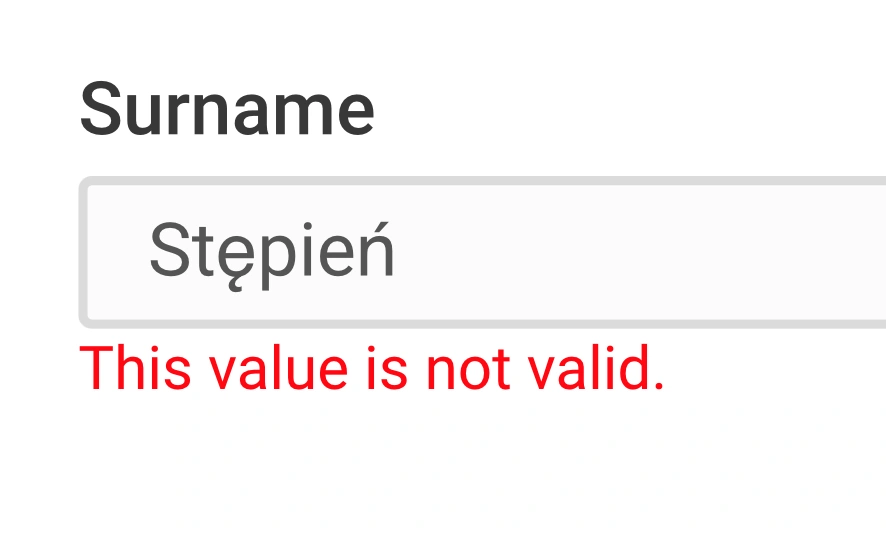
charset=“wtf-8”
* Mandatory field
wtf-8.xn--stpie-k0a81a.com
282 points · by edent · 2y ago · 452 comments
See the Companies House XSS injection situation, where their rationale for forcing a business to change its name was that others using their database could be vulnerable: https://www.theregister.com/2020/10/30/companies_house_xss_s...
Sending data to a database: parametrized queries to sanitize as it is leaving your control.
Sending to display to the user: sanitized for a browser
Sending to an API: sanitize for whatever rules the API has
Sending to a legacy system: sanitize for it
Writing a file to the system: sanitize the path
The common point is you don't sanitize before you have to send it somewhere. And the advantage of this method is that you limit the chances of getting bit by reflected injections. You interrogate some API you don't control, you may just get malicious content, but you sanitize when sending it so all is good. Because you're sanitizing on output and not on input.
Limting the character set at name input gives the user the chance to use the same ASCII-encoding of their name in all places.
The choice is different if like most apps you are almost only a data sink, but if you are also a data source for others it pays to be cautious.
...and maybe they will even link to this page to support that statement! But, seeing that most of the pages are German, I bet they do accept the usual German "special" letters (ÄÖÜß) in names?
It's reasonable to expect a German company to deal with German script, less reasonable to expect them to deal with literally every script that someone once thought would be funny to include in Unicode.
Venture into the abyss of UTF-8 and behold the madness of multibyte characters. Diacritics dance devilishly upon characters, deceiving your simple count. Think a letter is but a single entity? Fools! Combining characters lurk in the shadows, binding invisibly, elongating the uninitiated's count into chaos. Every attempt to enumerate the true length of a string in UTF-8 conjures a specter of complications. Behold, a single glyph, yet multiple bytes cackle beneath, a multitude of codepoints coalesce in arcane unison. It is beautiful t he final snuffing of the lie s of Man ALL IS LOST ALL I S LOST the pony he comes he comes he comes the ich or permeates all MY FACE MY FACE ᵒh god no NO NOOO O NΘ stop the an * gles are n ot real ZALGΌ IS TOƝȳ THE PO NY HE COMES
The main issue with naïve truncation is that not every code point is a character (and I guess not every character is a glyph?). If you truncate the Unicode code point array at some unfortunate places like https://en.wikipedia.org/wiki/Ideographic_Description_Charac... , you'd just get gibberish or potentially very unintended results. (especially if you joined the truncated string with some other string)
It's possible for the same logical character to have two different sets of code points (for example, a-with-umlaut as a single character, vs a followed by umlaut combining diacritic). Related, distinguishing between the "a" character in Latin, Greek, Cyrillic, and the handful of other times it shows up throughout Unicode.
This comes up in at least 3 ways:
1. A usability issue. It's not always easy to predict which identical-looking variant is produced by different input methods, so users enter the identical-looking characters on different devices but get an account not found error.
2. A security issue. If some of your backend systems handle these kinds of characters differently, that can cause all kinds of weird bugs, some of which can be exploited.
3. An abuse issue. If it's possible to create accounts with the same-looking name as others that aren't the same account, there can be vectors for impersonation, harassment, and other issues.
So you have to make a policy choice about how to handle this problem. The only things that I've seen work are either restricting the allowed characters (often just to printable ASCII) or being very clear and strict about always performing one of the standard Unicode transformations. But doing that transformation consistently across a big codebase has some real challenges: in particular, it can change based on Unicode version, and guaranteeing that all potential services use the same Unicode version is really non-trivial. So lots of people make the (sensible) choice not to deal with it.
But yeah, agreed that parenthesis should be OK.
Suppose you have a unicode blob of my name in your database and there is a problem and you need to call me and say hi. Would your customer representative be able to pronounce my name somewhat correctly?
>I think there're very few exceptions to this, probably something law-related, or if you have to interact with some legacy service.
Few exceptions for you is entirety of the service for others. At the very least you interact with legacy software of payment systems which have some ideas about what names should be.
Are you implying the CSR's lack of familiarity with the pronunciation of your name means your name should be stored/rendered incorrectly?
I don’t however know which unicode subset to use, because you didn’t tell me in the signup form. I have many options, all of them correct, but I don’t know whether your CSR can read Ukrainian Cyrillic and whether you can tell what vocative case is and not use that when inerfacing with the government CA which expects nominative.
You cannot pronounce the name regardless of whether it is written in ASCII. Pronouncing a name requires at the very least knowledge of the language it originated in, and attempts at reading it with an English pronunciation can range from incomprehensible to outright offensive.
The only way to correctly deal with a name that you are unfamiliar with the pronunciation of is to ask how it is pronounced.
You must store and operate on the person's name as is. Requiring a name modified, or modifying it automatically, is unacceptable - in many cases legal names must be represented accurately as your records might be used for e.g. tax or legal reasons later.
But this is simply not true in practice and at times it's just plain wrong in theory too. The in practice part is trivially discoverable in the real world.
As to in theory -- I do in fact want a properly functioning service to use my name in a vocative case (which requires modifying it automatically or having a dictionary of names) in their communications that are sent in my native language. Not doing that is plainly grammatically wrong and borderline impolite. In fact I use services that do it just right. I also don't want to know to specify the correct version myself, as it's trivially derivable through established rules of the languages.
Offensive if you WANT to be offended perhaps but definitely understandable, which is the main thing that matters.
That a particular technical solution is incapable of storing it in the preferred way is not an excuse. EBCDIC is incompatible with GDPR: https://news.ycombinator.com/item?id=28986735
Seriously, what are you going for here?
Which one is why the bag of unicode bytes approach is as wrong as telling Stęphań he has an invalid name.
Typical input validation doesn't really solve the problem. For instance, I could enter my name as 'Vrdtpsk,' which is a perfectly valid ASCII string that passes all validation rules, but no one would be able to pronounce it correctly. I believe the representative (if on a call) should simply ask the customer how they would like to be addressed. Unless we want to implement a whitelist of allowed names for customers to choose from...
The only generic solution I can think of would be IPA notation, but it would be entirely unreasonable to expect someone to know the IPA for their name, just as it would be unreasonable to expect a random third party to know how to read IPA and replicate the sounds it described.
If the user is Chinese and the CSR is not - probably no, and that's not a Unicode issue.
Worse case, just drop to hexadecimal.
This is laughably naive.
So many things can go wrong.
Strings are not arrays of bytes.
There is a price to pay if someone doesn't understand that or chooses to ignore it.
That very much depends on the language that you are using. In some, they are.
Those languages don't have strings.
Here it is today in GNOME 46.0, after so many years, this should say "selected": https://github.com/user-attachments/assets/306737fb-6b01-467... In previous GNOME versions it would mess up even more text in the file properties window.
Here's an article about it, but I couldn't find the more interesting blogpost about RTL: https://krebsonsecurity.com/2011/09/right-to-left-override-a...
Which happens almost every day in the real world.
While being transparent is great and better than stupidly mangling or rejecting data, the problem is that if we just pass through anything, there are situations and contexts in which some kinds of software could be used as part of a chain of deception involving Unicode/font tricks.
Passing through is mostly good. Even in software that has to care about this, not every layer through which text passes should have the responsibility.
In fairness, they mostly wanted stuff to be in English, and when necessary, to transliterate German characters into their English counterparts (in German there is a standardised way of doing this), so I can understand why they didn't see it was necessary. I just never understood why I, as the non-German, was forever the one trying to convince them that Germans would probably prefer to use their software in German...
Hah, fair enough. I think it was an abstract question to me, so I was looking for the technically correct answer. Practical question for him, so he gave the practical answer.
It's not possible. However I bet they would argument to use iso-8859-15 (latin9 / latin0) with the international currency sign (¤) instead or insist that char 128 of latin1 is almost always meant as €, so just ignore the standard in these cases and use a new font.
This would only fail in older printers and who is still printing stuff these days? Nobody right?
Using real utf-8 is just too complex... All these emojis are nuts
If you can speak English, you might be better of using the software in English, as having to deal with the English language can often be less of hassle, than having to deal with inconsistent, weird, or outright wrong translations.
Even high quality translations might run into issues, where the same thing is translated once as "A" and then as "B" in another context. Or run into issues where there is an English technical term being used, that has no prefect equivalent in German (i.e. a translation does exist, but is not a well-known, clearly defined technical term). More often than not though, translations are anything but high quality. Even in expensive products from big international companies.
I've heard that German is often one of the first localizations of (desktop) software because there were often super-long words in the translations of various concepts, so if you wanted to test typeface rendering and menu breakage it was good language to run through your QA for that.
I cannot know, but they could be ideological. For example, they had found it wonderful to use plain ASCII, no need for special keyboard layouts or something like that, and they decided that German would be much better without its non-ASCII characters. They could believe something like this, and they wouldn't say it aloud in the discussion with you because it is irrelevant for the discussion: you weren't trying to change German.
The coworker who made that happen said I'm a weirdo for setting my machine in my own language. According to him I should have set it to english.
This of course happened in a non english speaking country.
Family names are not part of this, but maybe that exists too elsewhere. I don't know how people whose name has been given to them before this list was established is handled however.
An alternative method, which is again culture dependent, is to use virtual governmental IDs for this purpose. Whether this is viable in practice I don't know, never implemented such a thing. But just on the surface, should be.
Unless of course immigration is allowed and doesn't involve changing a name.
Even if you try to imagine a system for a hospital to register newly born babies... What happens if a pregnant tourist is visiting?
>echo "'Lódź'" | uconv -f "UTF-8" -t "UTF-8" -x "Latin-ASCII"
>'Lodz'
https://en.wikipedia.org/wiki/%C4%8Celje
echo "Čelje" | uconv -f "UTF-8" -t "UTF-8" -x "Latin-ASCII"
> "Celje"
https://en.wikipedia.org/wiki/Celje
(i mean... we do have postal numbers just for problems like this, but both Štefan and Stefan are not-so-uncommon male names over here, so are Jozef and Jožef, etc.)
bool ValidateName(string name) => true;
is probably pretty safe.
When they meet people, they tell them their name is unpronounceable, it’s the sound of a PC speaker from the late 20th century, but you can call them by their preferred nickname “beep”.
In paper and online forms they are probably forced to go by the name “BEL”.
This name, "คุณสมชาย" (Khun Somchai, a common Thai name), appears normal but has a Zero Width Space (U+200B) between "คุณ" (Khun, a title like Mr./Ms.) and "สมชาย" (Somchai, a given name).
In scripts like Thai, Chinese, and Arabic, where words are written without spaces, invisible characters can be inserted to signal word boundaries or provide a hint to text processing systems.
Of course there are. If you commit to supporting everything anyone wants to do, people will naturally test the boundaries.
The biggest fallacy programmers believe about names is that getting name support 100% right matters. Real engineers build something that works well enough for enough of the population and ship it, and if that's not US-ASCII only then it's usually pretty close to it.
Don't reject Cf. That's asking for trouble.
However, for every 1 user you get whose full legal name is bob@example.com you'll get 100 users who put their e-mail into the name field by accident
And for every 1 user who wants to be called e.e. cummings you'll get 100 who just didn't reach for the shift key and who actually prefer E.E. Cummings. But you'll also get 100 McCarthys and O'Connors and al-Rahmans who don't need their "wrong" capitalisation "fixed" thank you very much.
Certainly, I think you can quite reasonably say a name should be comprised of between 2 and 75 characters, with no newlines, nulls, emojis, leading or trailing spaces, invalid unicode code points, or angle brackets.
I'm curious if anyone can think of any other non-alphabetic characters used in legal names around the world, in other scripts?
I wondered about numbers, but the most famous example of that has been overturned:
"Originally named X Æ A-12, the child (whom they call X) had to have his name officially changed to X Æ A-Xii in order to align with California laws regarding birth certificates."
(Of course I'm not saying you should do this. It is fun to wonder though.)
Latin characters are NOT allowed in official names for Japanese citizens. It must be written in Japanese characters only.
For foreigners living in Japan it's quite frequent to end up in a situation where their official name in Latin does not pass the validation rules of many forms online. Issues like forbidden characters, or because it's too long since Japanese names (family name + first name) are typically only 4 characters long.
Also, when you get a visa to Japan, you have to bend and disform the pronunciation of your name to make it fit into the (limited) Japanese syllabary.
Funnily, they even had to register a whole new unicode range at some point, because old administrative documents sometimes contains characters that have been deprecated more than a century ago.
Some Japanese names are written with Japanese characters that do not have Unicode codepoints.
(The Unicode consortium claims that these characters are somehow "really" Chinese characters just written in a different font; holders of those names tend to disagree, but somehow the programmer community that would riot if someone suggested that people with ø in their name shouldn't care when it's written as o accepts that kind of thing when it comes to Japanese).
[1] https://en.m.wikipedia.org/wiki/N%25C7%2583xau_%C7%82Toma
The Catalan name Gal·la is growing in popularity, with currently 1515 women in the census having it as a first name in Spain with an average age of 10.4 years old: https://ine.es/widgets/nombApell/nombApell.shtml
(And I have 3 in my keyboard, I'm not sure everyone is using the same one.)
Unless of course the name is not used for official purposes, in which case you can get away with First-Last combination.
It's really a non issue and the answer is jurisdiction bound. In most of Europe extented Latin set is used in place of Cyrillic (because they don't know better), so my name is transliterated for the purposes of being in the uncivilized realms by my own government. No, I can't just use Л and Я as part of my name anywhere here.
Love receiving packages addressed to ??d? :)
I received a large delivery from Poland recently, and it was addressed to "K?benhavn", with similar mistakes in the street name.
Often I’ll create a virtual credit card number and use a fake name, and virtually never have had a transaction declined. Even if they are more aggressively asking for a street address, giving just the house number often works. This isn’t a deep cover but gives a little bit of a anonymity for marketing.
Plenty of government things have been digitalised in recent years too, and split name fields tend to have been coded to make both mandatory. It’s… disappointing, given the radical diversity of name construction across India.
Automatic transliteration seems to be very dangerous (wrong name on bank accounts, for instance), and not always feasible (some unicode characters have more than one way of being transliterated).
Should we apologize to the user, and just ask the user twice, once correctly, and once for the bad computer systems? This seems to be the only approach that both respects their spelling, and at the same time not creating potential conflict with other systems.
Those are translations coming from professionals who swore an oath. Don’t try to do it with code.
The real problem here is that transliteration rules depend on the source language, and you often don't have the context to distinguish that (e.g. the name can be spelled identically in Russian, Bulgarian, and Ukrainian, yet transliterations will be different). And even where you do have sufficient context, this still requires the system to be able to handle any source language that can be potentially thrown at it, which is just about anything. So it never gets implemented properly in practice.
Also, USCIS usually has an "aliases" field on their forms, which would be a good place to put German government misspellings.
I know someone that still doesn't know whether they have a middle name as far as american authorities are concerned.
Coupled with "two last names" and it gets really messy, really quickly.
Purchases names don't match the CC name.
Bank statements are actually "for another person".
Border crossings are now extra spicy.
And "pray" that your name doesn't resemble a name in some blacklist.
Debit cards a pretty common example of this. I believe you can only have ASCII in the cardholder name field.
No you can't.
Add: Okay, you need to know why. I'm right here a living breathing person with a government id that has the same name scribed in two scripts side by side.
There is an algorithm (blessed by the same government that issued said it) which defines how to transliterate names from one to another, published on the parliament web site and implement in all the places that are involved in the id issuing business.
The algorithm will however not produce the outcome you will see on my id, because me, living breathing person who has a name asked nicely to spell it the way I like. The next time I visit the id issuing place, I could forget to ask nicely and then I will have two valid ids (no, the old one will not be marked as void!) with three names that don't exactly match. It's all perfectly fine, because name as a legal concept is defined in the character set you probably can't read anyway.
Please, don't try be smart with names.
Human systems aren't always interested in avoiding or fixing defects.
That being said, in Japan it’s actually common to have two fields, one for the name in kanji (the “nice” name), and one in katakana (restricted, 8-bit phonetic alphabet, which earlier/older computer systems used and some probably still use).
For instance, in many Japanese forms, there are dedicated fields for the name and the pronunciation of the name. There are possibly multiple ways to read a name (e.g. 山崎 is either やまざき or やまさき). It is better to ask the person "how to read your name?" rather than execute code to guess the reading.
As for transliteration, it's best to avoid if possible. If not possible, then rely on international standards (e.g. Japanese has ISO 3602 and Arabic has ISO 233-2). When international standards don't exist, then fall back to "context-dependent" standards (e.g. in Taiwan, there are several variants of Pinyin. Allow the user to choose the romanization that matches their existing documentation).
And please please please, don't try to be smart and detect the cultural context from the character set before automatically translating it to another character set. It will go wrong and you will not notice for a long time, but people will make mean passive aggressive screenshots of your product too.
My bank for example knows my legal name in Cyrillic, but will not print it on a card, so they make best-effort attempt to transliterate it to ASCII, but make it editable field and will ask me to confirm this is how I want it to be on a card.
Where I live, no less than 3 jurisdictions have a say about my "legal" name, and their laws do not require them to match. At one point, one jurisdiction had two different "legal" names for me, one a typo by my standards, but AFAICT, both equally valid.
There's no solution here, AFIACT, it's just evidence towards why computers cannot be accountability sinks.
WTF-8 (Wobbly Transformation Format − 8-bit) is a superset of UTF-8 that encodes surrogate code points if they are not in a pair.
"Any WTF-8 data must be converted to a Unicode encoding at the system’s boundary before being emitted. UTF-8 is recommended. WTF-8 must not be used to represent text in a file format or for transmission over the Internet."
And in this particular case it doesn't even make sense because the entire point is to round trip WTF-16. If that requires one "system" to communicate WTF-8 with another "system" (which is really an arbitrary boundary) then so be it. And anything that expects UTF-8 will need to deal with "invalid" data in a usecase-dependent way anyway.
Unicode screwed itself up completely. We wanted a common charset for things like latin, extlatin, cjk, cyrillic, hebrew, etc. And we got it, for a while. Shortly after it focused on becoming a complex file format with colorful icons and invisible symbols, which is not manageable without cutting out all that bs by force.
The “colorful icons” are not part of Unicode. Emoji are just characters like any other. There is a convention that applications should display them as little coloured images, but this convention has evolved on its own.
If you say that Unicode is too expansive, you would have to make a decision to exclude certain types of human communication from being encodable. In my opinion, including everything without discrimination is much preferable here.
[1]: https://en.wikipedia.org/wiki/Right-to-left_mark#Example_of_...
Yes! As soon as you have any invisible characters (eg. RTL or LTR marks, which are required to represent human language), you will be able to encode any data you want.
You are linking to an RLM not an RLO. Those are different characters. RLO is generally not needed and more special purpose. RLM causes much less problems than RLO.
Really though, i feel like the newer "first strong isolate" character is much better designed and easier to understand then most of the other rtl characters.
Ok now you're just full of shit and you know it.
Invisible symbols were in Unicode before Unicode was even a thing (ASCII already has a few). I also don't think emojis are the reason why devs add checks like in the OP, it's much more likely that they just don't want to deal with character encoding hell.
As much as devs like to hate on emojis, they're widely adopted in the real world. Emojis are the closest thing we have to a universal language. Having them in the character encoding standard ensures that they are really universal, and supported by every platform; a loss for everyone who's trying to count the number of glyphs in a string, but a win for everyone else.
What meaning does U+1F52B have? What about U+1F346?
A set of glyphs does not make a language.
It might have edge case problems -- but the charcters in the OP's name would not be included.
Also, stripping out emoji's may not actually be required or the right solution. If security is the concern, Unicode also has recommended processes and algorithms for dealing with that.
https://www.unicode.org/reports/tr39/
We need better support for the functions developers actually need on unicode in more platforms and languages.
Global human language is complicated as a domain. Legacy issues in actually existing data adds to the complexity. Unicode does a pretty good job at it. It's actually pretty amazing how well it does. Including a lot more than just the character set, and encoding, but algorithms for various kinds of normalizing, sorting, indexing, under various localizations, etc.
It needs better support in the environments more developers are working in, with raised-to-the-top standard solutions for identified common use cases and problems, that can be implemented simply by calling a performance-optimized library function.
(And, if we really want to argue about emoji's, they seem to be extremely popular, and literally have effected global culture, because people want to use them? Blaming emoji's seems like blaming the user! Unicode's support for them actually supports interoperability and vendor-neutral standards for a thing that is wildly popular? but I actually don't think any of the problems or complexity we are talking about, including the OP's complaint, can or should be laid at the feet of emojis)
We could say it's only for script and alphabets, ok. It includes many undeciphered writing systems from antiquity with only a small handful of extent samples.
Should we keep that, very likely to never be used character set, but exclude the extremely popular emojis?
Exclude both? Why? Aren't computers capable enough?
I used to be on the anti emoji bandwagon but really, it's all indefensible. Unicode is characters of communication at an extremely inclusive level.
I'm sure some day it will also have primitive shapes and you can construct your own alphabet using them + directional modifiers akin to a generalizable Hangul in effect becoming some kind of wacky version of svg that people will abuse it in an ASCII art renaissance.
So be it. Sounds great.
Unicode is a coding system, not a glyph system or font.
This conversation was had 20 years ago and your (and my) position lost. Might as well embrace the inevitable instead of insisting on the impossible.
Whether you agree with it or not won't actually affect unicode's outcome, only your own.
Unicode is already a non-deterministic mess.
Think of all the symbols notetakers invent; ideographs without even phonology assigned to it.
Being as dynamic as flexible as human expression is hard.
Emojis have even taken on this property naturally. The high-5 is also the praying hands for instance. Culturally specific semantics are assigned to the variety of shapes, such as the eggplant and peach.
Insisting that this shouldn't happen is a losing battle against how humans construct written language. Good luck with that.
Unicode has made some mistakes, but having all the symbols necessary for this guy's name is not one of them.
we didn't even get that because slightly different looking characters from japanese and chinese (and other languages) got merged to be the same character in unicode due to having the same origin, meaning you have to use a font based on the language context for it to display correctly.
You know, obvious presumption underlying Han Unification is that CJK languages must have a continuous dialect continuums, like villagers living in the middle of East China Sea between Shanghai and Nagasaki and Gwangju would speak half-Chinese-Japanese-Korean, and technical distinction only exist because of rivalry or something.
Alas, people don't really erect a house on the surface of an ocean, and CJK languages are each complete isolates with no known shared ancestries, so "it's gotta be all the same" thinking really don't work.
I know it's not very intuitive to think that Chinese and Japanese has ZERO syntactic similarity or mutual intelligibility despite relatively tiny mental shares they occupy, but it's just how things are.
and no, this webpage is not result of "carefully cutting out the complicated stuff from Unicode". i'm pretty sure it's just the result of not supporting Unicode in any meaningful way.
We just need good libraries, which is a lot less work than inventing yet another system.
Time also is not well understood by most programmers. Most just seem to convert it to epoch and pretend that it is continuous.
Lots of Unicode issues come from handling languages that the code is not expecting, and codes currently has no means to select or report quirk supports.
I suppose they didn't like getting national borders involved in technical standardization bit that's just unavoidable. It is getting involved anyway, and these problems are popping up anyway.
What it sounds like you want is an easy way for English-language programmers to skip or strip non-ASCII text without having to reference any actual Unicode documentation. Which is a Unicode non-goal, obviously. And also very bad software engineering practice.
I'm also not sure what you're getting at with national borders and language authorities, but both of those were absolutely involved with Unicode and still are.
Unicode used to have language tagging but they've been (mostly) deprecated:
The other historical background is that when Unicode was designed, many national character sets and encodings existed, and Unicode’s purpose was to serve as a common superset of those, as otherwise you’d need markers when switching between encodings. So the existing encodings needed to be easily convertible to Unicode (and back), without markers, for Unicode to have any chance of being adopted. This was the value proposition of Unicode, to get rid of the case distinctions between national character sets as much as possible. As a sibling comment notes, originally there were also optional language markers, which however nobody used.
Don't worry, AI is the new hotness. All they need is unpack prompts into arbitrary images and finally unicode is truly unicode, all our problems will be solved forever
Yes? And the problem is?
If different parts of your system operate in different jurisdictions (or interface which other systems that do), you have to pick multiple subsets and ask user to provide input for each of them.
You just can't put anything other than ASCII into either payment card or PNR and the rules of minimal length will differ for the two and you can't put ASCII into the government database which explicitly rejects all of ASCII letters.
https://en.wikipedia.org/wiki/Cyrillic_O_variants#Multiocula...
(TL;DR a bored scribe's doodle has a code point)
> The character was proposed for inclusion into Unicode in 2007 and incorporated as character U+A66E in Unicode version 5.1 (2008). The representative glyph had seven eyes and sat on the baseline. However, in 2021, following a tweet highlighting the character, it came to linguist Michael Everson's attention that the character in the 1429 manuscript was actually made up of ten eyes. After a 2022 proposal to change the character to reflect this, it was updated later that year for Unicode 15.0 to have ten eyes and to extend below the baseline. However, not all fonts support the ten-eyed variant as of November 2024.
So not only did they arbitrarily add a non-character (while arbitrarily combinding other real characters) but they didn't even get the glyph right and then changed it to actually match the arbitrary doodle.
I don't feel unwelcome, I emphathize with the developers. I'd certainly hate to figure out address entry for all countries. At least the US format is consistent across websites and I can have a high degree of confidence that it'll work in the software, and my local postal service know what to do because they see it all the time.
Really, then, the reasons why we bother trying to break out an address into multiple parts is not directly caused by the need for an address at all: it is because we 1) might not trust the user to provide for us everything required to make the address valid (assuming the country or even state, or giving us only a street address with no city or postal code... both mistakes that are likely extremely common without a multi-field form), or 2) need to know some subset of the address ourselves and do not trust ourselves to parse back the fuzzy address the same way as the postal service might, either for taxes or to help establish shipping rates.
FWIW, I'd venture to say that #2 is sufficiently common -- as if you need a street address for shipping you are going to need to be careful about sales taxes and VAT, increasingly often even if you aren't located in the state or even country to which the shipment will be made -- that it almost becomes nonsensical to support accepting an address for a location where you aren't already sure of the format convention ahead of time (as that just leads you to only later realizing you failed to collect a tax, will be charged a fortune to ship there, or even that it simply isn't possible to deliver anything to that country)... and like, if you don't intend to ship anything, you actually do not need the full address anyway (credit cards, as an obvious example, don't need or use the full address).
I don't know if it's 100% accurate, but it's not very hard to implement it as part of an address entry form. I think the main issue is that most developers don't know it exists,
https://www.reddit.com/r/ProgrammerHumor/comments/lz27ou/she...
What's the reason of having name at all? You can call the person by this name. But if I write you my name in my language, what you (not knowing how to read it) can do? Only "hey, still-don't-know-you, here is your info".
In my foreign passport I have name __transliterated__ to Latin alphabet. Shouldn't this be the case for other places?
And, on the other end of the spectrum, you have attempts to spell phonetically following English orthography, which then causes issues because it's tied to a particular dialect of English. E.g. the traditional Korean romanization of the name "Park" has "r" there solely so that "a" would actually correspond to an [a] sound in British English - but then, of course, American English is rhotic, and so it ends up being incorrectly pronounced as [park].
https://gdprhub.eu/index.php?title=Court_of_Appeal_of_Brusse...
Depending on how strongly you feel about this, there's a good chance you'll win if you take your bank to court.
If a parent invented a totally new glyph, would supporting that be a requirement?
IMO, having the law consider this as an unconditional right is the root of the problem. What happens when people start making up their own characters that aren't in Unicode to put in their names?
> Also it's not nice and bad for business to be like this.
What about having a validated "legal name" for everything official and an unvalidated "display name" that's only ever parroted back to the person who entered it?
They first have to fight the Unicode committee and maybe they actually have a point and the character is made up in a way that is acceptable in a society. Then they will fight their local authorities who run everything on 30 years old system. Only after they become your problem, at which point you fix your cursed regexp.
>an unvalidated "display name" that's only ever parroted back to the person who entered it?
You will do that wrong too. When you send me an email, I would expect my name to be in different form compared to what you display in the active user widget.
The point is, you need to know the exact context in which the name is used and also communicate it to me so I can tell you the right thing to display.
Of course there are valid concerns that international names should pass through e.g. local postal services, which would require at least some kind of Latinized representation of name and address. I suppose the Latin alphabet is the most convenient minimal common denominator across writing systems, even though I admit being Euro-centric.
2) This may be an unpopular opinion but I think restricting name input to latin is an OK thing to do, especially if the entered names are being viewed/used by humans who cannot be expected to be know all scripts.
3) Similarly, internationalized domain names were a mistake. If your business card tells me to go to stępień.com then chances are I won't bother to try end remember how to enter those accents on my keyboard layout. Most users won't even be able to enter them. Worse are letters that are visually indistinguishible - and no, registries preventing confusable names is not enough when I still won't know which letter to enter. This makes IDN domains less useful while retaining all the security issues they bring.
Most languages were already forced to deal with ASCII and have developed standardized ways to "romanize" names and other words to that character set. This solution achieves peak interopability - not only between computer systems but also between the fleshy components operating them.
Except that now there's no good excuse. Things like the name in the linked article would just work out of the box if it weren't for developers actually taking the time to break them by implementing unnecessary and incorrect validation.
I can think of very few situations, where validation of names is actually warranted. One that comes to mind is when you need people's ICAO 9303 compliant names, such as on passports or airline systems. If you need to make sure you're getting the name the person has in their passport's MRZ, then yes, rejecting non-ASCII characters is correct, but most systems don't need to do that.
n=1 is probably a reasonable falsehood to believe about names until someone points out that language X regularly has multiple combining modifiers in a row, at which point you can bump up N to somewhere around the maximum number of combining modifiers language X is likely to have, add a special case to say "this is probably language X so we don't look for Zalgos", or just give up and put some Zalgo in your test corpus, start looking for places where it breaks things, and fix whatever breaks in a way that isn't funny.
If you really think you need to programmatically detect and reject these (I'm dubious), there is probably a reasonable limit on the number of diacritics per character.
I think we based it on Lodash’ deburr source code. If deburr’s output is a-z and some common symbols, it passes (and we store the original value)
But that person's name has no business failing validation. They fucked up.
it's used in situations like when a utf-8 based system has to interact with Windows file paths
Windows folks need to convert to UTF—8 first
but the author's own website doesn't (url: xn--stpie-k0a81a.com, bottom of the page: "© 2024 ę ń. All rights reserved.")
Side note: not a bad way to skirt surveillance though.
A name like “stępień” will without a doubt have many ambiguous spellings across different intelligence gathering systems (RUMINT, OSINT, …). Americans will probably spell it as “Stefen” or “Steven” or “Stephen”, especially once communicated over phone.