370 points · by pier25 · 1y ago · 738 comments
One reason it says that React is a poor choice is performance issues. But front end performance issues are almost never the most pressing issue to deal with. React performance concerns in the real world are typically measured in, at worst, hundreds of milliseconds. Yes, there are a few specialized domains where this will matter. No, you probably don’t work in one. Greater leverage can almost always be derived from improving the backend.
The second reason the author says is that it’s based on a legacy eventing system which supports IE. The author goes on for quite a while to say how bad this is, but I question the assumption it’s predicated on: the legacy eventing system never bothers me, and it doesn’t create issues visible to my users. As far as it seems to me, this argument is akin to saying that React hasn’t bothered refactoring an old part of the code base. Yes, that’s not great, but it hardly strikes me as a reason to drop a framework entirely.
Finally, the author doesn’t actually give a prescription as to what to use instead of React. This is, personally, where the argument really falls apart. React does make a set of tradeoffs, I don’t deny that, but most alternatives I’ve seen make a worse set of tradeoffs that shift more work onto the engineer. Of course, since the author doesn’t actually highlight any alternative, we can’t have a discussion about what you’re trading away, but I suspect that the author makes no proposal because he knows that any alternative would immediately be shot down as obviously worse than React.
I disagree. Try loading up a library heavy site (i.e. React plus a half dozen associated helpers for state, UI and whatever, which is pretty common) on an old or cheap Android device. It can take multiple seconds before the page is fully loaded. Even once the libraries are loaded, React sites often involve parsing a giant lump of JSON before you can do anything, that’s particularly CPU intensive and takes time on low end devices.
> Yes, there are a few specialized domains where this will matter. No, you probably don’t work in one.
Again: I beg to differ. Anyone hoping that their site will rank well on Google needs to factor in site performance via core web vitals. Time and time again I’ve seen React-based sites perform horribly and it’s very difficult to dig your way out of the hole after the fact.
I actually think most of the problem isn’t React itself, it’s the ecosystem and the philosophy that surrounds it so often. You’ll have React, you’ll have some extra state management library on top, you’ll have some hideous CSS in JS bulk on top because no one wants to actually learn CSS… it’s all prioritisation of developer experience over user experience. And it’s industry standard these days.
The entire site may take multiple seconds to load, sure, but it's quite rare that this is a React issue. Typically, the real issue is something like the website making a bunch of API requests in serial rather than parallel. For instance, the issue of JSON parsing that you cited is actually an SSR issue; that's entirely orthogonal to React, and you can make the same error in any other popular web framework.
> I actually think most of the problem isn’t React itself, it’s the ecosystem and the philosophy that surrounds it so often. You’ll have React, you’ll have some extra state management library on top, you’ll have some hideous CSS in JS bulk on top because no one wants to actually learn CSS… it’s all prioritisation of developer experience over user experience. And it’s industry standard these days.
I think you're saying "React is slow" when you mean to say "the entire frontend ecosystem is slow". To which I respond... sure? None of this is React-specific. If you don't use React, you'll still have to use state management (or manage it yourself; have fun!), figure out something to do with CSS, etc, etc.
It doesn't matter what library or framework is used - even jQuery can score 100% page speeds on Google Lighthouse. It really only depends on following every single nitpicky thing that Google Lighthouse recommends, and finding a solution for it. I took a site (actually a few thousand sites) that was scoring about 5 to 35 out of 100 on Google Lighthouse (depending on the customiztions), up to 100/100 on Google Lighthouse. It took a lot of work, but the clients are happy now.
Where React doesn't do well is with lots of DOM elements. In another project I created a complex web application that had about 3000 div elements with drag-and-drop interface and all kinds of stuff going on. Well React couldn't handle it. The browser started crashing due to memory issues if the page was open longer than 20 minutes or so, it slowed to a crawl and eventually froze. I ended up switching that one component to a canvas based solution (Konva) and it solved the problem completely. I still use React for all the other simple UI stuff, but I learned my lesson about what React is really good at and what it's not.
And I have been saying this for well over a decade. Hopefully it catches on.
I have always asked for example of sites done in React where I couldn't tell it is done in React or other JS Front End. The "at worst, hundreds of milliseconds" is precisely why Web Apps never felt as good as native apps. And if we collectively cant make web apps good, why not go back to Interactive Web Pages that is mostly Jank Free. I say mostly because it is still not Native Apps level.
Recently submitted, [1] why does liking a tweet re-render the entire screen? done using [2] React-scan.
They're probably using Redux, which has been the go-to for state management in React for nearly a decade. I've always been averse to it because it's implemented using contexts and triggers those full re-renders - it was designed during the class-based components era and relied on people actually implementing shouldComponentUpdate(), which isn't really a thing with modern function-based components.
If they were using modern hook-based state management like Zustand or Valtio, full rerenders wouldn't happen.
My Core-i5 24GB of RAM desktop PC that's 8 years old can pretty much do anything I used to do in 2016, except smoothly run React websites, some of which are verging on becoming unusable.
This is nuts. People should stop using their M3 Pro Macbook as a benchmark for what's 'fast enough.'
I understand the desire to work on machines with lots of power and memory with a nice high res display and fiber connection. It makes the experience a great deal nicer. Even so, we should be keeping old and/or thoroughly mediocre devices around and testing on them periodically so we don’t succumb to illusions of good performance.
There are plenty of easy to use virtual scrolling libraries for React and vanilla JS. There is also `content-visibility` with CSS Containment now.
that was the case in 2015 when entry level android devices were quite slow, nowdays a cheap $200 android phone has at least 4-6GB of RAM and an eight core processor.
if that isn't enough for your react powered site, you are doing something very wrong.
You need to take performance seriously or it will just be bad. Most of the industry has chosen to be bad.
What almost always happens is that with a SPA the core business logic is more or less separate from the bits that are shown in the browser, so that if AngularJS gets deprecated you still have an API that you can use for your Vue/React/Angular rewrite.
However, if JSF becomes too much of a maintenance burden, the chances of me migrating to HTMX or a similar technology, even a full on SPA are pretty close to 0% when I have only a similar amount of time as in the case above.
Why? Because the previous implementation is going to be in the same codebase and like it or not, as more time passes and as more people work on the codebase, there will be coupling. Those technologies will intertwine to such a degree, that a clear cut replacement will be really difficult.
I guess what I’m pondering is why we don’t have an RPC/IPC component as a central part of Django, Rails, Laravel, JSF and all the others - so I could have server side rendering but separate repos (with separately managed dependencies) for the back end and the front end.
Maybe even deploy them as separate containers that talk to one another and have resources managed separately, so the old JSF permission check logic for rendering components in a deep tree cannot eat the CPU time that’s needed for some scheduled processes in the back end.
Try doing it on a flagship handset like a Pixel 8 Pro, and it's still a slow and miserable experience.
m.facebook.com, as an example.
In a typical web application use case (yes, there are exceptions) you're only rarely looking at usage from old or cheap Android devices. Occasionally you'll see a tablet, but even that's rare. The vast majority of the time your users are on either Chrome or Safari on a relatively modern Mac or Windows machine. In many cases the application loads once at the start of at least 10+ minutes of work, so initial load times rarely matter much.
If you're building a website that needs SEO, then yeah, React is completely the wrong tool, and you should just make a proper static site or hook your marketing team up with WordPress (or whatever takes its place once Matt is finished blowing it up). But those use cases, while common, represent a tiny fraction of total engineering effort across the industry, so most web developers here don't have the design constraints that make React a bad choice.
Pre-rendering everything has downsides of course, but it doesn't get much faster than that.
I think it's also a misconception that there is such a clear divide between app and content-oriented websites. Even the most content heavy websites, news sites for example, are highly interactive these days. Show me a popular content heavy site that doesn't have some sort of log in, interactive content, comment section, filtering, live blogs, alerts, notifications, search, and similar.
You also have to take into account the advantages of pre-fetching links, and only fetching and replacing the content instead of doing full page re-renders. All of these great things you can do easily with React and a React framework of your choice. You can even go further and have a hybrid of statically exported pages, SSR, and some SPA like highly interactive parts, reusing the same exact components in all these strategies.
All to say: React can be a great choice for a lot of use cases, also for content heavy websites.
My main contention with the OP’s point was the assertion that React is almost always the right answer. One of my biggest bugbears about any web dev discussion (particularly on HN) is that everyone treats it as a one size fits all argument and it isn’t.
If you’re making a webapp with interactivity levels like Gmail has then React is a sensible choice. The page reloads very irregularly. But if you’re making something like a blog with lots of drive by visits and only small islands of reactive content IMO it’s the wrong choice.
Server and client rendering? You must concern yourself with both. The best frameworks will not perfect abstract this for you. They can’t, it’s leaky. When the cracks show, it will be painful.
CSS-in-JS? I’ve used it and fought for it. Have you ever looked at the css output? That’s not a cake I’d want to eat. Compare it to a codebase with a well architected set of css and the markup and css actually do work for you. They are clarifying and reinforce structure. There are levels of productivity you gain based solely on things being clear and not convoluted that many people in our industry cannot recognize because they are fixated on the wrong thing. Whether that be what other people are using, or what gives dopamine hits (hot reloading, cool tech, etc)
Likely many developers don’t even know how to build something without React. They don’t know the first thing about html, server-side rendering, progressive enhancement or any of the things we used to use to build forms over data applications before React came along and its siren song drew away many developers, and, worse, created an entire generation that fits the criteria I’m describing.
The author doesn’t need to describe an alternative any more than he did, because the alternative is supposed to be self-evident. If it’s not, the person is supposed to take the plethora of breadcrumbs in the article and figure out how we used to do things before bloated, convoluted, and typically unnecessary frameworks.
When you look at something like Remix and Next you see people trying go back to the simple (forms, server rendering) by adding additional complexity. It’s doubling down on complexity, rather than finding simplicity.
The problem is building a front-end UI with compositional components (essentially the only way to build anything substantial), with sane handling of state, and with acceptable performance for interactive use (which means not round-tripping to the server every time, sadly, otherwise I'd keep using Wicket). Almost everyone doing front-end work has that problem, which is why React is a good "best practice". It's rightly the orthodoxy.
> They don’t know the first thing about html, server-side rendering, progressive enhancement or any of the things we used to use to build forms over data applications before React came along
Which is smart of them. That stuff is an overcomplicated waste of time. I mean, occasionally you need to debug some HTML, just as occasionally you need to read the disassembly of a binary, but most of the time there are more valuable things to learn.
Server-rendered front end frameworks (like Rails) have units of composition as well (partials, helpers).
> with sane handling of state, and with acceptable performance for interactive use (which means not round-tripping to the server every time, sadly, otherwise I'd keep using Wicket)
What "state" one needs to handle is app dependent. Some do need client-side interactivity and some don't. Obviously, if you need it, you need it. Saying "almost everyone doing front-end work has that problem" is something you'd have a hard time proving. Historically, most things people have built on the web have had relatively low levels of interactivity. There are brochure sites (read-only) and there are forms-over-data (read, with data entry) that both lend themselves well to a server-rendered approach. There are even more interactive applications like hey.com (a full-on email client) that is server rendered.
My team maintains 30 or so Rails applications complete with collaborative two-way sync form entry and real-time (enough) commenting with server rendering and Rails. The first app we built used React. I can tell you with absolute certainty (because I've done it) that the React version is still more expensive to maintain, still the place that the devs prefer to work the least, still the most expensive to extend.
> Which is smart of them. That stuff is an overcomplicated waste of time. I mean, occasionally you need to debug some HTML, just as occasionally you need to read the disassembly of a binary, but most of the time there are more valuable things to learn.
Are you trolling? The things I listed are "over-complicated"? HTML is what React renders. You need to write something like it when you write your JSX. Sorry, you gotta know that. Server-side rendering is necessary if you want anything resembling reasonable time-to-interactive or SEO. Progressive enhancement is something every web developer has to at least be aware of when it comes to CSS.
And, "debug some HTML"?
I've made websites in so many stacks and varieties that it would be intensely boring to list or read them, and I have NO IDEA what he thinks is better, or even if he is able to disambiguate the React architecture from the React library/stack, or which one he is talking about.
It's a tome, a full tome, without a clear position.
Mine is this: a truly state based rendering and eventing engine for frontends is a dream, a beautiful dream, not unlike the beautiful dream of a purely functional language based on the lambda (or rho?) calculus. The dream giveth and it taketh away, and it is always a fundamentalist dream; where that fundamentalism hits the cracks of reality is where engineers have to make tradeoffs.
The React architecture stack (well, the stack without prop drilling) stays somewhat beautiful as a dream in my opinion, which is to say it provides guide- and guard-rails to stay relatively productive delivering mid size applications across millions of devices without a ton of moments where I'm like "what the fuck is the rule of hooks, and how did I break it here?"
The react library stack, and by extension the node stack: sucks balls, full stop. I'm happy to get some other framework which has write/compile-time type safety, modularity and an eventing/rendering system that abstracts away most of my concerns for delivering over the web and is lighter weight, has less dependencies, etc. However, if the author wants me to change my ill-begotten ways, it would probably be more effective to explain how it is that each of the items in his list: "Preact, Stencil, Svelte, Lit, FAST, Qwik, or any of a dozen faster, smaller, reactive client-side systems" provide a better world.
In this area, I believe I'm a journeyman, reading a senior / master engineer's writing -- fine. But he is not informing me at all. I don't want to go learn the recommended 18 (12 unnamed) smaller client-side systems that apparently require less mental bookkeeping of me. I'm not even sure what that means -- I code tsx in vim, and do not feel like I have to do a lot of bookkeeping.
So, back to you -- what's your recommendation? I'm genuinely curious what you think would be better. Or the author, if he wants to butt in here. I just don't understand what you (or the author) thinks should be done. The forms processing and server rendering (say with Perl 5 and tcl were two early langauges for me) were not that great.
Basically, I know how to build a server side rendered application, I still reach for React, I know it sucks in so many ways, accessibility, performance, complexity, and so on. I just don’t know what to pick instead. It’s the first time a framework allows seamless refactoring into composable components. Powerful, terse and type safe templating language. Clear separation between state and presentation. The developer experience is just easier, even accounting for the additional rpc needed between client and server and the hook footguns.
Do I wish there was a better way to do server side rendering. Of course. For server side rendering to take off, the story for how to gradually add interaction need to be better. Not everything is static text. The moment you need something interactive, even the most fundamental thing: date picker, form validation, expand/collpase, selection, reordering, lazy loading... sprinkling in a bit of js in a server side language become an unmanageable mess. Trust me, I’ve done it with jquery, it can get the job done but it will be a compromise, nowhere near the ease and accuracy that react gives.
And I think the crux of the problem is that there is no obvious alternative. That isn't to say it can't, or shouldn't exist. I'm not a React loyalist. I was a working frontend developer when React came out and I remember how it took the web community by storm, because it was an obvious step forward.
When the alternative exists, it will be as purely obvious.
It'd be rather challenging to write guidance on which technology to use to build an application. Thorough guidance would need to consider far too much. You wouldn't have a tome, you'd have an anthology. You'd have to consider what is being built and by whom at the very least.
It becomes "self-evident" when you have enough knowledge and experience to make the selection and you successfully de-bias yourself from the "shiny" or the "common" (Which React was and is now respectively).
So, what would I recommend? Aside from the pat, "it depends" answer, I would recommend starting with a server-rendering based framework. I prefer Rails, personally, because Ruby works well for me and my team, but many others would do just fine.
Then, fight all superfluous interactivity for interactivity's sake in your applications. Stick to server rendering and form submissions until you need something more elaborate. Then, look for something you can use to augment behavior. I use Turbo/Stimulus, with which we are able to do a lot with very little. Others like HTMX. If one really needed the interactivity and declarative nature of something like React, then the list that the author mentioned would be good to explore. Most folks don't, and I think that's the main point that's lost on many.
Oh, and if you're building Google Maps, Miro, Linear or the like then disregard the above suggestions, they don't apply. Etc. (again, it depends)
As an aside, I was historically a huge React fan. I used it for quite a while. I'm still a fan of the declarative nature and one-way data flow. It's super powerful stuff. We actually get something somewhat similar with Turbo and the much more sophisticated Phoenix LiveView (can't recommend this one personally, haven't used it in anger). Procedural-based UI code for complex, highly interactive applications is a fool's errand in my opinion. For the basics though? Totally fine.
Maybe not to you, but it's by far and away the biggest complaint with any website or app that uses React/Angular under the hood in my experience. On any computer older than a few years, the sheer amount of JavaScript being demanded to be run creates serious system bottlenecks.
This is literally why I cancelled Spotify, because it's fucking absurd to me that I need a (then anyway) 700 MB app to stream music.
They don't say "modern software is slow", they say "my computer is slow, I need to buy a new one" and they do.
Let's be honest: for what the vast majority of people do on their computer, there is absolutely no need for a Macbook M3. The only reason is that the websites are developed by people who buy (or get from their company) a Macbook M3 and therefore don't see how much their website sucks on a reasonable machine.
I can track it very well on my father's homepage which has been the same for 25 years. He has a 4 years old desktop mac and the webpage takes more than 20s to load. On an M3 it takes 2s. This homepage is still loading exactly the same kind of information than 25 years ago, yet it is almost unbearable on a 4 years old desktop computer. Does my father say that this webpage is slow? No, because all software goes like this. My father says that his computer is now old and considers buying a new one.
You only know that factoid because you're an engineer and you looked it up. Users have absolutely no clue, and literally do not care.
When their smartphone is 3 years old and has no more storage space, they say "the smartphone is old, I need a new one".
Because they don't know that this is a problem of the software industry being extremely bad doesn't mean that it has no impact on them.
Get out of your bubble.
Eg. There's a delay between an Amazon.ca results page loading and it populating the search text box with the phrase you just searched for. As a result when I do two searches in rapid succession, it consistently interrupts my typing at exactly the right time to batter in incomprehensible text.
AirCanada and WestJet are two other websites that became awful to use after adopting React-ey style UI's.
This is funny to me, because I would think that for hundreds of milliseconds, anything user-facing is impacted. It's on the order of the human reaction time (~200ms). That's noticeable delay.
I do not work in frontend, so perhaps I am misguided. But I have had bad user experience using apps with even 100ms delay that require a lot of input (for example using excel or something in a streaming VM).
Many years ago I worked at a wonderful company that made the terrible decision to rebuild the frontend in React. We had a performance dashboard permanently displayed on a TV in the office, prominently showing the p99 time-to-interactive of our home page. It sat at TWENTY SECONDS for at least 2 years. No progress was ever made, to the best of my knowledge.
This was an e-commerce site, more or less. As per the author's reasoning, it absolutely should not have been an SPA.
The only client side component of interest would be filtering and sorting, (although the server could render the new state too). I would choose traditional server side + a little bit of client side code here.
Source: I work closely with him and have been frustrated with this stance until I saw people using Next and Remix for things like landing or contact pages.
This is not practical advice for the vast majority of software engineering teams.
Most teams do not have the privilege of being able to do research and prototypes across multiple options, at least in a way representative of what their final product will look like. Most teams - at least those in small to mid-size startups - will start out building A, route through A' and A'' and end up building B once they land on PMF. If you were to run 5 different prototypes on A, you're going to be a bit upset when you end up at A' and you're likely to run horribly technically aground when you truly find the right thing to build.
Yes, if at the point when you discover B you have the latitude to rewrite your entire codebase to fit your new criteria, then by all means, go ahead. That will definitely outperform React. I think the teams with that kind of latitude is an exceptionally small fraction of all teams, and the number of teams with the technical chops to do it correctly will be an even smaller fraction of that. The rest of us will use React, which is roughly 80% as good as the optimal solution.
To your point though - use the platform. Vanilla HTML, CSS, and JS. All of that will be reusable no matter where you pivot and not lock you in to a pattern that might not work well for where you land.
I did find some recommendations for other reactive front-ends buried in the article, but I didn't see anything that set them apart aside from the fact that they are smaller projects. Now, if I want to follow the article's advice and get off of React I have a ton of research to do, research that the article's title didn't hint that I'd have to get going on.
Try opening facebook.com; click the messenger, (+1 second) Click one of your chat groups (~2 seconds)
This is merely just to show something
From what I have seen, its quite easy to have performance issues with React
Or are you implying that React does not fit FB use case?
This is fine for solving random business integration concerns, but for application software we have to use on a daily basis, it really sucks.
Modern web applications sometimes feel incredibly shitty to use. Gmail, YouTube, YouTube Music, Reddit, Twitter -- these are all bloated, hulking, beastly things.
I'm really hoping Rust becomes popular for specifically web application development. It'll need to overcome the awkward WASM/DOM bridge, but then it'll sing.
Heavy software that users spend hours within are where those hundreds of milliseconds per action really add up. We should be angry about anything worse than single digit milliseconds with these tools.
We need an engineering culture of excellence in these domains. Channel the Steve Jobs energy to say this isn't good enough.
This is a bad argument against Rust in the frontend.
Web frontend development is very nascent in Rust, but there's already cool stuff taking shape:
And more than it just sucking, it is unnecessary. We have mature, well documented, cost effective solutions for developing software that have been around from years to decades. We know how to develop software. The problem is people trying to develop software with web tools.
I think in the article writers mind here we are talking hundreds of milliseconds on first load and the majority of actions are instantaneous after that.
This can be achieved, but it takes some diligence and product mind focus to optimize what you can how you can and even big companies like Google don’t always prioritize this the way they should
Colour me doubtful. As long as the DOM is accessible in JavaScript, it can't be a first-class object in WASM. And no one is going to transfer the DOM into WASM and break every JavaScript app out there.
I'm curious, why?
> performance concerns in the real world are typically measured in, at worst, hundreds of milliseconds.
I think outside of the privilege bubble where a significant percentage of the world is in, these concerns are measured in the tens of seconds.
> it doesn’t create issues visible to my users
What do your users look like? What kind of devices are they on? Is it mostly mobile or desktop? Are they mostly accessing your service on cellular networks or not? Based on that, what does your INP look like? IMO you'll see the impact of React's legacy synthetic event system by looking at your INP because it's reinventing in userland what the platform already does well. This impact on INP is amplified on mobile and moreso on low-end mobile. See CRUX data visualised by desktop or mobile below:
https://infrequently.org/2022/12/performance-baseline-2023/#...
> Finally, the author doesn’t actually give a prescription as to what to use instead of React.
I think he does and that's a big part of this article. It's almost literally everything from the "OK, But What, Then?" section. The TLDR is there isn't a one-size-fits-all.
I did read it. I didn't want to go into depth debunking every single sentence OP wrote because I thought it would be obnoxious, but I'll write a bit more.
> The TLDR is there isn't a one-size-fits-all.
That's what I mean - the author gives no prescription. Saying there is no one-size-fits-all is not a prescription. I'll respond to a specific quote the author said, which I believe to be the crux of his suggestion:
> Teams that have grounded their product decisions appropriately can productively work through the narrow form by running truly objective bakeoffs.
Most teams do not have the privilege of being able to "ground their product decisions appropriately". Most teams - at least those in small to mid-size startups - will start out building A, route through A' and A'' and end up building B once they land on PMF. If you ran a "bakeoff" on A, you're going to be a bit upset when you end up at A' and probably run horribly technically aground when you truly find the right thing to build.
Yes, if at the point when you discover B you have the latitude to rewrite your entire codebase to fit your new criteria, then by all means, go ahead. That will definitely outperform React. I think the teams with that kind of latitude is an exceptionally small fraction of all teams, and the number of teams with the technical chops to do it correctly will be an even smaller fraction of that. The rest of us will use React, which is roughly 80% as good as the optimal solution.
Oh and, yes, if you work at a huge company who has found PMF and has the latitude to rewrite your code into whatever the optimal solution is, don't let me stop you. That is what Google and Facebook did, after all. I just don't think many of us are Google or Facebook.
Are you expecting a prescription? If so, what could that look like? Specific technologies? When specific technologies are appropriate?
> Most teams do not have the privilege of being able to "ground their product decisions appropriately". Most teams - at least those in small to mid-size startups - will start out building A, route through A' and A'' and end up building B once they land on PMF.
I don't quite understand this. A bakeoff is meant to give you space to figure out what technologies are appropriate for the service you're building for your users and taking into consideration what your developers like. It's a collection of proof-of-concepts so it's a quick and lean way to get data on what's more likely to succeed for you. I can accept that the technology doesn't make a product, so focusing PMF is important, but you also don't want to pick something complex that you can't afford to manage as you scale.
The worst thing I see happening is you reach PMF and need to continuing scaling, but you hit a high complexity wall that you can't move past till you manage it. All that unnecessary complexity you took on and didn't invest your already limited resources is now tech debt that's oppressing your forward momentum. Bakeoffs can steer you towards the simplest tool you need to deliver your product so that it can stay out of your way so you can focus on iterating and developing your product.
> The rest of us will use React, which is roughly 80% as good as the optimal solution.
How are you measuring this? A lot of the evidence for using a technology and running with it without managing the complexity turns out badly (see The Reckoning series by Alex). And React is a high complexity tool that requires a lot of continued management investment.
The thing that appeals to me about doing bakeoffs to find the simplest thing for my product is not that it'll be the most optimal; it'll be the cheapest to maintain. The less complexity you have, the less you have to invest in managing it.
> I just don't think many of us are Google or Facebook.
I agree. That's why I think it's best to pick the simplest tools we can afford to manage so we can get on with building our products. Facebook or Bluesky or Airbnb can afford to build their products many times from scratch and they can pay to maintain whatever complexity they take on.
This is not my experience on real react sites. Loading the pages on mobile (say 4G) takes seconds to load with a partially rendered page which is slowly constructed. Loading the equivalent pages in HTML rendered server side would reliably be under 100ms (excluding assets). This is somewhat disguised by better connections and large images taking up, but all that js and json does have a cost.
You're probably trying to talk about the overhead of the framework, but what is the true overhead of a framework which encourages you to introduce bloat and create a separate component file and sometimes a separate network connection for every single component on your web page?
Here is a real case study with comparison of approaches from this author: https://infrequently.org/2024/08/object-lesson/
>The second reason the author says is that it’s based on a legacy eventing system which supports IE.
There are lots of horrible bits of react which are based on solving problems which aren't really a problem on the web any more - from manipulating the dom (pretty easy without react) to dealing with IE polyfills, and lots of bits that you really don't need the client to concern itself with (i.e. routing code). You may not care about that code but you are importing it and forcing your users to download it. It all adds to overhead.
There are also a ton of other points in the article which you've elided, which go into the multiple failings of React as a tool, and primary among them is that it encourages you to use react and only react, the ultimate in lock-in.
> Finally, the author doesn’t actually give a prescription as to what to use instead of React.
You want them to choose one framework instead of react, they're explicitly rejecting that choice and saying you don't have to become a follower of react or any other religion, instead they're advocating choosing tools based on the evidence they have presented, so they are IMO presenting a clear choice:
Server side rendering with a bit of js as required to load dynamic data
React or similar frameworks which try to push everything to the client
I'm guessing you're one of those developers who never browses the web on anything but the latest Macbook Pro and iPhone. I implore you to restrict yourself to some lower end devices for a few weeks and let us know if you still feel the same way.
The only reason any of the above sounds fine to take this long is because the standards of web development are so incredibly low.
The only reason that 100s of milliseconds might sound fine is because there are multiple layers of abstraction between levels, but as you can see from all the other responses here the 100s of milliseconds evidently does not sound fine.
Tell me your websites are unbearably slow without telling me your websites are unbearably slow :D
You can totally shoot yourself in the foot with any language or framework. And you can most certainly do that with React as well. As we so often see.
I've never had a performance issue I couldn't fix in React.
What amount of performance issues you will not need to fix if you were not using React to begin with?
Respectfully, I disagree on all of these points.
It's because when you write code using these libraries, your code looks nice.
I cannot say that for a LOT of libraries, especially MOST frameworks. Sorry for calling AngularJS out but look at a code sample from early Angular: https://stackoverflow.com/questions/42823436/angularjs-error... (It looks terrible.)
React will be unseated like jQuery got unseated when someone makes something that looks nicer. Every time you write a library (or even API at work), make sure to look at your code samples and you better be 100% be able to say "this is pretty."
Pretty definitely does not mean readable.
That said, I think client side UI/UX is about to see yet another large wave of change. Hearing chats from solidjs devs make me feel that there's a whole new and saner space to describe simple and fast programmable interactions.
Clumsy and hard to learn ? Sure. The code looking less cool than other frameworks ? Of course. Unbearably slow compiler ? Check.
But at least you got a full fledged, batteries included framework, with a powerful DI system and an established architecture to follow. Not the funniest framework but it works.
The only powerful thing but also big flaw with angular is that they deliberately expose a lot of the framework internals with a very neutral documentation that never explains that you shouldn’t touch this or this in most cases. It allows very nice and clean extensions of the framework but, oh my, if you inherit a codebase from a "smart guy" who knows the framework inside and out and "did better" than the boring angular architecture, then good luck.
I know this can happen in any codebase and I’ve seen it everywhere but Angular exposes so much things that you can make horrible things.
But in a team who have a boring CRM or SaaS front end it’s a pretty good framework to use. Except if you can do everything server side.
yeah, that's worthy, especially in teams, it avoids friction most of the time
But I realized that actually supports your argument. React with Hooks and functional components unseated old school React.
Is this a widely held opinion? Call me crazy, but I really liked class components. It was nice to see the lifecycle stages in the actual method names, and encapsulate the behavior inside of a method block. To me that was really nice to read.
With hooks, everything is inside a function without clear delineation. The lifecycle stages are put anywhere in there with (to me) strange looking calls to useEffect and such.
Before, I used to love whipping up a quick UI in React, but since hooks I loathe doing that. I really don't want to upgrade my existing apps to newer versions. And for potential future project I'm looking for an alternative.
Perhaps I don't like it so much because I'm primarily a back and systems engineer, and only do small frontends on the side.
Anyway I think react in general is kind of terrible. I’ve worked at three places whereFE teams made a react codebase that wound up being so scary and difficult to work in that essentially no one would touch it, until it eventually got rewritten. Two of those just rewrote it in react again, hoping that whatever faddish state library would save them from themselves. At the third, they rewrote it in svelte, which went much better. At least for me as someone who only writes FE code when I have to, svelte is much more comprehensible and sensible.
The solution is WebAssembly. Make your code look as nice as you want, as readable as you want, in whatever language you want.
No more JavaScript limitations.
But you accept a whole host of other limitations with WASM. It's a trade-off. You still need to access the DOM, which can't be done directly from WASM. Maybe someday it will happen? Okay, so use canvas instead and do all UI inside WASM? That seems like reinventing the wheel that is Javascript + DOM. WASM has plenty of uses, but replacing Javascript probably isn't where it shines. Javascript is still great for front-end tasks, WASM is good for lots of other things that aren't user-interface related, like running ffmpeg inside the browser. I'm doing this on a project and the front-end was easy to create a drag-and-drop file upload in javascript (React) and handle all user interface stuff like progress bars, etc. ffmpeg runs as WASM code doing whatever the Javascript tells it to do. I can't imagine also writing a front-end in Rust or something else that's supposed to run inside a web browser in WASM just because of vague "JavaScript limitations", when Javascript is really a good solution for front-end UI inside a web browser.
You can access the DOM through JavaScript glue. These Rust WASM frameworks do that:
- Leptos: https://www.leptos.dev/
- Sycamore: https://sycamore.dev/
- Yew: https://yew.rs/
- Dioxus: https://dioxuslabs.com/
Eventually you won't need the glue.
> Okay, so use canvas instead and do all UI inside WASM?
You can do that too. That's what this VB6 clone written in C# and compiled to WebAssembly does:
- https://bandysc.github.io/AvaloniaVisualBasic6/
- https://github.com/BAndysc/AvaloniaVisualBasic6
> vague "JavaScript limitations"
It's not vague. Despite 28 years of effort optimizing JavaScript, WebAssembly outperforms it:
- https://nuenki.app/blog/bloom_filters_optimisation
- https://jordaneldredge.com/blog/speeding-up-winamps-music-vi...
- https://www.amazon.science/blog/how-prime-video-updates-its-...
- https://web.dev/case-studies/google-sheets-wasmgc
That's a kick to the groin that's tough to walk off.
Don’t tell me “whatever language you want” means “whatever language named Rust you want”, thank you.
I wonder how much would WebAssembly suffer from this and compatibility issues. I hope browsers to improve WASM ecosystem so that it can be used more widely and without the need to ship the whole runtime with your website.
[1]: https://world.hey.com/dhh/turbo-8-is-dropping-typescript-701...
OK and then how do I do my form UI on that codebase?
When at all possible I write stuff in Scala, using Scala.js when it needs to run in the browser. But I still use React for the UI part.
My feeling is that the core issues were never really addressed. Javascript was utter shit 25 years ago and it still is. CSS was an inflexible complex mess. And it still is. And the browser's DOM tree was more or less an accident that resulted from a brief industry wide obsession with things like XML. Hacking UI frameworks on top of that is basically what most frameworks do. But it's just not a very good basis for any of that. Design by committee stuff. All of it. The worst is that there's a lot of good UI out there on other platforms.
The web was awkward and painful 25 years ago and it has gotten a bit better but actually not a whole lot. There's nothing pretty about it. Or state of the art (not even close). It's just a lot of mediocrity and a culture of people confusing this mediocrity with "apparently this is how it's done" and not even questioning it anymore. It was easier to do some things with Flash twenty years ago than it is with web technologies today. People have stopped bothering to attempt to even do a lot of these things. Just not worth the pain. And mediocre is good enough. Slap a drop shadow on it and call it a day. Maybe a cheesy css transition here and there.
I love brutalist websites like HN calling bullshit on this crap. Dang and his friends don't even attempt to dress it up. It's orange! Forever! Enjoy. It looked dated ten years ago, the same it does now. But it's also a major news website running circles around most of its competition. At best they might weak 1 CSS color around Christmas or so from orange to red. That's about the extent of "web design" that happens on this website. It doesn't need it. It would be just window dressing.
All these arguments about frameworks and libraries would be moot if the web technologies were properly designed, so i believe that is where we should focus our energies.
Why is it that after several decades HTML, CSS and JS are still so primitive?
For similar reasons, I thought Vue.js would win over React, but it's starting to seem I was wrong.
When you use an operating system, you don't see the millions of lines of code that go into scheduling/kernel, drivers, etc.
Most of the people commenting on this piece won't have read this whole article (it's long, and internet attention spans are short). As a result, you'll find plenty of the comments here were exactly predicted by his writing.
I see him as something of a Cassandra at this point, doomed to see the truth about web performance based on many years of research... and then to have nobody believe him. https://en.wikipedia.org/wiki/Cassandra
> In practice, the only thing that makes web experiences good is caring about the user experience — specifically, the experience of folks at the margins. Technologies come and go, but what always makes the difference is giving a toss about the user.
> In less vulgar terms, the struggle is to convince managers and tech leads that they need to start with user needs. Or as Public Digital puts it, "design for user needs, not organisational convenience"
This is the most important thing. The entire article series is making this point in great detail, and also being very angry at orgs (especially public services!) that don't get this.
I think this message does get a bit buried under invective against React. Surprise surprise, if you do start with user needs, then sometimes that does lead to you building a React-based SPA. I think from Alex's perspective working with organisations, looking at it from the other direction: for any given React SPA, it is unlikely that React was chosen because of user needs.
I get why people are offended or find it unhelpful. If you read through his Reckoning series, I hope you'll understand some of the righteous anger he has for organisations that fail to serve the user, even when public service is their explicit purpose.
Blaming it on React may not be the most effective strategy. Who knows. But I still find value in the message.
In my experience, regardless of your skill at communication, coworkers or bosses that are actually interested in getting to deep knowledge or detailed analysis about anything are extremely rare. If you need to communicate a subtle point or detailed argument, then you’ve already lost. This is because for any technical decision the opposite argument from FUD is easier to make and easier to digest, regardless of whether the FUD advice is to stay/defect on the tech stack or the design decision or whatever. IOW the winning strategy is basically to always go 2nd after what TFA calls the “thoughtful engineer” burns out the audience by being rational and thorough. Even more bluntly.. most people are just showing up to work and have no interest (and much less passion) for craftsmanship.
I wish it was different, since I believe in architecture / design. But, there’s a good chance no one cares about your detailed analysis at all and you’re much better off producing more shallow demos/diagrams/decks regardless of whether your audience is engineers or management.
My only quibble is that it’s certainly possible to choose React (or any popular solution to a problem) without considering other options too much, and still care about craft.
I agree! In general, people are resistant to change, period. Some are particularly wary of facts and logic (see: politics). Successfully getting points across, even when one "is right," often requires a lot of strategizing and non-technical effort.
Whole books have been written on this subject [1]. For those attempting to navigate the challenge, just remember that it's all too easy to burn out in the office while "chasing your ideals.". Doing this while keeping your sanity is an art :-).
--
1: https://pragprog.com/titles/trevan/driving-technical-change/
The sad part is that it's the same increasingly hostile arguments he's making while he spent the decade making sure that browsers remain bloated and tech requires Javascript to even barely function: see his entire work on web components.
> I see him as something of a Cassandra at this point, doomed to see the truth about web performance based on many years of research
He's not the only one speaking about web performance, or doing research. He's not Casaandra. At best, he's a false prophet.
His series on web performance gaps is good, though.
I'm confused by this characterization of web components. While they can minimally work without JS now (i.e., declarative shadow DOM), the whole premise builds atop of how the web and the browser works, and that is progressive enhancement. Your browser starts showing you the content before all of the content has finished downloading, and as it finishes, it progressively enhances the content of the page. Web components is a part of that story.
Why do you want web components to work without JS? Do you also put the same constraints on frameworks?
Of course not. They need Javascript to participate in forms (though a button on WCs still can't work as a submit button), they need JS to handle global styles, they need JS to handle ARIA (there are at least two different proposals for this), they need JS to fix text selection etc. etc.
Nothing in web components two dozen specs builds on top of basic browser functionality.
> Why do you want web components to work without JS? Do you also put the same constraints on frameworks?
That's bot what I wrote. I'm calling Alex Russel's hypocrisy. He's ranting against web frameworks while he's spent the past decade creating tech that needs more and more JS for basic functionality (and more JS to fix issues previous designs and patches) and is literally advised to be used as only through libraries and frameworks
(non-wrapping extra long lines have not helped but maybe that's on my user agent)
My rules of thumb:
* informational website / blog - static frontend (Django! :heart:)
* some interactivity - htmx
* a lot of interactivity (app that happens to libe in the browser) - spa (React and weep)
For a very strong assertion he makes (even if you need spa, react is obsolete), he dismisses finding a good alternative as an exercise to the reader. The ones listed offhandedly in a side note look all the same (as react) to me.
"In short, nobody should start a new project in the 2020s based on React. Full stop."
He lost me. My React web app of medium complexity is statically exported and gets cached by the user's browser. All the data it needs for the main page is fetched by a single graphql call. The UI code renders in less than 10ms even on old machines. Network and the backend are the primary bottlenecks for me.
Could I redesign and rearchitect it such that the frontend is very slow to render even on modern machines? Yes, quite easily. And I suspect, many people complaining about React's performance are doing just that.
> In short, nobody should start a new project in the 2020s based on React. Full stop.
Good arguments here but the dogma doesn't help.
People love complaining about React, but I don't know if they remember the pre-React world where you had to write the code to manage O(n^2) UI state transitions via recursive mutating callbacks. Simple things like "have a the list of photos shown always kept in sync with a label showning count of photos" was incredibly error prone, and the complexity of implementation went up quadratically with the complexity of your app (due to the n^2 state transitions you needed to worry about!)
Today React is not the only one to do this O(^2) to O(n) complexity reduction, but it was the first to go mainstream, and very much deserves its success in spite of its various shortcomings
"A pure function which transforms the entire input into the entire output" is obviously the simplest possible architecture for many programs, but people hesitate to use that architecture because of performance concerns. In practice, the baseline performance is often faster than they expect, and it can be made much, much faster using strategies like memoisation and fine-grained reactivity.
But before React came along, you just couldn't do this without major UX breaking bugs, because of how the DOM worked.
Say you have a form that you want to change depending on the state of the app. If the user is typing in a form field while an update to the app state comes, and a pure function that transforms (app state -> DOM/HTML output) resets the form (meaning removing the old out of state DOM and replacing it with the new DOM), the user loses focus on the form. So you have to add some kind of logic where the app remembers what form input the user was focused on, where in the field the focus was, etc. The more complex your app is, the more complex the DOM reset logic became, and you cannot abstract your way out of it with pure functions, because the DOM that relies on mutation slowly creeps into your pure functions anyway.
React changed this, because it gives you a pure function interface, but resets the DOM using mutation functions i.e. native DOM methods, surgically. This is achieved with the VDOM (Virtual DOM), by diffing VDOM states and then reflecting that to the actual DOM. This means when the DOM resets, there's no problem with elements getting removed and added back in, and the focus states etc. don't get thrown away with the DOM. Before React, nothing like this existed.
Could you give a practical example of what you mean here? I can't quite wrap my head around what kind of interaction you're describing.
Do you mean some kind of scenario like a shared document with multiple people editing it? This is a very niche case.
> This means when the DOM resets, there's no problem with elements getting removed and added back in,
Could you give a practical example of this? I've been building web apps for a long time and I don't know what "when the dom resets" means.
Hooks are a declarative DSL for accumulator arguments to the recursive function (the component).
If you would rather rewrite the render loop in continuation passing style, and have a 46 line recursive call expression which conditionally changes like 15 immutable parameters to set up the next render iteration for your component, I'd like to see the code when you are done.
We actually see similar innovations on the FP side as well, with persistent data structures that allow structural sharing so your "copy and update" operations can be fast enough to be usable (even if still not nearly as fast as in-place mutation)
https://youtu.be/bhvNvQA2oqA?si=bJYZYAU8uueb-6ST
And here’s a more advanced example that preserves input field focus and uses a context: https://github.com/jsebrech/vanilla-context-and-reducer
Does anyone remember a blog post from maybe 2016-ish which described the process of "building your own" react-like rendering loop? I remember it being a fantastic explanation of what the virtual dom is and does, and why the "UI is a function of state" paradigm is great. I remember it having a live example to the right side, with prose and code on the left. I can't for the life of me find it now :(
I remember the article very much taking the approach that you've never heard of React before, and walking through a series of problems and discoveries like "oh, what if we just render the state to the DOM every frame? let's see how that works".
Almost like a "you could have invented React" kind of vibe. I think there was a button-counter demo app.
With pre-react single page apps, if you had O(n) ways your webpage could display, you needed to write code to account for n^2 ways that each of those n states could transition into another one of those n states
With react, you write code to render n pages, and get the fine grained interactivity for free with good (enough) performance. It basically removed a tradeoff/dilemma that had been facing web developers since time immemorial, so no surprise it was a big hit
If you don't use a framework you will probably end up building one, and it's not going to be as good as the existing options.
Note: you might say node 16 is old and I agree. I'd much rather be on 22. But since I can't get out of this dependency hell without days or weeks of work the projects have been stuck for years.
I will just say that any project that lasts that long will require maintenance work now and then. The issues you describe seem quite minor and are probably relatively easy to patch up. React provides code mods that do a lot of the heavy lifting, your external widgets have updates, or alternatives.
I would also add that you don’t have to use dependencies with react. It’s always good to be mindful of dependencies and limit them.
It’s the same thing, you choose dependencies to save you time, or you do it yourself.
My main point is that with your own framework you will also run into limitations, causing big rewrites taking days/weeks/months, and/or lots of upfront cost..
Long may the reign of typescript, nodejs and react continue.
Last time I looked at react was 2016 or so and every tutorial was referencing some different mutually incompatible version of some component (router, redux, flux, some other alphabet soup) and everyone had their own list of essential ingredients in a basic hello world app. I came away from the whole experience thinking here’s an ecosystem that needs to mature another 10 years or so before I want to even look at it (I’m not a frontend person, it’s all academic to me.)
Is there a consensus on any of it yet? How to do routing, state, builds, etc? Or is there still as many combinations of components as there are tutorials?
Routing: react router (not very good imo but widely accepted and good enough)
state: No libraries. Just use “useState” and if necessary “useReducer”
Builds: vite
Then pick a query caching library so you don’t need to treat fetched data like its application state… ReactQuery is widely accepted and very good. Apollo if you’re using graphql
Unnecessarily complicated and confusing, with odd choices in the most recent version (that IIRC are not backwards compatible). I went with wouter after searching around.
> state: No libraries. Just use “useState” and if necessary “useReducer”
useState is the same thing as the old setState, and useReducer not much different - they're not sufficient for building an app because you just revert back to the original state antipattern, prop drilling.
I'm suspecting they are going to drop backwards compatibility again in the near future by deprecating support for the options API - leaving me with another headache.
And perhaps most important of all: it's the tool we know.
>But why would OP or I switch away from React when we believe it's mature, stable, fast enough, and has a huge community, resources, and ecosystem?
Yeah fair enough.
I will say though that solidjs seems like an improvement on react though.
Vue templates are, well, yet another funny little template language. The hello world example already seems way too magical. Just let me use the language I already know.
This has felt increasingly untrue recently. I hope I'm just experiencing the peak of the bell curve but I've been bumping into more and more devs who only have experience in SPA React and associated styling frameworks. Ask them to actually style something and they flake out.
I was used to some tribalism in backends (everyone thinks theirs in the best and equally hates PHP devs and Wordpress) but can all publish a static page if asked.
It's a self fulfilling issue. Mid-managers want React because Facebook and pre-juniors train to meet job postings. Not enough question it.
Big money FAANG posts have really distilled the market down.
Maybe I'm just an oldfart. When I started a quarter of a century ago, people were crowing about Frontpage experience. I'm fairly sure I'd boasted about Macromedia Dreamweaver 3 expertise. And there was an explosion of technologies being thrown around between different devs. But now you don't get to discriminate against bad technology if the market demands it.
It's pretty common to not want the default behavior of an A tag, so instead of the e.preventDefault(); e.stopImmediatePropagation(); dance, a clickable div works great. Non deep-linked sub-nav (tabs, etc...) come to mind.
Or maybe I'm hooked into a router and I need to pass some additional state, or control a transition direction, or maybe I want a navigation to happen after some async action completes, etc...
Also, not all clicks are navigation actions.
BTW, I'm not a react guy, just vanilla web components here, but genuinely curious why you see clickable divs as a bad thing?
* It often (always?) breaks middle-clicking/opening in a new tab. In your navigation example is fine, but for example in Jira it's an absolute crapshoot which links will behave properly when middle-clicked
* We already have a tag for a clickable element that is not a link: <button>
Just use <a> and you don't have to.
href="?tab=tabName"
> need to pass some additional state href="?state=stateId"
> or control a transition direction href={condition ? "/direction/a" : "/direction/b"}
> maybe I want a navigation to happen after some async action completesSmells like a mistake. Or a button.
> Also, not all clicks are navigation actions.
There are other interactive elements like buttons.
If you're linking to something, then just use a link. So people get their accessibility/screenreader support, and you can still use JS to accomplish whatever other auxillary behavior you want.
React solves problems we don’t have any more (eg IE), badly, at the cost of poor performance, lock-in and a host of other problems that other solutions just don’t have.
It means downloading MBs of javascript just to render a simple page.
It encourages multiple loads of massive json payloads for bits of the page which are then translated into html; this is a huge complexity and network tax for no gain.
It encourages constant re-rendering of page components.
It encourages mixing code and layout, making it incredibly easy for junior developers to make a terrible mess.
It encourages splitting web pages into thousands of components with poorly defined boundaries and putting lots of logic on the front end - this is disastrous for productivity and clarity when the project is of any size.
It has a bunch of legacy bits (double rendering, useEffect, useMemo, shadow dom etc) which just aren’t required and are often solutions to problems react itself created.
As to a prescription for what to use instead of react - anything else which is not ‘modern javascript’ would be a good place to start. Start with server side rendering and stateless web pages, add interactivity and dynamic loading as required.
The original motivation was to describe UI as a function of state. It sounds trivial, because it is when server rendering, but once you start sprinkling enough interactivity it can get messy. It's of course not the solution to everything, but above a certain level of complexity I really think you should let someone else handle the problem of syncing state with UI, and JS on its own will never do that for you.
Re the original purpose of react being syncing state, I’m really not sure this small problem is actually worth the trade-offs of massive complexity and lock-in, nor that react is a good solution for it (double renders, persistent rendering bugs, use state, hooks etc).
It’s not something important to lots of apps and there are loads of other options from simple polling to web sockets to reloads, this can be done in a far simpler way without react. Also the use cases where this is central are really quite small.
React + react-dom minified gzipped is around 60kB. Yes, this is a lot; but no, this is not MBs of javascript. If your (simple) pages download MBs of javascript, that means you have added lots of other stuff on top of react.
While I completely agree that react is unnecessary for simple sites, react itself is not guilty of megabyte-size javascript bundles.
* x-platform (that was a big thing in jQuery in the beginning): solved in JS
* DOM selection (not as elegant w/o some aliassing, but still): solved in JS
* making XHR: solved in JS
* building plugins: solved in JS
* method().chaining().style().of().programming(): not in JS
That's mostly I think.
“Most sites” sit in the world of marketing, ecommerce, blogs. True, they don’t need an SPA.
Then there are businesses that “require” highly dynamic websites with tons of data funneling through them. I use require here in the sense of business requirements set by the various Product teams.
These products benefit from being an SPA. Preload and fetch is such an incredible paradigm for speed and interactivity that every company I’ve worked for has appreciated. Company employees are not trying to run their work browsers without JS nor do they even have to particularly worry about mobile support. It’s a very predictable environment: office, work laptop, internet that can support video calls, and a modern browser. That’s the operational stack that many businesses require.
> The predictable consequence are NPM-algamated bundles full of redundancies like core-js, lodash, underscore, polyfills for browsers that no longer exist, userland ECC libraries, moment.js, and a hundred other horrors.
People really love to hate on npm without trying to understand the reason why it exists in its current form: https://bower.sh/my-love-letter-to-front-end-web-development
As a semantic aside, I wince when people call React a framework. If we think of an SPA in terms of an MVC framework, it primarily handles the V. So really it’s a view library since developers can use whatever M and C they want. Next.js is a react framework and as a React expert it’s something I have zero interest in using.
I could keep going but these arguments have been argued and counter-argued before. For a different spin on the success of react: https://bower.sh/react-is-bad-because-its-great
React isn't a library, it's a framework. A narrowly focused framework perhaps, but a framework nonetheless: it has to control the event loop and you have to follow its special rules (hooks), you can't just call into it like vanilla code.
It doesn’t have a great story for virtually anything outside of that single function which means for many large apps it is never enough.
• A large portion of the cost of maintaining a code repository goes toward maintaining the build.
• Multiple builds per repo create significant costs.
• Any web application with a UI _requires_ a frontend build for CSS/JS. Anyone around from the JQuery/pre-SASS days will recall the mess that lack of things like dependency management and ability to control import order caused.
• If the frontend build is already baked into the process, you can save costs by _only_ using a frontend build.
• SPA patterns are the easiest to use with a frontend build, have the most examples/comprehensive documentation.
The vast majority of sites out there would be just fine, and in many cases much better, as traditional server-rendered pages with a thin layer of JS on top for enhancements and for islands of interactivity. That massively reduces the complexity and cost of creating and maintaining a build.
Most of us aren't working on anything that requires the entirety of every page and the entire navigation model to be implemented on the client.
What I fail to see is how React is responsible for any of this because this sort of reads like his wife left him for one of the React engineer or some shit.
If your use case is a simple website, React is just a nice templating lib and you won't need to use any of the things people generally dislike about it. That AND your experience when you inevitably have to add some interactivity is going to be 100x better than vanilla JS.
As for the build step, there are many turn key solutions nowadays that "just work". And isn't a small build step a plus, compared to being at the mercy of a typo breaking everything? To me that piece of mind if worth a lot, compared to whatever manual testing you'd have to do if you work with "text" files.
I sincerely disagree. I am not about to add node to a project that gets by fine with Django + HTMX.
I'm tempted to say that adding hundreds of perishable npm packages to a project is a better heuristic for 'malpractice'.
Modern CSS is amazing. Why on earth would anyone use SCSS? It pays to look at what Vanilla can do these days.
> Even a "thin" layer of JS on top requires some degree of dependency management
Use modules and import away. If it is truly a thing layer, there's no need for further optimisation until far along in the product.
Why do you think that? What problem is a build tool solving for you that without it you think you're being irresponsible for not doing it by hand?
I’m saying—if you do not have high interactivity requirements, which I would claim is most things on the web—you will encounter a lot less overall complexity shipping mostly server-rendered pages with isolated, self contained JS bundles where you need them.
I was using multi-entrypoint build steps outputting separate per-page or per-feature CSS and JS bundles long before I ever worked on an SPA, it’s hardly a good reason to move your entire UI and routing to the client-side.
This is outdated nonsense for most sites.
Except it really doesn't. Core web technologies have gotten so much better since the jQuery/pre-SASS days that you can absolutely get by without a build step.
- http/2 makes bundling a questionable choice
- polyfills are pretty much no longer a thing
- CSS now has most (all?) of the features that people used SASS for (variables, nesting, etc.)
- es6 modules work
This has been a big talking point in the Rails community lately — one of the big selling points of Rails 8 was the fact that you can, by default, ship a whole webapp without a build step, and that this is considered the "happy path".
Maybe in 5 years this will be a practical approach, but there's a reason that old ways of doing thing hang around: they're well-documented and reliable.
The only point I can agree with is that React is stupidly hard to learn. It feels like a tool made for aliens, though once you master it, it can be pretty efficient.
Sorry to be the bearer of bad news, but the JS-free web isn't coming back. And if you're using modern JS, you might as well use React (or a similar tool). The user won't be able to tell the difference.
It feels like a clever proof of concept with a leaky abstraction at its core, one that no amount of effort can truly fix, no matter how much they throw at it. They’re even building their own compiler. A compiler. For something that’s supposed to represent the V in MVC.
As a SPA framework, it’s questionable. But using React to build server-side apps? That’s beyond absurd for me, it’s like Electron for the backend, only worse. And yet, the industry loves to pretend otherwise, so here we are.
Why people are so keen on stabbing themselves just because there's one or two weird shaped forks in the kitchen drawer. Why do suddenly everyone tries to use it for spreading butter or peeling eggs?
Just understand what unidirectional data flow is and you are golden. You know the entirety of React you should be using for your first year of full-time job.
As for your question, “Why does everyone suddenly try to use it for spreading butter or peeling eggs?”
I guess part of the reason is that many people rely on older tutorials and patterns where the usage of useEffect was much more tolerated or even encouraged as a catch-all solution. There’s still a lot of inertia from the old componentDidThis/componentDidThat paradigm, with useEffect being its direct replacement.
I feel it is only a recent tendency to finally abandon the overuse of effect hooks.
Just open an average Stack Overflow React question, and you’ll see how many useEffects are crammed in there.
It has never went anywhere? All it takes is a user brave enough to disable it or to use a web browser that doesn't use it or has issues with it. But for some reason many web devs actively ignore that.
Would it be fair to say in which case that React shouldn't be a tool teams reach for unless they have people who have mastery of it or can pay for it?
> user won't be able to tell the difference.
I think the user can:
It was so easy that people strived very, very hard to make it seem complicated - and they succeeded. Back in the day every React tutorial layered in soooooo much other stuff, Redux and a million middleware layers that completely obscured what React was.
The core of React though is really simple and no amount of attempts at complexification can destroy that.
Hooks is really one of those things where you need an IDE to tell you that you’re doing it wrong, since there’s a whole bunch of footguns. It’s doing its best to solve a hard problem inside the limitations of JavaScript, but it is essentially a kludge.
Just like in Flex the difficulty (and don't get en wrong often extreme awful difficulty) comes when someone fights against the system and can cause a cascade of terribleness. There were always telltale red flags when looking at Flex code when someone tried to circumvent the component lifecycle and the same smell can be spotted in React code.
Hard disagree. Hooks are 100% what is best about React these days and custom hooks make organizing or encapsulating and sharing behaviors between components a total breeze.
1. you can still write class based components if you want, but if you are in a team everyone will hate you for that because... 2. the preferred and vastly more flexible and powerful way is functional components. That's it, there isn't any other way or any other mystical layer of magic.
What everybody in this umpteenth omfg-react-is-satan thread is that implementing complex things with simple things is a fucking pipe dream. Fucking deal with it.
https://overreacted.io/making-setinterval-declarative-with-r...
However, I think any new paradigm is difficult starting out. Recently I've been learning OO for work and I've been finding it stupidly hard and entirely unintuitive.
Over the years, I'm seeing more and more unlearning of fundamental web from new frontend devs forged in boot camps.
On the other hand, with something like react-router you can now just download the full page content[2] but without <head> [3], and then make the browser re-draw only the parts that changed.
Only half-joking though. People can build things whatever way they like, and these frameworks can have good trade-offs. But sometimes the justifications devs give[4] just sound like they're reluctant to say "because I already know it, so I'm more efficient with it" or something like that.
[1]: "Paint holding".
[2]: Code splitting.
[3]: These savings are probably offset by the library's 19kB, anyway. Or with that small icon that was inlined as base64.
[4]: Which they don't need to give to anyone, unless it's for a situation like an employer asking for it.
As far as I can tell, React let's you write HTML in both the right and wrong ways, like all frameworks (including plain JS).
Maybe it seems like React is worse in terms of HTML because of how popular it is? There are more users of it, so more potential examples of bad HTML?
I think you have hit the nail on the head.
React can use links and still be dynamic. The problem is without it, you break the browser history, you break long press menu on mobile, you lose the link preview in the status bar.
I think many people would argue that it is easier to build a good web app in React than plain HTML/CSS/JS.
Also, website aren't slow because of React, they are slow because of shitty developers or insufficient budgets.
A tool like React can shrink the space you need to be vigilant about to ensure performance (not just speed but also UX), but you still need vigilance and attention to detail to make sure you're not making mistakes like running something on every re-render that you meant to do just once.
And it has its own idiosyncrasies that you need to be vigilant about. Like if you write a hook `const x = useMyHook({ optionA, optionB })` then you need to handle the cases (either at the call site or inside the hook) where the options object is new one every render and when optionA or optionB are non-primitives that change every render.
Good thing we’re mostly keeping the attitude to hobby projects.
Can’t imagine hundreds of artisans™ bikeshedding over what the hell this even means.
And I can’t read with a straight face an article talking about complexity of React while suggesting Vue (sic!) as an alternative. Lol!
A hybrid approach of server-side views with a simple lib like AlpineJS or HTMX for dynamic bits is far better in most cases. The initial page load is blazing fast because the server does the work. Then, for things like filtering or updating lists, you use the lightweight library for smooth, efficient updates. You get the best of both worlds—a super-fast initial experience and the ability to add dynamic features without the React baggage (and often-neglected backend).
Fortunately there has been some change in this area. FastHTML is a batteries-included library for Python and there are numerous standalone HTML generation libraries that can be used with other frameworks like Django, e.g. htpy, htmy etc.
I've been using alpine on a static site and it's really quite impressive just how much of "the stuff you probably want js for" it covers. So much so that you can pretty much say "if you can't do it in alpine, maybe we shouldn't do it at all".
Then you can just add Alpine as necessary.
The React API is way nicer to construct DOM trees than using Fragments, creating and appending children elements, concatenating strings to produce HTML, etc.
Imagine being able to do this without importing any 3rd party code:
const content = html`<h1 id=hello>Hello world!</h1>`; // New API: html Tagged templates [1].
console.log(content);
// Outputs: { type: 'h1', props: { id: 'hello' }, children: ['Hello world!'] }
document.querySelector("#container").patch(content); // New API: HTMLElement.patch.
I'm sure there are a few more details involved but it sounds like a relatively small addition to the current DOM APIs.I’m not aware of any initiatives like this currently. WebComponents could also benefit, as building a DOM tree within a class extending HTMLElement is still cumbersome: the WebComponents API doesn't really add anything to simplify DOM handling, which is why libraries like Lit exist.
--
1: Inspired by https://github.com/developit/htm
const content = document.createTemplate(`tagged string`).content
You can already effectively do this, though you'll have to decide for yourself if putting the following lines of code into a top-level module translates to "Writing your own framework": function html(markup) {
const templateNode = document.createElement(markup)
templateNode.innerHTML = markup
return templateNode.content
}
Then your code becomes roughly: import html from "MyModule"
const content = html`<h1 id=hello>Hello world!</h1>`; // No New API Needed
document.querySelector("#container").replaceChildren(content.childNodes)
You're losing the pretty printing in the console but there's options for that -- from tweaking the toString() prototype method to straight up creating a custom class that acts as an Element.Worth noting too: you could cheat in the html function above and have it directly return content.childNodes, thus reducing the differences between the two examples to simply "patch" vs "replaceChildren".
In your example, are you envisioning that HTMLElement.patch() is doing something different than Element.replaceChildren() or Element.replaceWith()? That'd be one area that wouldn't be addressed with this.
Having it first-party would be lovely but it's already pretty doable.
Regarding patch, morphdom explains very well the difference between replacing and patching the DOM [1]:
> Replacing an entire DOM tree is fast but loses internal state (e.g., scroll positions, input carets, CSS transitions). Instead, we aim to transform the existing DOM tree to match the new one, minimizing changes and preserving state.
Also, there's the matter of performance. Diffing and patching as a single method call implemented natively should be a lot faster than using a bunch of JS code.
---
I suspect there would be a lot of edge case footguns in trying to write something like patch() that tries to crawl the content as a diff and make only the minimal changes. Things like events being bound incorrectly to elements, what to do when the structures of the old and new don't match in some breaking way, etc.
Not saying it can't be done but I suspect it's more complexity than we think of typically when using a term like patch. Some of those items (such as transitions) can be pretty straightforward to deal with already.
> Also, there's the matter of performance. Diffing and patching as a single method call implemented natively should be a lot faster than using a bunch of JS code.
Performance and the DOM (especially as typically deployed in an SPA / the "modern" web) don't really go together already, so I'm not convinced that's a particularly compelling argument. Making it first-party on its own is already that compelling argument IMO.
The critique seems focused on SPA architectures heavily based on React, as seen in frameworks like Next.js and Remix. To be clear, I also lean away from that style of web application architecture, but I’m not sure this 20-page article effectively makes the case for simpler alternatives.
After the initial "SPA fever" died down, these frameworks cropped up to address the shortcomings of SPAs such as a lack of SEO-compatibility.
Since the term SSR has been... "repurposed" now, what I was talking about a simpler CGI-style approach—no JavaScript, no async complications like Suspense. Rendering React components server-side often requires special tricks, especially when components interact with DOM APIs or make HTTP calls.
As an example, Templ has a detailed guide on using React in a traditional architecture without server-side rendering React components [1].
---
1: https://templ.guide/syntax-and-usage/using-react-with-templ/
It lets you write your frontend and backend code in the same language, even sharing models and validation logic so refactorings work full stack.
You get strong typing and a rich SPA framework that includes routing, templates, and easy server calls.
There's a book ( https://frequal.com/Flavour/book.html ) and a Java SwingSet-like app with live demos and source code called Tea Sampler ( https://frequal.com/tea-sampler/ ).
It isn't? I find React to be great to work with.
Most importantly, it’s also not particularly performant on the client side in real-world scenarios.
For evidence, here’s a guy testing major websites using his awesome react-scan tool: https://x.com/aidenybai/status/1861442057598062653
I think last year an Amazon frontend engineer wrote some tweets explaining they tried React and it was too slow. So they keep using Java for SSR and sprinkle vanilla JS. They were still using jQuery until a couple of years ago and probably still are in some parts of their site.
Someone is contesting that "frameworkism isn't delivering" when we have objective data to prove that it is in fact not delivering.
The Amazon store is just a good example because there's a lot of data about it, not because it's FAANG.
But there's no inherent reason React couldn't be used for a page that basically shows pictures of products with a description next to them, the bottlenecks will have nothing to do with the frontend in a well engineered system for that type of site
Even freaking Google (who really should know better) suffers from that. Amazon's retail frontend uses plain HTML, so it works fine.
I'm discussing the retail site specifically because that's where CWV matter.
If a company has internal tools that take seconds to load it doesn't really matter. Captive users don't have much of a choice.
E-commerce is fundamentally small data once the user lands on a product page, so every subsequent link and click should be instant.
The Amazon site is pretty ugly, yes, but it’s functional and fast.
- a web site -- which has low interactivity requirements. Blogs, documentation sites, etc, go here. A vast majority of websites are in this bucket
- a web application -- which has high interactivity requirements. Things like Gmail, Linear, Google Calendar, and an enormous amount of SaaS apps fit in this bucket of things.
React is better at anything else at making the second. React developers happily pay the weird tradeoffs that come with it in order to efficiently develop the second.
React is pretty reasonably good at making the first, but the negative costs are more obvious.
As someone who has worked on one of the most consumed React apps in the world (Discord), I think the concerns with React are overstated. People want a good product, they don't care about the framework and it's costs. React is one of the most efficient (in terms of developer productivity) ways to get there.
I'm not a React loyalist; I would love to see someone dethrone React. My ears are always to the ground for new developments in technology. In my opinion it hasn't happened yet, but I would be surprised if it never happens.
But is that not the crux of the article? So much of the web is the former but is built and distributed as if it's the latter, with all the end-user downsides that entails.
Mithril.js beats it in my opinion.
I’m sure many developers would argue in favor of other libraries over React.
React is simply the most popular.
I know we're not supposed to accuse people of not rtfa but sometimes it's a struggle.
I don't appreciate the rudeness. I wasn't rude to you or the author, don't see any reason for you to be rude to me.
Let’s not get ahead of ourselves. An enormous amount of SaaS’s _wish_ they were a web app. A good chunk of them would probably have a net-better UX by dispensing of this delusion.
Re-Render the full page server side, app takes response, applies only the changes needed. Preserves scrolling state, etc.
Super simple pattern for building dynamic sites.
It achieves 95% of the effect, and you maintain one implementation, not two.
Yes it’s hard to learn the mental model but worth the effort.
My one tip to make your life with react easier …. don’t use state except within a component, instead send document events …… makes react 10X easier.
Having said the above I don’t do any SSR and not a fan of it.
Indeed, if your needs are more static, a SPA is probably not a good solution. But if you really do need a SPA, React is a sensible choice and can perform well assuming good engineering.
Everything is a trade-off, and SPAs offer a trade-off that is right for some cases and wrong for others.
There are multiple possible solutions to most problems, including gmail or google maps for example. Just because you want to load code and data dynamically doesn’t mean you need to buy into SPAs (the followers of which I’d argue are far more fundamentalist in insisting you can only use SPAs).
I've come to the realization that unless you're OK with some very clunky front-end, there's just no way to avoid quite a bit of JavaScript on the client. Once you need to write a non-trivial UI heavy web app, you quickly realize that avoiding JavaScript on the client is a non-starter, as cool as that would have been.
The issues involve a lack of standardized sophistication of the web technologies, like HTML controls being clunky, very unsophisticated and hard to configure/style properly, CSS not being properly composable, HTML forms not implementing the full set of HTTP verbs, etc... To me these are fundamental problems with the web architecture that need solving.
Revamping the web architecture to properly support a sophisticated negotiation of control between the developer, the browser, and the end-user would greatly reduce, if not almost eliminate, all the thorny problems that declarative UI frameworks and libraries bring into focus.
There's bloat and then there's sending the exact same thing over the network quadrillions of times at every page load because it's not standard and everyone needs it.
React is reported to be used by 39.5% of developers worldwide, while Vue.js is at 15.4%. The number of "apps" using just HTML+CSS is precisely zero, because those aren't "apps" they're documents.
The options you present are: "either use a JS framework or don't use JavaScript at all". That's a false dichotomy. I've built plenty of interactive apps with JavaScript without using frameworks.
And once you reach sufficient project complexity, you will end up with just another homegrown framework, with all the lessons learned by mature frameworks, left to be fixed over the next 5 years.
Sure you can develop very large projects in JS, as long as you don't mind being 1% as efficient, and having 100x more bugs. In JS, refactoring a huge project is the biggest nightmare in the world and really no human is capable of doing a great job of it in a reasonable time, even if they have a high IQ and decades of experience.
React holds an important space but its hardly the only tool that can succeed in a "large project with lots of screen updates and state changes". That's ridiculous.
My main point was to compare "frameworks" v.s. "no frameworks", rather than to say that React is best, but if you want my opinion then yes I do say React is indeed the best, and I admit it's an opinion not a fact. lol.
https://developer.chrome.com/docs/web-platform/view-transiti...
However the reason my Dialog Boxes open in a millisecond, and close in a millisecond too, is because I choose to render them locally. I'm not against SSR tho, as a viable concept. That's a different complex discussion where there are trade-offs to consider.
If appeals to the status quo were reasonable arguments, there would be no room to improve on what is.
The more popular a piece of software is, the more likely it is to have had the bugs worked out of it, the more people there are reporting issues, the more answers there are on StackOverflow, the more likely AI/LLMs are to be able to answer questions, the more secure it's likely to be, the more stuff interoperates with it, etc. Popularity alone isn't a good reason to select something, but it's a good data point, with which so judge viability.
I once was told to make a product "cool" and after struggling to understand what "cool" even meant, I came to an idea. Things are cool if they make it so you never see the world the same way again. react-three/{drei,fiber} and threejs are cool. [For example https://r3f.docs.pmnd.rs/getting-started/examples]
"It isn't React, just those specific implementations"
Perhaps it is React, JS ecosystems and overbloated frameworks generally. These tools provide abundant footguns.
- Form is hard. Doing it in backend make it even harder when the form is complicated. For example, a form with tab needs JS to operate and you need to signal the JS which tab the error is.
- If you're using backend form framework, you don't have control over the HTML unless you learn the hook points of it (do you add attribute in code, or in template? Where is the default template to override?) Compared to frontend framework where you can paste the CSS framework's example HTML.
- I wanted to build a new user wizard, which should be easy with a frontend framework as you can easily store incomplete state in memory. If not using JavaScript one would have to store the state in the untyped session variables, add hooks cluttering the HTML template, etc.
- Progressive enhancement is easier when you have to write the code only once. If there's a table and you want to refresh without refreshing the page, in React you just call the data fetcher again. In HTMX your backend needs to have a "full render" endpoint and a "table only" render endpoint. If you're using jQuery you might as well write the table loop twice in the backend template engine and in jQuery.
- I haven't see any good backend framework (be it Django, Laravel, Symfony, Gin) that has similar server-rendered frontend component like React. Many frameworks believed that logic should be precomputed in the view layer and the template engine should not be turing-complete.
I was thinking about moving to SSR-rendered SPA, but I know of no Next.js-style library for any frontend framework that actually allow form submission without JavaScript AND progressive enhancement with JavaScript using the same code.
Yes, this use case is better solved client-side but even in an SSR app you can always use rich widgets/web components in React, Preact, Vue, Svelte, etc.
> I wanted to build a new user wizard
Use some JS component(s) or web component(s) as I pointed out earlier.
> In HTMX your backend needs to have a "full render" endpoint and a "table only" render endpoint
See fragments:
https://htmx.org/essays/template-fragments/
> I haven't see any good backend framework that has similar server-rendered frontend component like React
Plenty of backend solutions give you SSR components that are composable and where you can colocate template with backend logic. See Razor pages in dotnet or Astro.
> but I know of no Next.js-style library for any frontend framework that actually allow form submission without JavaScript AND progressive enhancement with JavaScript using the same code
I'm 99% certain SvelteKit and Remix allow you to do this.
Seems the author recommended HTMX as an alternative in a couple of scenarios including my own use case (https://caption.me).
I checked out HTMX. The canonical example on the homepage (https://htmx.org/) was a button where a click calls the server and the response contains HTML to replace the outerHTML of the button.
I must be missing something here. Is HTMX really suggesting muddying the back-end code with front end code? So, any changes to front- or back-end would have to be carefully managed to avoid breaking the other side?
Feels like PHP all over again!
https://htmx.org/essays/a-real-world-react-to-htmx-port/
looking at caption.me, I see nothing that couldn't be effectively addressed using this hypermedia approach, and I suspect it would simplify the application. You don't worry about "breaking the other side" because there is no other side: everything is hypermedia, in the original mode of the web
I don't think PHP has much to do with htmx: you can use PHP if you'd like on the server side, but you can use whatever server side technology you'd like to produce HTML. People are using Go, Java, Kotlin, Scala, Rust, Python, Lisp, etc. with it and it works fine. It's a generalization of hypermedia controls[1] (anchors and forms) and, like anchors and forms, has no opinion on what the server side looks like.
One piece of good news regarding htmx is that the API is not going to change dramatically in perpetuity, so there is no treadmill to keep up with.
HTMX components are 1:1 coupled with back-end code. So if I try to build a complex UI with nested structures, I'm going to have to build a parallel structure in back end.
The back end will have to manage all state, so there will be round trips for everything and things in server side memory that could be managed easily on the client side. That would affect the scalability and maintainability.
I'm not getting a sense of why HTMX would be better than a pure client/server approach. I have no attachment to "hypermedia," or any other concepts penned in the 1960s!
A complex UI with nested structures covers a lot of area: the DOM is fundamentally a complex UI with nested structures. I'd need more specific examples to say anything intelligent about it.
htmx certainly doesn't necessitate round-trips for everything. HTML itself doesn't (see detail elements and HTML5 form validations) and client-side scripting is perfectly compatible with htmx:
https://hypermedia.systems/client-side-scripting/
htmx is better than a pure client/server approach in some cases because it relies on the already-built hypermedia client, the browser. This can, in some cases, dramatically simplify & improve applications:
https://htmx.org/essays/a-real-world-react-to-htmx-port/
(67% reduction in LoC, 96% reduction in dependencies, halved memory usage, 50% decrease in first load time)
Looking at your application, it appears to be amenable to the hypermedia approach, but I didn't do a deep dive on it. OTOH of course, if you are happy with the current approach I don't see any reason to move to hypermedia for its own sake.
It is one of more clear examples of a framework:
- calls your code
- heavily affects how the code is written
- requires significant build configuration (could even be argued it is something more than a framework, but definitely not a library)
A library does not impose any configuration. I don’t see any required configuration with React. You can use it wherever you want in your code as an addition.
My piece on that: https://datacadamia.com/code/design/library_vs_framework
I'm also glad that the local-first movement got some traction.
If I've ever come close to something like a natural law in software development, it's Conway's law. Therefore, this strikes me as saying: Design your airplane according to what the pilot needs, not aerodynamics or gravity.
Something not JS, or even TS. So it has to compile to JS or WASM or both.
Rust is cool. Dioxus looks really promising. https://dioxuslabs.com/
Elm is great. Actually quite mature in my experience. (Sure there are talks about the development model and release cadence, but still...)
Same $LANG as on the backend, as many langs compile to JS and/or WASM nowadays. But then how do you feed the browser a DOM? You still need something: HTMX, or... React?
And if you squint your eyes, isn't Elm also doing the DOM-feeding in a React-like manner? (I dont know for Dioxus).
Possibly the idea of React is really good, just Elm has implemented nicer? (and provides a good story for how to structure the rest of the application: state-mgmt, API calling, etc.
And Leptos: https://www.leptos.dev/
And Sycamore: https://sycamore.dev/
And Yew: https://yew.rs/
Blazor static rendering provides a great UX for rendering static content, Streaming Rendering is great for pages that needing to dynamically update and any pages requiring client interactivity I just progressively enhance Blazor's static content with Vue - avoiding any npm node_modules dependencies or client build tools.
One reason for the mess seems to me is the coexistence of many paradigms for achieving similar functionality (for example you can draw many different boundaries between client and server).
Combine this with the many distinct use cases (form factors, application types etc.) and the various non-interoperable platforms and you have a serious combinatorial optimization problem.
Depending on what one wants to do there might be a sweet spot of the 80%/20% type. Alpine.js seems to one such, which if it was developed many years ago it may have saved a lot of wasted complexity.
Unfortunately, it seems essentially impossible to get get traction in my country so I'm unsure what to do with it. I use it for my own projects. See https://saasufy.com/
Correct. The reason is not the frameworks but the languages. What is needed is a much more high-level and feature-powerful language.
Just look at react. Passing down dependencies/values is a pain. So what did react do? It introduced contexts. Similar, other react addons try to solve this problem. But they all sacrifice type-safety in the process.
They simply cannot solve this problem; only a better language can. Typescript maybe could, but they restrict themselves to not generate code (or at least very limited, I think for enums they do it).
Without a change here, nothing can ever improve.
There is absolutely nothing preventing you from keeping those safety - I’m not sure what you mean by that.
The typescript type system is very advanced, maybe even too advanced! I disagree that more sophisticated languages are required.
React won because it solved a real pain point for a group of people, using the techniques they were already using... but better!
Having built large apps in angular, handlebars, and jquery... it was (and still is) a godsend for building highly interactive, stateful web applications.
I am deeply skeptical of some of the stuff that people are doing now wrt. putting backend logic into React components, but the fundamentals of React are still very reasonable to me.
I build all my react this way.
No prop drilling, no Redux, no context, no mobx no state.
If you need to communicate between components then send a document event.
Your react application will be dramatically more simple without state.
I think react native is always a better choice than tools like cordova while the best choice is native development. every time i use a cordova app it is painful and you just know something is off. react-native apps are a lot nearer to native experience. you can differ them if your really trying to though. but if your just want a good native ios and android app react-native is a good choice. and you can slowly learn native development from there and shift to native if you like.
Things that generate html on the server side need to pay for the higher bandwidth costs that are hard to cache well.
In the other hand with spa, a well configured cdn can have a short ttl on index.html and cache the unique per deployment js bundles forever.
The only server bandwidth cost is the actual api data
GridWhale runs your code entirely on the server and then remotes the UI to the browser via a platform layer.
The advantage is that you can program a web app as if it were an old-style GUI app on a PC: your program has full and direct control over the UI. For example, imagine you need to disable a button due to permissions. In GridWhale, you just check the permissions and set .disabled = true on the control. This automatically propagates the setting to the UI. And because the .disabled property is on the server, it stays disabled even if you hack the client.
In contrast, with React or any framework-based UI, you need to write code in two places: on the server (at the API level) and on the client to show the proper UI. And if you're not careful, these two can get out of sync.
Of course, GridWhale is just a different trade-off. It works great for traditional business apps, but would not be appropriate for low-latency video games (at least not yet).
While frameworkism has bad sides, React (hooks) is bad in very unique and particular ways, sometimes switching a different tool is the answer.
I'm inclined to think this is one of the areas that GenAI can massively reduce cost. Claude will even iterate wireframes (in React).
As for performance, that's not going to ever be a framework problem. That's a deployment and scaling and architecture problem.
It is well architected, yet only uses a 500-line component lib and a 500-line router.
Why not just drop the requirement altogether? All I want is an internet of links, images and texts? Whats so wrong with Facebook that looks like this website? Just a bunch of links and texts.
I don't give a shit if the button is a square or round. Why do you get to decide what is "best" for me anyway? Let the web be the web and the user decide how to present them.
I really wish these people would pick up a history book. Unlike back-end developers, whose worth is intrinsically recognized as necessary, front-end development was lowly micro-managed job that must simultaneously keep up with customer expectations in a variety of formats while also rendering whatever slop passes for a REST API. React’s adoption was a combination of talented marketing and a genuine empathy for the frustrations of a 2010s web developer. They gave us a white-lie to pitch the idea to our managers: “It’s just the ‘V’ in ‘MVC’!”
JSX freed us from the jQuery-Rails template spaghetti. A quiet revolution soon followed and everyone’s been butthurt ever since.
Look — Server-side templates, especially the “stringly” typed variety, are a demonic chimera suitable only for depraved alchemists. There’s no type-safety, no IDE references. You’re in Hokey Pokey Hell — we start with a string, now we’re interpolating, back again, now once more deeper and let’s really put your editor’s syntax highlighter to the test!
It’s no surprise that stringly typed tools like HTMX and Tailwind are so deeply admired by mid-career developers who are frustrated by their lack of experience and eager to prove their talent. That’s all very normal and healthy, but the problem isn’t that React is too complex. Building software as team is a complex task of communication, and pretending to be illiterate doesn’t make the hard words any less difficult to read.
There’s most definitely room for improvement in React, and the team at Svelte demonstrated that you could have your state and skip the boilerplate too. Svelte’s compiler is a genius move and unfortunately for them, React’s upcoming v19 will commodify their complement.
It’s never been about replacing React — it’s about empathizing with developers and making it easier to work together.
Wanting to prove yourself isn’t a problem. It’s actually a sign that a developer is starting to form their own opinions. But it becomes toxic when the primary motivation comes from a desire to appear smart instead of actually solving a problem.
You’re absolutely right about typed classes and that’s how React Native does it. Writing and debugging CSS is hard for many of the same reasons that string-based templates exhibit. IMO the developers who push Tailwind are looking through the wrong end of the telescope. CSS is challenging because it’s a combination of declarative aesthetic UI and imperative state management. Choosing to represent that complexity with Tailwind guarantees what could have be a temporary ignorance into a more permanent crutch that retains the same faults of the underlying abstraction, tragically opting out of any of the benefits of embracing the system. Modern CSS is pretty great and learning how it works pays endless dividends.
I think you maybe don't understand what Tailwind actually does. The only abstraction is its "language" that is used to generate the list of class names you can then use to style elements, but that's not really an abstraction, because in the end it's not that different from using something like BEM and then having to remember project-specific classes. But with Tailwind, it's not specific to a single project. And you always have to understand CSS and how it works anyway.
I couldn't agree more with this. Components and TSX are a much nicer way to build UI trees, even on the backend.
I personally wouldn't choose it for new projects, and I consider it essentially a brilliant research language (it's inspired a LOT of other UI work).
0: https://elmcraft.org/lore/elm-core-development/
1: https://podcasts.apple.com/us/podcast/elm-the-future-of-open...
2: https://reasonableapproximation.net/2024/11/02/elm-community...
Any engineer who thinks that its React that is causing the slow renders and replacing it with X is deluded. Yes, there are ways to make slow React web apps. But there are also ways to make fast React web apps. It just requires effort and a little bit of foresight.
While it _can_ be super fast, in practice, it requires quite advanced knowledge of React-isms to get it there. Those React-isms require more code with increasing complexity, combine that with contributions from developers that have varying levels of experience and you end up with spaghetti code.
Consequently, I have yet to walk into a new role where the React code isn't a dumpster fire.
In a way, React feels very much like writing raw C - it has a lot of power to be fast but most developers aren't as smart as you (joking, sarcasm) so unless you're the only contributor; you're better off using a higher level language with fewer footguns.
Modern Angular, for instance, is amazingly ergonomic and the opinionated approach makes it difficult to drag the project too far down the unmaintainable rabbit hole. The compiler handles optimizations for you so you don't need to worry about render cycles or how a functional component loops around - making it friendly (in theory) to developers with varying levels of experience.
These ergonomics fall apart when developers try to make Angular projects "React-y" with tools like ngrx but for me; the biggest downside is that you have no control over the tooling (test runner, TypeScript version, bundler, etc). That is the only reason I avoid it in personal projects.
Svelte and Vue on the other hand suffer from similar problems in that they are fantastically ergonomic, but use custom file formats with bespoke compilers that are difficult to integrate with other established tools (TypeScript, linting, formatting, testing).
One thing that saddens me is that toolmakers (specifically TypeScript) sleep on opportunities to have much better front end frameworks because they don't provide the capability to extend the LSP and transpiler.
For instance the inclusion of Rust-like compiler macros in TypeScript could enable projects like Vue, Svelte and Angular to integrate directly into the language without the need for bespoke compilers and adapters to connect to tooling.
That way, much like how TypeScript has a built in compiler for JSX, Vue could integrate their template compiler within TypeScript rather than using external tooling that targets .vue files - example:
export const HelloComponent = {
tag: 'app-hello',
template: vue!(<div>Hello {{name}})</div>),
data: () => ({
name: "World"
})
}
And Angular class AppComponent {
static tag = 'app-component'
static template = angular!(<div>Hello {{ name }}</div>)
#[model]
name = 'world'
}
Alternatively, the completion of wasm would enable the use of languages with the appropriate feature-set required to build maintainable, multi-threaded & performant web applications - but at this point that seems like a distant pipe dream.So ultimately, while React isn't really a great choice for web applications, it's attained a jquery-like status where it's not really good but the alternatives are worse so you kinda have to use it.
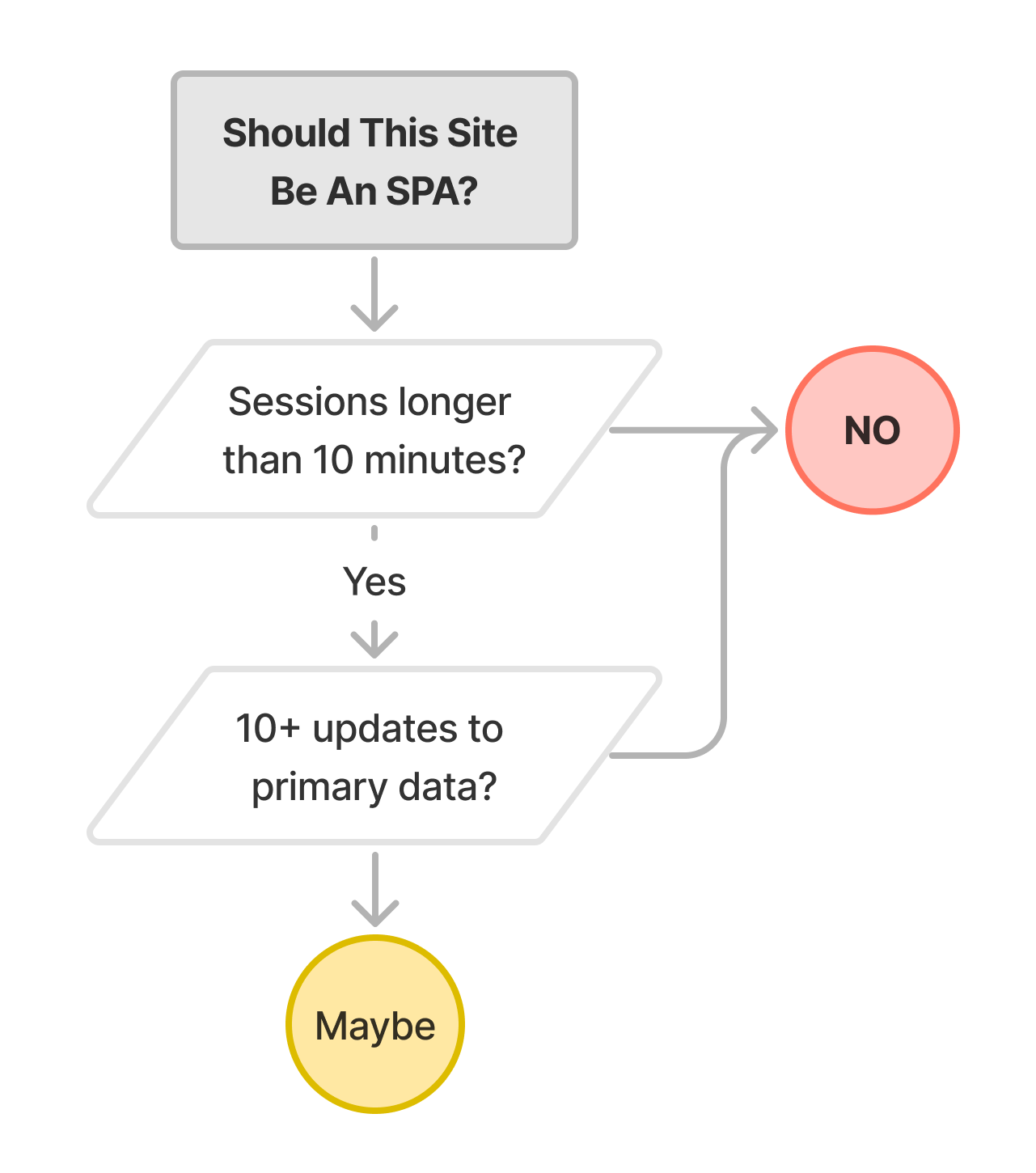
Oh, and the author would like to kindly point out that React is legacy now. Because they said so. In case you didn't know.
In most cases later frameworks are slow and bulky. I certainly hate using sites like X or Target on mobile. Random delayed loading of things, loss of scrolling position when going back, things just not loading the first time it delayed reactions. It sucks.
eg React Native is dismissed in 5 sentences, with no real solution at all given to the basic problem of wanting to have a website and mobile apps without writing your app 3 times. Let alone a website + mobile apps + windows + mac clients. The suggested solutions do not address this need -- eg there's some Apache crap that no one I've heard of uses (it's renamed Adobe Phonegap crap that Adobe bailed on and tossed over to Apache); some random link to a 5 year old google i/o presentation; etc.
As far as I know, there's basically 3 toolkits that offer this: React + derivates; Rails with Hotwire; and Flutter, which means trusting Google (fools only), and which has recently deprioritized desktop... so that's a rock solid foundation to pour millions of dollars of eng time into. And I guess Xamarin, if anyone is using that.
This is how you end up with an amalgam of legacy crap that no one wants to touch. I can’t read guarantee you that outside of big tech and a couple of unicorns started by experienced devs this will NEVER work reliably.
The ecosystem is another aspect. You have so many great options for off the shelf components and libraries with React that you might not have with other frameworks.
Before anyone mentions Custom Elements and Web Components, I must say I tried it. Gave it a lot of effort to be a solution but it is not!
That's covered in this section: https://infrequently.org/2024/11/if-not-react-then-what/#%22...
"The ecosystem is another aspect. You have so many great options for off the shelf components and libraries with React that you might not have with other frameworks."
That's covered here: https://infrequently.org/2024/11/if-not-react-then-what/#%22...
https://github.com/brillout/awesome-react-components
This point is not directly covered in the article.
With a topping of how this is all just solved by "giving a toss about the user", followed by a cloying apology for being vulgar
I'm not in web and am amenable to a good web dev hot take but this simply isn't worth the time, it's an array of generic wisdom delivered as if it's specific, written with the effort of someone who is proud of themselves when you disagree.
I was not able to notice any difference between them
that is neither here nor there. you are replying to an article whose thrust is that react ought never be used.
> Somewhere that’s actually an application might
might, lol? wait are you the author?
> most line of business applications would be better as something like Rails views rather than React
why?
And there's also the other side: people who insist in overusing React. Perhaps that's what the author refers to.
I for one have see HTMX eat React for breakfast in a few of my clients during consulting.
i don't know about all that, but this is an incredibly tired diatribe.
> Perhaps that's what the author refers to.
they are clearly not.
What about the rest of them?
Use something like Leptos and be happy:
https://krausest.github.io/js-framework-benchmark/current.ht...
And any high performance functions you need on the front end will be higher performance than JavaScript. Like bloom filters for example: https://nuenki.app/blog/bloom_filters_optimisation
Only in further updates to the DOM. There are very few use cases where you need to continually update thousands of DOM elements.
For most use cases, start up time and memory usage are really the most important metric.
But it's JavaScript glue code generated by Rust's wasm-bindgen that you don't need to care about. And eventually the glue code will be unnecessary with wasm component model DOM access.
As a disclaimer, I still prefer vanilla JS and progressive enhancement.
The other point isn't so much that there's a wrapper around the DOM, but that the DOM API itself is bad and slow. There's only so much pain a better language can take away here, and Rust isn't even a better language for that domain.