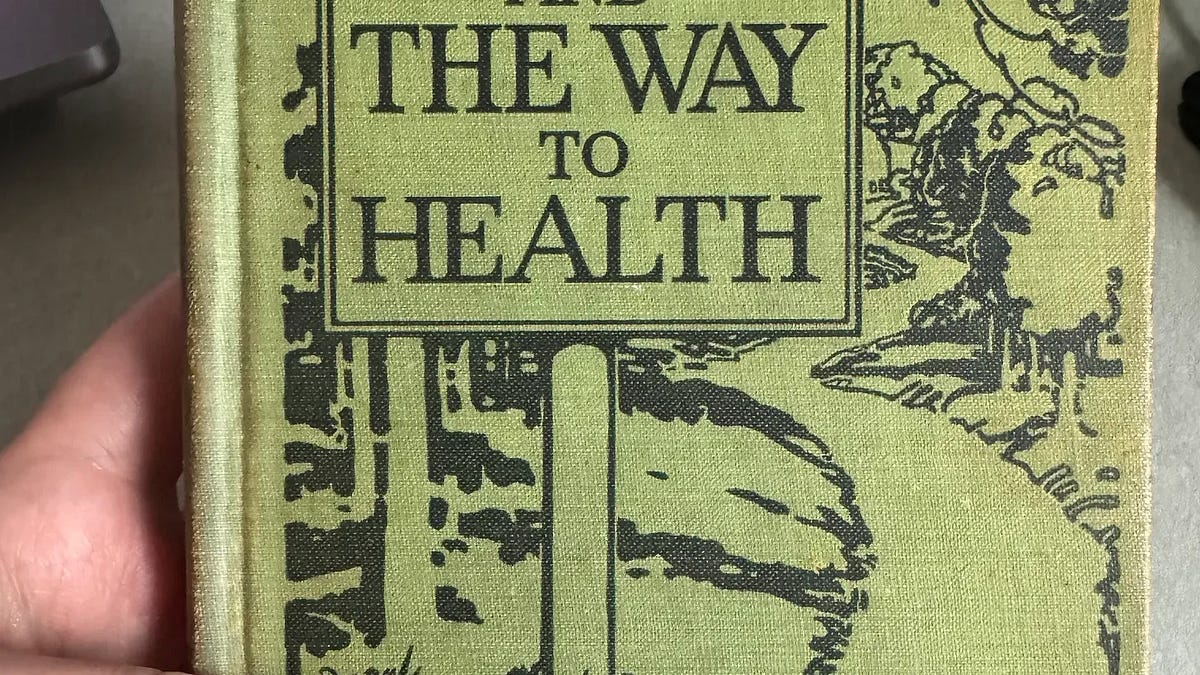
A pro-science, pro-progress, techno-optimistic middle school health textbook from 1929
"Science and The Way to Health" by Andress and Brown
moreisdifferent.blog
138 points · by drcwpl · 1y ago · 167 comments
Yet visit social media and it's absolutely overflowing with gloom and doom and histrionic political rage and fear bait. Saw a thread recently on Reddit about how many young people in the USA are contemplating suicide because the present or the future looks so bleak to them.
We'd have to fall pretty far for their standard of living to decline below that of Pharaoh Ramses II.
It's convinced me that the human brain is just not wired for abundance. Our brain keeps searching and searching for the immediate existential threats that millions of years of evolution have programmed us to know absolutely must be there. If we don't see them it actually makes us panic more since it means the lion is hiding so well we can't spot it and it's about to jump out and get us.
I agree it's a thought-provoking comparison. It's a remarkably distorted lens, the one modern humans apply to interpret pre-industrial civilization. Should we glamorize a patrician of ancient Rome? Their lifestyle would be a mediocre, low-prestige one, if faithfully translated into the modern world. The vaunted villas of the aristocrats were farmhouses—go look up farm prices in rural Georgia or Kansas: that is ancient aristocracy. If you owned a herd of goats, that was a measure of wealth and success; we'd interpret the same thing as poverty. A chickenwire fence isn't a signifier of blight, but a delineation of land, and a sigil of an authentic land owner—an elite.
The wealth of a great empire, the trade routes of rare spices and fruits from thousands of leagues away? That's Wal-Mart.
It's a provocative idea! The life of the Roman upper aristocratic class is fully accessible to probably a full majority of contemporary Americans. You could replicate practically every part of it, if you liked*. And you're right that that's no longer a benchmark for self-actualization today; we want—need?—so much more than that.
*(The only large difference, and this is much more than a footnote, is the total abscence of slavery. Iron-age farms needed large numbers of slaves—something with the social impact that they'd label the farm owner, the aristocrat, as a high-status invidual. A human ranking above many others. The industrial revolutions replaced most of this with machines. You don't acquire social status by being superior to a tractor).
(The part where the humans alive today aren't 99% farmers has wildly rewritten the human experience, and we're still far from adjusted to that).
Convict labor is very much a thing in the US. That still counts as slavery.
Practicing gratitude is a pretty common strategy for combating depression. If young people today in developed nations don't even understand how bad humans used to have it (and still do, in some places), how can they possibly be grateful for what they have?
Maybe AI-generated, historical influencers should be a thing. "Walked two miles to the river to fill my clay jug. Set my baby down and a croc took her."
Anyway, I'm not sure this is gratitude so much as the gratification in having someone you can look down on.
I'm talking about deep existential despair and doomerism though, like people discussing suicide or refusing to have children because they're convinced the world is ending because of online discourse and/or paranoia.
Edit: speaking of perspective: one of my favorites is to go find a global salary comparison calculator and input my first world tech salary. If you are on this site chances are you are at least in the global 5% if not the global 1%.
I'm not even in the US and I have multiple friends who have expressed to me that they'd be afraid to holiday there due to reproductive rights stuff. For say, two, three weeks.
It's like some sort of extreme anxiety that has no basis in reality.
> We'd have to fall pretty far for their standard of living to decline below that of Pharaoh Ramses II.
Not most people in America. Sure, Ramses didn't have a car, phone or modern medicine; but he could get whatever he wanted _that was available at the time_. That's the yardstick.
It also created lifestyles which aren't sustainable, destroyed our ecosystem, made gluttony and sloth our main cause of death.
If you look for the signs they're already visible, it's just that our system has a gigantic inertia. Look at things like ocean acidification and other climate feedback loops, massive wildlife extinction, loss of nutrients in veggies/fruit, PFAS in rain water, micro plastics polluting virtually every living organisms.
Humans work on hope, when things are continuously getting better we're thriving, when things start to fall apart ever so slightly it's much less fun, and we're slowly getting to that point. It doesn't matter how high you start, what matters is the general trend
Humans are built to thrive in danger, chaos and instability. I think a good chunk of humans go insane in a safe and stable environment and resent the things that allow them to live mundane, safe lives -- technology, medicine and rational thinking.
I think there's a certain amount of cherry-picking going on with this textbook, however, as you'd find just as many pro-science books today, and likely a number of "science is the devil"-type publications in the early 1900s.
It's an interesting read, either way, with some amusing editorializing by the article's author in the middle (no spoilers).
That's part of what Tom Nichols has been saying: https://www.sltrib.com/news/politics/2021/09/10/democracy-di...
This feels like a really uncharitable interpretation on what is going on.
To me it feels more like you have two sides, the two sides have viewpoints that feel very alien to the other side, so extreme that they feel like attacks but actually it's just a clash of worldview.
I don't think the lack of a challenge is the root cause of science denialism. It's a cultural thing, coming from a lack of confidence in the elites. Elites are distraught when inequality become larger and things get tougher for the poorest.
Like, who would you consider an 'Elite'? AFAICT, someone who's 'an Elite' thrives off of inequality, by definition. Without said inequality they wouldn't be 'Elite'.
Is it possible that your definition for Elite is similar to my definition for Specialist? Like 'Subject Matter Expert'?
I guess the way I used "elites" in my previous comment refers more to a certain perception of society some people hold, rather than to a definite group of people.
If we take the policies implemented during the COVID pandemic as an example, those came from the government, oftentimes backed by academia. Since a lot of people think the government is doing a bad job overall, they don't trust the legitimacy of those policies and oppose the scientific reasoning that led to them being adopted.
When the economy is doing well, people put more trust into their government, or the "elites".
Therefore, my thesis is that distrust into the institutions/science comes from a general discontent of the population, and is not a natural state of humanity.
> Humans are built to thrive in danger, chaos and instability. I think a good chunk of humans go insane in a safe and stable environment and resent the things that allow them to live mundane, safe lives -- technology, medicine and rational thinking.
No, I don't think that's true. Humans are built to learn from experience, and one thing that vaccines do is eliminate the experiences that justify their use. That also makes the experience/knowledge of smaller dangers more prominent. For instance, a kid getting his arm paralyzed from the (now discontinued) live oral polio vaccine, looks a lot different if people are commonly getting worse paralysis from wild polio than if no one is getting wild polio at all anymore.
The other thing you should probably take into account when regarding a book from 1929, is the experiences people had back then with (often dangerous) quack cures promising miracles. For instance (https://en.wikipedia.org/wiki/History_of_the_Food_and_Drug_A...):
> By the 1930s, muckraking journalists, consumer protection organizations, and federal regulators began mounting a campaign for stronger regulatory authority by publicizing a list of injurious products which had been ruled permissible under the 1906 law, including radioactive beverages, the mascara Lash lure, which caused blindness, and worthless "cures" for diabetes and tuberculosis. The resulting proposed law was unable to get through Congress for five years, but was rapidly enacted into law following the public outcry over the 1937 Elixir Sulfanilamide tragedy, in which over 100 people died after using a drug formulated with a toxic, untested solvent.
Humans are adaptive learners, shaped by both individual experience and cultural memory. The rise of anti-vax sentiments might be better explained by psychological and sociological factors. Like mistrust of institutions, the amplification of fringe views via social media, or the cognitive biases that prioritize visible risks over abstract ones.
The entire problem is this: Fifty four percent of Americans read below the 6th grade level, which means that the simple majority of Americans don't understand the world they live in and never will.
* Climate Change (caused by the tech of "burning lots of fuels")
* PFAS, pesticides, endocrine disruptors, etc...
* Opiods crisis, nartotics, etc...
* Impact of GAFAM on privacy, social discourse, etc...
In a sense, the "white coats in their labs" and "nerds with glasses" have been repeatedly found (lately) to be on the "wrong side of the issue". (There are usually scientists on both side of the issue, which is the saving grace for science: self-correction is built in.)
Maybe it's relevant that the book is dated from 1929, that is, right before a time where "white coats" started being involved into very shady stuff (eugenics, mass-media propaganda, global-scale destruction weapons, and of, course, industrialized death.)
The COVID crises could have been a time for science in general to earn trust again - in some sense it did, but this time people were overexpecting, and got disappointed at least (and downright enraged at worst, if they were on the wrong side of the politico-scientifict decisions.)
And the pendulum will keep swinging, but hopefully still rise.
Not surprising. I look at vaccines the same way as I look at any new medication: has it been tested long enough to know what the long-term effects of it are, and do the benefits outweigh the risks. I don't have a problem with MMR, TB and other common vaccines, that have been around for decades. If I'm traveling to East Africa I'm going to get a yellow fever vaccine. I also don't have a problem with the COVID vaccine because it was clear that the risk of not getting vaccinated was significant. But I have never gotten a "flu shot" in my life because the benefit of it is rather low relative to the risk of influenza given my demographics and health. If that makes me an anti-vaxxer, so be it. Don't really care.
Speaking for myself, having lived and worked in SE Asia for a while, I've had almost every vaccine known to man (the only one I'm sure I haven't had is the HPV). I've had 5 COVID shots (got COVID once in 2021) and get an annual flu-shot. The only side-effect I've ever had (that I'm aware of), is a sore arm at the injection site. I have no idea what that says about me. My mum reacts badly to most (not all) vaccines - especially the flu shots. People vary and I suspect our immune system (which I believe is poorly understood) has complex effects on the response to some vaccines.
The effects of the vaccines linger, by design. (Granted, in a generally productive way.)
I had 3 COVID shots; no issues with the first two. But 2 years later, my arm is still quite sore to the touch where I got my shot (and I can feel mild discomfort there even without touching it). So obviously a long-term change there.
That seems like reasonable risk assessment to me. It’s a minor chore to get but the benefit to you is also pretty minor. Lots of people skip the flu vaccine for those reasons.
But some folks skip the flu vaccine because they are convinced that the vaccine itself will harm them. I hate the term “anti-vaxxer” but if I were to apply the concept, it’s mostly to that unbalanced risk assessment.
It’s an interesting question why some folks develop such an unbalanced assessment. And I dislike “anti-vaxxer” because I think is dismissive and derogatory, and leads away from trying to understand each other.
It's not just that. I generally avoid taking medications unless I need to (when prescribed), which so far in my life has been extremely rare. It may not be "harmful", but I don't want to put any chemicals in my body if I don't have to. Most medications come at some cost, in that besides doing what they are designed to do, they also interact with other cells or systems in ways that may not be desirable. Vaccines are no different in that respect.
I'm pretty sure setting a personal bar/risk tradeoff that lets you take a significant number of vaccines doesn't make you an anti-vaxxer.
But in any case, I'm not going to live my life by what labels others put on me.
And yet science says the opposite. The prevailing evidence suggests that humans are generally better suited to stable and safe environments, with danger and chaos typically leading to detrimental effects on mental health.
Generally, humans are better suited to stable and safe environments. But it would be irresponsible of genes not to include, occasionally, humans who did better in chaos because chaos frequently happens.
That, alone, could point to two very obvious but very different conclusions.
One is that people in those societies need medications more.
Alternatively, people in these societies get needed medications more.
I suspect the average American gets more therapy than the average Afghan, but I suspect the Afghans would still benefit from it.
Lots of anti-vaxxers are fine with other kinds of drugs and use them liberally, even in many cases street drugs. They'll eat fast food, processed food, use household chemicals, do all kinds of other things that expose them to things they don't understand and may not be good for them, but vaccines are just the devil incarnate. The word vaccine seems to provoke a visceral gut reaction among a lot of them.
Like you said it goes way, way back. Something about vaccines creeps a lot of people out for reasons I don't understand.
If you're spreading lies about medicine because you distrust authority...
Well, first of all, you're dumb because you believe falsehoods.
But more importantly, you're a danger to my health, my friends and my families' health, and to your own health as well.
Why would we have any patience for this?
Your rugged self-important individualism is not worth more than any of that.
You appear to be thinking that you're taking some heroic stand on principle. Your principle is leading you astray. It makes you antisocial, a danger to your neighbors.
I think it's the fact that vaccines are heavily pushed on everyone, which is very different than a medication that you choose to take, or your doctor specifically prescribes for you, to address a medical condition. Taking chemicals to cure some disease is different than taking chemicals when you're healthy simply to decrease a risk that you may or may not consider relevant to you. Also, often vaccines are administered not for your own sake but to protect the community, and so again it's a different calculation where you're injecting chemicals (or injecting your kids with chemicals) not because you think you need them but to potentially protect others should you become ill. Also there often isn't as much explanation around vaccines (besides COVID) as to their makeup, etc., compared to some medication that your doctor prescribes to you (i.e., if my Dr prescribes a blood thinner I'm going to get a pretty thorough explanation of it and can ask questions, whereas with vaccines it feels mandatory without much explanation other than "the surgeon general said to".
So it's not at all surprising to me that there is strong resistance to vaccines from some people who have no problem with medications in general.
A lot of things that we were forced to do during COVID still stick with me and have basically made me intensely distrustful of authority to a degree that wasn't present before.
It was just bullshit after bullshit enacted in law and forced on people. Walking in certain directions in the supermarket, going outside for only X minutes per day to exercise, only X people allowed at your table at the pub, etc. Just endless totally unscientific bollocks.
It's like getting into a heated debate with someone. You start out and actually listen to what people are saying, but then eventually it's just like, come on man, fuck off, I don't even care if you're right, I'm tuned out.
Fast food doesn't force me to eat it under penalty of imprisonment.
- Vaccines are usually injected, injection makes most people uncomfortable. Most of them get over it, but it can be panic inducing for a small number. Among street drug users, injection is usually considered extreme, as in, the thing only true addicts do.
- When you get vaccinated, you are fine, and then you get a few unpleasant side effects. That's the opposite of the usual drugs you take when you are sick and make you feel better.
- Sometimes, vaccination is made mandatory, many people don't like to be told what to do with their bodies, even if there are good reasons for it.
- You never know when a vaccine have saved someone. Someone didn't get sick, but is it because of the vaccine, natural immunity, luck, or simply a lack of exposure, maybe he will get sick eventually, you can't really tell, and you don't really notice when something doesn't happen. However, when a vaccine hurt someone, or failed to prevent the disease it should protect against, that's very noticeable.
- The most successful vaccines are now often considered useless, because the disease they protect against is so rare, why go through the discomfort of the vaccination when it is so unlikely for you to get sick either way? It is a tragedy of the commons, as the reason the diseases is so rare is because of widespread vaccination.
I agree the needles don't help though.
So I don't think its vaccination perse, at least not on its own, but vaccines have various things going against them. Like someone else in this thread said, government mandate + preventative medicine has the right ingredients to form a conspiracy theory with, religious doctrine has historically amplified that as well. Additionally, there's also a distrust of 'big pharma' in general, and especially with minority groups a history of dubious or even malevolent medical experimentation by the government.
A big part of the antivaxxers are now also anti 5G, advocate against the use of sunscreen, are against wind energy and EV, sometimes pro-russia, anti-deepstate, etc. Some of this is fossil lobby, some of it is the result of Russian propaganda and other parts are just organic whackyness, like the flat earthers.
This sort of language makes problems worse and even further decreases trust.
Casting a wide net and calling ivermectin a "risy drug" when a quick search engine query will show it is used safely in humans as an antiparasite drug. When someone who is skeptical about vaccines reads these sorts of blatant falsehoods why in the world would they believe anything else you say?
If you wanted to warn people against using forms formulated for animal consumption then you could've just said that, instead you painted with a wide brush which justifies someone to not trust you.
Sure, some of these might be the same people, but I disagree that there's a big overlap between anti-vaxxers, which are not uncommon (I know quite a few who "vaccine resistant" which in many people's minds == anti-vaxxers), and anti-5G which is very niche (I've never met or interacted with a single person who thinks that), or anti-EV which is again a different demographic ("I want to drive my gas guzzling F-150 because Amerika is #1")
I wouldn't be surprised if he mixed in a few other "vitamins"
RFK, who is vaccinated along with his children: "I’ve been fighting 40 years to get mercury out of fish. Nobody calls me anti-fish."
===In July, Kennedy said in a podcast interview that “There’s no vaccine that is safe and effective” and told FOX News that he still believes in the long-ago debunked idea that vaccines can cause autism. In a 2021 podcast he urged people to “resist” CDC guidelines on when kids should get vaccines.===
===“I see somebody on a hiking trail carrying a little baby and I say to him, better not get them vaccinated,” Kennedy said.===
===That same year, in a video promoting an anti-vaccine sticker campaign by his nonprofit, Kennedy appeared onscreen next to one sticker that declared “IF YOU’RE NOT AN ANTI-VAXXER YOU AREN’T PAYING ATTENTION.”===
[0] https://apnews.com/article/rfk-kennedy-election-2024-preside...
If you know anything about marketing you know that for such messaging to be culturally pervasive is a result of years of effort and organizing.
Weird that people still get raped and murdered in your "safe and stable" environment. Sometimes the perpetrators don't even see justice and get away with their crimes. How do you account for that?
> a certain amount of cherry-picking
Without a doubt. I don't trust authority because I've been abused by it before. I'm sure you didn't mean to punch down but that's how many of us would rationally perceive it.
I read a better analogy; they compared the life table of humans with the life table of Chimpanzee or Bonobo. The change between before and after the introduction of modern medicine is obvious.
This textbook is from 1929 and was probably being written at the exact same time as the Snopes monkey trial (1925). You're reading science hype because science was under attack; and not from "social justice warriors" but from conservative Americans. Notice that the single most transformative discovery in all of biology, evolution, isn't mentioned.
That attack on evolution is still taking place. In Texas there was an attempt to strike all references to evolution and climate change from the curriculum, along with other attempts to introduce biblical references. When did that take place? That was this year; oh, and in 2023: https://www.wsj.com/us-news/education/texas-education-board-...
Getting mad at "social justice warriors" for an imagined reaction while ignoring the actual attacks on science is... well, it's what I've come to expect.
The post and your comment emphasize how the impact of science depends more on the public than the handful of scientists who create it. Roughly ~0% of people understand any given scientific topic. It will always be completely asymmetric. It will always involve stuff like belief in an ideology, struggles for political power, (relatively blind) trust in a movement or leader, etc. As a result, there is no world in which scientists don't regularly harm whoever follows them, the same as any leader in an uncertain/asymmetric environment (by getting stuff wrong accidentally, or actively abusing their power for personal gain).
The part about social justice warriors is actually interesting because that view will come across as "we hate science!" to some people but the real idea is somewhere between "successful science requires exerting some political power over other people" (obviously true) and "western science was built on a foundation of coercion and oppression, making lots of technological progress and causing some unavoidable tragic effects." Whatever the "truth" is, it's really complicated ethically.
It's the Scopes trial.
Interesting point RE the Snopes trial. You are right, evolution is not mentioned in the book as far as I can tell. Even though it is foundational to understanding the human body (in particular some weird features it have which any half-good creator would never design that way.)
The SJWs / woke cult are a bit of a personal hobby horse for me. I think it is important to mention, since woke ideology comes from academics at top universities, as well as journalists at top media outlets -- people who have a lot of power to shape the public discourse and influence public policy. The power of Christian fundamentalists over society and culture, on the other hand, has been waning, if one looks over the past few decades. Yes, they are in the ascendancy at the moment with the 2024 election and whatnot, but overall their influence is waning. Of course, both anti-science from the left and from the right are issues we should worry about -- I'm just giving an argument why we might want to be a bit more worried about anti-science from the left. How much either issue is discussed probably greatly depends on what circles you run in.
Note I did mention how there is no discussion of sexual health or women's health in the book. That is an issue with health textbooks that has been improved a lot but still exists to some extent today due to Christian conservatives.
I just miss when yall were simply libertarian and talked about taxes! We can go back to that one day right?
I was involved in a previous iteration of the culture war (religion vs atheism) pretty heavily. If this is anything like that, it'll start fading once people feel like the cultural dominance of the group is broken.
If you want a rule of thumb, hollywood being considered non-woke and universities not requiring diversity statements (cultural conservatives consider these to be roughly isomorphic to the old loyalty oaths) would be generally what to look for.
Edit: These institutions losing their influence would probably also be sufficient. There's nothing inherently important about hollywood, so if another locus of entertainment gains prominence, and it has different cultural views, that would also qualify.