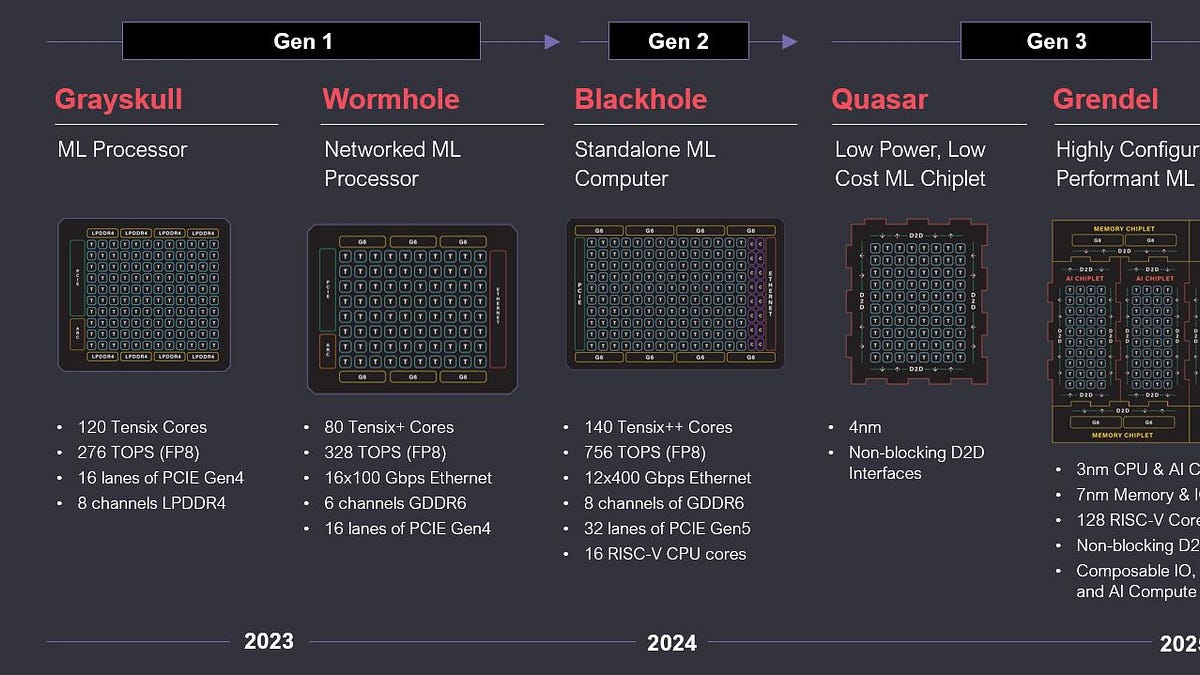
Tenstorrent and the State of AI Hardware Startups
Semi-custom silicon is a bigger problem than Nvidia.
irrationalanalysis.substack.com
224 points · by zdw · 1y ago · 124 comments
What I realized though is that as much as I'd like to buy and host it and make it available, I'm not sure the economics or interest are there yet. The focus today is so dedicated to Nvidia that "fringe" gear is still just that. People who really want to play with it, will just buy it themselves. They've probably been doing that with hardware for a long time.
So, it is a bit of a catch-22 for me right now. Hopefully interest grows in these sorts of offerings and demand will pick up. The world needs alternatives to just Nvidia dominance of all of AI hardware and software.
Well, looking at their (as far as I can see highest end) accelerator the n300s we get:
- 24GB of memory
- 576GB/s of memory bandwidth
- $1400
As a hobbyist this is still not compelling enough to get excited and port my software - same amount of memory as a 4090/3090, half the bandwidth as a 4090/3090, slightly cheaper (than a 4090), more expensive (than a 3090), much worse software support. Why would I buy it over NVidia? This might be more compelling to bigger fish customers who would buy thousands of these (so then the lower price makes a difference), but you really need small fish people to use it too if you want to achieve good, widespread software support.
However if they'd at least double the amount of memory at the same price, now we'd be talking...
In a recent thread, just about everybody was talking about how Intel should have released its "Battlemage" line of cards with 48GB+ and how they'd actually have a very compelling offering on their hands had they done so. https://news.ycombinator.com/item?id=42308590
Missed opportunities.
That said, I know some of the Tenstorrent guys and they're extremely smart and capable. They'll figure it out, and the company is probably going to 10x.
Yep. And just to be clear, this isn't necessarily a strategy to directly make money, as the market for people running these things locally is probably not very big (as a lot of people in the Intel thread said). But it's a strategy to beat the CUDA monopoly and get everyone and their dog to support your hardware with their software. I know I would be porting my software to their hardware if it was actually compelling for small fish, and I know plenty of other people who would too.
AMD also somewhat falls into this trap. They're slightly cheaper than NVidia, and their hardware is roughly good enough, but because their software stack and their hardware support sucks (just look at their ROCm compatibility list, it's a complete joke with, like, 3 models of GPUs, vs NVidia where I can use any GPU from the last 8 years) no one bothers. Being good enough is not good enough, you need to offer some sort of a unique selling point for people to tolerate the extra software issues they'll have with your hardware.
Any model, any hardware, zero compromise. TT support is on the roadmap and we talk to them.
It is interesting the world ( or may be RISC-V world ) seems to think any company can simply break the contract and agreement others signed, while pretending they are still righteous. At the same time thinking this wont happen to their IP.
Well I think we will all know soon.
And the treatment of the 'partner' upon whose IP the deal depends:
> Neither Qualcomm nor Nuvia provided prior notice of this transaction to Arm [2]
[1] https://www.qualcomm.com/news/releases/2021/01/qualcomm-acqu...
[2] From Arm's initial court submission.
Both Qualcomm and Arm claim that they follow the requirements of the existing ALAs, while the other party has breached them.
Without access to the original texts, we cannot verify who tells the truth.
Even when a judge will give a decision for this conflict we will not be able to know who is right if the ALAs remain secret, because in recent years there have been plenty of absurd judicial decisions, where judges have been obviously wrong.
According to Qualcomm, they had no obligation to notify Arm about their business intentions. While I do not like Qualcomm for many reasons, for now there is no ground to believe more the claims of Arm than the claims of Qualcomm, so any of the two could be right about this.
Perhaps Arm is right and Qualcomm must pay the royalties specified in the Nuvia ALA instead of the royalties specified in the Qualcomm ALA, which is the main subject of this conflict, but if this is true then Nuvia has been conned by Arm into signing a really disadvantageous ALA, which is somewhat surprising, because among their business plan variants must have been one of being bought by some big company, in which case their target should have been to retain ownership of the IP developed by themselves.
There is no doubt that even if Qualcomm pays only the low royalties specified in the Qualcomm ALA, Arm will obtain a revenue orders of magnitude greater than any revenue that could have been obtained from Nuvia, had it not been bought by Qualcomm.
The reason why Arm does not like this increased revenue from the Nuvia work is that Qualcomm has decided to replace all the cores licensed from Arm in all of their products with cores developed by the Nuvia team.
Thus the loss of the royalties for the Arm-designed cores will be even greater than the increased revenue from the ALA royalties.
So Arm attempts to use or abuse whatever was written in their ALAs in order to prevent competition in the cores implementing the Arm architecture.
Even if Arm had been cunning enough to have included paragraphs in their ALAs that justify their current requests, there is no doubt that the real villain in this conflict is Arm, who fights for forcing the use of CPU cores that are weaker and more expensive than what is possible.
> So Arm attempts to use or abuse whatever was written in their ALAs
> Even if Arm had been cunning enough to have included paragraphs in their ALAs
Clauses requiring consent for transfer of IP rights (or on change of control) are standard everywhere and Nuvia would have been fully aware of this at the time of signing the ALA.
True. But if Qualcomm think they are not playing any tricks, playing by the rules clearly stated in the contract. You can bet they will appeal and fight on even if they lose.
A lot of juicy details will come out during the trial. Just like the Apple vs Qualcomm case ( Where Apple was clearly in the wrong ). We will all know soon and make up our own judgement.
Even granting that ARM is completely within their right, this is a pretty bug reminder of the dangers of building on sole-source licensed IP when there’s an open alternative. I have little doubt that ARM drove some number of startups into choosing RISC-V.
Which may or may not matter in the long run. But it is rolling the dice and by definition a short term maximization strategy.
However, the ‘dangers of building on sole-source’ licensed IP is true in general but a bit overdone in this case. Qualcomm had a large number of options using Arm IP including developing their own cores in house. However they chose to do something that was - on the face of it - in breach of license agreements that Nuvia had signed.
I love this comment because it could apply to both sides of the case. However the dispute is a little more complex than most commentary implies.
> generals refighting their previous war
Here I think you are talking about the risc vs cisc debate. It is true that in modern OOO cores this is basically meaningless. I think the only truly relevant piece is fixed encoding widths, which make wider decoders feasible on a lower power budget.
On the other hand I think risc-v owes a lot of its popularity to how easy it is to understand and implement a bare bones core. Marketing will be a huge challenge for any newcomer, but risc-v is doing very well on that score.
The place I think risc-v has made really good innovations in ISA design is in the vector extension. It seems to me that it allows for code to be written for larger vectors and the machine can apply whatever vector width it has available. I believe this should allow new cores to improve the performance of old code in a way that more explicit designs like AVX have struggled with.
At least not in the training end of machine learning, which is the big money sink.
What striking about this whole business is that it's still mostly hammering on a decades-old idea with more and more hardware and data. That worked great for a few years, but now seems to be reaching its limits. What's next?
> Llama 3.1 405B can currently replace junior engineers
I'd like more exposition on these claims.
I am not a programmer, and I know C and Python at about a 1 day crash course level (not much at all).
However with sonnent I was able to be handheld all the way from downloading android studio to a functional app written in kotlin, that is now being used by employees on the floor.
People can keep telling themselves that LLMs are useless or maybe just helpful for quickly spewing boilerplate code, but I would heed the warning that this tech is only going to improve and already helping people forgo SWE's very seriously. Sears thought the internet was a cute party trick, and that obviously print catalogs were there to stay.
I then wrote a web AudioWorklet for playing PCM in 3 minutes, which complied to the same interface as my Mac/iOS/Android versions, ex. Setting sample rate, feedback callback, etc. I have no idea what an AudioWorklet is.
Two days ago, I stubbed out my implementation of OpenAI's web socket based realtime API, 1400 LOC over 2 days, mostly by hand while grokking and testing the API. In 32 minutes, I had a brand spanking new batch of code, clean, event-based architecture, 86% test coverage. 1.8 KLOC with tests.
In all of these cases, most I needed to do was drop in code files and say, nope wrong a couple times to sonnet, and say "why are you violating my service contract and only providing an example solution" to o1.
Not llama 3.1 405B specifically, I haven't gone to the trouble of running it, but things turned some sort of significant corner over the last 3 months, between o1 and Sonnet 3.5. Mistakes are rare. Believable 405B is on that scale, IIRC it went punch for punch with the original 3.5 Sonnet.
But I find it hard to believe a Google L3, and third of L4s, (read: new hires, or survived 3 years) are that productive and sending code out for review at a 1/5th of that volume, much less on demand.
So insane-sounding? Yes.
Out there? Probably, I work for myself now. I don't have to have a complex negotiation with my boss on what I can use and how. And I only saw this starting ~2 weeks ago, with full o1 release.
Wrong? Shill? Dilletante?
No.
I'm still digesting it myself. But it's real.
It's less to do with junior/senior/etc.. and more to do with the types of problems you are tackling.
It's a real system, not kindergarten "look at the React Claude Artifacts did, the button makes a POST request!"
The 1500 loc websocket / session management code it refactored and tested touches on nearly every part of the system (i.e. persisting messages, placing search requests, placing network requests to run a chat flow)
Also, it's worth saying this bit a bit louder: the "just throwing files in" I mention is key.
With that, the quality you observed being in reverse is the distinction: with o1 thinking, and whatever Sonnet's magic is, there's a higher payoff from working a larger codebase.
For example, here, it knew exactly what to do for the web because it already saw the patterns iOS/Android/macOS shared.
The bend I saw in the curve came from being ultra lazy one night and seeing what would happen if it just had all the darn files.
I fully believe recursive application of current SOTA LLMs plus some deployment framework can replace most software engineers who work in the cornfields.
The logical conclusion is that projects will balloon with code pushing LLMs to their limit, and this massive amount is going to contain more bugs and be more costly to maintain.
Anecdotally, supposedly most devs are using some form of AI for writing code, and the software I use isn't magically getting better (I'm not seeing an increased rate of features or less buggy software).
There is a point where in some sense it is less effort to just write the thing yourself. This is the argument against micro-libraries as seen in NPM as well, but my point is that the threshold of complexity for "write it yourself" instead of reaching for a premade thing changes over time.
As languages, compilers, tab-complete, refactoring, and AI assistance get better and better, eventually we'll reach a point where the human race as a whole will be spitting out code at an unimaginable rate.
i went to a groq event and one of their engineers told me they were running 7 racks!! of compute per (70b?) model. that was last year so my memory could be fuzzy.
iirc, groq used to be making resnet-500? chips? the only way such an impressive setup makes any kind of sense (my guess) would be they bought a bunch of resnet chips way back when and now they are trying to square peg in round hole that sunk cost as part of a fake it till you make it phase. they certainly have enough funding to scrap it all and do better... the question is if they will (and why they haven't been able to yet)
Already through the gapevine I'm hearing that H100s and B100s have to be replaced more often.... than you'd want? I suspect people are mum about it otherwise they might lose sweetheart discounts from nvidia. I can't imagine that cerebras, even with their extreme engineering of their cooling system, have truly solved cooling in a way that isn't a pain in the ass (otherwise they wouldn't have the clause?) and if I were building a datacenter I would be very worried about having to do annoying and capital intensive replacements.
So I would say Claude is useful for simple execution when you know what you are expecting, relying on it to learn sounds like a short term gain for problems down the line. At a point where LLMs can reliably lookup sources and reason trough something to explain it there will be no coding left, but I feel we aren't close to that with current tech.
I think having been coding for a long time, I don't think you fall into the same category. Dart having paradigms not too different from other standard languages, a lot of these skills are probably transferable.
I've seen beginners on the other hand using LLMs who couldn't even write a proper for-loop without AI assistance. They lack the fundamental ability to "run code in their head." This type of person I feel would be utterly limited by the capabilities of the AI model and would fail in lockstep with it.
It is true, but also irrelevant. Just like most programmers today do not need to understand CPU architecture or even assembly language, programmers in the future will not need to understand for loops the way we do.
They will get good at writing LLM-optimized specifications that produce the desired results. And that will be fine, even if we old-timers bemoan that they don’t really program the way we do.
Yes, the abstractions required will be inefficient. And we will always be able to say that when those kids solve our kinds of problems, our methods are better. Just like assembly programmers can look at simple python programs and be astounded at the complexity “required” to solve simple problems.
So the benefit of LLMs is negligible in the long term, for beginner/junior programmers, as they essentially collect knowledge debt. Don't let your juniors use LLMs, or if you do, make sure they can explain every little detail about the code they have written. You don't have to be annoying about it - ask socratically.
Similarly, LLMs can be used as educational tools.
In the end, learning and self-improvement needs some non-trivial motivation from the individual.
The answer to your question is to show them it’s valuable to learn. If they find they’re completing their tasks adequately from AI assistance, then give them harder tasks. Meanwhile, model how your own learning effort is paying off.
Note how if they are left with AI-trivial tasks and the benefit of learning remains abstract, we shouldn’t expect anything to change.
All discussion on this is so much sports team fandom until Jensen and Lisa stop pillow fighting on the biggest pile of money since that 50 Cent cover and the highest margins since the Dutch East India Company.
I just spent a few days getting FlashAttention and TransformerEngine built with bleeding edge drivers and all the wheels to zero typing install on three generations of NVIDIA and shit (PS you’re build advertises working without ninja but fucks up CMake INSTALL paths): this is the unassailable awesomeness that no one can compete with? ptxas spinning a core for longer than it takes to build Linux and sometimes crashing in the process?
No, this is central committee grift sanctioned at the highest levels to the applause of HN folks long NVDA.
But no, they're supposedly just too incompetent to run PyTorch or whatever. Fuck that, the hackers kick ass.
This shit is broken because shareholders get more rent when it's broken.
I'm smart and experienced enough, and the people working on the toolchains are capable and even smarter, but these systems are just extremely hard/complex. The hardware is buggy, the firmware is buggy, the drivers are buggy, every layer above it (compilers, kernels, multiple layers of frameworks) also all buggy. Add on top of that everyone is implementing as fast as they can, every part is changing constantly, and also a good chunk of the code being used is being written by researchers and grad students. Oh, and the hardware changes dramatically every couple years. Sure all tech is swiss cheese, but this is a particularly unstable/treacherous version of that atm.
BTW, shareholders obviously have no idea whether what's being sold works well or not, but there's no financial incentive (in terms of selling stuff/profiting) if your product doesn't even work/work well enough to compete. And if it were so easy, you would see any number of hardware startups take over from the incumbents. Sure there are network effects, but if I could run PyTorch (or really, just train and inference my models easily) faster and cheaper, me, and I assume lots of other people would switch in a heartbeat. The fact that no one (besides Google arguably if you count having to switch all your implementations over for TPUs) has been able to do it, whether they be startups or multi-billion dollar companies (including Amazon, Meta, and Microsoft, all who have direct financial incentive to and have been trying), points to the problem being elsewhere.
I don’t doubt that it’s a lot of work to maintain a clean userland and present a good interface with clean link ABIs. The people who pull it off and make it look easy are called names like Linus.
But the “everything is buggy” argument is an argument about institutions, not software artifacts. We know how to throw test and fuzz on a component and bang it into shape. Now this is a question of both resources and intention.
But NVIDIA’s market cap is like 4 trillion bucks or something.
I want perfect or a firing squad at that number.
lol
At the moment it looks like an experienced engineer can pressure LLM to hallucinate a junior level code.
Of course, that means you won't be able to train them up, at least for now. That being said, even if they "only" reach the level of your average software developer, they're already going to have pretty catastrophic effects on the industry.
As for automated fixes, there are agents that _can_ do that, like Devin (https://devin.ai/), but it's still early days and bug-prone. Check back in a year or so.
LLMs seem to be accelerating the trend
...and that's just as asinine of a claim as the original one