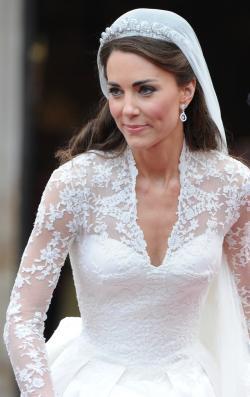
How Kate Middleton’s Wedding Gown Demonstrates Wikipedia’s Woman Problem
According to Wikipedia’s 2011 Editor Survey, just 9 percent of Wiki editors are women. While the gender gap is better than it was—in the early ‘00s, it...
Slate Magazine
217 points · by soupboy · 14y ago · 174 comments
Honestly, I cannot think of a good reason to delete any article at all, unless it's obviously fraudulent, marketing-oriented, illegal, or obscene according to a widely accepted definition of obscenity. All of these standards can be applied fairly strictly, and with much less vagueness than notability.
- It's not like Wikipedia is short of disk space to store a few million extra text articles.
- The argument that it would be too difficult to maintain lots of extra articles is also weak, because not every article needs to be regularly edited, and more articles on niche topics might actually attract more editors.
- No, we won't end up with a page for every John Doe and his cat. That's just alarmism. Besides, if something like that ever becomes a problem, a better response would be a prohibition on self-promotion or some other clear guideline, rather than a vague requirement of notability.
- If these deletionists are just being OCD and wanting everything to be tidy and clean and under their editorial control, I would say that they need to take a break. In fact, it's possible that people with certain psychological traits self-select for Wikipedia editorship. But the kind of intolerance and self-centered narrow-mindedness that overzealous deletionists exhibit doesn't suit the spirit of a collaborative online project. Keep your OCD to your own home/office and away from public spaces, thank you very much.
Right now, I get the impression that it's too easy to flag something for deletion and too difficult to counter the deletionist argument, especially since the deletionists are so familiar with editorial procedures. This inequality needs to change. The burden of proof should be on people who want to remove information from the Web, not on those who want to keep it. Isn't that the same principle that we fought tooth and nail to uphold against the onslaught of SOPA, ACTA, etc?
edit: I just searched for the page and it is deleted! I am going to get to the bottom of this, this is ridiculous, who do these people think they are?
edit 2: When the editor apologized to me, she told me to notify her if the page was ever deleted "If the article gets deleted, please let me know. -- Uzma Gamal". I've sent her a message and will update...This is crazy!
And if we did? It think it would be rather cool for everyone, living or dead, to have his own Wikipedia page. In fact these might have special status as non-deletable.
If your family ran a web site about its family, would you deny any member a page, especially if some members already had pages?
Now consider our larger family, all us humans that have ever been and ever will be. Besides the many topics about our "family" covered by Wikipedia, some of us have pages specifically about us. Why shouldn't all of us have our own pages?
Well before Wikipedia came along, I've wished that each person on Earth could have some way of being recorded for posterity. Some peoples' record will of course be more interesting than others'. But we're all family, even the boring and embarrassing ones.
The underlying motivation for "notable" is a potential bug in Wikipedia, not a problem with "notability" per se. The notability requirement is epiphenomenal, a kind of code smell for the Wikipedia guidelines.
The underlying issue is whether the Wikipedia attribution and citation guidelines are strong enough to indicate when an article contains content that is possibly fallacious. Non-notable topics are more likely to have fewer references, and hence the information about a non-notable subject are more subject to manipulation.
It would be an interesting acid test for Wikipedia (perhaps a sub-Wikipedia, like http://everything-en.wikipedia.org/) to open the floodgates on "non-notable" entries. Articles would start out by default with a banner that says "No editor has reviewed whether this article contains credible sources." Another editor could swoop in, read the citations, and remove the banner, or change it to: "The sources cited in this article are easily manipulated, and lack independent review."
Iterating over http://everything-en.wikipedia.org editor guidelines, Wikipedia could evolve a strong set of guidelines for remaining authoritative over the long-tail of information.
I wish this would happen, but I don't know if/how it would.
If you do have good sources for something, e.g. there is even a relatively small biographical section on someone in a published book, or a journal article, or something similar, the separate "notability" requirement has been increasingly going away, so that "but I've got sources" trumps it. I wrote a bit on that last year: http://www.kmjn.org/notes/wikipedia_notability_verifiability... (I also discuss some of the history around these requirements, some of which were motivated by trying to do something about Usenet physics cranks who found Wikipedia and decided it'd be a great place for articles on all their pet theories.)
I've been systematically going through several references and adding articles on everything in them, and haven't run into people objecting to my articles or trying to delete them for several years, since the end of the more "notability" focused era. Now as long as my articles include some references, they seem fine. One of my projects is marching through the Allgemeine Deutsche Biographie adding articles on random people who were mayors of Prussian towns in 1850, and that kind of thing. There's even a Wikiproject trying to organize efforts to cover everything in that particular reference: http://en.wikipedia.org/wiki/Wikipedia:WikiProject_Missing_e...
I do think it's also valuable for there to be other projects, which catalog information that can't be referenced well. For example, Know Your Meme does a pretty decent job of doing original research in history-of-memes. There are several genealogy projects that attempt to catalog people more exhaustively as well. But those are pretty different projects from Wikipedia's goal of summarizing stuff that's published in the existing literature, with references. Wikipedia doesn't have to be the only wiki on the internet, so I don't see why those original-research projects can't develop in parallel.
See Rob Pike's[1] Wiki page, for example; it's just a couple of paragraphs describing where he was born and what he did and does professionally. From his personal life, there's only 8 words.
I'm someone who likes to remain pseudo-anonymous, but I'd be OK with a page like that.
Then they get used to it.
You're right. I've given up creating new articles on Wikipedia, due to the hassle I've had with deletionists.
But the reasoning you are using to get there seems to be pushing wikipedia to be more like google (keep pretty much all of the content and let pagerank sort it out) and less like wikipedia. There's nothing wrong with google, but it already exists, and we don't need another one.
Wikipedia is fundamentally based on editing. Deleting pages is just one aspect -- what about removing paragraphs? I think my paragraph is important, so I add it near the top of a page. You think the paragraph is completely useless and want to remove it entirely. What do we do? Remove the paragraph, keep it, or move it down the page?
You also don't address a lot of obvious problems, like namespace issues. If the policy is not to delete anything, then there will be more articles and greater ambiguity. I like the fact that, when I use wikipedia, it usually goes to the right place immediately or offers a short list of ways to disambiguate.
(http://en.wikipedia.org/wiki/List_of_bus_routes_in_Essex)
(http://en.wikipedia.org/wiki/List_of_bus_routes_in_London)
(http://en.wikipedia.org/wiki/London_Buses_route_9)
(The London article has some fascinating facts.)
But these articles have been the target of deletionists.
People, perhaps rightly, get confused that you can have a list of fictional ducks (http://en.wikipedia.org/wiki/List_of_fictional_ducks) but not lists of Olympic athletes.
Edit: Re the wedding dress, my mother was an expert maker of lace, among other accomplishments, and I've seen a fair amount of lace.The lace on Kate Middleton's dress is definitely notable.
As someone not familiar with lace or wedding dresses, it's far from obvious why it would be notable. If you wrote up a response explaining, I'd bet that a lot of readers here would find it informative.
I'd say this is more often the case than not. The few times I've interacted with wikipedia editors I've found our differences to revolve around differences in opinion rather than quantifiable standards. Of course, the opinion of the wiki-nazi carries the day. I agree wikipedia would be better served if it focused its editing on clear cases of unacceptability ("obviously fraudulent, marketing-oriented, illegal, or obscene according to a widely accepted definition of obscenity") plus in improving the language and grammar of the contributions.
I find this opinion extremely ironic. The whole point of wikipedia was to be an encyclopedia, including all of the baggage that word carries. We don't need another raw dump of information--that's what the internet is for. Wikipedia has a special place in the mind of the world; having an article there gives your cause an air of legitimacy that simply being on the internet doesn't have anymore. And this is exactly why people want their pet causes plastered all over it.
If Wikipedia were just another dump of information, no one would care to have their information on it. That is what is ironic about this argument. The only reason people care to be on wikipedia is precisely because of the "deletionists" and editors who work to keep articles on the site notable. Without them, wikipedia simply wouldn't matter.
Most of the outside creators contribute out of direct interest in the subject matter. Too much editing is done for ego-boos and a sense of enpowerment. This isn't always true, of course, but it is true often enough to generate the problem and keep it going.
Its easy to say "some other clear guideline" but I think your going to run into the exact same problem wikipedia currently has. Can I create a page for my cat? for my friend's cat? the neighborhood cat? a stranger's cat?
Edit: Wikipedia solves this problem currently with disambiguation pages. Those would become useless once they hit a certain size.
Thus, assuming no vandals or spammers ever create pages, you have very many pages created, and not so many people available to check and maintain those pages. Over the years spammers and vandals insert some changes. Or the information just becomes out of date.
So, now someone has to pay to store and host this stuff, which is not ever used by anyone, and which is out of date or full of links to handbags and shoes and medication, or with "BOB IS GAY LOLOLOLOL".
Would you trust wikipedia as much if it had a page for your neighbor's dog?
Eh, I'm pretty sure that is already prohibited. Or, at the very least, looked down upon:
http://en.wikipedia.org/wiki/Conflict_of_interest_editing_on...
Hm. So it's not okay to edit your own article, but it /is/ okay to pay someone else to do so?
http://en.wikipedia.org/wiki/Wikipedia:Plain_and_simple_conf...
That... seems really weird. Well, not weird, but disappointing.
He runs Wikia.
What you are proposing is in direct conflict with his personal interests, but you can never win an argument on Wikipedia with that as evidence.
Now, watch people 'delete' my comment by downvoting, without giving me any counterargument.
> Honestly, I cannot think of a good reason to delete any article at all, unless it's obviously fraudulent, marketing-oriented, illegal, or obscene according to a widely accepted definition of obscenity.
None of these are objective, though, meaning this argument will never end. In particular, there is no 'widely accepted definition of obscenity' even within any particular country, let alone the entire English-speaking world (assuming you only care about the English-language Wikipedia).
> The argument that it would be too difficult to maintain lots of extra articles is also weak, because not every article needs to be regularly edited, and more articles on niche topics might actually attract more editors.
There's the danger of the more out-of-the-way articles becoming spam-traps. The technical solutions would stifle article creation and modification, which seems directly counter to your goals.
> No, we won't end up with a page for every John Doe and his cat.
Why not? How is not having a page for every John Doe and his cat not simply deletionism?
> In fact, it's possible that people with certain psychological traits self-select for Wikipedia editorship.
Non sequitur based on psychological projection or other such nonsense. You have no real basis for this statement.
That's a very broad definition of deletionism, and I'm not interested in arguing about terminology. (Hey, I don't want any wedding gown photos on my hard drive. Am I a deletionist too?) Besides, distinguishing between private desire/preference and public editorial behavior is exactly what I'm trying to advocate here.
> None of these are objective, though, meaning this argument will never end.
Objectivity is not black and white. Some rules are easier to enforce fairly than others, and some rules are more subjective than others. I'm not saying that Wikipedia should officially adopt any of the rules that I listed off the top of my head, but they were meant as examples that may be less subjective than "notability". The less room a rule for deletion leaves for subjective interpretation, the better.
> There's the danger of the more out-of-the-way articles becoming spam-traps.
An article that is over 50% spam might be a good candidate for deletion. Compare this rule with "notability". Which one is more objective? Deletionists are patrolling every out-of-the-way article anyway. If they really want to contribute to Wikipedia, they should devote more energy to deleting obvious spam instead of arguing pointlessly about "notability".
> Why not? How is not having a page for every John Doe and his cat not simply deletionism?
Because not everyone gives a fuck about having his or her own Wikipedia page. Just like not everyone wants to have a public Facebook wall. Lack of interest is a powerful resource that modern societies should learn to leverage to the benefit of all. If the page doesn't get created in the first place, there is nothing to delete. You can call this deletionism too, but then we're back to arguing about terminology.
> Non sequitur based on psychological projection or other such nonsense.
Maybe it is, but so is your so-called criticism. (Yes, that's tu quoque.)
Notability is a technical term on Wikipedia. It's a mistake to interpret it as the common English word or concept. It's also not all that subjective: When defined for all possible articles, notability is necessarily extremely abstract. However, notability is being refined and re-interpreted for specific areas in a community process. I'm not always happy about this process, and I certainly don't agree with its results in all cases, but that's a different issue.
It's this process that matters. There has to be some process to determine whether an article gets included (though extreme inclusionists may disagree). For this process, Wikipedia:Notability is the constitutional law, the individual Wikiprojects' notability criteria are the law derived from the constitution, both of which are applied to specific instances, in a system with a rich body of case law and with various bodies for arbitration.
In a way, it's more useful to think about notability not as an attribute of an entity, but simply as a short verdict of the current process. In other words, a thing is not notable enough to get its own Wikipedia article, but rather the fact that it got included and remained included makes it notable according to the technical meaning of Wikipedia.
Of course this is complicated and of course there are horrible downsides of having such a complicated system. Maybe we should just opt for a simpler system and resign to the fact that the end result will be worse. However I doubt that people would herald the new inclusionist Wikipedia where everyone's dad can get an article, instead they'd mercilessly pounce on the new Wikipedia full of spam, self-advertising, non-referenced, non-verified, non-sensical and attack articles.
I'm a moderate inclusionist (or I was, years ago when I was active on Wikipedia), but the quality of the inclusionist arguments outside of Wikipedia itself is pathetic. I think this is because there are almost no deletionists outside of Wikipedia which elevate the discussion with good counter-arguments.
I'd be interested in reading some of the "good" deletionist & inclusionist arguments inside Wikipedia that you mention. These pages [1][2][3] seem to summarize most of the well-known arguments from both sides, but each of the points listed there are too schematic for a casual reader to make sense of what's actually going on within the community. Besides, some of the arguments there actually look even more pathetic than anything I've read outside of Wikipedia. (What the hell does Roe v. Wade have to do with this?)
[1] https://secure.wikimedia.org/wikipedia/meta/wiki/Deletionism
[2] https://secure.wikimedia.org/wikipedia/meta/wiki/Association...
[3] https://secure.wikimedia.org/wikipedia/meta/wiki/Association...
> people discussing Wikipedia policy are doomed to rehash arguments long made on Wikipedia meta pages... poorly.
Members of some communities seem to think that outsiders are not fully qualified to participate in debates about their beloved policies. But often a detached outsider's perspective is exactly what is needed to fix a broken status quo.
For example, both the deletionist and inclusionist "Associations" are made up of experienced editors with strong commitments pro and con. These folks might not be in the best position to talk about the many hurdles that new contributors face every day, which has more to do with maldistributed burdens of proof and the lack of clearly articulated standards.
Well-intentioned new contributors don't care whether Wikipedia should be paper or toilet paper. They care when some editor on a power trip spends 30 minutes arguing to delete a little article when he could have spent a much more productive 3 minutes looking up a couple of references that the newbie didn't know how to include.
You may recognize gwern from comments here at hackernews, and after reading it I didn't feel that I'd wasted my time (which should be read as mild praise relative to a typical submission to hackernews).
Make a page called 'notable wedding dresses' and stick it in there. Would any geek but the most insanely hardcore really want a separate page for each minor version of Perl? No, of course not. And that's what the effect of celebrity wedding dresses is like in the world of fashion: a minor dot-point revision of one tool.
I find such articles extremely useful, so I'm not advocating that they be deleted. But surely the wedding gown worn by a British Monarch who is widely known for her fashion sense is at least as relevant to the world at large.
I agree with the current top poster: they shouldn't delete anything that doesn't conform to general rules of objectivity.
There's also a bit more scrutiny given to anything about currently living people, as opposed to articles on inanimate technical subjects, because of the potential for libel, though I'm not sure that was relevant here.
That is not a good encyclopedic. Encyclopedia's are to document and archive for current and future generations. They are a store of knowledge for knowledge's sake. You include stuff that may not be relevant today because it may be relevant tomorrow.
My previous company was a chip and Wi-Fi module startup (ZeroG Wireless). I had requested our company name to be created around 2009. At that point, we had been around for 4 years and we had taken $30m in funding. However, we were never granted a section on Wikipedia.
On the other hand, plenty of internet companies who were around than launch much shorter than that and their names are currently on Wikipedia, for example, Pownce. I am sure that many others are granted a Wikipedia entry for being around less, accomplishing less than what we did. The only difference is that these were Internet startups and ZeroG was not.
Some people simply need to wake up and stop living in their own bubble. Let's hope that one day they can realize that others do care about things that the community doesn't care.
There are a lot of ways to get yourself discredited on Wikipedia, but trying to get an article written about yourself, your company, your band, or anything else you are intimately involved in is the most reliable.
> You need to have your company name created first before anyone can write about you.
No you don't. If you're logged in and you go to a blank page, you can just start writing something there, unless the page has been specifically blocked from page creation because someone keeps putting spam there.
I would say that the combination of not knowing how Wikipedia works, asking other people to do something for you, and on top of that, trying to get an article written about yourself, your company, your band, or anything else you are intimately involved with is a perfect way to get yourself ignored and discredited.
In short, someone who knows enough about Wikipedia processes reads it and decides it should be deleted will put it up under the Articles for Deletion.
It's pretty natural that people who are more comfortable with the web will be more comfortable making Wikipedia edits; I've been a small-timer since college (I've made maybe 15 edits in whole). It'd be worthwhile for Wikipedia to make a push towards getting a better representation in their ranks: at the very least, they'd be able to draw on a larger body of knowledge and perspective.
The problem is not contribution, it is deletion and some of the strange "we don't care if it's actually right if more sources think it" policies. They make it frustrating for anyone who doesn't think like existing editors to contribute, as your hard work gets erased and ignored. Because these people believe they are operating in a meritocracy, the editors feel no pressure to acknowledge that other people may be interested in things they themselves are not.
It was the last time I tried to edit anything in WP, as I always had this kind of problem.
I read it a lot like anyone else and donate small money every year but each time I read about the behind the scene, I'm appalled.
It got fast track deleted the next day.
Wikipedia has reached an equilibrium point between articles that cannot be deleted and deletionist desires to delete everything. In many cases the deciding factor, or the demand to the deletionists' supply, is public outrage.
There should not be any notion of importance. All knowledge is important. What I find important is as valid as what any one else values as important.
Frankly, and to my shame this is the first time I have given any thought to it, I am disgusted that something which, IMHO, is supposed to be an unbiased information repository actually deletes knowledge. To me, this is the most disturbing case of censorship I have ever thought about. Government censorship is expected, bad news, sure but expected. But this is supposed to be above that. How can they bleat on about SOPA etc, then allow a small number of geeks to tell me I can't see an article about some princesses dress? Wikipedia is NOT Geekpedia. And it should not be censoring knowledge.
Quite sad actually. My Wikipedia love bubble just burst. :(
We're talking about editing a specific body of work (Wikipedia) to exclude things deemed unfit. In fact, the motto of the NY Times is "all the news that's fit to print". That's editorial control, not censorship, because they don't try to prevent Small Town Weekly from printing a story about a lost dog, they just refuse to print it in the NY Times.
There's been a lot of talk in recent years about how the "initial work" of adding information to Wikipedia is mostly done, and that from here on out, it's going to be mainly about adding new content as it's created (new events, people, companies, etc.). But it seems possible that myopia on the part of editors could be having inadvertent effects.
I don’t buy this at all. Almost every topic that I’m deeply familiar with has inadequate coverage on Wikipedia. (Examples: color science, latin american history and politics, cities in southern mexico, various mathematical topics (here the articles tend to be overwhelmingly technical and entirely lacking in context, motivation, or history), the history and function of many common household appliances, particular bits of human anatomy, computer user interface design and its history, typography, 17th–19th century political philosophers, various US Supreme Court cases.)
Every once in a while I try to tackle one of these, but writing a good encyclopedia article is still a ton of work.
Most topics have some kind of Wikipedia page, but only a tiny fraction are anywhere close to as comprehensive as they should be. Just consider: there are more than 20 million books in the Library of Congress, whereas if the English Wikipedia has about 2000 articles with “good article” or “featured article” status.
I agree that there are a ton of the current 4 million articles that are nowhere near complete, in many cases not even 10% complete. That's an area that could use considerably more work than new-article creation imo.
That said, long-term I bet on Wikipedia converging more on the desires of Wikipedians (who are so screamingly not representative of the population that it almost pains me to have to mention that) than on any objectively awesome target for Wikipedia. Happily, Wikipedian's consensus target for Wikipedia is, even if far from perfect, pretty close to one of the most useful tools on the Internet.
The fundamental issue here seems to be that there's a select group of "Wikipedians" who are the primary editors. As long as the site doesn't make editing/adding articles a more user friendly/advertised feature, things aren't going to change.
Case in point: I went just yesterday to add some new content to an article, along with which I had a citation to add. Imagine my surprise when I found out that citations are still added in MediaWiki syntax! I can say without a doubt that every single acquaintance of mine who doesn't have an interest in computers (and quite a few who do) would have been utterly discouraged at this point from editing the article.
How difficult can it be to add a GUI editor? It would be a small, purely technical, step that could have a significant impact on the userbase, if advertised properly.
It's actually not clear that's true when it comes to primary writers. There are a group of active editors (about 3000 at any given time) who do much of the maintenance work, e.g. putting articles into categories, formatting references, editing for style, moving stuff around, adding infoboxes, etc. But at least one study (I'll see if I can dig it up) found that a surprising percentage of the total content on Wikipedia is written by random anonymous IP addresses that show up to write a few paragraphs on a subject and are then never seen again.
Most GUI text editors around the web are horrible buggy piles of crap (to take one example I was recently frustrated by, the editor at Adobe’s forums – and Adobe is a gigantic company with thousands of highly paid, experienced developers). The result of any such effort could easily end up making the software more complex and harder to use rather than easier.
More info here : http://www.mediawiki.org/wiki/Visual_editor
If there are major parts missing that people deem important maybe they need to step up and provide some funding to get them done.
The article for the XBOX 360: http://en.wikipedia.org/wiki/XBOX_360
The article for the Republic of Ragusa: http://en.wikipedia.org/wiki/Republic_of_Ragusa
Wikipedia's editors (or, perhaps more accurately, humanity) have a bias in thinking details in the present are more important than details in the past.
All that said, the article on the Republic of Ragusa was far better and longer than I'd have expected, given its use as your counter-point.
> The other day I read a dozen thousand words about Assyrian archeology in my DVD copy of Encyclopedia Britannica, but when I wanted to read about the Xbox 360, there wasn't even a single entry, so I gave up.
http://www.theverge.com/2012/7/12/3154537/paul-miller-offlin...
> Wikipedia's editors (or, perhaps more accurately, humanity) have a bias in thinking details in the present are more important than details in the past.
I don't know if that's entirely true. I think it significantly depends on what those "details" are: http://en.wikipedia.org/wiki/History_of_video_games
Almost no one is interested in Linux distributions, but having articles on them doesn't somehow discourage any women from contributing and may encourage those who are into Linux. However, it does when topics that are socially coded as feminine, such as wedding dresses, are deleted because of their topic it does send a message about what is valued by the community.
Those social codings are also a problem, but a different problem than the one being discussed here. The best way to fix that underlying issue in this particular case would be for more men learn about the history of fashion and get interested in the construction of garments, rather than seeing clothes as trivial or beneath notice. In the absence of that change, the next best thing would be for these particular men to be aware of their bias and let other people talk about the importance of clothing even if they don't agree.
> ...the site remains a boys’ club.
This is a somewhat unfair characterisation since the gender of an editor is usually unknown to other editors or irrelevant to the topic at hand.
> "We have over 100 articles on different Linux distributions, some of them quite obscure … and [they have] virtually no impact on the broader culture, but we think that’s perfectly fine." [Jimbo Wales]
Claiming that Wikipedia editors are "perfectly fine" with having hundreds of articles on non-notable topics like minor Linux distributions is a bit of a stretch. Sub-par articles on minor technical things like programming languages and F/OSS projects are constantly being flagged for deletion or merging[1] and to be honest I'm not particularly surprised that what was, on 29 April 2011[2] a stub on a wedding dress was nominated for merging. Of course, the article has since grown into a useful and well referenced piece, but I don't think its fair to claim this incident represents Wikipedia's "woman problem" unless one is also willing to discuss Wikipedia's "Lisp problem"[1] or Wikipedia's "Linux problem"[3].
[0]: https://en.wikipedia.org/wiki/User:Pseudomonas/IP_editors_by... [1]: https://en.wikipedia.org/wiki/Talk:Arc_(programming_language... [2]: https://en.wikipedia.org/w/index.php?title=Wedding_dress_of_... [3]: https://en.wikipedia.org/wiki/Talk:SliTaz
The article was flagged only 16 minutes after it was created, so it didn't have time to evolve.
silly, stupid, rhetorical. Three insults in one reply - I am impressed.
/s
How is your reply any more relevant than his comment?
Gadzooks, you're right! His comment wasn't just silly; it was irrelevant, too! I missed that. Thanks for catching it!
clarification: Yes, honestly. I don't get most of the sexism debates.
I could tell. If you'd like to explain where you're coming from, that might invite a less snarky reply since you'd become a human being with a unique background and the potential for critical thought. Perhaps someone will even help explain to you what you "don't get". You might even have the chance to find out what others think.
As it is, the only thought I have is that you asked a stupid and inflammatory question. I shared that thought with you. Are you actually interested? Because walking into a bar fight and punching someone in the nose is not the right way to find out how it started.
But if of Linux distros users 95% are men and 5% are women is it sexist to say that linux distros are _mostly of interest_ to men?
Now, those numbers are mostly a guesstimation, but it seems to coincide with the Wikipedia numbers, and also with what I see in all Linux forums, conferences and user groups I've seen. Anybody is free to correct those.
I believe in those statements:
1) Linux could be used as well by a man or a woman interested in it. 2) Linux is _not_ used equally (in aggregate) by men or women. 3) Due to cultural reasons not as much women compared to men are interested in Linux (or IT in general). 4) The reason for that is not just that it is a "boys club". Traditional office jobs (i.e non secretarial) used to be a "boys club" too at some point, but that haven't stopped women getting into them since the sixties or so. Are biology male geeks less sexist? Because women seem to flood into biology majors and not so in IT majors.
While I highly regard Wikipedia's amazing and quite successful project, and hope there will be more editors that are female (oriented, not necessarily biological), there is still a lot that's not there, perhaps will never be, yet matters for various cultures and localities around the world, Wikipedia English has a built in bias (hint: English), and it's not a gendered one.
The most common outcome is that I never hear from anybody. The articles don't get nominated for deletion, and neither do they get improved by anyone else.
I'm not bothered really; better to delete them then than when I'd actually written the article.
In other words, the problem is that it both belongs, and doesn't belong. And they need to resolve that paradox, maybe setting a new precedent or revising their official criteria.
I think the "not enough women" thing is just a side issue. And one that has an easy and blatantly obvious solution: if you're a woman and you want to become a Wikipedia contributor or moderator, then go do it. If enough of you do it, then the gender balance will shift notably. If enough of you are not interested, then it won't. There's nothing inherently wrong with either state of affairs, it would be just the way it is. For example, I don't think it's "wrong" that the overwhelming majority (99.8%+) of hair cut folks at Great Clips over the years, in my direct experience, have been women, because that probably just reflects the natural level of interest of men and women in working in that role. I don't feel oppressed or excluded. If I wanted to work there cutting hair, or have a man cut my hair, I'd make it happen, end of story, and if not, or either way, I'd live with it and move on.
if you're a woman and you want to become a Wikipedia contributor or moderator, then go do it.
I think the point is that they did, and their contributions got deleted.
The Slate article by Torie Bosch,
http://www.slate.com/authors.torie_bosch.html
a professional journalist who edits a project covering technology and society issues, reports from this year's Wikimania meeting that Wikipedia continues to face criticism from readers who think its group of editors ("Wikipedians") skew too heavily to "geeks" and result in underrepresentation of topics of interest to women. Thus far Wikipedia is still working on plans to encourage more women to become Wikipedians and to edit more regularly.
She finishes up by writing, "I’ve never been a Wikipedia editor. The community struck me as uninviting, legalistic." I'll be interested in her experiences if she decides to wade in. Unlike most Wikipedians, Torie Bosch has actual professional editing experience, having had to submit manuscripts to editors who chop out her darling words, and having had to chop out words from the manuscripts of other reporters. Most Wikipedians have not had professional editing or research experience of any kind before joining Wikipedia, and what I find most "uninviting" about Wikipedia is not that it is "legalistic" (although it often is legalistic) but that many Wikipedians are completely clueless about what a good source looks like and how bad many of the current articles have been for how long. I'm not sure yet if Wikipedia is pursuing a successful strategy to improve content quality.
http://strategy.wikimedia.org/wiki/Wikimedia_Movement_Strate...
After being very involved in Wikipedia editing just as there was a major Arbitration Committee case on topics that I have researched thoroughly for years,
http://en.wikipedia.org/wiki/Wikipedia:Arbitration/Requests/...
I have reduced my involvement mostly to "wikignome" editing of random mistakes I encounter as I use Wikipedia as a reader. I still have the SOFIXIT mentality,
http://en.wikipedia.org/wiki/Wikipedia:SOFIXIT
of cleaning up problems in Wikipedia as I find them, but to fix big problems on Wikipedia caused by point-of-view-pushing propagandists is even more work than editing a publication as an occupation (something I have done), and yet unpaid. So I really wonder how much time Torie Bosch will devote to Wikipedia when she could be doing editorial work in an actual collegial environment at Slate with pay and professional recognition.
The Hacker News comments before this comment have mostly referred to the issue of "deletionism." For example,
Every time a "problem" like this makes the news, the real problem always seems to be overzealous deletionists with their ridiculously strict notability requirement. . . .
Honestly, I cannot think of a good reason to delete any article at all, unless it's obviously fraudulent, marketing-oriented, illegal, or obscene according to a widely accepted definition of obscenity.
I wonder if there is an organized campaign to fix the overzealous deletion problem (by changing the "notability" policy), to boycott as long as it remains and pledge to donate if it is changed to a more objective policy.
Why are any articles deleted, unless they are factually wrong? Censorship. Who is to say what will be important in the future? Censorship. Who is to say that people will want to read? Censorship.
I have noticed alot of information/articles upon wikipedia get deleted/flagged for deletion at a rather zelous rate and in that I have one question: WHY, if they are not superceeded or and made redundant then personaly I feel they should never be removed.
The one-word reply to comments like these is "Deletionpedia."
http://deletionpedia.dbatley.com/w/index.php?title=Main_Page
I was just browsing random pages of Deletionpedia to see what was posted there before the Deletionpedia project fizzled out (which appears to have been back in 2009). These are by no means the worst examples of material that has been deleted from Wikipedia (I'm not sure if Deletionpedia was ever an exhaustive list of deleted articles, or only a selected sample of those), but the sheer lack of maintenance of Deletionpedia over the last few years calls baloney on the idea that there are lots of readers happy to read stuff that has been deleted from Wikipedia. As bad as Wikipedia often is, EDITING (modifying and deleting) stuff on it so that Wikipedia more closely resembles an encyclopedia makes some Wikipedia pages much better reads than many of the millions of pages would turn up in a keywork search on the same topics.
I don't believe that a lot of readers see value in an online "encyclopedia" with a no-deletion or hardly-any-deletion policy because no one has put up the money to fund one, and I'm not aware of anyone here on Hacker News who is donating programming skill to start one. If you really think articles "should never be removed," build a service to host articles written by anyone about anything and see what happens.
The big problem on Wikipedia is not deletionism. It is insertion of promotional articles (some more subtle than others), propaganda articles (likewise), personal or family vanity articles (very numerous), and fan and hobby articles that are not based on any reliable sources and are written in a manner more suitable for MySpace than for any encyclopedia.
A lot of people who attempt to edit Wikipedia never look up the article about what Wikipedia is not,
http://en.wikipedia.org/wiki/Wikipedia:What_Wikipedia_is_not
and attempt to publish their own thoughts, promote their own causes or businesses, social network in an online encyclopedia, self-report the news, or otherwise post material that has nothing to do with maintaining a free online encyclopedia built from reliable sources.
Ward Cunningham, the creator of the wiki thinks it is worthwhile: http://www.wired.com/wiredenterprise/2012/07/wiki-inventor/
"no one should have that sort of central control"
However, if Wikipedia has another aim - to make the scope of its content bias-free, then I think it has not thought it thoroughly yet: even structuring information as encyclopedia entries is inherently biased and restrictive (not necessarily bad though). Correlating Wikipedia's contributors' sex to an assumed gender bias in its scope (who gets to decide the articles' 'gender'?), as Wales does, proves how naïve such a project currently is.
There are too many structural problems with Wikipedia - documented over the last few years by various angry bloggers - for me to feel OK with Wikipedia. Some of the content - good. The community & rules - blech. c2 is a better wiki. :-)
Wikipedia has become a success because of its culture. It should be very careful about changing that based on the demands of the entitled multitudes.
So the question is realy for me is wikipedia a source of knowledge/history/facts or is it biased towards flavour of the month(FOTM) and if it is the later then perhaps they need to revaluate there priorities.
As to a solution, maybe they could have all articles that are flagged for deletion, need approval by one male and one female. Though in that I will say that some males have a female mindset and some females have a male mindset and in that they should be able to express and vote based upon there mindset as apposed to some physical gender.
There is no golden solution though I do feel the zelous removal of articles be curtailed and a approach of only removing non-factualy/incorrect articles be the approach taken and in that, there will be less issues and references to items that have been removed.
I hope they resolve a amicle approach or I fear they will only spawn a womenpedia based site for women only and that would be a sad day and a true wakeup call to the insanity and directions being taken. Look at business for examples how issolation impacts - you will see many females who state they promote women in business and yet you never see a man saying I promote males in business. One is accepted and the other is sexist. But sadly they mearly add fuel to the issue and instead of addressing the issue, I personaly feel they exacerbate the issue. Though if you were or felt persecuted - you to would stand up and do something about it, if you were strong person. Not all people are strong in defending there morals and fairness and in that it does highlight women are just as right to feel persecuted. Though I do wish the approach of "Supporting fairness in buisness" was adopted as apposed to "Supporting women in buisness" was the standard they promoted as it is just that - about fairness and that can and does work both ways on many level.
Much respect to Mr Wales for spotting this issue and taking onboard, a true sign of a fair person.
I also have no interests in make-up and wedding dresses and the like, but I fully respect they are facts of the World and in that have as much right as any linux distro to be there, I'm not forced to look up those articles, nor am I forced to read linux distros on the site but having that option is something I compeletly and utterly support and to do otherwise would be unfair and that is something that I feel uncomfortable with and hopefully this clear and documented bias can be eliminated in any form it takes in life, be it race, sex, orientation or origins. We are all humans and in that we strive to be better every generation we spawn. Humanity is wonderful when it works and aporant when it fails. Lets stand up and count everybody.
Note that I'm talking about real, actual men and women here; not the stereotypes that folks have in their head, but the actual people they want to do editorial work.
A better example: What about guns? The gender balance when it comes to vocal, visible people who like guns is heavily skewed towards males, but people don't call out gun control advocates as causing trouble for 'men's issues', or 'trying to silence men'.
The issue here is less 'geeks hate women, and so women's articles suffer in wikipedia', and more 'geeks care less about subjects outside their bailiwick, like fashion, and so those articles suffer in wikipedia'. The question is really 'how do we loosen the reins of the geeks a little', not 'there's not enough Genital Type V amongst our editors'.