273 points · by tosh · 1y ago · 327 comments
- Apple Vision Pro: 3660 x 3200 pixels
- Pimax 8K X: 3840 x 2160
- Pimax Crystal Light: 2880 x 2880
- HTC Vive Pro 2: 2448 x 2448
- HP Reverb G2: 2160 x 2160
- Meta Quest 3: 2064 x 2208
- Sony PS VR2: 2000 x 2040
- Pimax Crystal Super 3840 x 3840 (57 ppd, unreleased)
The VR180 3D footage gets spread to 180° (horizontal) and inside your HMD you see around 70-90° (again horizontal²) or so at a time. You can see that below 8K per-eye image resolution, you will start noticing a decrease in visual fidelity.--
² the Pimax has around 159° horizontal FoV.
If it records "naively" where the vertical pixel maps to the angle relative to the horizon, then you get the least amount of detail around the "equator", and you get the most at the "poles" above and below you. Which is not only totally imbalanced, but imbalanced in the worst possible way!
Back in 2017 Google introduced a new format that YouTube VR uses:
https://blog.google/products/google-ar-vr/bringing-pixels-fr...
It's called an Equi-Angular Cubemap, so each pixel represents the same amount of area in a VR projection.
Unfortunately, outside of YouTube it still hasn't really taken off as far as I know, although some VR video players support it.
I wonder if Blackmagic records in it? Or more generally, in what shape does the 180° image fall on the rectangular sensor -- and so how does actual resolution vary across the VR projection?
https://blog.mikeswanson.com/apples-mysterious-fisheye-proje...
Interesting that it's such a strange transformation, even the author of that article hasn't been able to decipher it exactly. The Google EAC seems so straightforward and "neutral", I'm surprised Apple created their own format (unless Google's format requires licensing, but I don't think it does).
A pixel, is not always a pixel. There's more to the story.
Both have Micro OLEDs with 3840 x 3552 pixels.
clowns
Screen resolution isn't that important when playing a fast-paced game for example.
Then there are countless other things like screen refresh rate, contrast, brightness, light bleeding, god rays, visible pixel grid, sub-pixel aliasing, eye tracking and foveated rendering, color spaces, tracking fidelity, weight, sweating, pressure sores, poor audio etc.
Many things to get wrong indeed.
Here is that thread [0], with mostly professional takes. One interesting take-away:
> I’ve pre-ordered one. Vision Pro sales will be around 1/2M at the one year mark, and there’s a total of about 3 hours of immersive content available on the headset across every app right now.
> That’s a once in a lifetime content opportunity.
[0] https://old.reddit.com/r/cinematography/comments/1hhvwfv/bla...
If you ask me, the Vision Pro’s sales up to this point justify discontinuation. I think that Apple is only making investments in Vision Pro because they don’t really have another long play for “the next great device form factor,” and because Meta hasn’t thrown in the towel yet Apple presumably refuses to sit back while Meta dominates marketshare for a specific type of app platform.
I think that Apple and everyone else is very aware that VR/AR is more likely than not be close to the maximum user base. Meta’s been doing everything it can to make the platform stay within impulse buy territory because they know it’s not really a purchase that potential customers are going to seriously believe that they’ll spend hours and hours every day using like a traditional game console or PC graphics card. Meta has to convince you to buy a device that they must certainly know from their own telemetry that users only interact with for a handful of hours every week.
The only reason Apple is sticking with it is that it’s a long term play and they have unlimited money. Or maybe because they refuse to give up until Meta gives up. They can’t let Meta own a computing platform out of pure business ego.
What he might be thinking is that there are 400k to 500k people who have already spent $3500 on a device which currently has no content. If he got 10% of them to "spend" $2 on his short immersive video experience, that would cover the cost of the camera + shoot + profit, in his first successful attempt.
How much are you spending on marketing to reach those users?
As it is right now it feels like those early days of film, which seem incredibly awkward because they didn't know how to use it to tell a story. But they were clearly casting about for something they knew was there. It just took a while to find.
It seems like that you could have made the conclusion that it should be discontinued before it went on the market if "poor sales" justifies that for this device.
With the Vision Pro, that kind of enthusiasm just isn't there. If it was going to be the next big thing, there would be a lot of hype for it even though its rough around the edges. The general public isn't rejecting the Vision Pro because it costs too much and has no apps, they're rejecting it because wearing a computer on their face isn't something they're interested in.
Doubly crushing for Apple given it sold worse than their low expectations, they shut the production manufacturing and cut sales expectations from 800k to 400k.
The technology might need another decade (or two), but I think it’s very shortsighted to think VR/AR is close to its maximum user base.
In the first case you have a type of product that is evidently very useful but isn't ready for the general public. In the second case, you have a product that early adopters can't find a routine use for.
That said I also don’t think we’re are a time-local maxima of users either.
What are you basing this on though? From all accounts they’re pretty close to selling the number of units they could manufacture.
These are sales that are on par with the Nintendo Virtual Boy.
And if they can’t manufacture any more than that, they have an even bigger problem.
It’s now been a year and a half since the first model was announced and there is no sign of a second model to move the product into a more mass appeal device.
We saw critical follow-ups like the iPhone 3G and Apple Watch Series 1/2 come out as quick releases that were in retrospect very important to establishing a practical device that a regular person might consider buying. I think the fact that we haven’t seen one yet is a huge problem.
If Apple couldn’t make another leap in a calendar year it’s clear that they will never catch up to Meta. Meta is out there selling a gazillion Quest 3S bundles to your local Costco impulse buyer.
Maybe for current device clunkiness and capabilities.
I expect that would change if it could do a good job of replacing desk screens, or let people spend their commute staring at a hud instead of staring at a phone.
But at the same time everyone knows that the tech will get there eventually. A lot of current VR products seem to mostly exist to position companies to be able to exploit the market once the tech gets good enough.
https://www.kandaovr.com/Obsidian-Pro
Panoramic photography for VR is on my bucket list although I have a huge list of other projects such as having a reliable camera-to-audience system for stereograms I shoot with another other camera from that company
https://www.kandaovr.com/qoocam-ego
Note there are cheap pano cameras too
https://www.kandaovr.com/qoocam-3
though my Uni has a resource center for that kind of thing and I can probably talk my way into borrowing one of the better ones.
Stereo panos can be absolutely amazing on a consumer VR headset, I've greatly enjoyed crowd scenes from Paris such as in front of the Louvre and an observation deck on the Eiffel tower.
The 3d economy more fundamentally needs some kind of photo-to-3d technology and that is going to take multiple photographs from different angles, a depth camera helps but in one shot it does not give you the pixels that are only visible on the L or the R channel in a stereogram because of obscuration.
I've got a friend who makes 3-d models using a $265 million camera
https://mastodon.social/@UP8/111915448546172624
one thing we've talked about is where to get the missing pixels that aren't in any of the photographs, it's a tougher problem for him as a scientist than it is for me because he can't make stuff up.
Pano content in VR really is something new.
Apple's lack of vision with the Vision Pro is shocking as is the arrogance that somehow a $3k headset will revive interest in something people wouldn`t pay an extra $5 for at the movies.
With twice the memory and a desktop grade processor the AVP could trash the Quest 3 at immersive application but Apple is stuck on a backwards and conservative vision of mobile apps floating in the air - totally mundane sci-fi (Washuu had this in Tenchi Muyo) but a $3k headset has to do all, not just what one rich dude thinks is stylish.
If you are doing any VR or AR work you realize memory for textures is terribly short and 'more pixels' is the road to nowhere.
Lots of as-well-made-as-able 3D "stereo" movies in Disney etc that work on AVP beautifully. None of those are the same "you are here now" sense as the Alicia Keys demo.
Agree with you on Apple's seeming reluctance to empower a new UX/UI for the AVP affordances. Having a multi-window iPad strapped to your face is less compelling. Over the past 15 years one notices how much of iOS UI was invented by the market (pull down to refresh, for instance). Perhaps they want to see what people come up with for this.
Most people have seen maybe three real 3-D movies from among: the Avatars, a Pixar movie, Hugo, The Hobbit, the Transformers one where they tore up Chicago, and... yeah, I'm hard-pressed to name another movie right now that was shot in 3-D... oh, and Drive Angry. Which no one saw.
The vast majority of movies offered in "3-D" were post-processed junk.
The BlackMagic design is aimed squarely at cinema use, where BM is already one of the industry standard platforms for color grading and increasingly for editing, and already highly respected for image acquisition. This matters because film distribution agreements increasingly mandate specific technologies for production to mitigate the risk of customer complaints abouts image quality.
The 3d part of the camera is somewhat relevant for the cinema release market (and VR headset users who want to watch a movie in 3d...but I think this will remain a small market because wearing a helmet/goggles to watch a movie is inherently anti-social), but even if you never plan to release in 3d it's nice to be able to acquire that way for vfx purposes. Recording ground truth 3d information during acquisition is always going to be superior and cheaper to inferring it computationally from a monocular image.
Any projection is bound to separate areas which could be compressed more efficiently together.
A native stereoscopic spherical video encoder could improve compression even more, since side by side views are quite similar in general.
Now that's an interesting problem to solve ! (and a very hard one probably)
Existing video formats already support this for interlacing, although you could also let inter-prediction refer to earlier parts of the same frame and get most of the benefit.
Edit: I'll certainly read the rest of the articles!
A setup with a fixed VR camera and a 180 FOV could totally transform the experience, because now with a VR headset I'd be the one tracking the ball with my head movements like in a real stadium.
Many smaller local clubs suffer from low attendence due to local factors like people leaving the area, not having time or just bigger clubs playing at the same time.
This could be overcome with global audiences and live VR recordings (where you're still able to move your head) and potentially be a nice source of income for many clubs selling virtual stadium tickets.
https://www.usa.canon.com/shop/p/rf5-2mm-f2-8-l-dual-fisheye...
Firstly, it’s an actual cine camera so has a lot of cine features for reviewing, output, formats that are recorded etc.
Next is the lenses, this has a wider inter pupillary distance so will feel more dimensional and natural. It also has wider coverage.
Then there’s the sensors and readout: this can capture 8K per eye, for 90fps. This is required for the Apple immersive format because it partially surrounds you and so you need 8k per eye to make sure you have good resolution coverage for the portion of the video shown on the 4k per eye display.
There’s no other commercial product that compares to this.
I’m no photographer, but it seems like it’d be tough for someone to justify spending $30K on a single purpose camera - when you could just use an existing high end camera like RED + new lens.
The canon fisheye lens does not have the same IPD as this lens.
Beyond that, you’d still be limited by the sensor. The highest RED sensor is 8k? This is 8k per eye. Thats double (actually slightly higher than double).
So, you could make something inferior, yes, but not the same capabilities.
These are cameras that productions rent by the day for a specific shoot, not something they buy outright. Similar to high-end cine cameras, slow motion cameras, underwater cameras, etc.
I don't think hobbyists are the target market. Isn't that price in-line with any studio-quality camera? (I have no idea if this qualifies as a studio-quality camera, but I can imagine at least a few studios would be willing to try it out).
WITHOUT the cost of additional lenses. Then you add in sets, lighting, generators, cast, etc.
All of this is fractions compared to maybe millions of dollars for marketing.
And if you are a small film crew, you rent.
For mass market consumers, you can already shoot in Apple's spatial video format with an iPhone.
Anyway, this feels like the beginning of that.
Strange Days: https://en.wikipedia.org/wiki/Strange_Days_(film)
> The film's SQUID scenes, which offer a point-of-view shot, required multi-faceted cameras and considerable technical preparation.[5] A full year was spent building a specialized camera that could reproduce the effect of looking through someone else's eyes.[5] Bigelow revealed that it was essentially "a stripped-down Arri that weighed much less than the smallest EYMO and yet it would take all the prime lenses.
It's an unfairly forgotten film. Much like Blade Runner, it suffers from a clunky plot but has quite smart world building.
I find GPT quite useful for those “tip of your tongue” type queries, and have used it to name movies and actors quite a few times.
What’s funny is that there are others out there that are thinking the same thing regarding that film. Cheers!
Fragments of a Hologram Rose (1977) also by Gibson already had this.
Does anybody know even earlier instances?
I saved a newspaper clipping from a local theater showing "BRIANSTORM". My father's name is Brian. 7 y/o me thought the misspelling in the ad was hilarious.
Also, see the last episode of season one of Black Mirror.
And "brain dances" in Cyberpunk 2077.
There was a scene, where one of the researchers looped a porn scene, and they busted down his door, to find him in bed, twitching.
is underrated, the visual depiction of the lab is like Crichton's Looker. In my mind Research Triangle Park is as cool as it is this movie, in real life it falls short only a little.
Thoughts -> (electric signal) -> LLM decoding and calling a generative model -> (electric signal) -> Brain
Anime has the advantage of being drawn frame-by-frame, thus able to "change" lenses, cameras, etc mid action-packed shots. Using this may allow for shooting two different setups at once, achieving a similar effect.
I would love to see that attempted today again with how much progress we've made in terms of screen resolution and camera quality.
The iPhone 15 and 16 pro models can take 3D photos and videos right now https://support.apple.com/guide/iphone/spatial-photos-record...
I would love to have a 3d tv that works without glasses even if it was a limited depth thing (like multiple screens on top of each other to create real depth within a confined space) but I think the technology of the 3DS screen wouldn't scale to larger screens.
iirc this is effectively what looking glass displays do [0], or at least the early prototypes I saw, split a projected beam across 16 or so panes of glass. I've only seen the little one in real life but it was pretty enchanting. They go up to 32" and 64", something like 20,000 dollars tho [1] I don't know if they've actually made any sales of the larger formats
I was recently googling for whether these displays supported Apple Spatial Video and the answer was yes after some 3rd party conversion and playing media back straight from the iPhone it was recorded on, sounded annoying but feasible [2]
[0] https://lookingglassfactory.com/about
[1] https://www.pcmag.com/news/looking-glass-unveils-second-gen-...
[2] https://stereoscopy.blog/2024/09/22/how-to-use-the-looking-g...
But back then everyone just said "3D is a gimmick I hate it I just want an normal TV" and the fad died.
https://ja.wikipedia.org/wiki/SH-12C
The iPhone recently added support for actually shooting spatial photos in addition to videos so I need to try that out.
We've had techniques for editing videos on underpowered PCs since the 1990s. Possibly earlier.
You use something called a "proxy workflow": For each 8K source video, generate a 480p "proxy" with the same frame timing but a much more manageable amount of data. You edit the entire film using the 480p videos. Then once you're happy you "render" the video - which swaps the high quality sources back in and produces an output file. The final render might take all weekend for an hour-long video - but you've only got to do it once.
Then a person called the negative cutter would go through the list, duplicate the editing decisions on a high-quality negative without the generational loss, and that would go on to become the final print.
That’s why sometimes you’ll see a deleted scene from a movie whose picture quality looks quite poor. That was most likely taken from the workprint, and never went through negative cutting or any finishing.
Is it really? I haven't touched "high end cinema cameras" but if my consumer camera can generate ~1TB/hour and it's a "normal" consumer camera, I'd easily expect 4x that in high end cinema gear for 3D video (multiple videos stitched into one essentially)
But again, haven't used any of those or looked it up, so what do I know. It doesn't sound outlandish to me though.
If your consumer camera generates 1TB/hour then you're generating data as fast as a Red Komodo [1] recording at 6K "VFX, Extreme Detail Scenes"
Consumer quality? A high-end iphone can record 4K 60FPS video and an hour's footage takes up 24 gigabytes.
And you're watching 4K 60fps video on Netflix? Youtube? Maybe 12 gigabytes an hour.
According to https://support.apple.com/en-us/109041 4k60 recording in ProRes needs 220 MB/s storage, so an hour would be ~792 GB. Sure, you can choose to throw away most of that data with more lossy compression, but the barely-acceptable bitrates used by streaming services are not at all the right point of comparison here.
Of course most people wouldn't shoot at 60 fps for historical reasons, and raw video codecs are intra-only so data rate scales linearly with fps. They're just relatively heavily lossily compressed raw images in a box, basically.
Does anyone have better ideas?
There are options from caldigit on the low end: https://www.caldigit.com/t4/
or qnap on the mid end: https://www.qnap.com/en/product/tvs-h874t
To prevent causing issues upstream you would want to write to a fast NVME SSD first before backing up to a HDD array. Unfortunately, it doesn't support this use case as the NAS is designed for movie streaming, offices, security cameras etc.
Sure, I could get one from Germany. However I did that with a Google Pixel 6 Pro and that turned out to be hell when I needed to claim warranty on it. Which required an address in Germany. So I'm not really inclined to go down that road again.
This is the page you want https://www.blackmagicdesign.com/media/release/20241217-01
What I find interesting is that there appears to be no way to view the live video on a set of goggles for the camera operator, or the director. At least, it's not mentioned in the link above.
Also, it seems like Apple must have contributed to Blackmagic's investment in this product, right? There are ~300k Vision Pros, so maybe Blackmagic will sell a couple hundred of these units? Without Apple's involvement, how could they have justified the investment in hardware and the new version of Resolve?
My background was in film where I also worked on stereo for certain big projects. I know some anti-Apple folk will criticize my comments below so I want to be clear I’m talking about 3D video specifically.
I think it’s a bet on the future. Even though Apple aren’t high volume, they’ve dramatically shifted the professional stereo video landscape more than anything else in the last decade.
This is everything from bringing full resolution stereo videos for home viewing , to making a seemingly standardized format for 180 videos. Even if the latter is just restricted to their platform.
If I was BMD, I’d be seeing how everyone else is now following Apple in this specific area. Even though Meta were first, they’re undeniably also following Apple in some key areas. Same with Android XR. You can just look at their software releases/announcements over the last year as evidence.
If DaVinci can output to a range of formats, then it reduces the issue of it being apple specific. It’s a bet that they’ll be effectively the only professional game in town when all the brands (Apple, meta, Google) want to start driving content.
Beyond that, I don’t think the outlay for hardware is that high. It’s largely based off the Cine 17k, so most of the investment is amortized there.
Also even beyond the VR space, there’s the market for immersive experiences like projection events, the Vegas sphere, theme parks etc…
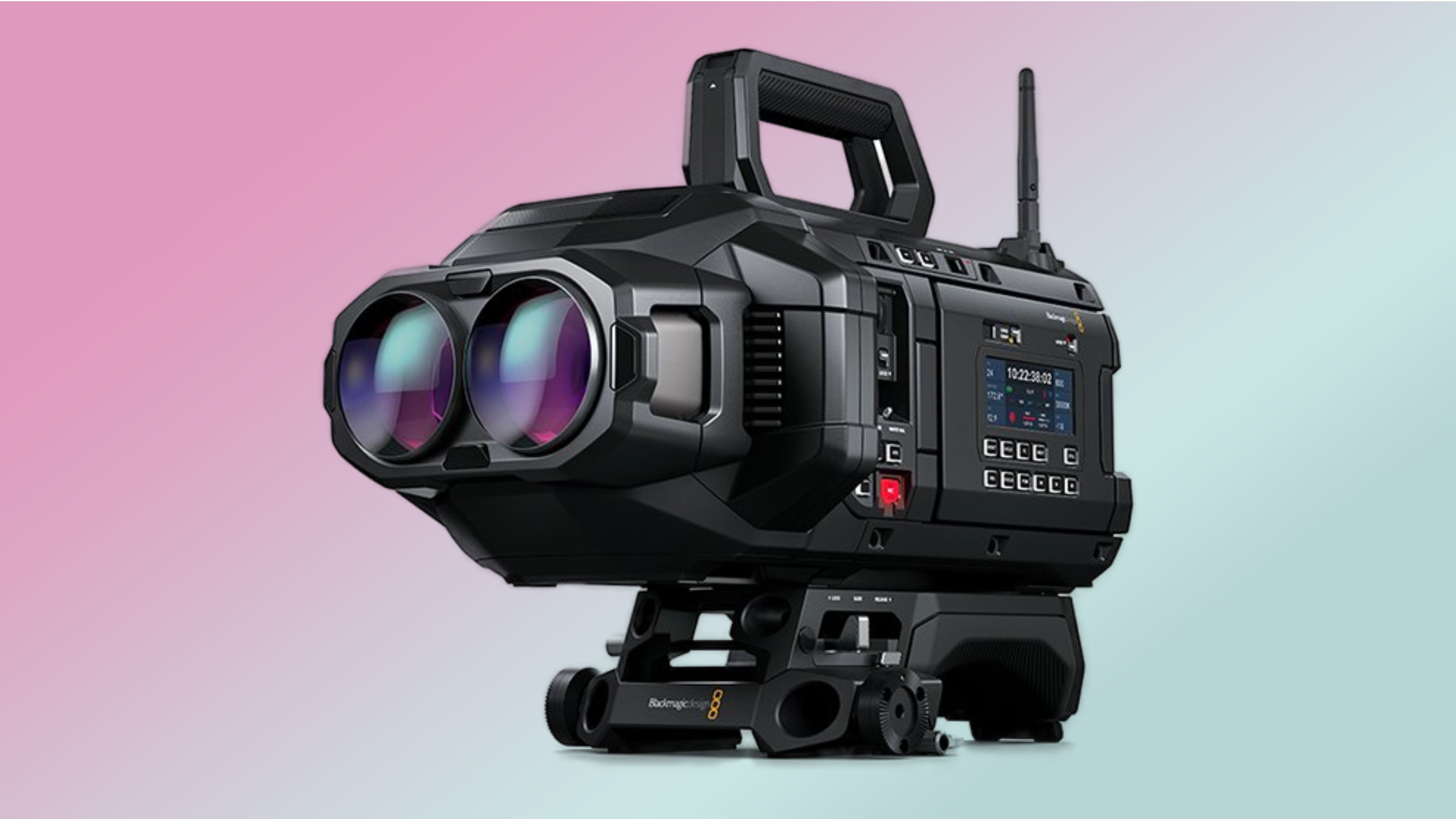
https://www.blackmagicdesign.com/products/blackmagicursacine...
which seems to be more in line what the article talks about
Then again... Maybe if AVP owners represent an audience that you'd like to target it wouldn't be a bad decision. Everyone that owns one will probably be starved for special content and I'd imagine they'd be willing to buy something specifically made for their niche platform.
But based on the Vision Pro demo I would expect to see them prioritise non-fiction content e.g. Planet Earth style movies, concerts, athlete profiles etc.
What's the point of integrating two cameras into one unit, when you can just capture with two cameras. It's a software problem.
Say you want a stereogram that shows you Manhattan or the Grand Canyon as if it were a model laid out on a table before you. A human-like stereoscopic shot of those places will not produce the depth.
(Maybe something can be computed, but that's a separate discussion.)
Converting to the "Apple Vision Pro" format is the last step on the pipeline, after editing.
0: https://www.blackmagicdesign.com/media/release/20241217-01https://www.blackmagicdesign.com/uk/media/release/20241217-0...
The article you linked mentions it uses BRAW which is indeed supported in Resolve today already.
You’ll turn your head and the image will just stay fixed in 3D in front of you?
But of course the quality is probably a lot lower than with this camera
Um, okay, what is supported and what is achievable are two entirely different things. Even with the fattest of pipes, uploading media content to the cloud is only considered fast if you're a turtle or a snail. Even with 12Gbps connection it takes 10-12 minutes to transfer 250GB files.
https://www.blackmagicdesign.com/products/blackmagiccloudsto...
Firstly, it is not passthrough video.
Secondly, you cannot currently have the same experience on the quest. You can have lower quality versions of it, but immersive video is 8k per eye at 90fps.
There has literally never been cameras available to consumers to capture that till this specific camera. Unless you did professional custom camera rigs.
As someone who owns both a Quest and a Vision Pro, and has worked in stereo for a large portion of my career, the two experiences are not remotely comparable when it comes to video today. The quest excels in other areas, but this is one where Meta have very weak coverage on.
Moreover, it's not really a proprietary format and you can already play them officially on Quest.
Nobody has been able to extract Apples immersive videos yet and I’m not convinced the Quest has the decoding power for it.
It’s a lot of pixels to decode (16k at 90fps) , while also doing reprojection of the frames (https://hackaday.com/2024/04/18/unraveling-the-secrets-of-ap...) and I don’t believe their Qualcomm chip used has enough juice leftover to do that.
That's not to say it cannot be used for other things. Blackmagic frequently market all their cameras for prosumer/professional film-making, but you can use the cameras for so much more than just recording films, although the marketing is geared towards film-markers. Doesn't make it misleading.
Sometimes tech is amazing.
https://en.wikipedia.org/wiki/List_of_3D_films_(2005%E2%80%9...
Of the 13 3D movies released this year only four are native 3D, and those are all fully CGI animation, so none of them used 3D cameras. Avatar 2 (2022) was the last movie to use 3D cameras for live action shots and Avatar 3 is the only upcoming movie known to be using them. It's beyond niche at this point unless your name is James Cameron.
If you pay attention in their work you can see how they try to hide the hard drive array that was required, and sometimes also the accountant holding on to it so that it doesn’t get swept away.
Vision Pro has been released for near a year now. I don't think it got the traction that's anywhere close to the hype when it was first announced. Not even among VR enthusiasts, let alone the mass consumer market.
There is an Apple Store near where I live. When I walk by it, 9 out of 10 times there is nobody around the Vision Pro booth, when many people are playing with iPhones and iPads.
In the first year, they were constrained by the number of displays Sony could produce.
> Sony, the supplier of Vision Pro's ultra high resolution OLED microdisplays, can't manufacture more than 900,000 displays per year. Apple needs two displays per headset, so this bottleneck would impose severe limitations on how many Vision Pros can be produced.
https://www.uploadvr.com/apple-vision-pro-production-severel...
As far as I've seen, their sales were in line with the number of units they could be expected to build, at least until Sony is able to ramp up production.
> 2024 Apple Vision Pro Shipments Estimated Between 500–600 Thousand Units, Micro OLED Key to Cost and Volume
https://www.trendforce.com/presscenter/news/20240118-12003.h...
https://techcrunch.com/2024/10/13/apple-might-release-a-2000...
This is so that people can begin making content for the Apple AR headset that comes out 3 years from now, not the $3500 devkit.
Pornographers
IMO vision pro is like the first iPhone/iPad and in a few years if they keep refining it there will be a larger adoption.
I think the main thing is that it should support full mac os apps without tethering to an external macbook/mac mini. They need to move the compute out of the headset itself and into the battery module. Apple probably would never do this, but imagine if you bought a mac mini sized compute module that could go on an external display or connect to a vision pro device. If the compute was separate the headset would be significantly lighter and more comfortable.