270 points · by secretmark · 1y ago · 290 comments
I started listening to a podcast called "the history of the early church" to learn a bit more about that but unfortunately I think the target audience was Christians interested in theology rather than nerds interested in history. Recommendations for books etc are welcome!
Is that really so odd? Doesn't "catholic" mean something like "universal," and I think it would be very odd for one faction of a split organization to cede that kind of title to its rival faction.
I might be misunderstanding your point, but I kinda feel it should be followed up with a kind of "Did you know, Western European, that these two different things are actually similar in this way you didn't know about?"
This became an important point for the survival of Orthodoxy during the Arian crisis.
Christians make a distinction between churches and the church. The former is the physical building or even denominations like Lutherans or Roman Catholics. The latter is the group of people that are part of Christianity, across time and denominations. The Universal Church refers to the latter.
Galatians 1:2 "…the churches of Galatia…" vs Colossians 1:24 "…for the sake of his body, that is, the church…"
> [We believe] in one, holy, catholic, and apostolic Church."
In Latin:
> Et unam sanctam catholicam et apostolicam Ecclesiam.
https://en.wikipedia.org/wiki/Four_Marks_of_the_Church
Catholic just means universal.
From their point of view, the West abandoned the true (i.e. orthodox) faith.
Also, it's hard to argue that the Eastern Christians changed more than Western ones. For example, since the 12th century the pope has forbidden priest marriage. There is some debate in the Catholic Church about allowing this again. If that is implemented, it would simply be a reversion to what the Orthodox Church has always done.
Also, it's not like the Roman Catholics claim to be heterodox or something, they also claim that their faith is "orthodox".
Then.. an anti-western emperor came to power had all the Latins/Italians in Constantinople massacred (>10% of the population) and things went pretty much downhill from there. It was very rapid, though. There were of course disagreements before the late 12th century but both sides generally acknowledged that they were part of the same Christian word/universal empire (even if they didn't quite agree who was in charge).
The "Great Schism" wasn't even that great at the time, there were plenty of schisms that proceeded it, it just happened to be the last one and nobody really knew what it mean for the next few hundred years.
The videos are presented by a pastor of the Community of Christ church in Toronto, but they're from a historical rather than religious perspective.
Early was earlier tho - the people that twist our recent revelations about the content of the testaments to support the perverted teaching today are literally twisting the closest text in existence to Jesus himself, to "explain" (pervert) a statement Jesus says in the Gospel of Thomas - a text predating all Gospels, may actually be perverting words truly spoke by Jesus, which is "leading astray" the truth that has come out from the millenia - as he said it would...
Not one sentence of this have I heard someone speak or have I read on someone's page.
One source of many: https://en.m.wikipedia.org/w/index.php?title=Gospel_of_Thoma...
For me it did a great job describing the context in which the church began, the major figures throughout the early church, and the spread, schisms, and events that helped shape the church in its formative years.
[1] https://en.wikipedia.org/wiki/Josephus
[2] https://en.wikipedia.org/wiki/Josephus_on_Jesus
[3] https://scholar.google.com/scholar?hl=en&as_sdt=0%2C5&q=jose...
It is also a useful corrective to the Western tendency to see its values and attitudes as universal, even where they are a product of a particular history and culture.
It's not about converting, just covering the history.
Meanwhile, the Catholic church's own profusion of saints whom you are supposed to beseech for specific blessings is dangerously close to a polytheistic practice in its own right.
See:
> Marcion preached that the benevolent God of the Gospel who sent Jesus Christ into the world as the savior was the true Supreme Being, different and opposed to the malevolent Demiurge or creator god, identified with the Hebrew God of the Old Testament.[2][3][5]
"...what kind of God could outstrip the attractions of all other things? Could any unitary, single-person god do so? Hardly, or at least not for long. Single-person gods must, by definition, have spent eternity in absolute solitude. Before creation, having no other persons with whom they could commune, they must have been entirely alone.
Love for others, then, cannot go very deep in them if they can go for eternity without it. And so, not being essentially loving, such gods are inevitably less than lovely. They may demand our worship, but they cannot win our hearts. They must be served with gritted teeth.
How wonderfully different it is with the triune God. In John 17:24, Jesus speaks of how the Father loved Him even before the creation of the world. That is the triune, living God: a Father, whose very being has eternally been about loving His Son, pouring out the Spirit of love and life on Him. Here is a God who is love, who is so full of life and blessing that for eternity He has been overflowing with it..."
[1] https://www.unionpublishing.org/resource/delighting-in-the-t...
He recommends books and primary sources for every episode and they vary from interesting more pubscience type stuff to incredibly expensive and deep academic sources out of print.
The gentleman who runs it is very obviously jewish in practice but only uses that to inform his historical context instead of override it, its very refreshing as someone who is an atheist.
- The Origin of Satan by Elaine Pagels; I read this one so casually that I don't have a good summary due to poor memory.
- The Passover Plot by Hugh J Schonfield; author contends that Jesus believed that he was the prophesied Messiah and engineered his arrest and crucifixion out of sheer genius and clever actions. Fantastic read.
- Jesus the Jew by Géza Vermes; author sees Jesus as a sincere apocalyptic preacher who believed he was the Messiah.
- From Jesus to Christ by Paula Fredriksen; author looks at how Jesus went from the Jewish Messiah to the head of a major religion.
- Becoming God by Bart Ehrman (you can find him doing interesting interviews or debates on YouTube); same as the one directly above.
- The Jesus Puzzle by Earl Doherty; author contends that Jesus was not a historical figure, but rather another heavenly figure understood to have been crucified in the firmament between heaven and earth. I'm really impressed by the argument so far. I'm not quite finished with this one.
Each prophet sows the seeds for the next within their teachings - each prophet knows how their teachings will become perverted over time, each knows the end of the end of their religion before they start it but they start it anyways bc of the seeds - they can't unseen the fruits borne of them, to them it's plain how people areiving incorrectly and obvious as to what is important and why - it is up to each prophet to determine how to do this in their time and place, speaking to the hearts of the people at that time.
Then they only must pull a Muadib to transform their society - only those with great conviction and faith can do it bc it's quite likely that after a point the prophet also believes themselves to be "real" (they always were of course - if not they would not have had the ears to hear the truth behind what the last prophet said) -
A person playing prophet bc they have the ability to, believing that they are fact a prophet, and having true faith in what they teach - like John the Baptist, they will attain powers they had not - they will attain thru their faith alone not a divine intervention or blessing and not for certain reasons or with limit, it isn't necessary to need something to miracle it so, wanting alone is enough.
All prophets faked it til they made it - every one of can do exactly as they have, it only requires right belief, that we can.
Anyways I'm ranting what I should really just make into another Testament - it will be much, much shorter if I ever do.
I don't think Jesus thought of himself as a prophet. I think he believed he was the Messiah.
Orchestrating the destruction of the Jewish temple (and thus most Jewish religious practices) at the hands of the Roman Empire after his own death would have been quite the feat
(1995). The Origin of Satan: How Christians Demonized Jews, Pagans, and Heretics. New York: Vintage Books. ISBN 978-0-679-40140-7
I also recommend another lecture series called "From Jesus to Christianity" by The Modern Scholar taught by Thomas F. Madden.
The British History Podcast starts in deep pre-Roman times and, after ~460 episodes, is up to 1091.
See perhaps the references / (printed) sources at:
The translated blessing text itself seems almost modern. Funny to see how little we've changed in some ways.
[0] though I'm afraid to admit there is at least one actual tambourine...
> Matthew 6:5-14 > 5 “And when you pray, do not be like the hypocrites, for they love to pray standing in the synagogues and on the street corners to be seen by others. Truly I tell you, they have received their reward in full. 6 But when you pray, go into your room, close the door and pray to your Father, who is unseen. Then your Father, who sees what is done in secret, will reward you. 7 And when you pray, do not keep on babbling like pagans, for they think they will be heard because of their many words. 8 Do not be like them, for your Father knows what you need before you ask him.
That is, he teaches a humble, private, and not-showy way of praying, as opposed to the Jews of their time. But this is causing tension and schisms in Christian churches everywhere. I grew up in a fairly conservative one - grey suits, quiet / low energy services, nothing too outlandish. But family of mine ended up in more Evangelical churches, with live music and the like. Then there's Catholics where opulence and grandeur is apparent in their cathedrals, and while I can appreciate them for their architecture and atmosphere and the like, I don't think that's in line with Jesus' teachings of humility and helping the poor etc, especially not given how much money goes and went around in the church.
Hmm, but in the Exodus, the ark of the covenant was glided in gold with cherubs on the four corners. Same with the Jewish Temple, it was probably decked out in marble. Unlike Protestants, Catholicism have arts, choral music and statues and architecture not because they are "worshipping it" but because these things are supposed to direct the mind upwards towards God.
I think the Catholic Mass is the ancient form of worship by the early Church. There's multiple references to the Real Presence in the Eucharist in New Testament (ie. the road to Eramus and the breaking of bread, and in John 6:53*) and the Sanctus is still in the Eucharistic Prayer, and besides, its an obvious break with the Jews who did burnt offerings in the Temple.
John 6:53–58, “Very truly I tell you, unless you eat the flesh of the Son of Man and drink his blood, you have no life in you. Whoever eats my flesh and drinks my blood has eternal life, and I will raise them up at the last day. For my flesh is real food and my blood is real drink. Whoever eats my flesh and drinks my blood remains in me, and I in them. Just as the living Father sent me and I live because of the Father, so the one who feeds on me will live because of me. This is the bread that came down from heaven. Your ancestors ate manna and died, but whoever feeds on this bread will live forever.”
When talking to the Samaritan woman at the well Jesus talks about worship being true and of the spirit.
John 4:23-24 NIV
[23] Yet a time is coming and has now come when the true worshipers will worship the Father in the Spirit and in truth, for they are the kind of worshipers the Father seeks. [24] God is spirit, and his worshipers must worship in the Spirit and in truth.
A reminder to forgive and seek forgiveness from those you have wronged (as reinforced in Matthew 6:14-15, Leviticus 19:18, Proverbs 17:9 ) before asking for forgiveness and before worshipping God:
Matthew 5:23-24 NIV
[23] “Therefore, if you are offering your gift at the altar and there remember that your brother or sister has something against you, [24] leave your gift there in front of the altar. First go and be reconciled to them; then come and offer your gift.
Showing that fake worship means little:
Matthew 15 8:9 (NIV) quoting Isaiah 29:13
[8] “ ‘These people honor me with their lips, but their hearts are far from me. [9] They worship me in vain; their teachings are merely human rules.’ ”
I think it depends on the motivation. If it is to elevate people's minds it is fine, if it is to show wealth and power it is not.
> especially not given how much money goes and went around in the church.
The church does actually use a lot of its income for the poor. It mostly does this in third world countries so its not evident in rich countries. Its not that long ago (20 or 30 years) that the church was the largest operator of AIDS clinics in the world - mostly in Africa where the need was great but the money was lacking. The same is true of other large Christian churches. They also tend to follow the rules of doing good quietly so they do not do PR to let everyone know what they are doing like secular philanthropists.
Its something you can verify. Some bits of the Catholic church (I recall finding a Vatican statement of income and expenditure a while back) make accounts public, and I think many other churches must do too.
It is not "opulence and grandeur" that are on display, but beauty, or Beauty:
* https://ndpr.nd.edu/reviews/aquinas-on-beauty/
* https://en.wikipedia.org/wiki/Transcendentals
See also "Beauty, Truth, and Goodness":
Sacred art exists to honor the Lord. We ourselves may remain poor and humble in the middle of all this beauty :-)
Are you asking about the scriptural basis from ancient times that they use to justify their modern practices? (i.e. the immediate topic at hand) Or are you looking for theological and/or scientific opinions on whether the claims they make are true, for at least some meaning of the word “true”?
I similarly had my mind blown reading an article last week, about how sports & game card collectors are now having their packs CT scanned so they can identify what cards are inside (and the value of the pack) while keeping them sealed.
https://www.nytimes.com/athletic/5987857/2024/12/12/trading-...
I know when I read Spanish, I have to mentally convert the order of words to what makes sense in English (for example, "Thanksgiving" in Spanish would be "Day of Action of Thanks" if translated directly).
This is just one example. There are other instances where a word is a loanword from Greek or Latin because it is an early technical term. For example "sanctification" is taken directly from a Latin technical term that is translated that way because of how early Latin translators chose to translate the Greek.
>In the beginning of Time, the great Creator Reason, made the Earth to be a Common Treasury, to preserve Beasts, Birds, Fishes, and Man, the lord that was to govern this Creation; for Man had Domination given to him, over the Beasts, Birds, and Fishes; but not one word was spoken in the beginning, That one branch of mankind should rule over another.
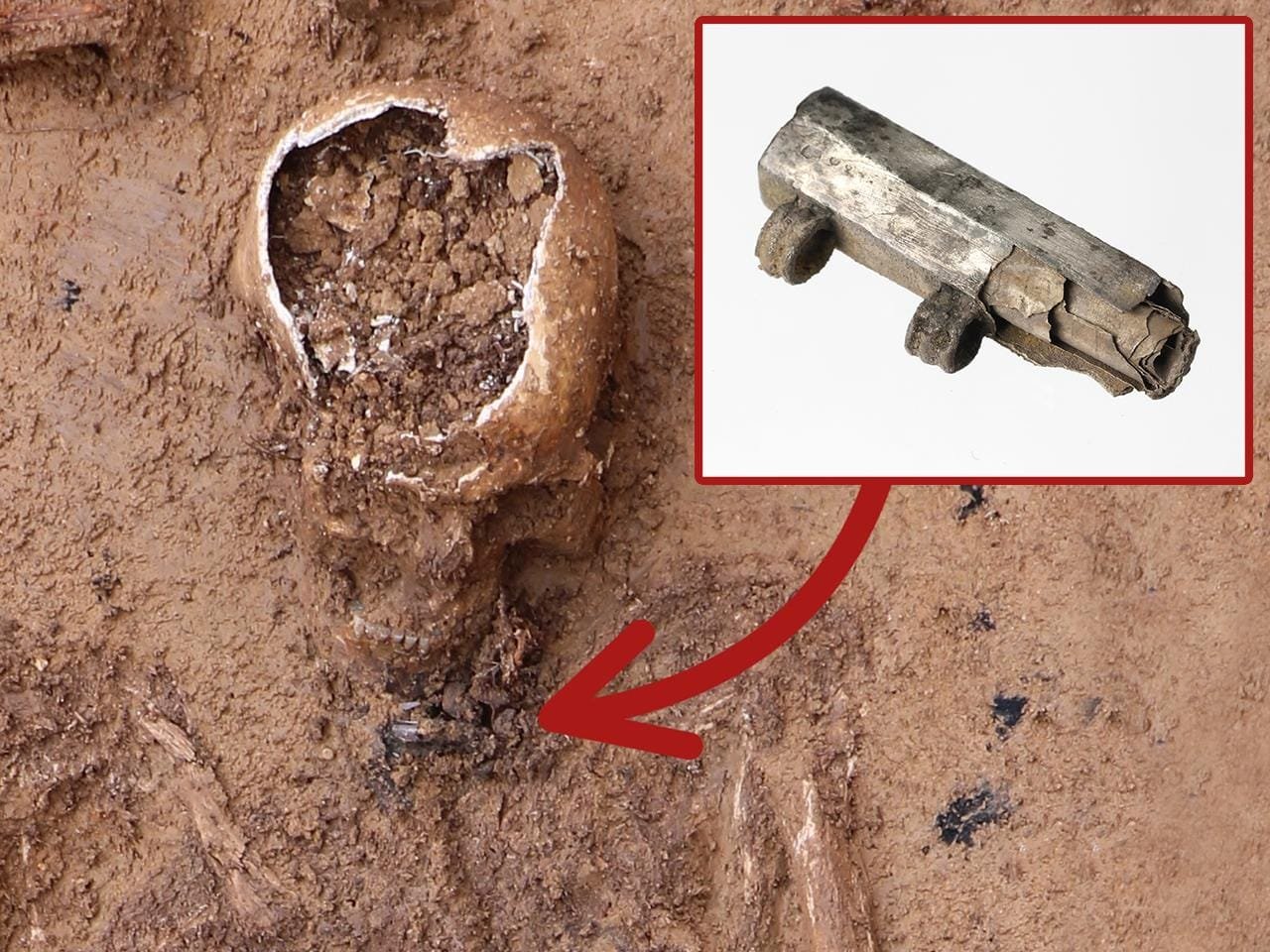
Press release with link to the video is here: https://frankfurt.de/de-de/aktuelle-meldung/meldungen/frankf...
Was this some sort of Latin shorthand?
>> The inscription begins with the Trisagion, the threefold cry of “Holy” [based on Isaiah 6:3], which remains part of the liturgy of the Eucharist to this day. In this case, however, it’s written in Greek [“agios, agios, agios”] but in Latin script.
https://www.uni-bonn.de/en/news/university-of-bonn-researche...
https://en.wikipedia.org/wiki/Christogram
Edit: Actually, here's the full transcription in Latin and German: https://archaeologisches-museum-frankfurt.de/index.php/de/?v...
One thing I don't understand is the picture of the scroll though. I don't see how they were able to figure out the letters? They don't look like an alphabet to me
Interesting; does anyone have a link showing a typical amulet from that era, for comparison?
[1] https://historia.ro/sectiune/general/culte-si-credinte-in-da...
Religion is an invention of the rennaisance. People at the time would have just perceived what we see as "religion" as worldview, much like people today typically believe in a fusion of economic theories.
well, that explains it then </s>
> inhumation burials — a practice uncommon in other Roman cemeteries in Frankfurt
To save others looking it up: "inhumation burial" seems to be a technical term in the field for what we simply call "burial", i.e. digging a grave and then covering the person with dirt and/or rocks. I'm not an expert, but given that this became the primary method of disposal in Christian culture (and still is, in many traditions who believe that cremation prevents the body being resurrected), one could infer that this is an indicator of Here Be Christians.
If you know even a smidgeon of theology, it's not technically possible to define (mainstream) Christian faith without any reference to Jewish beliefs. Jesus was, of course, himself raised a Jew, as were both Saints Peter & Paul, although the latter was also a Roman citizen who wrote in Greek, and they famously quarrelled quite a bit about how much of Judaism should be incorporated into the new religion, well documented in the New Testament itself and plenty of extra-biblical evidence.
It does seem a reasonable claim that nothing in this text contains elements of Judaism that were not already or subsequently incorporated into what became Christianity (though I'm pretty sure at this point it didn't yet have a name other than "The Way". I could be wrong there.)
However, just for fun:
- "Holy Holy Holy" is most definitely a reference to the (Hebrew) book of Isaiah, which was also quoted in the (Christian) book of Revelation aka Apocalypse (Greek, New Testament)
- Of course they don't use the name Yahweh when talking about the God/Lord of the World, of whom Jesus is claimed to be the Son. Neither does the Septuagint (Greek translation of the Hebrew scriptures, produced for use by Greek-speaking Jews a few hundred years before Christ). But they are most definitely talking about the same God.
- I'm not sure if this pre- or post- dates the Jewish tradition of replacing the Name with "Adonai" (Hebrew for "Lord") or its Greek/Latin equivalent, on the grounds that the Name itself is too holy to be spoken or to risk being destroyed if the manuscript gets damaged or, you know, buried in the ground to decay with a dead person. But that could also be a factor.
Unfortunately they don't provide a transcription of the Latin text into modern characters so there's no opportunity right now to go nuts on that but it would be interesting to see what specific Latin words were used compared with translations of the Septuagint, and the original Greek and Hebrew texts themselves.
Still, thanks for posting!
Warning! Unnecessary nit-picking incoming...
Jesus isn't a mispronunciation of Yeshua, it's a transliteration. Initially the Hebrew/Aramaic ישוע was transliterated to the Greek Ἰησοῦς which is essentially a phonetic transliteration with the ending changed to the Greek masculine singular.
That was then transliterated to the Latin Iesus with basically the same deal ie phonetic with an ending change.
And that morphed into Jesus, probably about the 16th century, when the swash 'I' became a 'j' sound.
> more accurately be "Joshua"
It wouldn't really be more accurate; it would just be a transliteration through a different route. The most that can be said is that there are fewer hops.
It would still likely have most of the sounds wrong, esp if Jesus' name was originally pronounced in Galilean Aramaic. As I understand it that wouldn't have pronounced the final 'a' like an 'a' but more like a glottal stop. But that's right on the edge of my knowledge so I could have made the last bit up.
That said, there is arguably no simpler or purer form of Christianity than simply having faith in and a personal relationship with Jesus Christ.
In the age of the Messiah the faithful are truly drawn “from every nation, from all tribes and peoples and languages”. If your wife would go to any (decent) Catholic or Orthodox church, and learns to "read" the building and the liturgy of Holy Mass, maybe she could recognize the contours of the “pure” or “more Jewish" religion she is yearning for. She could go to modern or more traditional Latin/Greek/Ukrainian/Syriac/Ethiopian/... rites and in the plurality of all those different cultures and temperaments recognize over and over again the exact same elements and basic plan, organically evolved yet meticulously preserved in a chain of unbroken sacramental obedience.
Entering the church building she’d gradually walk from the holy water near the entrance, through the “outer courtyard” for the lay people, to the sanctuary with the sacrificial altar, golden vessels and incense, elevated and separated by altar rail or curtain. Behind is the tabernacle, the Holy of Holies containing the Real Presence, indicated by a lit candle. And if she was to e.g. carefully analyse the words of the Eucharistic prayers in all these different rites and languages, she would find over and over again the same underlying structure, complete with the Haggadah.
But language and cultural differences aside, there must be fundamental differences as well. It is Christ Himself who took the prescribed liturgy of the ancient Passover meal and gave it its full and final meaning by substituting Himself, in the presence of the apostles, for the merely symbolic lamb. It is through Christ that the Trinity is fully revealed.
How then could e.g. the exact same holidays have been retained? For instance, why would you celebrate Shavuot, if with Pentecost the Holy Spirit directly descended on the Church? Another example: the Lord's Day is not "Sabbath on the wrong day". Sabbath laws do not apply to those under the New Covenant. Beyond the most excellent idea of dedicating an entire day to the Lord with plenty of obligatory prayer, rest, food and family/community time, the Christian Sunday is simply not the Sabbath. On Sunday we celebrate the Resurrection, which occurred on the first day of a new week (the supernatural "eighth day", beyond the natural fullness of the old week).
The priest in this age is also no longer a Levite. To properly offer this sacrifice, he is now sacramentally ordained by proper religious authorities “in the Order of Melchizedek”, reminiscent of the royal priesthood of David and the priesthood of Adam and the firstborns. And where the old liturgy was a sign of divine grace, the liturgy of our age is an effective cause of divine grace. If the priest obeys the liturgy that has been prescribed for his own rite and his own day, no amount of personal corruption can take away the sanctity of his work. This also means that there is no fundamental need for wars in the Holy Land or for "conquering" the Temple Mount by force. The Temple is already being built. Every time the faithful, after having been sacramentally cleansed of mortal sin through baptism or confession, participate in the Lord’s sacrifice by eating the body and drinking the blood of the Lamb, they themselves will inevitably become more and more the dwelling place of the Lord within the material creation.
[1] https://en.wikipedia.org/wiki/Frankfurt_silver_inscription
https://archaeologisches-museum-frankfurt.de/index.php/de/?v...
I personally cannot make heads or tails of the script used in the various images, but it seems about right.
(Note that V and U are generally used interchangeably in Latin, since they were the same character. Same with I / J.)
That taboo already existed even before the New Testament was written. The Septuagint, an early Greek translation of the Old Testament, was written around 260 BC and uses this convention, translating the Lord's name as "kyrios"- "Lord." The authors of the New Testament itself extensively quote this translation, and firmly established this convention within Christianity as well, especially because most Christian converts wouldn't know Hebrew or be expected to learn Hebrew to hear (remember that literacy rates were very low in this era compared to now) Jewish scriptures in their own languages.
Speaking of literacy, I notice that the Latin of this inscription is very messy. I don't know much Latin myself, but the handwriting is terrible, to the point where I wonder if the maker of this scroll was only semi-literate.
To a modern eye (like mine), other examples of Roman cursive look hard to read as well: https://en.wikipedia.org/wiki/Roman_cursive
Seems very possible when you consider that this is before the Roman Aristocracy decided to muscle in on the action and take over the church. Many of the original disciples and apostles were semi-literate working class types from the north country (see “nothing good could ever come from Nazareth”) and Paul, the one who wrote the most (but even then likely dictated a lot of it) was a late addition to the team. Sure he recruited a bunch of possibly “middle class” tradesmen and business owners to set up churches in their homes (Priscilla and Aquila, famously) but it was still mostly an underground movement among the slave and worker classes before Constantine decided he could put it to his own use.
Just wondering what is the "plenty of extra-biblical evidence"?
Could you expand on that? Is there any specific reference to the book of Isaiah, and is "holy" (AGIOS in the Latin of the scroll) a good translation of the Hebrew word?
Perhaps, but in this Latin inscription we have Jesus being referred to as "IHS XP" - a Greek(!) abbreviation of Jesus Christ, so not avoiding his name altogether.
Religion latched onto which ever means of disposing of their dead the locals already performed. No different than how religion took over local customs and traditions to help bring in more people into their fold.
Communities that didn't properly dispose of their dead would of experience a net-positive when pushed to follow a religious which their funeral tradition helps prevent epidemics. Those people would most likely of uplifted the religion when they though divine intervention reduced their epidemics. In reality, it was as laws of physics reducing the propagation of contagions.
Fun fact, disposal via vulture consumption is another good means to contain contagions. Their digestive system is like battery acid and kills mostly everything. Natures evolutionary animal that assists with preventing epidemics. A natural wake.
It's fair to say that there is general consensus amongst Biblical scholars that there was a historical Jesus of Nazareth. Calling it a scientific consensus is a bit of a stretch though. As far as I'm aware there's zero scientific evidence for His existence. Just that the surviving textual evidence makes little sense if He didn't.
The Roman census that required every family go back to their hometown did not happen (why would it?). Romans kept very good records of censuses and such an event would be well covered.
So why does the Bible have this story? The best guess is that Jesus was well known to have come from Nazareth. Yet the older messianic texts say the Messiah would be from Bethlehem. The gospel author undoubtedly was trying to square that circle to make sure the prophecy was fulfilled. Something they'd not need to do if Jesus wasn't real. The author had to explain to people who had grandparents who knew him as being from Nazareth why that still jives with older prophecies.
"When I administered my thirteenth consulate (2 B.C.E.), the senate and Equestrian order and Roman people all called me father of the country, and voted that the same be inscribed in the vestibule of my temple"[0]
The nerve to use "Common Era" when specifically talking about the spread of christianity.
What relevance in an age when the moral high ground is now a weakness or, at best, simply an ineffective strategy?