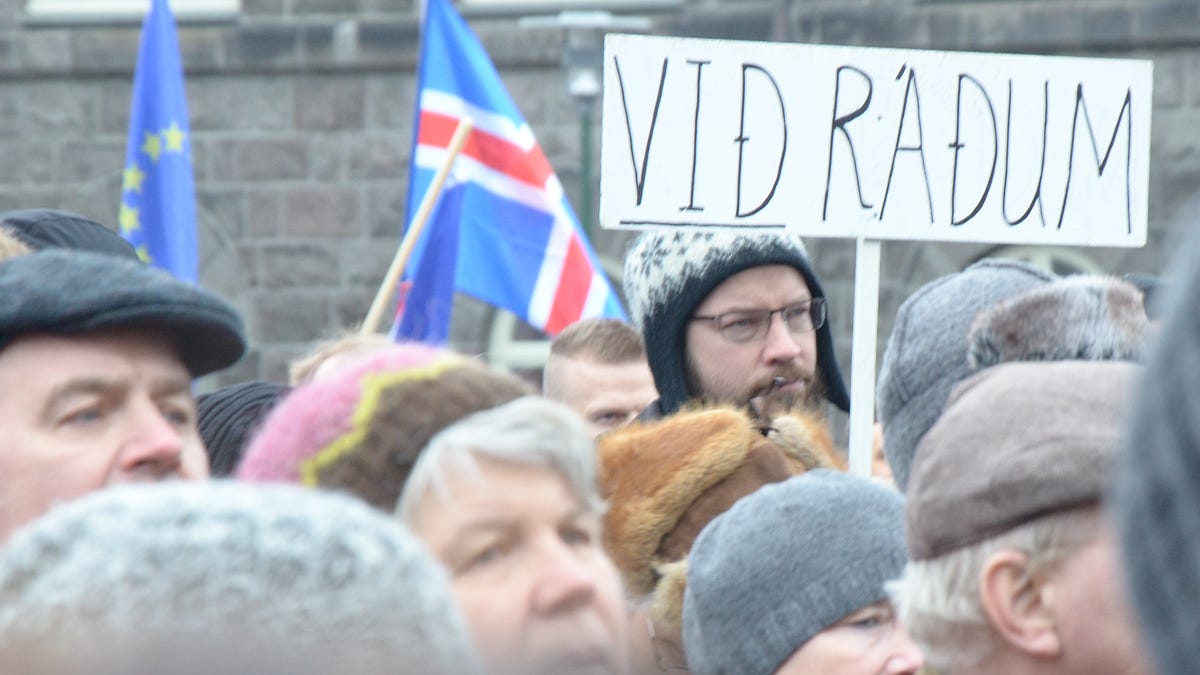
Is Iceland getting ready to join the EU?
A new change in Iceland’s government means that joining the EU is back on the cards for Iceland.
mikegalsworthy.substack.com
295 points · by mariuz · 1y ago · 691 comments
> By May 1992, the EEC had been renamed the EEA (European Economic Area) and all 7 member states of EFTA signed “The EEA Agreement” alongside the 12 member states of the EC.
The EEC was not renamed the EEA. The Maastricht treaty (signed February 1992, effective November 1993) established the European Union (EU), and renamed the "European Economic Community" (EEC) to the "European Community" (EC). Alongside the EEC-now-EC, there was also the European Coal and Steel Community (ECSC, dissolved in 2002) and the European Atomic Energy Community (EAEC or Euratom, still exists), and the three linked Communities were known as the "European Communities", which was another expansion of "EC". And the EC formed one of the pillars of the European Union, until the Lisbon treaty (signed December 2007, effective December 2009) merged the European Community into the EU and it ceased to independently exist, although Euratom continues as essentially a subsidiary body of the EU. And then the EEA is a separate arrangement, established by a treaty between the EC, its member states, and the EFTA member states, signed May 1992, effective January 1994. So the EEC was not "renamed" to the EEA. The EEC/EC/EU and EEA are separate but overlapping arrangements – the EEA is geographically broader in scope, but topically narrower (certain EU laws and regulations are excluded from the EEA, and hence the EFTA states do not have to adopt them)
The EEA has much the same scope as the EEC. So in practice the EEC was renamed to the EEA (and the EC was instituted with a broader remit), even if the mechanics of how it was implemented are slightly different.
It was not renamed to the EEA, in practice or otherwise. The EEA is a geographic part of Europe based on an agreement between the EFTA, the EU, and the various member states. The EEC was a supranational organisation with a whole internal structure (council, parliament, etc). They are not even the same kind of entity.
You can argue about the roles of these different bodies and how some of them were superseded by some others. Although non-EU, EEA member states are outside both the CPA and the CFP, which were cornerstones of the EEC. The EEA is not some mythical, ideologically pure version of the EU as it was back when it was only a common market (it never was). It’s a completely different thing. It was initially a way of functioning for countries that wanted to be close to the EC, but not too close. Saying that the EEA is the EEC renamed is plainly, factually wrong.
The EEC was renamed the EC and disappeared in 2009, at which point the EEA had been existing for 15 years.
> both the CPA and the CFP
Should be “both the CAP [common agriculture policy] and the CFP [common fisheries policy]”.
The EEA had several significant exclusions compared to the EEC/EC at the time of its founding: agriculture and fisheries (although it has some application to trade in those products), customs, external trade, taxation, monetary policy. Furthermore, under the Amsterdam treaty (effective 1999) the EC gained responsibilities for immigration, visas, asylum, and judicial cooperation in civil law (which were transferred from the non-EC part of the EU), and the EEA was not extended to cover those new areas (although some of them apply to the EEA member states through their independent membership of Schengen). The EEA is also excluded from the scope of the EU trade mark (f.k.a. community trade mark) and EU unitary patents. The EEA agreement promises future negotiations on extending EU patents to the EEA, but thus far nothing much has happened there, in part because actually getting a common EU patent system up and running turned out to be very difficult and despite being first proposed in the 1970s it took until 2023 to actually become a reality (the biggest obstacle, but not the only one, has been Spain's objection to Spanish not being one of the official languages of the EU patent system–the ultimate solution was to effectively give Spain an opt-out from it)
Exactly the kind of thing I'm talking about. So the EEA is a much closer successor to the EEC than the EC, which has a significantly expanded scope, is.
Also, what's the point in loading and unloading in Iceland, when you're already fairly close to ports like Rotterdam, Antwerp and Hamburg? I get that you could in theory ship around the pole, split your containers in Iceland and ship to the US and EU from there. It's just that unloading a container ship isn't that fast, and we're already shipping so much that the load could just be distributed across multiple ships with separate destinations.
> one of the biggest producers of refined aluminum
But yet that's still where the lion's share of revenue for their Government comes from.
For everyone else, Singapore is important because it sits right at the end of the historical trade route of the Straits of Malacca. There is a whole wikipedia entry about it.
Not a given, but an okay speculation fodder.
Iceland not all. You can easily get around them. The Azores were the trading and fruit manifactoring hub there instead. They could deliver all the fruits for all of Europe. What can Iceland deliver to Europe? They are also in the center, not the north route.
In either case, Europe and the US have such efficient rail/road freight that I can't see economics of putting a hub in Iceland making sense. You may as well have ships travel direct to the respective continental mainlands.
The value is cross-loading delivers greater network effects. You have many possible paths to get to your destination, and can pick the most optimal for your particular needs at each step.
Most container ships are on a sailing schedule - they visit a set number of ports, and generally stick to it (absent other issues).
So you can get out of your origin country quicker by just picking the next ship with the cheapest rates going to approximately the right location.
For the shipping lines it's more efficient to just pick up a lot of containers at once and visit multiple ports than try and get a full load to just one destination.
It also means that each port they visit they're also getting paid for new cargo for onward destinations, not running empty (or waiting for another full load) to do another trip.
Maersk list ship schedules here: https://www.maersk.com/schedules/portCalls and with a few clicks, it's obvious that most ships call at many ports.
...between SEO spam and AI generated nonsense proliferating like wildfire, that's becoming less and less tenable by the day.
Plus your crew may need some downtime sometimes.
Interestingly, cars have similar economics. Details vary quite a bit, but every 100lb (nearly two full tanks of gas for me) makes you 1% less efficient. It only really matters if you have driving habits that tend to burn that excess energy somewhere, like rolling in hot to a stop light and hitting your brakes rather than anticipating the light cycle and coasting in.
Limiting range also lets you use smaller craft with things like smaller fuel tanks.
Iceland does quite a business on this sitting between euro and American destinations. Greenland might get into this too.
Also probably gets some crews at home each night flying the leg back instead of needing to stay on the mainland for a day/night before doing a later return leg.
I always wonder how realistic is this? I assume we dont need special vessel for this shipping lane and we can somehow always clear all the ice before us.
With climate change there are longer and longer times of the year when there is no ice. And when it does reform it is often not as thick as before, so less robust ships may be needed.
good one!
also, i was thinking about UK joining EFTA, though so far they didnt...
It belongs to the few thousands people that live there and want to be part of Denmark and Europe.
There's really no claim to Greenland other than "it's close".
Fun fact, though, you can walk from Canada to Greenland. When the winter sea ice freezes. I think it's about 20 or 30 km. This has cross-pollinated people, language, culture for thousands of years in the north.
“The US used this justification during WWII to prevent Nazi control of Greenland.”
I’m not saying this is valid reasoning. But if I needed to build a movement to reclaim Greenland from the perfidious Danes, it’s how I would do it.
> want to be part of Denmark and Europe
Just because the US can take it off them if they really want? What would Denmark do about it realistically?
Why would he need a legal basis? It's clear he says stuff and then later we'll see.
It's just another part of his shlock-and-awe campaign, like all these appointments of obviously unqualifed people to important positions. He does stuff like this to get people riled up, and ready to believe he's capable of anything. And always talking about him, non-stop.
Why?
Iceland's interest rate is 8.5% https://www.cb.is/other/key-interest-rate/
EU's interest rate is 3% https://www.ecb.europa.eu/stats/policy_and_exchange_rates/ke...
The higher Icelandic rate is set for Icelanders by Icelanders in order to bring their 4.8% inflation rate down to the 2.5% target.
If Iceland adopted the EU's interest rate which is mainly set for France and Germany, that would be a 5% interest rate cut which is a massive stimulus. Icelandic inflation would skyrocket and there would be no chance of hitting the 2.5% target.
People should also look into Optimal Currency Area theory popularized by Paul Krugman eg https://archive.nytimes.com/krugman.blogs.nytimes.com/2012/0...
The US Dollar works because of massive fiscal transfers from states on the coasts to states in the interior. The US also allows whole areas to deindustrialize like Detroit in order to solve the unavailability of currency adjustments between states.
Are Icelanders willing to subsidize Greece? Are they willing to forgo their ability to devalue their currency like in 2008? Without devaluation that means deindustrialization.
For all the above reasons, Iceland joining the EU would be the stupidest and most economically illiterate decision in it's history.
And in fact, I think you have it exactly backwards in this case.
Many countries have dollarized their economies - replacing a local currency supported by high interest rates with the US dollar which has even lower interest rate than EUR - as a tool to tame inflation or kill hyper-inflation. Other - small non-EU countries have adopted the Euro for the same reason.
And with the same result - a massive fall in inflation.
This isn't just theory, this has been observed to work over and over again.
Iceland doesn't suffer from hyperinflation and it's already got an established central bank and trusted institutions. Lowering the interest rate in this environment would 100% lead to more inflation.
Plus Iceland relies on currency devaluation to cope with shocks. It would be crazy to give this up.
It would not, simply because joining the Euro Area isn't a one time thing, but a series of steps, and they wouldn't move forward as long as the inflation is higher than in the rest of the EU.
> If Iceland adopted the EU's interest rate which is mainly set for France and Germany, that would be a 5% interest rate cut which is a massive stimulus.
Interests rate is only one of the factors involved in controlling inflation, and the fact that Italy has been able to adjust its economic policy in order to align its inflation figures to Maastricht requirements and join the Euro Area is a good proof of that.
> People should also look into Optimal Currency Area theory popularized by Paul Krugman
It has been popularized by Robert Mundell in the 60s, for which he got the Sveriges Riksank prize (the "Nobel") in 1999, not by Paul Krugman.
> For all the above reasons, Iceland joining the EU would be the stupidest and most economically illiterate decision in it's history.
The creation of the Euro is IMHO the "most economically illiterate decision in […] history" but moat of your arguments above miss the mark.
By "popularized" I mean brought to a modern audience in Krugman's New York Times column. It's Mundell's theory of course.
Interest rates are the main way to fight inflation. Glad we agree that the Euro is a silly currency union!
They cannot join Euro until inflation stops being higher, because that's simply how it works: countries must achieve “convergence criterias” before they can enter the single currency.
Edited to remove Sweden because it's obliged to eventually adopt the euro.
The case of Sweden is interesting though, they don't have an opt-out clause so they are obligated to adopt the Euro eventually, but they exploited a loophole by not joining the newest version of European Exchange Rate Mechanism after the 1999, which prevents their entry in the Euro.
Of course, the EU often ignores its own treaties. So that's not a hard guarantee. But the first rule of the EU is that everyone has to pretend it follows its own rules even when it doesn't, so it's not like Icelandic leaders can just announce they'll join the EU but won't adopt the Euro.
> Denmark has a treaty opt-out from the obligation to join the eurozone even if it complies with all criteria.
They are required to say they will at some unspecified future date, but that's another matter.
Also, yeah, the Danish Krona is pegged to the euro at ~7.45 so there is little incentive to switch over.
Can you elaborate?
Although it doesn’t make sense, because the influx of cheap money would make joining the EU an obvious boon for that class, wouldn’t it?
A shock therapy Euro adoption is not in the interest of anyone.
Nobody cares about inflation. They just need the right "democratic leaders". See Georgia. /s
The inflation absolutely matters.
That's because of how US politics work. Less populous states have disproportionately higher political power. It's not a monetary policy thing. It's a core difference between US and European politics.
> The US also allows whole areas to deindustrialize
That's because Americans are free to live and work where they choose.
There's a lot more nuance here, if you look at Obama's memoir, he writes quite frankly about the dilemma of propping up the US auto industry with government dollars. When they (US automakers) asked for bailouts, he found them quite mismanaged, but if they went under a large portion of the US economy would find itself unemployed.
Considering its remoteness and population size, where Iceland sits today as country is an absolute success story. Don’t give up your sovereignty.
I wonder in the coming years if we'll see the US actually become more like the EU. I expect there to be significant competition between Texas and California, in terms of industry, polity and philosophy. As the US continues to be internally fragmented politically, we're bound to see states compete actively, sometimes even to the detriment of other states. While we won't see a significant fragmentation like the EU, we will see a country that's so internally divided, there would be saboteurs and collaborators with enemies. We're kind of already seeing this, for example Texas and Florida shipping their illegals into Massachusetts and NY, states being firmly in the control of one party, with no room for switching governments, and the ever present question of states' rights.
Let's imagine for a second you want to create a startup making cell phones, or cars, or TVs etc. You base in say Texas for the taxes, but workforce can freely move to the Texas from California. They have zero language barrier, they have zero legal barrier. Legal, highly skilled immigrants in California can freely move to Texas for work. The product you make has to conform with both Cali and Texas laws, bud federal ones are unified. It needs to be localized for 1 single language. And it can be immediately sold to the 350mil market with minimal changes. Now if you do the same in France, you are limited with French workforce, because of the language barrier and legal barriers. Then to sell to the whole EU you need to comply with 24 laws and localize to 21 language. And support all that. EU company is less competitive on this basis alone, plus USA doing brain drain (which they foolishly want to limit now) is not helping.
Which is a game-theoretically sound choice given the lack of legal authority to prevent unlawful entry to begin with.
Startups?
Their solution? Create an inner union of the EU countries that really matter (Germany, France, Beneleux ...etc). No I'm not making this up. It's not even the first time this idea was floated around. So to me it seems that the EU as a single block is almost finished.
I don't know how old you are but as a European with a passing interest in politics I have been hearing this at least every month for the last ~20 years. And I'm sure it was said long before then.
What you need to understand is that the EU exists, and has pretty much always existed, in a constant state of crisis. There is always some major disagreement, some urgent problem. This is just a consequence of the EU's existence as an attempt to unify (in some respects) 27 pretty diverse member states. The EU has survived all of these crises to date. I'm not saying it will exist forever, but I see no reason to believe that the current set of crises will be the ones to kill it. The EU may change but I think it will trundle on for the foreseeable future.
Also, there is already an "inner union", it is called the eurozone. Again... constant state of crisis.
you're drawing some pretty far-fetched conclusions here
Germany and France have always been the core of the EU (and its founding members).
I don't necessarily think it is a good idea. I am a firm proponent of the EU. In a world where the other major powers are many times bigger than any individual European country, Europe cannot defends its interests when every member country is on its own. There are many issues with the current shape of the EU, but I see it as a necessary step on a path to something better.
Weird how everyone always forgets about Italy
https://en.m.wikipedia.org/wiki/European_army
https://en.m.wikipedia.org/wiki/Federal_Europe
You’ll notice it’s not exactly a clandestine conspiracy lol
That’s how it’s done: hard power and economic growth. Every empire in history had those two things. Europe has neither.
It’s even more true with the euro zone where some members are directly harmed by the high exchange rate.
It would make a lot of sense to go back to a smaller more integrated union with the countries which want it and leave the ones which only want the single market be part of a less integrated union.
Then again, considering Germany and France disagree about pretty much everything at the moment, I doubt it would go very far.
That option does exist, albeit in a bit of a roundabout way. Nothing is stopping a member country from leaving the EU and joining EFTA and the EEA afterwards. The fact that no country is seriously contemplating this is telling.
Our takeaway at the time was that this has to be the most effective billboard in the country as there is only one road between the major international airport and the capital.
I am still stunned that Brexit was left to a 50% + epsilon referendum.
> Should the United Kingdom remain a member of the European Union or leave the European Union?
There was nothing about what should happen if "leave" won.
The referendum should have been for the UK to prepare a detailed plan for leaving the Union and then have a referendum on whether or not to implement that plan.
In Australia, a constitutional referendum requires a double majority to pass: both a majority nationally, and a state-wide majority in a majority of states (so at least 4 out of 6).
Unlike Australia, the UK has no written constitution, and is a unitary state with devolution instead of a federation. Still, Brexit was undeniably a constitutional-level issue, and taking the constituent countries as the analog to states, they could have adopted the same "double majority" rule in the UK for the Brexit referendum. And if they had, the referendum would have failed: it got a majority nationwide, but in only two out of four constituent countries (England and Wales but not Scotland and Northern Ireland).
A big problem the UK has – which Brexit has arguably only worsened – is its extreme lopsidedness – one of the constituent countries (England) is over 80% of the population, so a big enough English majority on any issue can override the will of the other three constituent countries. And yet there are essentially no constitutional provisions to protect against this. Adopting a "double majority" for the Brexit referendum would have been a small step in the direction of doing so, at least by establishing a precedent.
[0] The fact that it was legally non-binding is not an issue: the legislation could have simply specified the conditions under which the referendum would be "deemed to pass", and require some appropriate government official to make a formal declaration as to whether those conditions had been met or not.
The problem with not proceeding following a "50% + epsilon" is you're then suddenly ignoring the majority of the electorate which has its own political backlash.
The trick is to not have a referendum unless the outcome likely to be definitive. This is actually codified in the Good Friday agreement as a condition for the Secretary of State for Northern Ireland to call an Irish unification referendum.
The referendum should have been two part. 1 want to leave or not? 2 how about this specific option (channel) or shall we forget the it all?
We have long known that unanimity holds us back internationally, and that the switch to majority vote is way overdue - but leading European Union member states to accept that is going to be a long slog. We'll get there and we have started on the path: trade policy for example is already qualified majority voting.
In practice most decisions are still technically unanimous, because it looks better politically and it doesn't cost anything more (since a majority can simply pass whatever they want, they are not forced to concede anything to the obstructionists; with the newer rules, it's smarter for any isolated bloc to immediately trade any publicly-stated opposition for any minor favour they can get).
This is the reason why Orban, despite all his bombast, has no influence whatsoever on the actual decisions; but also why German resistance against overdue fiscal reforms has basically melted.
Why single out Hungary and Poland specifically? Is it worse than when Austria, Netherlands, France, etc. have a different opinion to the rest of the union and torpedo progress just to pander to the right wingers in their country?
Also, as an European I know virtually no people opposing EU membership, when there are, it's generally less educated people thinking that the economy or whatever would be better.
It appears that opposing EU membership is kind of a taboo, and many educated people are afraid to express their opinion on the subject. Which tells you all you need to know about the legitimacy of EU.
You should be very careful with these kinds of sentiments. Openly contemptuous elitism is how we ended up with Trump in US.
Here are 2 recent reports
https://www.pewresearch.org/short-reads/2023/10/24/people-br...
https://encompass-europe.com/comment/clear-support-for-eu-me...
IMO the EU regulation doesn't go far enough as it excludes banning AI for "military use".
Had russia attacked a NATO country of the EU directly, said country would have been at a disadvantage.
There have been reports of experiments with autonomous drones in the russia-Ukraine war.
If the EU bans AI for military uses and our adversaries do not, I am afraid someday we will regret our mistake. But it will be too late.
I hope to see even more "stupid AI regulation" in the future, fingers crossed.
Recently I benefited from a "stupid regulation" mandating minimum Internet speeds carriers need to provide. How dare the policy makers interfere with the extortionate prices every single ISP in the market colluded to impose on the population. Muh liberty!
The European Parliament is elected every few years by citizens in all member states.
The European Commission is nominated by the European Council and and confirmed by the European Parliament.
The European Council consists of government officials from the member states where they have been chosen by national democratic processes.
It may be a little complicated, but it's all rooted in democratic processes. Please stick to the facts and keep the populistic anti-EU nationalistic propaganda to yourself.
(Every kid in the EU has been learning those basic facts in school for decades, making it surprising that this populist nonsense still catches on with so many people. I have an easier time forgivin non-EU folks, but even those should check the facts before claiming things.)
Care to explain how any of that is undemocratic?
Consider that icelandic mortgage interest rates are currently 9-11% but a few years ago they were 4% which was celebrated as historically extremely low rates.
If we join the EU we’re pretty much guaranteed to lose this exclusive access to our waters, and that will be devastating for the economy, given how the fishing industry is one of very few industries keeping the economy afloat. Especially considering exports to other countries.
Unlike Iceland, fishing is a negligible part of the U.K. economy (c0.1% vs c10%), yet was used by people who couldn’t give a stuff about fishing as a weapon.
As I understand, part of the reason that Norway wanted to stay out of the EU was to fully control fishing in their territorial waters. I can understand why Iceland may wish to do the same.
The EU has an abysmal history of setting and managing ITQs in its waters, with Iceland having some of the best (but not at all perfect) managed waters in the world.
So there is plenty to be skeptical about when it comes to how negotiations would go on the matter.
No, this is mostly about fishing rights afaik. Britain also kept having issues on that front.
Now, every country joining the EU is expected to join the Euro at some point.
https://economy-finance.ec.europa.eu/euro/enlargement-euro-a...
"Who can join and when?
All EU Member States, except Denmark, are required to adopt the euro and join the euro area. To do this they must meet certain conditions known as 'convergence criteria'."
UK and Scandinavia got to opt out of the Euro, for example.
https://en.m.wikipedia.org/wiki/Whaling_in_the_Faroe_Islands
https://en.wikipedia.org/wiki/2008%E2%80%932011_Icelandic_fi...
(Though, perhaps it helps that the UK is no longer in the EU).
What they would have been allowed or forced to do and whether their response could have been the same.
> As Greenland is one of the Overseas Countries and Territories of the European Union, citizens of Greenland are European Union citizens.
> In 1985, Greenland left the European Economic Community (EEC), unlike Denmark, which remains a member. The EEC later became the European Union (EU, renamed and expanded in scope in 1992). Greenland retains some ties through its associated relationship with the EU. However, EU law largely does not apply to Greenland except in the area of trade. Greenland is designated as a member of the Overseas Countries and Territories (OCT) and is thus officially not a part of the European Union, though Greenland can and does receive support from the European Development Fund, Multiannual Financial Framework, European Investment Bank and EU Programmes.
Similar to French and other oversees territories, they can move to and work in the EU, but other EU citizens can't do the reverse. Don't have to follow the laws, yet get funding regardless. Pretty sweet deal.
One of the issues they had with the EEC was basically European fishing fleets coming over and decimating their fishing stocks and thus food supplies and jobs.
The current Inuits are no more "native" than the Norse settlers, and in fact arrived later than the Scandinavians.
Comparing the treatment of Greenlanders in any way to "genocide" is terrible. A "misguided" Western intervention, perhaps, but mostly at the wish of the Greenlandic heads.
"They're stealing our fish!" gets voters riled up, even in countries where the fishing industry is economically insignificant and/or unprofitable.
Well-off European states with lots of sea (Norway, Iceland, Greenland, the UK) are disproportionately likely to reject EU membership due to the Common Fisheries Policy.
It's too bad that the EU failed to recognise, way back in the EEC days, that having all these countries in the EU was far more important than some fish. (And just wait to see what a huge problem the Common Agricultural Policy is going to be for Ukrainian membership.)
It's a country inhabitated by Danish people, the fact that they are in the low thousands doesn't change the fact it's their land.
My understanding is that they're stable since the financial crisis.
Simply put, they want an inverse Brexit.
Iceland's energy is highly renewable (hydro, geothermal), and they have substantial potential for mineral carbonation of CO2. Mafic rocks like basalt, particularly with high olivine content, are close to the top for targets for conversion of CO2 to carbonates.
People here will say that we will lose control of our fishing rights but we already lost them to a handful of filthy rich families.
But this excludes things such as farming and fishing, the latter of which has been very important for Iceland because the EU has never always got that right in a painful attempt to make all member states equally unhappy, and representation of where those rules are decided (Council, Parliament) or proposed (Commission).
Even outside the EEA, the size of the EU on the continent means European countries who want to do large amounts of frictional-less trading end up importing the EUs rules (e.g. Switzerland, post-Brexit UK) with no say on them.
By joining the EU they have voting power and influence over their own destiny which they lack under those agreements. Currently they must accept EU rules without being able to influence them.
No, they don't really must accept all rules. Only the ones that will benefit them. This will cease once they join the EU.
I speak as someone who has started both political party here (the Icelandic Pirate party) and participated in IMMI (International Modern Media Institute).
Please don't buy into the hype, we have turned over the Silk road servers to the USA despite not having a MLAAT with them and took down Khilafah.is on technicality when it suited us.
We also blocked the pirate bay after our version of MPAA / RIAA complained.
A few middle managers took the fall for the actual top bankers and served at most a few months in a country club-esque open prison for non-violent offenders. There was a news item years ago about one getting upset for losing weekend privileges to get ice cream at a local shop.
Our new constitution was thrown out for not being created in an acceptable manner.
Regarding your last question, we did bring in outside investigators from the EU for parts of initial investigation / prosecution.
I'd recommend Sigrún Davíðsdóttir's blog (http://uti.is/) if you want more detailed coverage of what actually happened here.
She's done excellent work.
https://www.rna.is/eldri-nefndir/addragandi-og-orsakir-falls...
This is not true (or at least it is not that simple [but you probably know that]). The new constitution is still a draft which was accepted to become a new constitution in a national referendum in 2012. There was nothing inadequate about the drafting of it except failure by the ruling parties to deliver in the results of the referendum (I have my theories as of why which I will say later).
I think you may be referring to the judgement which made the election for the constitutional congress (a separate election the one which asked if we should adopt it, or parts of it), which was voided over (a rather petty) technicality (again I have my theories as to why). The parliament were able to bypass this by simply hiring the same people that won this election to the congress. The only thing this changes is that the mandate for writing the draft came from parliament instead of via a national election. And since it was composed of the same people, it changed absolutely nothing.
Now why then hasn’t the new constitution been adopted even though the nation voted to adopt it 12 years ago?
My theory is that the ruling parties are opposed to it, and don’t want it, even though the nation clearly wants it. Why are they opposed to it? My theory is that they are sheltering the interest of the fishing companies, since the new constitution makes it abundantly clear that the fisheries belong to the people of Iceland, and are not to be bought and sold like they are currently.
I’ve read a lot about them and it’s basically always the same as reading information about it here: people saying the EU brings a lot of benefits and another person in reply of that comment saying it’s actually a non-EU treaty/document that’s to thank for that.
On the other hand the EU seems like it costs the country a lot of money to be in since the country has to do their part in supporting failing economies that are also part of the EU.
For example: €100 EUR = 41,172.31 HUF (Hungarian Forint)
The hope was that the single currency would be soon followed by political union. Without this the Euro has been a disaster, leading to the European debt crisis, and painful austerity as the price of bailout.
Granted, the only two countries to do so (Montenegro and Kosovo) never bothered with creating their own currency to begin with, they went straight to Euros post-independence (with some disgruntlement from the EU). And then there's also two (Bulgaria and Bosnia) which are technically not using Euros, but their currencies are pegged to Euros and stupidly simple to convert (1 EUR = 1.95583 BAM/BGN, so just multiply/divide by 2).
Schengen governs border controls, not the right to work and residency, which is a function of EU membership, not Schengen membership.
I think Switzerland has a bilateral agreement with the EU (or via EFTA) that allows for free movement and employment of people, so they enjoy these freedom as well despite neither being in the EU nor the EEA (but they are a member of EFTA).
Belgium took 3 years to process the form for national insurance which caused me to draw down about 20,000 Euros. I couldn't drive my European vehicle in Belgium because I didn't have Belgium license plate which was required for insurance. Rather than working for the first 3months, I had to visit the gemeentehuis every alternate day to push some piece of paperwork to some government authority. I couldn't park my car in Belgium outside my property because I didn't have permission to do so because it wasn't a Belgian vehicle. In order to rent a property I needed a Belgian bank account, which I could only get if I was a Belgian resident, forcing me to live in a hotel temporarily and using that as my address. I required my accounts to be signed off by a Belgian notary, of which there is a government enforced limit, so to speak to one for a microsecond cost 1000 Euros minimum. At the time, operating a British company in Belgium cost 17,000 Euros fee. I still receive paperwork from the Belgian government more than 10 years after leaving.
The other countries aren't much better, and the only country that was easy to start working in was the UK.
Ireland isn't in Schengen, but a French person can move there tomorrow for work or study etc. They have to show a passport at border control, but otherwise face a very similar situation as they would moving to Germany (fill in some papers, get a local tax id etc).
ref: https://europa.eu/youreurope/citizens/work/work-abroad/index....
They each have many implementation details, like if you are in EU but not in Schengen you don't have access to certain common databases.
The desire of countries cherrypicking and sovereignty made Europe very complex structure, I can't wait to have Federal Europe with every country in it with a simplified structure. Can be like US, can be like Switzerland or Germany maybe but thise structures over structures is just way too much and its begging for simplification.
Apparently, %36 of Spanish businesses haven't heard of the Schengen area and another %18 have heard of it but don't know what is it: https://europa.eu/eurobarometer/surveys/detail/3177
don't want my money to support that
Denmark's krona is also pegged to the Euro.
> Barcelona, previously a jewel of Europe, now has as many homeless as LA in some areas.
Ok, I just Googled: "Barcelona homelessness"
> In December 2023, Fundació Arrels, an organization that helps the homeless, reported that 1,384 people were living on the streets in Barcelona, the highest number ever recorded.
> The 2024 count estimated that the homeless population in Los Angeles County declined by 2.2% to 45,252.LA is also an order of magnitude bigger than Barcelona, so absolute numbers (even if carefully only tracking people sleeping rough) are a weird point of comparison.
Joking aside, I (as EU citizen) personally don't really care whether they join the EU or not. They're a bit too much out of the way, too small etc. And EFTA already covers a lot of it. But if they want to join it'd be nice.
If they join they should do it forever though and not change their mind again when another conservative government comes to power. I'm really sick of Britain with all their fussy wheeling and dealing around the Brexit era (and taking attention away from real issues). That can't happen again. For three years Brexit was in the news every day with them asking for stuff they knew was impossible and acting offended when they didn't get it. I'm really glad that's over but if Iceland is so divided on this issue the same could happen again.
As big as the political problems the US has been having in recent years are, I don't think that's likely to happen in the short-to-medium term. But, if these problems just keep on getting worse, then eventually it may become a very real possibility.
They have to amend the treaty anyway to allow a new member state to join, so why couldn't they just amend it to remove that limit at the same time?
What really matters here isn't the letter of treaties, it is the political reality that it ain't happening. Canada's economy is very tightly bound to that of the US, joining the EU would be erecting all these new barriers to Canada-US trade which would hurt the Canadian economy, and the reduced barriers to Canada-EU trade wouldn't be enough to counteract that. There is no escaping the geographical reality that the US is right next door, the EU an ocean away.
And the political reality is that no one in the EU wants to widen the discussion to countries like Morocco, so the rule that the country must be in Europe is useful.
Trump has threatened 25% tariffs. If that were to happen I wonder if that ocean would suddenly seem much smaller.
They're Europeans, and a nice bunch.
also, legislation in EU is harmonized, i.e. all important legal bits between the different countries are the same (implementation might differ slightly)
(In fact, the people in several states in the EU thought it was a bad idea but their states' parliaments ratified Maastricht anyway.)
I'm guessing the EFTA/EEC agreements are nice enough.
Sorry to shatter your illusions, but geographically speaking Iceland is as much a part of North America as it is of Europe. <https://www.funiceland.is/nature/geology/tectonic-plates/
For example, one could look at Germany, in 50 years there was only little growth:
- All of these are decent growth in my eyes.
- Germany might not be the best proxy for the EU economy in general.
- EU countries are doing better than non-EU countries in the region in aggregate.
They are no longer a poor nation of fishermen. They are now among the wealthiest countries (per capita) in the world. They would not be well suited to taking Russia's role in the European economy.
About the closest similarity is that Iceland does have a significant energy sector. But it's hydro and geothermal, not well suited to export. They might make an awesome data center hub.
Try tourism, outstripped our biggest industry (fishing exports) years ago.
> They might make an awesome data center hub.
Except for the fact that we're equidistant to any major population center which means high latency to everyone. Might work for AI, crypto mining or the few other non-latency dependent hosting niches however.