From Pegasus to Predator - The evolution of Commercial Spyware on iOS
My talk explores the trajectory of iOS spyware from the initial discovery of Pegasus in 2016 to the latest cases in 2024. The talk will ...
media.ccc.de
384 points · by cookiengineer · 1y ago · 154 comments
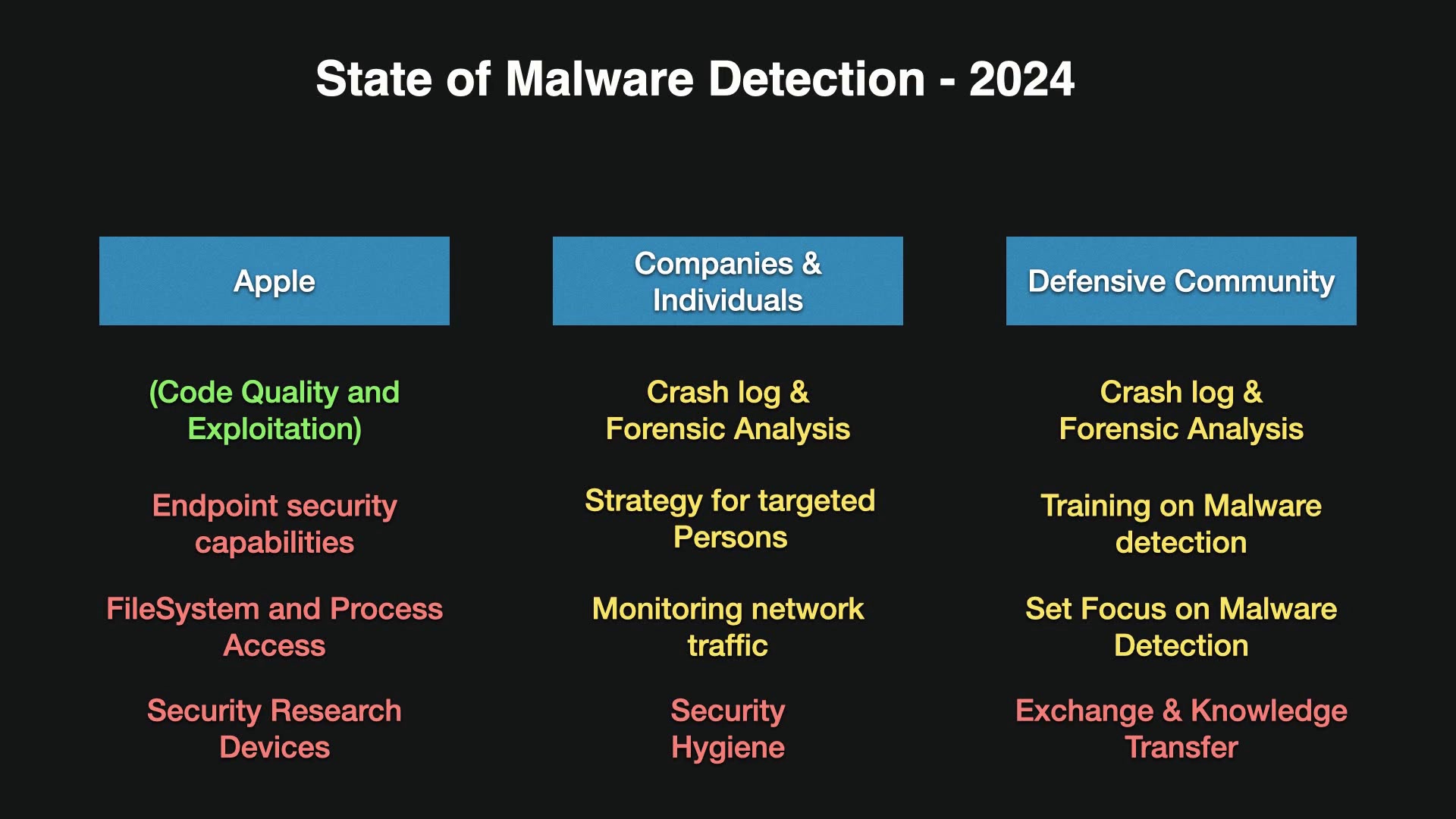
The efforts in this space by defensive organizations are laudable, but very, very immature. There's this meme that has crossed over into the software space of the planes the come back with a lot of holes in them, indicating the regions where extra armor plating is actually the least important. The commercial spyware industry is a lot like that. Those stories you see of people finding exploits via crash logs and iOS databases? That's the lowest hanging fruit. People who know what they are doing are not leaving traces there. And pretty soon those who don't will stop dropping things there too. It's really, really important to understand that the detections well that these people are sipping from will dry up very soon. The proposed solutions from the talk are not nearly enough to help. Some of the things they're asking for (process lists, for example) are already exposed, but we're currently in the Stone Age of iPhone forensics on the defensive side. Those on offense, who are incentivized by money but also now by necessity, will far outstrip any attempts to catch them after-the-fact :(
So far the approach still seems promising, but I would need more devs to help me as I'm contributing in my free time and I won't accept funding for my cyber security related projects, ever.
Would be nice if some other folks feel the same way as you and we can revive the Hypathia project to be better in the sense of eBPF process analysis, in-memory modification detection, and network analysis via XDP.
You can detect a lot of malicious behaviour this way, where programs and processes deviate from their usual behaviour; e.g. trying to access files they're not supposed to.
> ...we're currently in the Stone Age of iPhone forensics on the defensive side.
Since I've seen your comments show a pretty good understanding of AOSP/Android, what's your take on its posture against CSVs? Especially given that Google has been pursuing both legal [0] & technical defenses (at every level of the software stack) against them quite actively.
[0] Ex: https://www.centerforcybersecuritypolicy.org/hacking-policy-...
- How much impact will moving sharedlibs (mediaserver, for example) / runtime / libcore to Rust will bring? And if all libs will need to be moved? Or, are the likes of memory tagging, sanitizers, hardened allocators (Scudo in bionic / Arena/dl/Ros in ART) enough of a defense?
- Now that Android devices have as much compute/RAM as servers do (and fast battery charging is almost ubiquitous), do you see VM sandboxing apps (like in ChromeOS does with crostini) become a thing?
- Believe the drivers (Binder at one stage, GPUs, of late) remain a source of exploits; do you see a microkernel like Zircon being folded into the Android Kernel? Longer-term, will moving away from Linux (but maintaining compat via emulation, say) become a necessity to combat CSVs?
- I see a bunch of eBPF use since Android 12+. Do you foresee Google providing more APIs to aid forensics / monitoring (like Knox/EMM) without needing root (or abusing Accessibility/VPN/DeviceAdmin/ADB Shell/etc).
Thanks.
I have a sidebar question for you: what phone do you use if you are comfortable sharing.
I’m wondering if you are bias towards the walled garden of apple with its perceived security or android or some other.
From your question I am guessing that this is a disappointing answer, since you probably wanted me to point to a specific phone and an explanation of why I think it is better. But any honest security professional is incapable of giving you a simple answer. I have a beat-up iPhone 13 mini because I like small phones and Apple is unlikely to make a new one soon. I have Lockdown Mode off because it would make my life more annoying than it needs to be. My threat model does not include sophisticated attackers that would be thwarted by security mitigations present in a new device or paranoid software. Should it be in yours? Well, I can try to help you answer that question. But for these attacks the problem is that 99.99% of people will never be targeted by them. But it's not very easy to tell if you're part of the 0.01% (these are made up numbers, btw). There are a lot of things you can do that can make you more or less attractive–for example, if you're a journalist, or a political activist, you might be more concerned. But what if your cousin you're close to is actually a VP at Google? More difficult to say. If you connect all the dots you can build all sorts of models where you should turn this on, regardless of who you are. But the fact is that security is not free and they almost always come with some sort of tradeoff against usability or cost. You could be mowed down on the street by an assassin tomorrow but that is generally a bad reason to never leave your house or walk everywhere in a kevlar vest.
My general advice for people, taking into account practicality and ease of implementation, is to go with a fairly modern phone of their pick that gets regular security updates, so they're not the subject of much lower-cost attacks that reuse patched vulnerabilities. I know a lot of the people who work on security at Apple and they're smart people who really care about making things that are good. Whether the walled garden accounts for that, or even if I think they always make the right choices…well, I have Opinions on that but that's for another day. They certainly make mistakes, but they also do good work. If you look at Android you'll see similar, with it pulling ahead in some areas and being behind in others. I've done a lot of research on Apple's security story and worked on Android's but I can only really rank them on specific facets rather than as a whole. Really I would say, pick up an iPhone or Pixel, be careful about things that are far more likely to hurt you (like, say, phishing), and otherwise just keep a pulse on this area if it interests you. Otherwise I think you have more than enough in your life to worry about.
Nowadays, presuming anything else is unreasonable, unless you want to scam somebody into buying a 'security product'.
But the basics are not even here: you should not use any compiler, all critical pieces of software should be assembly written with very lean SDK (aka extremely stable machine code), namely without the abuse of macro-preprocessor.
Everything else is just posture.
The problem you have over the medium term is that CNE is incredibly cost-effective, so much so that you need something like multiple-order-of-magnitude cost increases to materially change how often it's applied. The alternative to CNE is human intelligence; it competes with literal truck rolls. You can make exploits cost 10x as much and you're not even scraping the costs just in employee benefits for an alternate intelligence program.
What that means is, unless you can foreclose on exploitation altogether, it's unlikely that you're going to disrupt the CNE supply chain for high-caliber state-level threat actors. Today, SOTA CNE stacks are probably available to the top IC/security agencies† of all of the top 100 GNP countries. It probably makes sense to think about countermeasures in terms of changing that to, like, the top 75 or 50 or something.
I think we tend to overestimate how expensive it is for adversarial vendors to keep up with countermeasures. It's difficult at first, but everything is difficult at first; I vividly remember 20-30 extraordinarily smart people struggling back in 1995 to get a proof-of-concept x86 stack overflow working, and when I first saw a sneak preview of ROP exploitation I didn't really even believe it was plausible. As a general rule of thumb I think that by the time you've heard about an exploitation technique, it's broadly integrated into the toolchains of most CNE vendors.
Further, remember that the exploit development techniques and people you've heard about are just the tip of the iceberg; you're mostly just hearing about work done by people who speak fluent English.
† Reminder that customers for CNE vendors usually include many different agencies, invoiced separately, in the same governments.
The platforms that have famously had many significant exploits over the years, and are the cause of many major data exfiltration operations?
Are you pretending that viruses and worms don’t exist? Why does forwarding through we have things like windows defender or anti viruses then?
Who can afford these tools? What lengths have people gone to earn/keep large sums of money? What problems are society going through right now?
Its just stealing your data, which doesn't seem bad. But now, someone who probably doesn't like you has your location, habits, friends, future events. There are so many things that these people can do to interrupt the lives of journalists, activists, and just regular people with stalkers, and all of those things are covert because "How is your ex-girlfriend's friend supposed to know you made a bumble profile 2 days ago, find it, and match with you?"
Even when heads of state are being extorted. Morocco used it against France and Spain. It fizzled out of the news cycle and nothing happened. And those countries later announced multi-billion Euro investments in Morocco. If anything, this is a signal hiring Pegasus is very profitable and they can do whatever they want.
† I picked Bahrain because they're the smallest country we know for a fact has been a customer of multiple CNE vendors, but that probably means Bahrain plus the next 20-30 countries down the list.
"SOTA" is just an abbreviation for "state of the art".
“Implant” would be like any remotely installable persistent exploit that grants access to an attacker over a period of time.
Also, I’m pretty luddite when it comes to highly-hyped AI stuff, (in spite of my income being heavily tied to developing AI models) but I have found ChatGPT to be shockingly good at explaining super niche terminology and even jokes. So I do recommend people feel comfortable turning to that if they ever feel uncomfortable asking “dumb” questions publicly.
Make selling/using these attacks against government or other users a terrorist level event. Go after the heads of NSO and their like.
I'd say at that point the companies would be absorbed into the national intelligence infrastructure of the host county and cease to be independent entities who can be bought for the highest bidder. And I know NSO is basically like that now, but
I'd love to see some criminal sanctions for things that their software has been used for stick.
The state is rotten to the core.
I don't even blame them. The real problem is the lack of philosophy and ethical standards in the tech industry.
Computer Technology is so shallow. Apple for example talks about being a proponent of privacy and at the same time the M1 Computers have built-in terrible spyware that cannot be removed (Apple made sure of this).
Every time I talk about this I am labelled as paranoid or sometimes "stupid". Alot of people simply rationalize this built in spying as "good".
The bitter truth is that we made our bed. Now we have to sleep in it.
Can you say more about this?
I think there could be some movement here, but there is certainly a level of protection that national governments are doing for these companies because they want their services.
>> We are aware of audio issues, especially during talks of day 1 (2024-12-27). Some talks have been released in a preview-version, but are still being worked on behind the scenes.
https://pub-e2fd917248b04c518e963d141d588b4c.r2.dev/outputfi...
I was going to blame wireless mics, but they seem to be fixed?..
buy top of the line android like pixel pro: there's a huge toggle switch "allow 2G".
buy a middle or lower end device, no matter from Samsung, Motorola, etc... and for some inexplicable (heh) reason all companies decided that paying an engineer to apply a patch to remove that toggle from stock android was a solid investment :ponderingfaceemoji
you can still disable it with the very user friendly
*#*#4636#*#*
first hand: it's an artifact of "small coalition" governments, typically funded by resource wealth, and therefore without sophisticated public services that can support a spy agency who would develop their own inline national surveillance and intelligence infrastructure. it means they will always have to go to the commercial or grey market (like these vendors) to get this spying capability in malware, and eventually there will be diplomatic consequences to cutting some of them out with vulnerability patches.
there's another game at play where as iphones become more expensive and high risk to exploit, spyware providers switch away to things like vehicle entertainment systems, home and office AV and automation, and other personal tech. the market is small, but long term persistent. on the defender side, we just have to find a way to manage.
You eliminate a ton of "complicated, probably exploitable things" in spaces known to be commonly exploited. Oddball image formats, the Javascript JIT engine, "complex" messaging (Facetime, MeMojis, that... entire ecosystem of weird-not-text-not-image stuff that Apple does), WebGL, WebRTC, link preview processing (I expect a common 0-click exploit chain is through that system), and probably some other stuff.
The phone/tablet is entirely usable without this stuff. Some websites don't render images properly, "that one guy's website" doesn't do the animations, but you can individually bypass Lockdown mode for sites, apps, etc - and you still get the protections for everything else.
And if you're a web developer or app developer, please. Test your website on an iOS device with Lockdown mode enabled. Pick image formats that render properly, it's not hard. And if your app requires something that isn't supported in Lockdown mode, that's fine - but please show some sort of useful error message that indicates that, perhaps, this crash/glitch/whatever is the result of Lockdown mode, and you can disable it by following these steps. Then, also, don't sell to some random purchaser of apps.
But Lockdown mode really, really helps reduce the attack surface. Try it. You'll like it! And it might just help prevent getting you popped by this sort of crap.
... then install QubesOS on your full computers and don't look back. ;)
However, I don't have access to Safari on a dev machine and until Apple fixes that, I'm not testing websites on iOS. Sorry not sorry, but even Microsoft Edge is cross platform these days, if Apple wants independent websites to support their browser (especially their own restricted browser profiles) they need to stop making it exclusive to their hardware.
Seems like a good idea to test against if you're already doing Safari testing but I'm not sure if automated tooling supports the toggle.
I'm sure Apple could take Gnome Web and turn it into a cross-platform Safari browser if they wanted to, but so far they haven't (and probably don't want to).
As a web developer, I'm also not bothering to test anything on iOS, it's just so much pain that it's not worth it. You need to buy a dedicated device with a specific iOS version and never update it (since you can't even change the browser version on iOS) and as for the debugging tools, they suck so much that I had to resort to Firebug.js a few times in the past.
Yeah no thanks, I just test on Android and hope it's good enough on iOS.
And a sensitive device should not be easily discoverable to gatekeep who can actually send anything to it. This is also renders it unusable for day to day family tasks.
Also, is JIT disabled for alternative browser engines in EU?
I would rather be interested in ways to detect these software phoning home on my home wifi with my firewall - for now. I might change this stance any moment in the future heh.
How would you inspect it if it was piggybacking of a trusted but compromised endpoint? What if the data exfiltration doesn’t use a networking protocol you can monitor at all, like Bluetooth beacon transmitting?
The answer to almost any “why are people not saying this” is because it’s usually not that simple.
The ratio of people that actually need this mode to people publicly advocating for it approaches zero very quickly. I'm quite sure no state actor will spend $7 figure 0days to get my cat photos.
Also, for most people, it's not the cat photos on their phone that are of value. It's the banking credentials, business login 2FA keys, crypto 2FA, email (which allows, for almost all accounts, a password reset), etc.
https://discussions.apple.com/thread/8282686
Not sure what to make of it.
Is it possible to reach the server side of the Time Machine from the Mac itself? Has such a breach been demonstrated?
So if timemachine has versioning then maybe then you probably have some options, I’m not sure I’d call this being “safe” from ransomware.