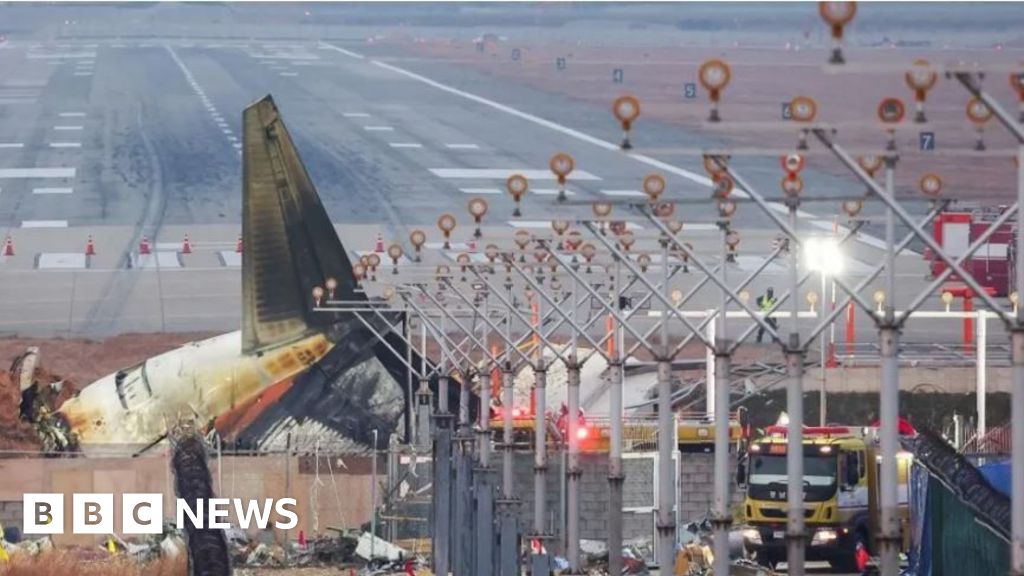
South Korea plane crash: Why was there a wall near the runway?
An air safety expert says lives could have been saved if the "obstruction" was not there.
bbc.com
135 points · by vinni2 · 1y ago · 334 comments
<strikethrough>There was a similar accident in Hiroshima, Japan several years ago: Airbus A320-200 skidded past the end of the runway at similar speed and struck down ILS. It eventually stopped -- damaged the airplane but no fatality.</strikethrough>
1. Localizer at Yeosu Airport, similar to Muan's, raises safety concerns, 2025.01.02 (23:58), KBS News.
Are you talking about Asiana Airlines 162? It hit localizer on its way to the runway because it came in too low. It then hit the runway, skidded on the runway, and stopped about halfway (after veering off the runway at the last moment).
If the same thing happened in Muan, the plane would have hit the localizer and then touched down, stopping in the runway. The fact that the localizer's base was concrete wouldn't have mattered because that's not where the plane would hit it.
The barrier was 250m away from the end of the runway, the extra 50m if following regulations wouldn’t have changed the outcome. And if the wall wasn’t there, the plane would dive right into a highway anyway. That’s the point.
Where did the idea of fortifying Localizer (LOC) come from, was there prior art specifying any degree of fortification (or lack) ? Perhaps these kind of radar (adjacent) installations are traditionally fortified, like maybe the civil air services were influenced from militry air services were things tend to be overengineered?
Perhaps saving the LOC is more important than saving a single aircraft? Some idea like this piece of infrastructure being more important that any single aircraft's safety?
The point is we might not see the reason why fortifying the LOC was obvious or straight forward to the Korean engineers.
Also, I've seen no credible evidence to support the idea the LOC is supposed to be built on a level surface, or built in a destructable way. Addressing the first point, the LOC makes sense to be slightly elevated given how they operate with near field low power radio waves. That said, these kind of slightly elevated instrument might not require an earthen mound, sourounded by concreate walls. Which goes to the second point, I can think of reasons to have these kind of LOC runways homing antenas destructable, and I can see them being robustly durrable. This thing was way past the end of the runway, and as unpo0pular as it might seems... it's a very bad thing to run out of runway. Somebody else wrote that some airports have a lack of open field beyond the end of the runway, and so it's a persuasive argument stuff could be built out there.
<https://en.wikipedia.org/wiki/American_Airlines_Flight_1420>
Partially-effective runway braking and a much greater distance from runway perimeter to the nonfrangible ILS structure likely played a role.
That one touched down short of the runway at a much lower speed and configured for landing.
Nit: I think the word you want is “frangible”, easy to break.
I'm speculating, of course, but pilots made the decision to land there (albeit in a very short amount of time). They probably made the reasonable assumption that they could "safely" (as safe as it can be, of course) overshoot the runway in that direction. They were certainly not expecting to hit a concrete structure that would pulverize their plane.
Having large concrete structures near airports is not unreasonable, hiding them absolutely is. If instead of a hidden piece of concrete it had been a terminal like in SFO, a sea wall, or another known hazardous structure, the pilots could very well have decided to land somewhere else. Including in the very large body of water next to (or beyond) the runway.
You don't know, I don't know, and we might never know depending on what is uncovered by the investigation.
There was also construction work going on at one end of the runway (until March), and the threshold was pushed back 300 metres, shortening the runway by that much:
http://aim.koca.go.kr/eaipPub/Package/2024-10-31-AIRAC/html/...
The runway also is not flat (which is why the localiser beams at that end need to be raised in the first place to intercept the correct glideslope angle).
As the OP mentioned, trying this (a very fast landing, with no gear or flaps, spoilers) at many airports around the world on such a short runway (albeit one which with gear and flaps down is long enough for normal landings with the required 240 m runoff areas), is not going to work well.
Of course, I'm making the assumption that the pilots somehow had to attempt a "a very fast landing, with no gear or flaps, spoilers". The core of the issue is probably there, hopefully the investigation will yield useful results.
But what I am fundamentally questioning is whether the pilots would have attempted that landing if they had been expecting a piece of reinforced concrete at the end of the runway.
To say it differently, it's not the existence of deadly obstacles near an airport that bothers me (after all, some runways are quite literally in the middle of cities), but the fact that the pilots could have reasonably not know about them. That, for me, is a pretty big issue.
There were plenty of concrete structures nearby when US Airways Flight 1549 ditched into the Hudson river: notice the pilot aimed for a path where there weren't any. Maybe that Jeju air pilot could have attempted something similar. Maybe not. But the absurd nature of that deadly piece of reinforced concrete probably didn't help making a good decision.
I dont think the plane would get pulverized hitting a brick wall, and the distance will also slow the speed.
And the highway is not above the plane's travel axis, so the highway is a non sequitur. Not to mention even more distance to slow down.
People should stop doing this. Transport category airplanes are designed to suffer multiple failures and still be controllable. Why the airplane landed where it did, when it did, and how fast it did are the relevant questions.
I do hope the investigation yields results that improve air travel safety.
The cause of any fatality in aviation is never a single thing. It’s invariably a chain of events where removing any one thing in the chain would prevent the disaster.
But that doesn't mean debating whether there's a better way to engineer typhoon-resilient localizer antenna arrays isn't also a good use of time. Safety makes it imperative to discuss all of these matters exhaustively.
Re ocean, no, that isn't so great - sea rescue is a lot more difficult to perform than on land.
I am fairly sure this will be one of the findings of the investigation. I hazard a guess that every sane operator of an airport in the world is walking from the end of their runway to the airfield perimeter and taking a look anyway.
https://en.wikipedia.org/wiki/Engineered_materials_arrestor_...
There are cinderblock a cinderblock wall and numerous chin-link (and razor-wire-topped) fences in the area, which do control airport access. Those would likely not have proved fatal to the aircraft to any similar extent however.
Nobody knows yet why they landed in that configuration. Failed go-around? Engine out landing? Cut wrong engine after a bird strike? Loss of hydraulics? Too rushed for landing checklist in an emergency? All of those are possible. More than one may have happened. Wait for the flight data recorder data.
One article says the runway was equipped with EMAS, an Engineered Materials Arresting System.[1] This sits in the area just past the end of the runway, the part marked with painted chevrons. It's a thin layer of concrete over blocks of a material which includes foamed plastic holding pumice-like rocks. If a plane overruns the runway, the wheels break through the thin concrete layer and start pushing through the plastic/rock mixture, grinding the rocks into powder to absorb the energy. This usually damages the landing gear, but the rest of the plane survives. 22 planes saved so far.[2][3]
It didn't help here. The plane seems to have skidded over the EMAS area on its belly, instead of breaking through and getting the braking effect. The surface of the EMAS area has to be tough enough to survive jet blast on takeoffs, so it can't just be a sand pit.
[1] https://focustaiwan.tw/society/202412300010
[2] https://ops.group/blog/swerving-to-avoid-why-arent-we-using-...
[3] https://www.faa.gov/newsroom/engineered-material-arresting-s...
> https://focustaiwan.tw/society/202412300010
Nowhere in that article says Muan Airpot has EMAS, it says a local official confirmed that Songshan Airport in Taipei has EMAS, following local concerns that Songshan Airport has an even shorter runway (2600m vs 2800m in Muan).
A thread full of armchair experts is already bad enough, please don't make it worse with seemingly well-supported misinformation.
Muan does have the chevron markings on the overrun area, but that does not always indicate EMAS.
Seriously, I think the incident it's a hard lesson for airport designer and ICAO. For better civil aviation safety, the next airport runway should have ample room for safer aircraft landing without landing gears. Previously there's no real-time aircraft tracking requirement for passenger aircraft only for cargo, but after MH370 it's mandatory now and even ICAO acknowledged this very reason for the new regulations introduction.
Furthermore (this is pure speculation at the moment) I think chances are the crew were kind of cosplaying PIA PK-8303 - forgot about landing gears in a stress from bird strike, attempted go-around after realising it, but had not enough power from engines due to bird strike or ground hit. It's plausible final investigation report will conclude absence of localizer antennas wouldn't save them.
Most runway overruns occur with no or few fatalities:
I don't think so.
It's simply not possible to build airports in useful places and guarantee three-mile runways.
Muan airport runway distance is one the shortest in Korea, less than 3 km and ironically during the incident reportedly there is an ongoing construction to increase the length of the runaway to more than 3 km, but effectively further shorten the runaway to 2.5 km (similar to Yangyang Airport). Strangely South Korea has many shorter runway international airports.
Most of the modern international airport have more than 4 km runway, and new major airports for example Qatar Doha, US Denver and SA Upington has runaway length close to 5 km.
[1] Operational Landing Distances: A new standard for in-flight landing distance assessment.
[2] Muan Airport runway previously shortened, impact under scrutiny:
You need the passengers to survive.
And that's eminently possible, even where the hull itself is destroyed (several cases of fuselages splitting in two or three with no or minimal fatalities):
This is not how safety works.
> Something bad is going to happen if you do that at any runway on earth.
Then the question is can we do any sort of engineering to reduce the number of fatalities that might occur when this _inevitably_ happens.
> Stop looking at the wall and look at the minutes before the crash.
The plane hit the wall and exploded. The wall seems pretty important here. I mean, yes, there are also other problems to solve, but solving them does not let you off the hook here.
Accidents would still happen.
There are dozens of ways to solve this problem. From the short term of better structure engineering to the long term of better ILS antenna installations that don't require such large structures in such commonly dangerous positions in the first place. We could even get into better run off engineering to handle the somewhat unusual case of a fully gear up landing.
It's just insane to me to say "it's a red herring" as if this were a mystery novel and not an emergent failure of several safety mechanisms.
The bay is survivable and I don't think you can hit the terminal. You could possibly hit the freeway though. That said, two of the runways at SFO are 1.5 km longer than the one in Korea.
> In Toronto you'll crash into a highway.
That runway is 1.5 kilometers longer than the one in Korea and it's another kilometer to the highway that sits uphill.
We aren't talking about any of your examples in this crash. And it isn't relevant for many other places either. If you have an open field behind a runway and you put a concrete block directly at the end of it, you can't defend your decision with "well, in this other city it doesn't matter because you'll hit the terminal". It's some weird form of whataboutism that I simply don't understand.
It's inexcusable and it's tiring seeing people defend it as if it's okay.
https://www.pbs.org/newshour/show/south-korean-officials-wer...
A terminal beside the runway at roughly the same distance is not against regulations.
Almost every rule in aviation is written in blood, so if there's a rule about something, there's probably a damn good reason why.
Causality isn’t an equivalence relation with blame. A moral aspect has to be established.
Meaning if we can build the same antenna array but with less risk to airplanes and all at an acceptable economical cost, it feels like something we should do. Regardless of whether or not a runway overrun at other airports and in other situations poses more or less risk.
> In SFO you'll end up in the bay or hit the terminal depending on the orientation. In Toronto you'll crash into a highway.
Ending up in a bay or crashing into a highway would likely have resulted in far less loss of life.
Not sure if there's a regulation that requires this kind of arrangement, but I wouldn't be surprised if there are stricter rules about structures that cross a plane's usual trajectory.
Any length of runway you agree on can still fail. As you just said, it's an eventual certainty.
Rather than fixating on what didn't cause the crash how about we spend that energy on finding out why this flight unlike 99.99% of flights couldn't stop in the allotted space.
If they were gonna land halfway down the runway why didn't they just do another go-around? Did the thrust reversers not work? Doesn't the 737-800 have a backup way of dropping the landing gear?
There is no way to make a runway safe if a plane lands halfway down it, even if the brakes and landing gear are actually working. It's just not possible; runways are limited by geography and we tend to run aircraft as heavy as possible.
Aviation accident history definitely disagrees with you.
None of these people are calling for not investigating the other factors.
At the moment after encountering the Muan Murder Wall, there were 2 souls alive, one severely injured, and 179 corpses, most mutilated beyond all recognition.
Multiple things had clearly gone wrong with the flight, and we're going to have to wait for results of investigations to determine what crew and/or ATC actions and decisions contributed. But the principle lethal mechanism was impact with the immovable object of the Muan Murder Wall, and the ensuing instantaneous deceleration, disintegration, and conflagration of the aircraft and the souls aboard.
Even with multiple contributing factors, had the Muan Murder Wall not existed at that location, the aircraft would have overrun the runway and quite possibly airport perimeter, but would have slowed far more gradually and likely encountered structures less substantial than the Muan Murder Wall.
Wikipedia has a category page listing 55 runway overruns: <https://en.wikipedia.org/wiki/Category:Airliner_accidents_an...>
Sampling from that we find that such accidents often result in no or few fatalities, particularly on landing. E.g.:
- Sriwijaya Air Flight 062 (2008): 130 souls, 124 passengers, 6 crew, 1 fatality, 23 injuries, 130 survivors. The aircraft struck a house, 3 of the injured were occupants. The sole fatality occurred some time after the incident. <https://en.wikipedia.org/wiki/Sriwijaya_Air_Flight_062>
- China Eastern Airlines Flight 5398 (1993): 80 souls, 71 passengers, 9 crew, 2 fatalities, 10 injuries, 78 survivors. The aircraft experienced a tailstrike during a go-around attempt in heavy rain / high winds, broke in three, and came to rest in a pond. <https://en.wikipedia.org/wiki/China_Eastern_Airlines_Flight_...>
- Philippine Airlines Flight 137 (1998): 130 souls, 124 passengers, 6 crew, 0 fatalities, 44 injuries, 130 survivors. Ground casualties: 3 dead, 25 injured, as aircraft ploughed through a residential area. <https://en.wikipedia.org/wiki/Philippine_Airlines_Flight_137>
- American Airlines Flight 331 (2009): 154 souls, 148 passengers, 6 crew, 0 fatalities, 85 injuries, 154 survivors. Aircraft landed > 4,000 feet from the threshold with a tailwind in inclement weather. <https://en.wikipedia.org/wiki/American_Airlines_Flight_331>
- TAM Airlines Flight 3054 (2007): 187 occupants, 181 passengers, 6 crew, 187 fatalities, 0 survivors. The exception in my (random) sample, this aircraft had a nonfunctional thrust reverser on the right engine. Lack of grooving on runway, heavy rain, hydroplaning, asymmetric thrust, and a large warehouse directly beyond the runway perimeter all contributed to the fatalities.
I've omitted one link I'd selected, Air France Flight 007 (1962) as that incident occurred on takeoff, not landing, where fuel load and flight profile greatly alter conditions and likely outcome, and isn't directly comparable. <https://en.wikipedia.org/wiki/Air_France_Flight_007>.
If anyone cares to examine the 50 other listings on the Wikipedia category page, I suspect a similar patter of largely survivable overrun incidents prevails. The conspicuous lack of Muan Murder Walls seems significant.
Here's Google Maps view of the area south of Muan airport:
<https://www.google.com/maps/@34.9731352,126.3829389,1299m/da...>
From a road directly outside the airport, looking toward the ILS structure, we see that had the wall itself not been there the plane would have struck a cinderblock wall as it continued on. This would have damaged the aircraft, but less so than a solid concrete wall:
<https://maps.app.goo.gl/mMGqBC9PX6sEF85B9>
Switching directions we can look to the south along the path the aircraft would likely have followed. The terrain is flat and clear, save for further navigation light structures which would likely have given way readily to the aircraft:
<https://maps.app.goo.gl/Retvh9MH48ta5xPS8>
Note a hill in the distance. This could have helped slow the aircraft further, gently:
<https://maps.app.goo.gl/m1D3WrMG5QYz6cvE8> (above image zoomed in).
Vegetation is low trees and shrubs, which again could have provided a fairly gentle stopping force against the airframe:
<https://maps.app.goo.gl/aCBtY9at1Q1oCZXz6>
Approximately 300m or so from the end of the runway are a few rather unwisely-located pensions and hotels. Those would likely contribute to ground casualties if impacted.
Another few metres past those, mudlands and bay waters, which would be more emenable to a survivable overrun.
AA 1420 (1999) is notable for similarities with Jeju 2216:
The aircraft continued past the end of the runway, traveling another 800 feet (240 m; 270 yd), and striking a security fence and an ILS localizer array. The aircraft then collided with a structure built to support the approach lights for Runway 22L, which extended out into the Arkansas River. Such structures are usually frangible, designed to shear off on impact, but because the approach lights were located on the unstable river bank, they were firmly anchored. The collision with the sturdy structure crushed the airplane's nose, and destroyed the left side of the plane's fuselage, from the cockpit back to the first two rows of coach seating. The impact broke the aircraft apart into large sections, which came to a rest short of the river bank.
Captain Buschmann and 8 of the plane's 139 passengers were immediately killed in the crash; another two passengers died in the hospital in the weeks that followed.
145 souls, 139 pax, 6 crew, 11 fatalities, 110 injured, 134 survivors.
<https://en.wikipedia.org/wiki/American_Airlines_Flight_1420>
Even though this aircraft also hit an ILS structure, fatalities were far lower than those of Jeju 2216, likely as AA 1420 had decelerated significantly both on the runway (despite severely limited wheel and air brakes) and its subsequent 240 cross-terrain slide.
Atlantic Airways Flight 670 (2006) literally fell off a cliff. 4 fatalities of 16 souls. <https://en.wikipedia.org/wiki/Atlantic_Airways_Flight_670>
Bangkok Airways Flight 266 (2009) literally struck a (presumably nonfrangible) control tower. 1 fatality, 71 souls. <https://en.wikipedia.org/wiki/Bangkok_Airways_Flight_266>
https://www.ntsb.gov/investigations/AccidentReports/Reports/...
> The calculated ground trajectory indicated that the flight 1420 airplane departed runway 4R at about 97 knots and impacted the runway 22L approach lighting system support structure at about 83 knots.
97 knots is 112 mph. Somewhere below another commenter said Jeju Air 2216 left the runway at about 160 knots (184 mph). It's a pretty big difference.
I'm no expert, but my guess is that the main distinguishing factor of all the accidents where most/all survived is not the lack of killer berms, but the speed of the plane when it left the runway.
If you look at "Video of aircraft after touchdown sliding along the runway and impacting the fence:", you will find out that it took them ~1.7 sec from leaving the tarmac until they hit the construction. If you measure the distance on Google earth you come up with ~140m. That means they hit the construction with roughly 296km/h or 160 knots. If it wasn't the construction it would have been the treeline or something else. That plane was doomed, concrete construction or not.(Assuming the math is correct:) That's the average speed over that distance. The plane would have been slowing down the whole time.
So if we know the landing speed (which should come out of the flight data recorder), we'll know the terminal velocity given the average speed (distance/time) which is determinable from the video.
No doubt Jeju 2216 was moving hot, but a longer run could have bled off far more speed, and kinetic energy is based on velocity squared, so every bit helps a lot.
In the video it looked like the plane was only running on the rear landing gears, I assume with no brakes applied, since that would've caused it to violently pitch down I assume. Only in the last bit did it pitch down and started scraping along the runway. It certainly doesn't look like it was efficiently shedding speed (but looks can be deceiving).
Are we talking about the same crash? In the video I have seen[1] the plane appears to be on its belly dragging on the runway.
It's also definitely the case that the cement-reinforced dirt mound is not best practice for a locator array.
Some of them even move around the recommended touchdown point depending on other factors, if the runway is extra long.
What is going on here and what's with this crazy ass logic?
Nothing is crazy about it. Many people in this thread (like you) are in a tizzy over a concrete wall for a plane landing with no gear at high speeds. Your argument is basically "having no wall would make me feel better" which has no logic and very obtuse.
The ground is also a hard obstacle and this plane would've hit uneven ground shortly after the runway regardless. It's going to disintegrate either way.
Google tells me: "Modern jets land between 120–150 kt. This depends on weight, weather conditions and several other factors."
So even after scratching asphalt for 2/3 of the runway it was still faster than the normal landing speed.
My uneducated gut feeling says pilot was trying to abort the landing.
We really need a placebo controlled double blind study to learn if landing gear is actually effective of just a cargo cult like parachutes.. [0] https://www.bmj.com/content/363/bmj.k5094
Why did they need to land when they did?
Why did they need to land so soon after the mayday call? (only 8 minutes from mayday to crash, as I understand it)
Why couldn't they land on a longer runway?
Why did they land so far down the runway?
What forced them to land in a clean configuration?
As an airline pilot, these are some of the questions I have. The flight data and cockpit voice recorders should be able to answer these questions.
Though, I am a little sceptical of the claims that it would have hugely reduced fatalities either way. Runway excursions into unmanaged terrain at that speed don't usually work out well for the passengers, even when the terrain appears relatively flat.
I'm not an airline pilot, but I'm still curious to see what caused such an unusual crash, since there doesn't seem to be any single issue that could have caused what happened. So far, my best uninformed guess is a combination of pilot error and bad luck: the approach wasn't stabilised, so they started executing a go-around, and THEN a multiple bird strike caused catastrophic damage to the right engine. This may have led to smoke in the cabin/cockpit which they interpreted as a fire (or some other issue, vibrations etc.) that made them decide to shut down the engine, but they shut down the wrong (left) engine. So now they think they have a dual engine failure. At this stage they obviously don't have time to run through paper procedures, and they put the plane into clean configuration to maximise glide and attempt a 180 to try and land back on the runway. Then they either couldn't or forgot to deploy the gear, and floated down the runway partly due to ground effect from being at an unusually high speed, thus landing at high speed almost halfway down the runway. Thoughts?
Either 8 character passwords are fine and secure, or bad and should be banned? With no context between “€x8;,O{w” and “password”?
I suspect runway design has more variables than just distance to obstacles.
... you can't be serious with this? 300 more feet of unused runway is equivalent to if not better than 300 feet of buffer. You're fixated on following the "rules" without any understanding as to why they exist.
https://multimedia.scmp.com/embeds/2024/world/skorea-crash/i...
What they were saying is that just because other airports feature runways situated next to natural obstacles and this is allowed and equally dangerous, it doesn't mean this airport needed to have this particular, deliberately designed and implemented obstacle next to the runway.
The reason for the concrete-reinforced berm was typhoon resilience. It begs the question whether there are alternative designs that are trade of requirements better.
Compared to that mall collapse, a berm that far off the end of the runway won’t even be notable.
They used a HIGHLY flammable material to completely cover a raised highway.
(All of that said, I read from so many people now that the plane would have disintegrated once it did finally start to drag given the speed, and there is another parameter wall shortly after the berm.)
Stinks of bad crew resource management and ATC which is why the ATC and airline for raided by SK officials.
If there were significant winds it would have compounded those factors.
It is curious that the gear was retracted. I can only think that this was due to some kind of system failure? Perhaps that same failure explains the decision to double back instead of going around?
Lots of questions, hopefully there will be answers.
Still, the structure does not seem to meet the standard for frangibility that is indicated for objects in the approach path within 300m, although it’s not like it was at the very end of the runway.
Runway over/undershoots are actually quite common, and the building of a nonfrangible structure on an otherwise safe skid zone is a significant error in design principles that is not common or conformal to industry standards.
If those antennas had been placed on property designed towers instead of a concrete bunker, the passengers and crew very well may have walked away without a scratch, despite any errors on the part of the crew or procedures of the airline.
That's why EASA says put the plane down if there’s a strike on approach. Ryanair 4102 is a good example of a close one there as a reference.
People often have an idea that ATC actually controls what happens. They just give advisory guidance to pilots, who ultimately decide what to do. A clearance to land or the lack of one does not absolve the pilots from making their own judgments and decisions about how to conduct the navigation of the aircraft, and where and when to land.
Usually, it’s a bad idea to not follow ATC guidance, but in the case of emergencies especially, pilots call the shots.
> no idea he had to make the approach in the opposite direction.
So the wall is actually at the beginning of the runway. That wall was never never meant to be at the end of a landing but at the start of landing.
I don't understand why this isn't made clear. Basically the runway was used against the design specifications.
You always want to land with a headwind and never a tailwind, so ATC will use whichever end is favorable for the current conditions.
In this case, if they attempted to land with a tailwind then the on-heading vector component of wind velocity must be added to the airspeed to get the ground speed... whilst this was a contributing factor to the accident, it's not something to focus on.
There will be a thorough investigation but it will take some time to get answers.
If that's right then OP would be correct in saying, this direction wasn't meant to be used.
It should perhaps be pointed in news coverage since I equated "opposite direction" with "wrong direction" - hence my scepticisms about the wall.
Do you mean at Muan?
We don’t know why the pilot elected to double back instead of go around. There may have been indications of a progressive failure that indicated that course of action, but it does seem hasty. That haste may have caused them to not be able to set up a stabilized, minimum speed approach, and may have contributed to the long touchdown, which certainly was a contributing factor.
Still, a 14 ft high concrete structure within 300M of a runway end is unusual, and does not fit the standard for frangable structures which is the guidance for runway aligned equipment.
There are airports in which approaches always or very nearly always follow the same profiles given local conditions. SFO, SJC, and SAN would be three examples off the top of my head.
SFO's major approaches are over the bay, opposite approaches would involve rapid descents dictated by mountains near the airport.
SJO and SAN are both limited by proximate downtowns with tall towers. Nominal approach glide paths cut below the rooflines of several structures, and make for some interesting experiences for arriving travellers.
Airports like this are designed to have two approach directions -- in this case, 10 and 190 degrees. Either approach direction would have been acceptable depending on the prevailing wind.
Maybe it's the cheapest way to engineer the ILS localizer to be flood-resistant? I don't know.
The runway should be as long as it’s required to be. If after (and before) the paved runway they need a length of open space, that should be however long it is required to be, too. Beyond that there could be a minefield, a pillow warehouse, an ocean, a mountain, etc. It shouldn’t matter.
Only infinity billions of dollars for each airport and likely cause other issues, but, progress!
Nothing about this crash was normal, and talking about a thing past the end of the runway is misdirection.
It might be more useful to start with the solid concrete plane stopper and work backwards than work forwards from 1903.
We all know the cockpit voice recorder exists and is essential for investigating a crash. I seriously doubt there are secret cameras recording the tarmac and it's all been hushed up. There are simply no cameras there.
Frankly, I'm baffled.
So why do you think such cameras don't exist?
P.S. Back then, as well as today, I'm surprised at the level of pushback on this question, but no answers.
I don't understand what means "would not be drawn"?
> Asked by a reporter if he thought the wall was a factor in the disaster, he did not give a direct answer and instead said it was right to call the plane crash the Jeju Air disaster, rather than the Muan Air disaster.
If I get this right, I think this CEO deserves props for not trying to point blame away. Let's see what investigation shows.
Does this mean the crash was so violent that the 179 bodies disintegrated into more than 600 parts?
If there had been enough engine power to control direction on the ground, there might also have been enough power to remain airborne, but based on limited information, that wasn't so. Under the circumstances the pilots would have wanted to stay airborne to buy time for a more controlled descent, were that possible.
All these speculations are preliminary and may completely change once the black box information is released.
Sure about that? 160kt (how fast someone calculated it went off the end of the runway) is way above Vs1 for a 737, there should be plenty of rudder authority. Heck, Vapp is usually in the 130-150kt range.
If they were trying to take off again, there wasn’t any hope.
I found this comment helpful from a Reddit thread.
>The embankment is there to protect the road from the jetblast of departing aircraft in oposite runway direction. Thats why it is allowed directly in the safety area.
Show you working. Not feelings because people don't have intuition for such unusual motion. You could equally have said "a few hundred meters would be enough."
I don't think people who say that it's a bad idea to have a concrete wall at the end of the runway argue the plane should make its way to a nearby motorway. I think most refer to using EMAS, ie a crushable concrete floor in which the plane sinks and stops.
but was it the end of the runway? As I understand, the pilot came in from the opposite direction, i.e.
> The pilot then aborted the original landing and requested permission to land from the opposite direction.[1]
So that wall was located at the beginning of the runway if the runway was used correctly.
From the bottom image[2], it would appear the wall is located behind the point where planes begin their take-off (and I assume their landing) - but I'm no aviation expert.
[1]: https://www.bbc.com/news/articles/ckgzprprlyeo [2]: https://ichef.bbci.co.uk/news/1536/cpsprodpb/9090/live/ab9db...
Most runways are intended to be used in both directions depending on the wind. This one doesn't seem to be an exception?
50m of arrestor bed? Some difference, probably meaningful.
But this isn’t the right question to ask, as it isn’t the right question to ask why the wall was there. Why did the pilot and ATC decide it’s a good idea to attempt a gear up landing in the wrong direction is a good start.
After the incident, PIA pilots were audited and determined like 1/3 had fake or suspicious pilot licenses(!!!). Lots of paying other people to pass tests for you. Internationally, PIA has been banned from landing by like all first world countries.
It’s too early to actually draw a conclusion. We should wait for the full investigation.
There are a large number of compounding problems here. That was just the last one.
"...the runway design "absolutely (did) not" meet industry best practices, which preclude any hard structure within at least 300m (984ft) of the end of the runway."
"it emerged that remarks in Muan International Airport's operating manual, uploaded early in 2024, said the concrete embankment was too close to the end of the runway."
I mean that was a pretty obvious design flaw that went against common standards. I agree it isn't cut and dry yet but an investigation isn't going to change the above info.
OP is 100% right that many, many things must have gone wrong for the position of this structure to remotely matter (human or mechanical errors).
Let’s wait for the investigators. It’s not good to fixate on this outcome.
No commentary on the pilots’ role here, we don’t know nearly enough to judge. Could be they did a great job and they were just doomed. But the end result is that they didn’t get it down safely.
> suspicion
"suspicion" seems like fragile grounds for "Absolutely".
Lately I’ve seen lots of people doing such snarky comments, without reading carefully, or just writing things that are absolutely illogical… what is going on?!
Always a funny one, it's for all intents and purposes
But, it is possible that it was a case of poor crew performance.
In any case, the concrete blockhouse at the end of the runway was unhelpful, and it is also outside of the standard guidance for runway aligned obstructions. In most cases, those antennas would have been on frangible towers, and the crew, at fault or not, as well as the passengers, would have had a decent chance of walking away unharmed.