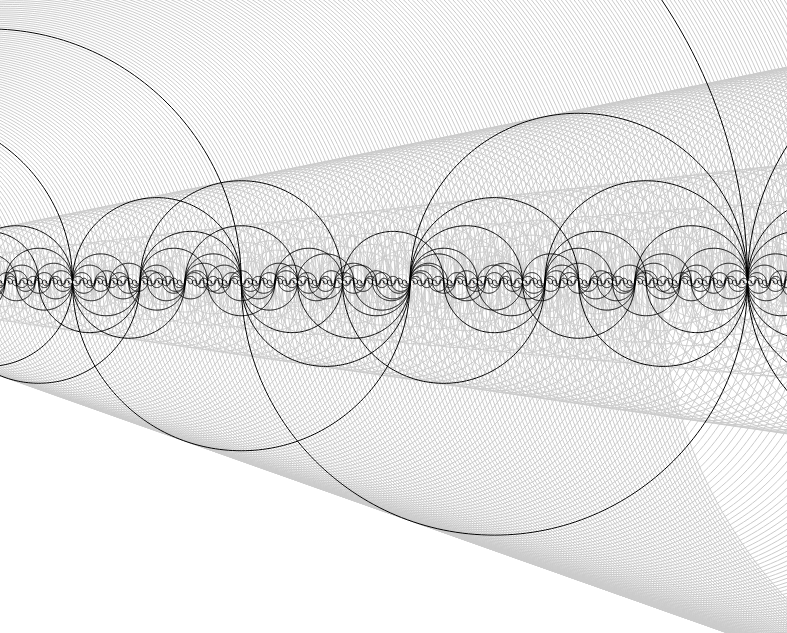
El Patrón de los Números Primos: Prime Number Patterns
Prime number patterns.
jasondavies.com
359 points · by dmarinoc · 14y ago · 100 comments
I used the software from this site[3] to generate a large Sacks spiral graphic, which I had custom-printed on my shower curtain. To most folks who see it, it's just some pattern of dots, but knowing the order within gives me great joy.
[1] https://en.wikipedia.org/wiki/Ulam_spiral
Fig.5 from [2] (Sacks spiral) reminded me of light cones tipping over and pointing at the singularity as one enters a black hole.
[0] http://www.pitt.edu/~jdnorton/teaching/HPS_0410/chapters/bla...
[1] http://plato.stanford.edu/entries/spacetime-singularities/#G...
which do reveal certain patterns
It does seem to break a bit if you resize the browser after the initial render. A refresh will fix it though.
http://news.ycombinator.com/item?id=4202198
1 upvote, no discussion.
Indeed, this title shouldn't be allowed to stand, it should be changed to the title on the page itself, based on moderators' recent behavior.
Added in edit: Oh look - downvotes for pointing out that the current HN system of finding interesting items occasionally fails.
We know a lot about number fields, multiplication and sieving... but the primes themselves (the "holes" left in the wake of the sieving process) are something of an epiphenomenon to all of this.
It's reasonably simple to prove using the fact that every twin prime pair except (3, 5) is of the form (6n − 1, 6n + 1).
gives a proof why.
I've always been inclined to think 1x = x, and think of one as fundamental. But the pattern shows that rather than 1x being fundamental, rather there is the issue of x exists or x doesn't exist. x doesn't exist => 0. I wonder if 1*x = x is really a distraction away from a better type of thinking around existence.
Also, I've always been wary of the part of the rule that says that 1 is not a prime number. Why is that?.
2. Because the math works out better
If it turns out that things that depend on prime numbers work in all cases except for 1, you might as well define 1 not to be a prime number.
Many proofs depend on the unique factorization of primes, many directly and many many more indirectly. It is a trivial mechanical modification to them to deal with the non-uniqueness of a prime factorization if you admit 1 as a prime number by explicitly taking that case and saying it doesn't affect this case. So in that sense, no, it's not important.
Except... you've now taken numerous proofs and made them longer... and for what? There's no didactic advantage. There's no proof that is made easier by letting 1 be prime. What's the advantage of adding all these special cases? None.
And that's the real reason. In the end, "by definition" is the only justification, and the reason we choose the definition is that it works the best. Unlike 0 to the power of 0 where there's at least a bit of argument to be had (though the overwhelming preponderance is for it to be 1), there's no reason to put 1 in the set of prime numbers. Even if you don't personally consider it a "lot" of evidence, it's still entirely one sided.
In the case of prime numbers I believe you cited one of the best reasons of leaving 1 out of the set. If someone needs a name for "the number one and all prime numbers", they can define it.
e.g. 6 can be shown as
xxxxxx
  xxx
  ---
  xxx
  x|x
  x|x
  x|x
My Spanish is somewhat rusty so I didn't know it also meant boss. :)
None of this is rigorous, but I think contains some intuition with a kernel of truth.
Thing about prime numbers - ask yourself this question: Does the universe operate on base 10!
Endless fun aint they.
/rant
It is against the rules to talk about this problem, though. From the guidelines: "Please don't post on HN to ask or tell us something (e.g. to ask us questions about Y Combinator, or to ask or complain about moderation). If you want to say something to us, please send it to info@ycombinator.com."
Because of this, I think there should be a meta-HN so rather than shutting down discussion and causing it to bubble up and eventually boil over, it can be openly ignored until a fantastic idea comes along (or refused nonetheless), instead of total silence or a constant buzzing noise like my post and the parent which, honestly, detracts from the overall quality of HN proper.
If the OP thought the "prime number" aspect was interesting, he would have posted it as such.
Instead I'm sitting here looking at the OP thinking...this is not a very interesting visualisation of prime numbers.
Top-10 Prime Numbers in PatternsEdit: Why would anyone down-vote this comment. Barbarians at the gates, I tell you!
The only possible explanation is that the down-voters thinks that the relationship between number theory and other kinds of math is so obvious that it needs no further explication to those who are less informed. In which case, this is the pinnacle of arrogance. Or the down-voter believes that there is no such relationship between number theory and other kinds of math, in which case this is the pinnacle of ignorance.
In any case, I personally found the visualization inspiring. I.e., it makes me want to learn some more.
As I mentioned, I don't know much about number theory, but I do know that it uses a lot of math that is counterintuitive at first blush. Perhaps this visualization gives us a clue as to why that is the case.