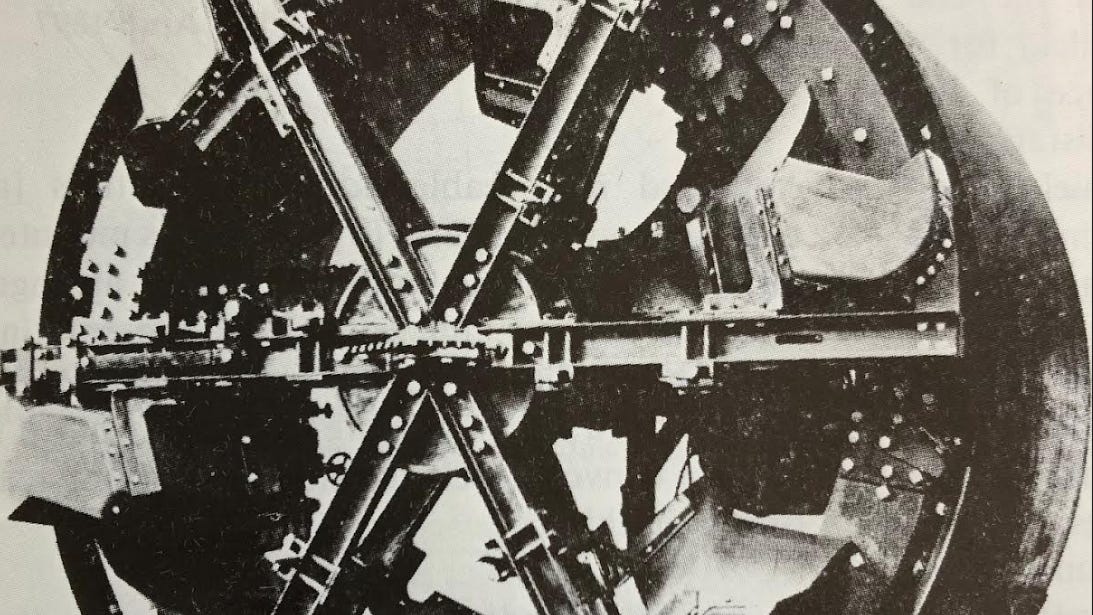
The Evolution of Tunnel Boring Machines
Tunneling is an important technology for modern civilization, as a tunnel is often the only reasonable way to create a direct path between two points.
construction-physics.com
93 points · by chautumn · 1y ago · 88 comments
tbms are cheaper if you must go deep, but deep is a negative for subways since people must get down which takes time (faster is always better).
It is claimed that cut and cover is toa much surface disruption - but cut and cover is much faster and so the disruption to any one place can be quick enough. Better to manage disruption than eliminate it.
when a tbm breaks your project is delayed while you wait for parts and then fix it in place.
Tbms do go under everything else, but experience proves you can find things and go around them quick enough (sometimes there is a delay as somethingeof archeological interest is found - but evperience shows this is still cheaper than a TBM.
Yes TBMs are cool and useful but the simple shoud not be over looked
What projects in developed countries have used cut and cover recently? In trying to find out, I see that HS2 under west London and the Canada line under Vancouver chose tunnels over cut and cover because it was cheaper.
Canada Line was mostly Cut-and-Cover - only the bits below downtown and crossing below the water were bored, the bulk of the underground was done cut and cover for cost and speed to make sure it opened for the 2010 olympics.
It was not a popular choice - not really announced before the project was approved, and local businesses along the route took a big hit.
Vancouver's current Broadway Line Extension is being done with TBMs to avoid the impact that the cut and cover canada line segment construction had.
Not really a new project, but parts of the subway in Stockholm are cut and cover. One of those tunnels (from the 1930s) has been leaking in water for some years and is up for a total overhaul, so basically digging up everyting and doing a new cover.
The section is 8 m wide and 925 m long, projected timeline is 6-7 years starting this fall. It will be a massive project, as one of the busiest streets in Stockholm is directly on top of it.
I know in Sweden the Västlänken project partially used cut-and-cover at least for the part going southwards..
So, while it's doable, it's not exactly "Just dig a hole, build the tunnel and cover, done." It's a major disruption to shops along the street.
A problem with TBMs is it can be difficult/costly to secure the tunnel sufficiently against water ingress. If you mess up that one the cost of your tunnel can easily double or more.
Here in Norway we recently built a railway tunnel with TBMs (Blixtunnelen) and it's having problems with water ingress. A fairly mild problem relative to how bad these can get, but it's enough that the tunnel constantly has to be closed for repairs to the railway infrastructure due to water drips.
That over 90% of projects are using TBMs strongly suggests they're usually the better option.
Note that I said street and not highway. Some highways (limit access) are good for longer trips, but your subway would be better off using a side street parallel to the highway since while most people use the highway your subway doesn't need to get to any point on the highway while points on the side street - while of limited interest have at least some interest. City transit design is a complex subject that whole books are written about (sadly the people who are in charge don't read them)
Older cities without existing grids can have older metro lines following streets (a limitation of the time they were built, by cut and cover) but newer ones generally don't follow streets. They provide more direct routes, and new crossings over rivers or to islands.
Look at Prague or especially Copenhagen for example.
https://openrailwaymap.org//mobile.php?style=standard&lat=55...
There isn't some industry saying "yes we could cut and cover here, but we prefer the slower more expensive option of a TBM"!
(I see NATM mentioned; there have been safety issues https://www.hse.gov.uk/pubns/natm.htm )
The HS2 cut and cover tunnels were all in greenfield: https://www.hs2.org.uk/building-hs2/tunnels/green-tunnels/ ; much of the cost there goes on planning and documentation, an under-appreciated cost. It's also questionable as to whether they were needed at all; a plain cutting with embankment open to the air would have been fine from a civil engineering point of view, or even in many places just flat track, but the tunnels were planned because people objected to a railway running through fields.
At least for Vancouver, there was absolutely an industry arguing for the slower-more-expensive TBM option on a route that followed exactly a road (the Broadway line extension) - local businesses along the route. The previous line which was mostly done by Cut-and-Cover (the Canada Line) had a very major impact on businesses along the route for years.
There are plenty of people who will acknowledge that something is cheaper _overall_ but the impact on a small group being higher can make them extremely vocal, and that has to be managed in public projects.
(better translate from the german version, as it has more information and examples)
<gestures at the contents of an average HN comment section whenever the subject is public infrastructure>
Coolo, you are building tunnels in a city that doesn't exist yet.
Start here - https://en.wikipedia.org/wiki/Opportunity_cost
Do you have any interesting examples of modern day cut and cover that are not part of a TBM run?
> TBMs are cool and useful
They are what is needed to move humanity forward.
You have trillion $ centers that using 3D you can add massive amounts of access to. This is not like reclaiming land from water, which is ~stealing, this is value adding through topography, it's creation.
And the Erie Canal dig the sections through swampy ground in the winter. That was partially to avoid Malaria. Circa 1825
Which states that due to sandy soil concrete was injected with lances. It was done by a French company.
Might be the same tunnel?
Anyone know what’s going on here? Intuitively you’d expect two small tunnels to be cheaper; you’re moving a lot less material.
What I’m curious about, though, is what, if anything, changed to make this single-bore approach suddenly popular. A lot of new metro lines seem to be built that way, but old (and not, like, 19th century, even most 20th century stuff) always seem to be double-bore.
I think Barcelone Line 9 is the one that popularized it. I suspect the other factor is that they figured out how to make large TBM.
How does the volume of material removed not directly impact machine and crew costs?
Some more discussion then: https://news.ycombinator.com/item?id=37836889
The only thing they’ve done with their Vegas tunnel is to make it cheaper by making it too small to have proper emergency egress, but they can get away with it since with just their chauffeured Teslas going through it only fitting a few people each (making the system extremely low-capacity), they can’t really fit many people in at once, and it’s short enough so combined that makes it not that much of an issue.
In the newest section of the Vegas tunnel they have now only built a one-way tunnel instead of a tunnel for each way, making it cheaper again but low-capacity to a basically comedic level.
Nobody has explained to me what the boring company has actually done innovating TBM, the machines themselveds distinct from a cash injection and some energy from Musk as lead investor. TBM are flow process. It's a pipeline of inputs and outputs. It's scheduling.
The LV tunnel isn't a complete success either. It's not operating completely as promised yet is it?
Today, rock tunneling machines have achieved tunneling rates of over 700 meters per week, and soil tunneling machines have achieved rates of over 200 meters per week, though this is dependent on the size of the TBM
Ie, that rock tunneling can be > 3x quicker than soil tunneling.
There is a half mile long tunnel in the California desert that an addled miner made with hand tools and dynamite over 38 years. Self funded and part time.
https://en.wikipedia.org/wiki/Burro_Schmidt_Tunnel
Then digging through unstable rock with water intrusion and danger of flooding the costs have to go way way up.
In the end they thrust a group of horizontal steel pipes to stabilize the soil and dug beneath it - and those pipes were 15 cm(!) below existing line 3.
Had this thought the other day and wondered if there would be any advantages over metal cutting teeth. From the article, I gather that replacing cutting teeth isn't that much of a problem nowadays so that mitigates one advantage it might have.
Probably way more expensive but you could go faster and don’t need to deal with hauling the material out. It might glassify the surrounding soil and make its own support structure too.
Get a couple kW in the same wavelength (10640nm) with a proper adjustable focus (movable diopter) and a galvo and a vacuum assist and you can just start raster-scanning your way through the rock.
[1]: https://en.wikipedia.org/wiki/Meristem#Root_apical_meristem