74 points · by hodgesrm · 1y ago · 129 comments
There are tons of things that could be done. Virtually none are being done nowadays, much less retrofitted to existing structures.
Bushfire prevention via design is essentially in its infancy, much like earthquake safe designs took decades to become widespread in California after the 1933 quake. It wasn't like structures built in the 40s had "learned the lessons" and were earthquake proof. It has taken the better part of a century to get there.
https://cliffmass.blogspot.com/2025/01/did-la-fire-disaster-...
https://cliffmass.blogspot.com/2025/01/where-and-how-did-pal...
The other inconvenient truth is that the lack of good water management, prescribed burns, and forest management has been problematic across the country. Climate change isn’t the cause, even though attribution teams desperately try to make it that - it just makes things worse. But forests have dry fuel that will light up at some point and that’s regardless of climate change. There’s inadequate proactive planning for this.
https://www.bbc.com/news/world-asia-28305127
Class action, power company handed biggest payout ever at the time of $480 million.
Killed 119 people and destroyed more than 1,000 homes.
As for water? The bushfires were just too big and engulfed entire townships.
I think it is worth pushing back on this, because while yes, in the absolute sense, no single incident can be traced back to the broader pattern; the inconvenient truth remains.
Our addition of the greenhouse gases into the atmosphere is the long lever that can move the world. Between 1970 and 2020, 381±61 Zetta Joules (10^21 joules) of additional energy was absorbed into the system (i.e. the Earth).
This estimate was prepared using satellite data, which is public source, https://essd.copernicus.org/articles/15/1675/2023/
How much energy is this? It's roughly 80% of the estimated energy of the Chicxulub impactor. Albeit spread over a significantly longer period of time.
The strongest explosion humanity has ever created is in the order of 10^17 joules, or a hundred Quadrillion Joules.
We've managed to add 1.5 million times that number in this 50 years. We've been essentially adding one tsar bomba's worth of energy every fifteen to twenty minutes for the past five decades.
Based on my reading so far, we don't actually know what all of this additional energy is doing to the system. One theory based on satellite data has been that 'wet-gets-wetter, dry-gets-drier' — and some satellite data and simulations bear this out. See, this intensity analysis of NASA/German GRACE and GRACE-FO satellite data, https://www.youtube.com/watch?v=QsbgZ9om0t8.
Now others disagree, because it's a complicated system and we don't know what this energy is doing... And so the debate rages back and forth.
But here's the inconvenient truth. While we may not know exactly what all of this additional energy is doing to the system, we do know that it isn't going to do nothing.
It is the inescapable truth that we're in the middle of a statistically anomalous period of extreme weather events. Was each and every one of these directly caused due to global warming? No, of course not. But that doesn't mean that the additional energy we've added to the system didn't change the dynamics of the system in such a way that made this outcome more likely.
Or, more simply, we've biased the dice and - as they keep getting rolled - we keep getting these "surprises."
I am young enough that in my lifetime, the Earth will look dramatically different than the one I was born into.
So yes, you're strictly right. But no, I think it's worth examining the statement further and pointing out that yes, this is just the sign of what's to come.
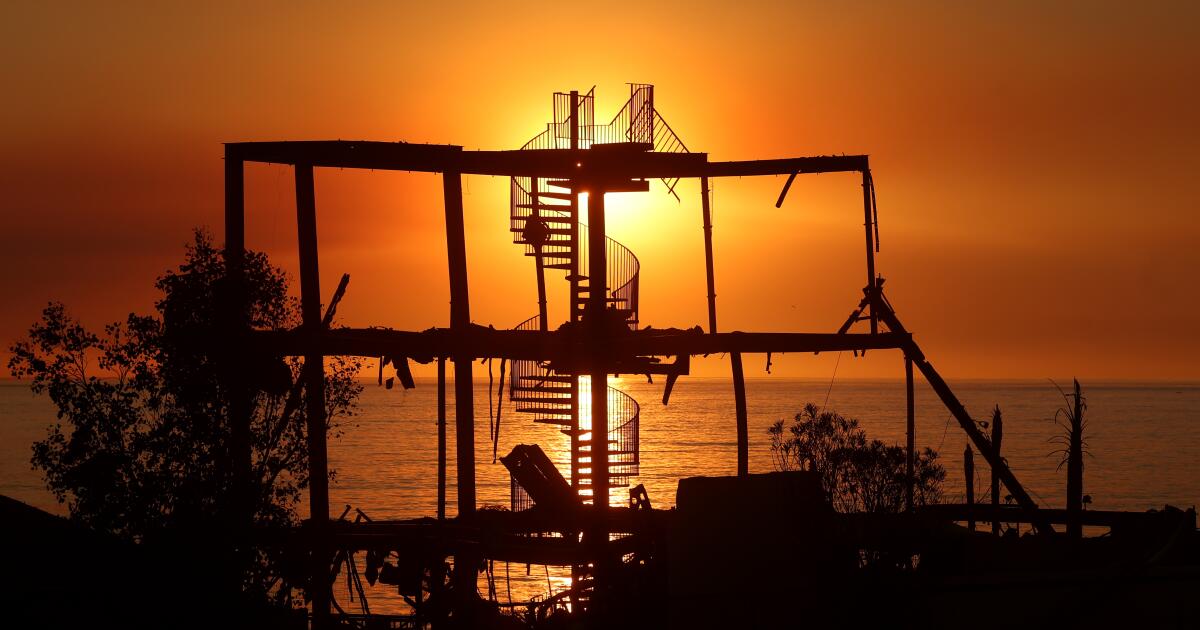
The region experienced back to back years of high rainfall, spurring brush growth.
This year the region experienced severe drought, converting all of that growth into fuel.
Last week the region experienced 100 mph winds, which converted spot fires into fast-spreading conflagrations that could not be fought.
This pattern of instability is an outcome of climate change.
So yeah, it was caused by climate change.
Or do people still think that banning plastic bags and carbon taxes stop wild fires.
From the outside, wet years and dry years and desert winds seem very much like the expected climate for SoCal.
Over the last few decades averages for events have changed, and not for the better:
> It was found that nearly all the observed increase in burned areas over the past half-century is due to human-caused climate change. It is estimated that from 1971 to 2021, human-caused climate change contributed to a +172% increase in burned areas, with a +320% increase from 1996 to 2021. In the coming decades, a further increase in annual forest burned areas is expected, ranging from 3% to 52%.
* https://www.drought.gov/news/study-finds-climate-change-blam...
climate change makes a difference at the margin but the sheer number of recent events has a lot more to do with how we manage our forests/urban upscaling.
It's not. In California, we've been discussing forest management for at least 25 years since a series of wildfires broke out. There have been plenty of discussions about how we should be managing forests, trying to build consensus around best practices, and building the political will to implement them. It's been a maddeningly slow process.
If anyone is coming into the conversation out here saying, "California has bad forest management, they need to rake the forest floors" or whatever, it shows that they're entering the conversation with at best a 1990s mindset of what modern forest management is like. Yeah, we know, that alarm has been clanging for 25+ years. Come at us with solutions, not problems, we know the problems.
This excerpt of the last week tonight show 90 year old electric line equipment responsible for fires : https://youtu.be/qBpiXcyB7wU?feature=shared&t=515
I don't pretend to know anything and I don't know how common this is but it is pretty concerning and I wonder if anything has been done about that.
[0]: https://www.mediamatters.org/fox-news/fast-moving-wildfires-... [1]: https://www.dailykos.com/stories/2025/1/12/2296400/-Critics-... [2]: https://www.washingtonpost.com/politics/2025/01/09/los-angel...
Forest service people have tried educating the public about how new forests have a different set of issues - high density, uncleared dead wood, pests spreading easily, and all that. But no one amplifies those points because it is politically inconvenient. It’s also incredible how little money is spent on access roads, fire breaks, properly located reservoirs, firefighting aircraft, power line management, and so forth given how large state and federal budgets are.
Similar fire in Chongqing, China back in 2022. The fire was pretty close to the city. The total acre burnt was less than 1000 acres in total.
High winds don't help:
> “I’ll be clear: We could have had much more water. With those wind gusts, we were not stopping that fire,” Pasadena Fire Chief Chad Augustin said.
> When winds are as strong as they were Tuesday and Wednesday — reaching 100 mph on mountaintops and surpassing 60 mph along the coast — firefighters are severely limited in their tactics, experts said. They make it too dangerous and all but impossible to establish any fire perimeter. They blow flames as tall as 200 feet horizontally and send balls of red-hot embers flying at speeds that can carry them a mile or two away, where they start what are known as spot fires.
[…]
> The lack of firefighting by air was a critical deficiency that persisted from Tuesday night through early Wednesday, fire officials said, and one that has allowed other devastating Southern California fires to spread in the past, including the Woolsey Fire, which burned across a footprint just to the west of the Palisades Fire in 2018.
> “Without helicopters, this kind of a brush fire, we cannot stop it on the ground,” said Margaret Stewart, an LAFD spokeswoman.
* https://archive.is/https://www.washingtonpost.com/weather/20...
If you don't stop it within the first 5 min, it quickly gets out of control. There's so much stuff to burn.
But it's an ecosystem that has evolved for fire.
https://en.wikipedia.org/wiki/Chaparral#Fire
https://en.wikipedia.org/wiki/Bushfires_in_Australia#Before_...
The fires in LA were a failure and more redundancy will soon follow like improved building codes, better forest management, etc.
The winds prevented the use of aircraft, either for direct attack or to insert handcrews.
That means firefighters need to drive/hike in, which can take hours. By that point, it's grown to the point where the wind is blowing embers over your head and causing spotfires miles away.
With the winds again, your containment options are limited. It's already too large for a direct attack. It'll jump your mineral earth containment lines, and you can't light a backburn.
The only real option then becomes property protection, and with a water shortage and finite resources that becomes a challenge.
Fire crews were ready to fight fires in Los Angeles, and quite a lot of fire crews from outside the area were brought in before the fires even started - they knew how dangerous the situation was, and they were trying to do what they could by staffing up. Once the winds died down, fire-fighting aircraft could fly and started containing the fires on the mountains, but much of the residential areas had already been lost, there was just too much fire and too few resources to keep it under control.
It’s not clear why they’re not buried other than cost. A few bent poles must now be replaced in our neighborhood at great expense.
Looks like they’d be cheaper buried in the long run.
plus we make our utilities pay prevailing wage
2. yea, prevailing wage requirements are definitely relevant to the marginal cost of a labor intensive undergrounding project
3. why is pg&e the topic of discussion here?
I think this is well-known and not at all some sort of secret inconvenient truth. After any disastrous event, there will always be people coming out of the woodwork saying “you should have listened to me.”
Pretty unimpressed by this article, frankly.
Look at the before pictures in LA. Homes with flammable exteriors and dense plantings.
Look at Laguna beach to the south. About half the town burned in the 90s. Strict building codes and regular inspections. It’s expensive and annoying to homeowners, but it works.
It is not ignored by local policy folks:
> Molly Mowery, an author of a 2020 report for Los Angeles County on how to reduce wildfire risk, said that the county now takes wildfire into account when reviewing new housing development plans. The problem, she said, is that nearly 90 percent of the county’s housing stock was built before 1990, before many subdivision or building code requirements for wildfire hazards took effect. Once fire enters these communities, the homes are the fuel.
* https://archive.is/https://www.washingtonpost.com/weather/20...
But to a certain extent government can only do what the citizens want to be done:
> Nic Arnzen, a town council member in Altadena, where thousands of homes, businesses, restaurants and parks were lost in the Eaton Fire, said the unincorporated community in Los Angeles County was trying to address fire risks. Less than a month ago, the town council chair wrote a letter to Los Angeles County Supervisor Kathryn Barger, recommending she adopt a controversial land-use plan that would direct development away from the Altadena foothills “and other high fire hazard zones.”
> It had been a subject of debate for months. Residents concerned about the community’s vulnerability to an inferno roaring off the slope of the San Gabriel Mountains favored the plan. But others didn’t want to lose the ability to develop their properties in the hills. […]
* Ibid.
Same thing as in all European cities in the middle ages, where building codes eventually enforced itself.
But you are correct, politicians can only “lead” a much as voters allow.
Iirc, one of items listed was rocks/gravel surrounding the house on the ground so any embers that landed beside the building had nothing to feed on ignite.
> “It’s stucco and stone with a fireproof roof,’’ he said, adding that it also includes pilings “like 50 feet into the bedrock’’ to keep it steady when powerful waves crash into the seawall below it.
* https://nypost.com/2025/01/10/us-news/owner-of-miracle-malib...
And you don't need to have a building made out of concrete either, as long as the shell and the surrounding area is not flammable:
* https://www.builderonline.com/building/safety-healthfulness/...
* https://www.nfpa.org/en/education-and-research/wildfire/prep...
All it really means is that when it comes to a battle between fire prevention people and people who like their gardens, in the absence of a fire, the people worried about fire are going to look like scolds and the people who want the individual freedom to have a garden are going to win the political fight. More of a collective outcome of our society than oversight by policymakers.
Good luck trying to ban gardens in the Oakland hills, people just won’t do it even if policymakers want it. Probably the best way to do it would be to deregulate insurance and give them discretion - “oh you want to have a garden in a fire prone area, sure - that will just be 3x your original bill”
Trees and dense shrubs near the house are.
I replied: sure, but it would have to have been at least 10 miles wide to protect from the 100mph-wind carried embers...
Well, yeah. Americans tend to laugh at European construction codes, label us with words suggesting we live in a dictatorship... but with every report I see from the newest natural disaster in the US, be it fires, floods or hurricanes, I'm happy that building codes are very very strict here.
> For example, municipal and fire prevention agencies must give property owners advance — and continual — warnings to clear dead vegetation and to wet dry brush within 10 feet of the house with periodic, prolonged sprinklings.
Try that with your average American and the poor sod tasked with doing that will be at best yelled at with "leave my property", and that's assuming they can inspect the property to begin with.
The other thing that is subtle and maybe not obvious about American culture — firemen generally are not lumped in with the rest of the government. Police are looked at with extreme suspicion very frequently, but firemen are just generally liked. Yes there are people who don’t want anyone on their property that they didn’t invite, and in some states those people have the law behind them (I grew up in Texas), but firemen coming by to let you know that your property has too many trees near the home are probably the least likely to be shouted off. There is one group, though, that doesn’t want to hear the message - the wealthy. Often they have an image in their head of how they want their house to look and what kind of landscaping they want, never mind what best practice is. They will listen politely and then completely ignore the advice they get because it would keep them from having the picture perfect English cottage look, or maybe they’d have to see their neighbors in their winter ski chalet, or whatever it is that’s in their head. When the Tahoe area has a fire like this, it will be because of these attitudes, 100%.
i seem to recall quite a few buildings collapsing in Turkey and in Greece in the last quarter century after earthquakes
Agreed, but that's even more of a sign for "the US should be even more proactive in regulations and enforcement than Europe, not the other way around!
In any case we do have areas that are prone to wildfire, especially the Balkans, Greece and Turkey get hit regularly and hard. But the human toll is always very low even if the fires rage, because our buildings don't consist out of the cheapest sort of wood and cardboard and there is ample distance between homes and forests.
> i seem to recall quite a few buildings collapsing in Turkey and in Greece in the last quarter century after earthquakes
Yup, and in almost all cases it turns out that either the owners intentionally circumvented the code or construction was shoddy because someone diverted money and substituted cheaper but unallowed materials.
Our greatest issue tends to be floods like in the Ahrtal or the beginning of Spain, because our building and zoning codes haven't caught up with climate change. Unfortunately, what I call "Americanism" (or y'all "American Exceptionalism") seems to have seeped into our culture as well - the attitude that humans are superior to nature's forces and can bend them to their will, and so I'm afraid history is doomed to repeat itself.
Did they also have unprecedented 100mph wind gusts, and strong winds blowing for days? It's impossible to fly fire mitigation aircraft in those conditions, and the terrain where the fire was spreading the most were rugged mountain areas, mostly not accessible to firefighters.
Can you provide specific citations?
And.. normally, I might ask that for argumentative reasons, but… sitting here, south of Pasadena, I really want things to look at to understand what this might do to the place I live.
Right now it’s my understanding that this is yet another once-in-a-lifetime disaster. I think our generation is at… five of these, at least?
A couple of days before the fires started, I received a major red alert on my phone (I was in Los Angeles just prior to the fires - Recognizing the danger, I decided to leave).
I expected to see a large-scale response—fire trucks stationed everywhere, extra firefighters on standby, planes ready to deploy, and vegetation being watered—but none of that appeared to happen.
This isn’t about partisanship. One of the core responsibilities of our elected officials is to effectively manage situations like this. Until we address the root causes (like global warming), these events will continue to occur, and we need better preparedness in the meantime.
BTW: which locations in the whole Los Angeles (you know how big it is? actually there's no guarantee the fire works be in LA) you should get fire trucks stationed?
There wasn't any rain registered since April, there were unprecedented (last time we had such big ones was 15 years ago) dry, 100mph winds. This means using air support was also not feasible at the time.
We mostly talk about Palisades, but when watching WatchDuty app, fires were constantly popping up in random places.
It was a nightmare, and it is frustrating to see politicizing the whole thing or criticizing that fire men did something wrong.
Why those people aren't volunteering and helping?
There are some things that is impossible to do with what we have.
Much more effective would be for example having all building up to the latest fire code, but majority are of course old.
Could more have been done to make a fire of this size less likely? Perhaps. But once it starts, and reaches a certain size, with winds as they were and combustible material in its path, all you can do is get out.
Unfortunately, this seems to be fast becoming a partisan position.
I’m responsible for clearing brush in that hillside, so that it’s n-hundred feet from structures. It’s checked in May, or thereabouts.
https://en.m.wikipedia.org/wiki/Oregon_Fire
The world is changing
""...Ignitions downwind and across streets are typically from showers of burning embers from burning structures.” This fundamental misunderstanding has likewise led to a misunderstanding of prevention. No longer is it a matter of preventing wildfires but instead preventing points of ignition within communities by employing “home-hardening” strategies — proper landscaping, fire-resistant siding — and enjoining neighbors in collective efforts such as brush clearing."
Because it's things we already know about, but refuse to do anything about. For example:
> “The assumption is continually made that it’s the big flames” that cause widespread community destruction, he said, “and yet the wildfire actually only initiates community ignitions largely with lofted burning embers.”
We've known about embers for decades, and why you need to clear the area around your home of ignition sources:
* https://www.nfpa.org/education-and-research/wildfire/prepari...
Here's a potato-quality video posted thirteen years ago on landscaping best practices:
* https://www.youtube.com/watch?v=_NVe0gu69FY
A news story from twelve years ago about a home that survivied (with a charred landscape around it):
* https://www.youtube.com/watch?v=6rgUp245nso
Which is talked about in the article:
> This fundamental misunderstanding has likewise led to a misunderstanding of prevention. No longer is it a matter of preventing wildfires but instead preventing points of ignition within communities by employing “home-hardening” strategies — proper landscaping, fire-resistant siding — and enjoining neighbors in collective efforts such as brush clearing.
We may also have to accept that perhaps Mother Nature can still be more powerful than humans at times:
> The National Fire Prevention Assn., a national nonprofit that provides standards for fire suppression operations, calls for a minimum of three engines or 15 firefighters for a single-residence fire, a number that is impossible to attain when fighting a fire on the scale of the Palisades or Eaton fires.
> “We’re not recognizing, analyzing, questioning how we’re failing,” Cohen said. “We just think we need more airplanes and more helicopters flying 24 hours a day.”
> More CL-415 super-scoopers or Firehawk helicopters will not help when water is being dropped into 60 mph wind gusts.
See also "Why Los Angeles was unprepared for this fire":
> Water runs short: […] “There’s no urban water system engineered and constructed to combat wildfire,” said Michael McNutt, a spokesman for the Las Virgenes Municipal Water District, which serves 75,000 people in northwest Los Angeles County. The system was intended to supply water to homes and businesses, he said, and to help fire crews defend a large structure or several homes, not multiple neighborhoods at once. […]
They might have said something along the lines of make sure you have water, the ability to use it (hello Maui), and people who know how to use it.
Or maybe they thought that was needless to say and had more advanced advice like clearing dead brush, making fire breaks, etc.
Or ... Well yeah. It would be nice to know what advice was ignored. I'm sure there was plenty in that category.
When I saw the pictures of the completely burnt out districts, the first thing I thought of was Hiroshima. At least we got most of the people out first this time, though.
It's common sense to everyone else.
As everyone else clearly has built their houses in a fireproof manner, activated personal fire prevention tactics like watering their surroundings and, as the article stated, tried to decrease community hotspots succeptible to being ignited by ember, what do we even need these experts for, am I right?
I mean, clearly it's common sense, right?
LA is at the same latitude as North Texas, and Texas isn't exactly known for snow. Where I live in the Midwest we're guaranteed at least one good snow every winter, and it's been around freezing temperatures for weeks.