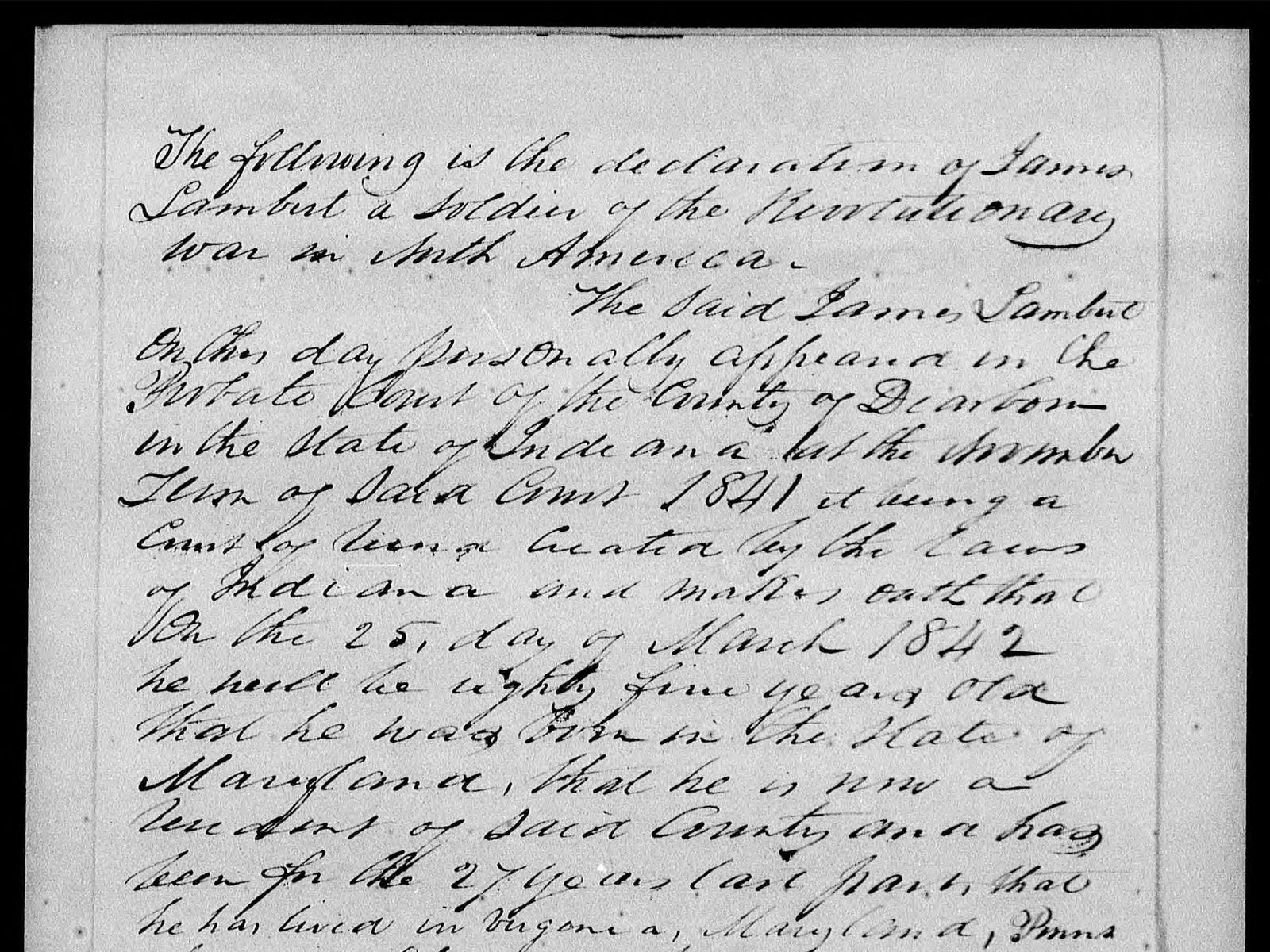
Can You Read This Cursive Handwriting? The National Archives Wants Your Help
Anyone with an internet connection can volunteer to transcribe historical documents and help make the archives' digital catalog more accessible
Smithsonian Magazine
257 points · by lemonberry · 1y ago · 251 comments
* Article doesn't provide a direct link to the topic mission
* Signup is pretty easy. Well organized and even gently requires you to have two forms of 2FA.
* Sign up complete. Go back to the primary page and try to find the mission. A little buried but not too deep.
* Notice I'm not signed in. Ok, let's do that. Now I'm back on the main page and navigate back. Find the first document and open it. Really interesting to scan through the doc and to read. People back then generally had really nice handwriting.
* Ok, what next, how do I transcribe? ... ? Oh it says I'm not logged in again. Fine, click the link and...
* I'm logged in and directed back to the main page, again.
Look, this is an interesting project and I'd love to spend my spare cycles to help out. But they really need to clean up this process.
Volunteers shouldn't have to jump through kinda poorly designed interfaces to help out.
Do you perhaps have uBlock Origin enabled or some other limitation on Javascript/cookies that might be messing with your login status?
The direct link to the mission that was in the social post. https://www.archives.gov/citizen-archivist/missions/revoluti...
Once I was logged in I spent another 45 minutes trying to find a document to transcribe. Every single one I found or was given from a challenge had either already been transcribed or was a typewritten document or manifest that the OCR had already done an OK job with. I reviewed a few documents for accuracy, closed the browser, and never went back.
It's a shame it's so hard to use. I really was hoping for something I could pop open for 15-30 minutes a day as a break from work and contribute to instead of doing a crossword or watching a video.
WTF, why? I'm not putting my bank info in there. The whole process sounds like a PITA in several ways, but in general I'm getting fed up with no-importance sites requiring 2FA as if they're a brokerage.
> The agency uses artificial intelligence and a technology known as optical character recognition to extract text from historical documents. But these methods don’t always work, and they aren’t always accurate.
The document at the top is likely an especially easy document to read precisely because it's meant to be the hook to get people to sign up and get started. It isn't going to be representative of the full breadth of documents that the National Archives want people to go through.
Like if this is a crowdsourcing project, why not do a first pass with an LLM and present users with both the image and the best-effort LLM pass?
Later
I signed up, went to the current missions, and they all seem to post post-1900 and all typeset. They're blurry, but 4o cuts through them like a hot knife through butter.
Edit: apparently it’s called cross writing [1]
Possibly for the reason that came up in your other post: you mentioned that you spot checked the result.
Back when I was in historical research, and occasionally involved in transcription projects, the standard was 2-3 independent transcriptions per document.
Maybe the National Archive will pass documents to an LLM and use the output as 1 of their 2-3 transcriptions. It could reduce how many duplicate transcriptions are done by humans. But I'll be surprised if they jump to accepting spot checked LLM output anytime soon.
I expect thats a common theme from companies like that, yet I don't think they understand the issue they think they have there.
Why not have the LLMs do as much work as possible and have humans review and put their own name on it? Do you think they need to just trust and publish the output of the LLM wholeheartedly?
I think too many people saw what a few idiot lawyers did last year and closed the book on LLM usage.
Then you have the problem that some of these ancestors not only had terrible penmanship but also spelled multi-syllabic words phonetically since they likely were barely educated kids who spent more time when they were young working on the farm or ranch instead of attending school where they would've learned how to spell correctly.
I don't know whether your LLM can handle English words spelled phonetically written in cursive by an individual who had no consistency in forming letters in the words. It is clear after reading a lot of correspondence from this person that they ignored things that didn't seem important in the moment like dotting i's or crossing t's or forming tails on g's, p's, j's, or even beginning letters consistently since they switched between cursive and block letters within a sentence, maybe while they paused to clarify their thoughts. I don't know but it is fascinating to take a walk through life with someone you'll never meet and to discover that many of the things that seemed awesome to you as a kid were also awesome to them and that their life had so many challenges that our generations will never need to endure.
Some of my people have the most beautiful flowing cursive handwriting that looks like the cursive that I was taught in grade school. Others have the most beautiful flowing cursive with custom flourishes and adornments that make their handwriting instantly recognizable and easy to read once you understand their style.
I think there are plenty of edge cases where LLMs will take a drunkard's walk through the scribble and spit out gibberish.
I'm reminded of an old joke though.
Ronald Reagan woke up one snowy Washington, DC morning and took a look out of the window to admire the new-fallen snow. He enjoys the beautiful scene laid out before him until he sees tracks in the snow below his window and a message obviously written in piss that said - "Reagan sucks".
He dispatched the Secret Service to the site where samples were taken of the affected snow and photos of the tracks of two people were made.
After an investigation he receives a call from the Secret Service agent in charge who tells him he has some good news and some bad news for him.
The good news is that they know who pissed the message. It was George HW Bush, his Vice President. The bad news is that it was Nancy's handwriting.
[0] https://catalog.archives.gov/id/54921817?objectPage=8&object...
[1] Reproducing here since I cannot share the chat since it has user uploaded images. " The text in the top half of the image is handwritten and partially difficult to read due to its cursive style and some smudging. Here's my best transcription attempt for the top section:
...resident within four? years, swears and says that the name of the John Hopper mentioned in the foregoing declaration is the same person, and he verily believes the facts as stated in the declaration are true.
He further swears that the said John Hopper is in reduced and indigent circumstances and requires the aid of his country.
The declarant further swears he has no evidence now in his power of service, except the statement of Capt. (illegible name), as to his reduced circumstances ...
Sworn to before me, this day...
Some parts remain unclear due to the handwriting, but let me know if you'd like me to attempt further clarification on specific sections!"
> In fact it seems to mix up some portions of the latter half of the typed text with the written text in the portion of it's "transcription" about "reduced and indigent circumstances".
What typed form? What typed text? That image is a single handwritten page, and the writing is quite clean, not "barely legible".† The file related to John Hopper appears to be 59 pages, and some of them are typed, but they're all separate images.
Are you trying to process all 59 pages at once? Why?
I should note that transcription is an excellent use of an LLM in the sense of a language model, as opposed to an "LLM" in the sense of several different pieces of software hooked together in cryptic ways. It would be a lot more useful, for this task, to have direct access to the language model backing 4o than to have access to a chatbot prompt that intermediates between you and the model.
† My biggest problems in reading the page: Cursive n and u are often identical glyphs (both written и), leading me to read "Ind." as "Jud."; and I had trouble with the "roster" at the bottom of the page. What felt weirdest about that was that the crossbar of the "t" is positioned well above the top of the stem, but that can't actually be what tripped me up, because on further review it's a common feature of the author's handwriting that I didn't even notice until I got to the very end of the letter. It's even true in the earlier instance of "Roster" higher up on the page. So my best guess is that the "os" doesn't look right to me.
I misread 1758 as 1958, too, but hopefully (a) that kind of thing wears off as you get used to reading documents about the Revolutionary War; and (b) it's a red flag when someone who died in 1838 was born in 1958 according to a letter written in 1935.
I'm confused by what you're asking. Are you asking me to like (upvote) your comment if this is a crowdsourcing project? Don't we already know it is a crowdsourcing project?
“So if this is a crowdsourcing project…”
Like is serving as an indication that someone else approximately said the phrase it introduced, in a way often associated with the “Valley Girl” social dialect but regularly seen outside of it.
https://en.wikipedia.org/wiki/Like#As_a_colloquial_quotative
“Some participants have dedicated years of their lives to the program—like Alex Smith, a retiree from Pennsylvania. Over nine years, he transcribed more than 100,000 documents”
Have different LLMs transcribe those same documents and compare to see if the human or machine is or accurate and by how much.
https://trustdecision.com/resources/blog/revolutionizing-ocr...
Looking at the (admittedly single) example from the National Archives seems a bit more open than perhaps the other two examples. It’s not impossible thst LLMs could help with this
It was more successful at a few others I tried but it's still a task that requires manual processing like a lot of LLM output to check for accuracy and prompt modification to get it to output what you need for some documents.
https://catalog.archives.gov/id/54921817?objectPage=8&object...
This was something I enjoyed when I decided to learn a language by translating short stories. (Edit: Of course, you have to choose an author whose diction you respect. Your unfamiliarity with the target language encourages you to mull over the author's use of diction and the nuances the author is trying to convey, and then find appropriate diction in English. This means you spend a long time immersed in the imagery.)
It worked better when I realized I could stop taking most notes.
Can it be used to greatly simplify efforts by getting through boilerplate? — Yes.
Should the result be reviewed and proof-read by human? — Also yes.
---
Here subtle one: https://catalog.archives.gov/id/34384201?objectPage=40
Here is (one of) transcripts made by `o1-pro`:
  (2)

  …and I don’t know whether it can be reset for a
  date in December or not. Cornell seemed
  anxious that it should not come up too close to Christmas,
  and of course new suspicion [would be aroused?] [about?] him.
  I will take this up with the Judge as soon as I can get rid of the brief.
  Meanwhile I would like to know whether there is anything else
  in which I can be useful to you, since it behooves me
  in ways of uncomfortable relations with the present management.

  Are you going East in December?
  Has any word come from Hagerman?
  Were there any noteworthy developments at the hearings
  on the [Teapot?] trial?

  I have no inclination yet whether Wheeler will be wanted in
  Washington, but the chances are that he will not.

  With regards to all the brethren and [flock?], I am

  very sincerely yours,
  George A. H. Fraser
Somehow GPT-4o performs better on this example and fails only on "New Mexican practise" part.
---
and I don't know whether it can be reset for a date in December or not. Cornell seemed anxious that it should not come off too close to Christmas, and of course New Mexican practice would support him. I will take this up with the Judge and with Hanna the moment I can get rid of the brief. Meanwhile I would like to know whether there is anything else in which I can be useful to you, since it behooves me to be diligent in view of uncomfortable relations with the present management.
Are you going East in December?
Has any word come from Hagerman?
Were there any noteworthy developments at the hearings on the Tenorio tract?
I have no intimation yet whether I will be wanted in Washington, but the chances are that I will not.
With regards to all the brethren and flock, Dan
Very sincerely yours, George H. H. Baser
Edit: Oh I see from another thread this OCR site is your creation. Nice work!
Also your link goes to the wrong page. Here’s the right one: https://catalog.archives.gov/id/34384201?objectPage=190
on a more serious note, working through a transcription project for letters and journals that nobody has touched since they've been archived is such a wonderful feeling. Aside from being in front of the physical document itself, your degree of separation from the writer and point is time is vanishingly small!
I always like to observe when they cross something out or make a mistake and think about what could have caused that. Did a friend pass by the door and scare them? Did they get distracted looking out the window? It's all so close and yet so far away :)
My family is Ivy-League, all the way, and has the worst goddamn cursive writing I've ever seen. It can take me an hour to read a Christmas card from my sister.
"2T BD IAF UF", 2 tablets, twice a day, immediately after food until, finished"
I like to write in cursive for a few reasons
1. I find it makes my hand cramp less 2. It offers some shallow privacy in public 3. I don’t want to lose the skill 4. It’s fun!
But…computers can definitely do this way better, right?
EDIT:
I tried giving the sample to 4o and it gave:
The following is the declaration of James Lambert, a soldier of the Revolutionary War in North America.
The said James Lambert this day personally appeared in the Probate Court of the County of Dearborn in the State of Indiana and at the November Term of said Court (1841), it being a court of record created by the laws of Indiana and made oath that:
On the 25th day of March 1842, he will be eighty-five years old, that he was born in the State of Maryland, that he is now a resident of said county and has been for the 27 years last past; that he has lived in Virginia, Maryland, and Pennsylvania...
> But…computers can definitely do this way better, right?
No.
Cursive writing is analog and fluid, lacking consistency across authors and often inconsistent by an individual author as well. When done well, it could be classified as its own art form. When done poorly, it can resemble the path walked by a chicken on meth.
This is obviously disprovable, in that if they could, they would, and this call to action would not exist.
“The following is the declaration of James Lambert, a soldier of the Revolutionary War in North America.” “The said James Lambert, on this day personally appeared in the Probate Court of the County of Dearborn in the State of Indiana, at the November Term of said Court [1841], it being a court of record created by the laws of Indiana, and made oath that on the 25th day of March 1842 he will be eighty‐five years old; that he was born in the State of Maryland; that he is now a resident of [said] county and has been for the [27] years last past; that he has lived in Virginia, Maryland, [and Pennsylvania]; that…”
These kinds of problems, matching up cursive to actual text, would seem to play to the absolute best strengths of an LLM, given how much basic language structure the models encode.
You are a paleologist specializing in analysis of cursive handwriting; tell me what the following text says: (pasting the picture).
  The following is the declaration of James Lambert, a soldier of the Revolutionary War in North America.

  The said James Lambert this day personally appeared in the Probate Court of the County of Dearborn in the state of Indiana and at the November Term of said court (1841), it being a court for claims created by the laws of Indiana and makes oath that:

"On the 25th day of March 1842, he will be eighty-five years old; that he was born in the state of Maryland; that he is now a resident of said county and has been for the 27 years last past; that he has lived in Virginia, Maryland, Pennsylvania ..."https://www.google.com/url?sa=t&source=web&rct=j&opi=8997844...
It took about one minute to decipher the first sentence in the sample. Is that considered good these days?
Here is an example of a non-expert compared to an expert reading aloud [0].
I learned cursive in school in the early 2000s, but I could never read my grandmother's handwriting. Whenever she mailed me a card, I would have to have my mom read it to me.
The result is that kids in Montessori learn to read faster and earlier. (They're usually writing in cursive first, which gives them a foundation of the letters and their phonetic sounds, before they begin reading exercises in earnest.)
Somewhere in it there must be real science, but damn is it hard to find.
At this point I'm more prone to take an out of context look, and try to assert what exactly happened where cursive got phased out, or more generally, how it goes for cultures that don't teach cursive at all.
For instance do Korean kids face severe issues because cursive hangul isn't taught in school ?
If not, we can go back looking at it like a preference or an alternative that can help in very specific scenarii.
“I became expert in deciphering the sisters’ handwriting, and that of their ancestors, parents, and friends. Each era and each correspondent presented different challenges. Some hands were sprawling, some spindly, some cramped; t’s went uncrossed at the ends of words, and f’s and s’s were interchanged; spelling, capitalization, and punctuation could be erratic or idiosyncratic. Often, to save paper and postage, the sisters turned a single sheet ninety degrees and wrote back across a page already covered with handwriting. I learned to be especially attentive to these cross-written lines, in which the sisters invariably confided their deepest feelings in the last hurried moments of closing a letter. Here I would find the urgent personal message that had been put off for the sake of dispensing news or settling business. In one such postscript, I discovered Elizabeth’s account of a conversation with Horace Mann in which the two spoke frankly of their love for each other and finally settled on what it meant.”
A photograph of a letter with cross-writing is here:
https://www.masshist.org/database/1774
Marshall wrote more in an article for Slate:
https://slate.com/news-and-politics/2005/05/reading-the-peab...
Could these be instances of the long s, “ſ”, easily confused with an f?
I'm looking at the piece in the Instagram post linked by the page, which begins, "honor of holding in their service". The lines are so straight, the letters are so uniform!
I also remember teachers telling you when writing cursive to seldom lift your hand from the page. I think that act of keeping your pen on the page for most of the writing process encourages a smoother and more natural flow, reducing the chance of jerky, uneven strokes
A lot of bad handwriting stems from using it to write down things quickly (see: https://imgur.com/doctors-strike-5ANma ).
If you instead focus on doing slow calligraphy, your handwriting can improve rapidly.
I highly doubt most people could write that well
> Sheldon Richman quotes data showing that from 1650 to 1795, American male literacy climbed from 60 to 90 percent. Between 1800 and 1840 literacy in the North rose from 75 percent to between 91 and 97 percent. In the South the rate grew from about 55 percent to 81 percent. Richman also quotes evidence indicating that literacy in Massachusetts was 98 percent on the eve of legislated compulsion and is about 91 percent today.
Any reason for this being an American thing?
I'd still assume fine penmanship was a mark of the upper class though
Pretty easy to get started after signing up at login.gov
then https://www.archives.gov/citizen-archivist/get-started-trans... with video: https://www.youtube.com/watch?v=dwQ5pEWWFY8
The support forum is https://historyhub.history.gov/citizen_archivists/ to ask questions
It is definitely easier to read print though - for a lot of people's handwriting anyway. It's much easier to be lazy and just do an illegible scrawl with joined-up writing than print.
It varies a lot though; I had a PhD supervisor whose handwriting was illegible to everyone - even himself! My wife's handwriting on the other hand is practically a font.
Print is just so slow to write...
Mostly though, speed comes with practice. If you only write in cursive, you'll no doubt feel manuscript writing slow. I only use manuscript writing and find cursive painfully slow.
However my point is valid for print too I guess.
Regarding time saved and the fact that they are two different systems, I don't get it. Time saved for what? They are not so different, cursive is built on top of print, just optimized for not lifting the pen from the paper too often (hence it is supposedly faster to write).
What do you mean? You asked how kids can write without learning cursive, and print is the answer how. What is your point about print?
Cursive might be faster for an experienced writer (though Google tells me that claim is debatable), but it takes a long time to get there. I learned cursive as a child, used it for years, and it was never faster than printing, it was much slower. When I say ‘print’, I use an in-between style of half-cursive fast print that isn’t cursive but a lot of people use in practice, and it’s much faster for me that trying to write legible cursive.
However cursive is neither faster nor more legible to read, as evidenced by this article and the pages that need translating. If we’re going to compare cursive and print, the metric should be overall speed and accuracy of communication, not how many milliseconds the pen-holder can save while writing something nobody can read.
Today, it no longer matters. People type & text mostly, and typing is way faster than either cursive or print. The number of situations that require handwriting continues to decline. We don’t use handwriting enough anymore to develop cursive fluency and efficiency.
I realize many legal documents are "signed" via keyboard, meaning you just need to type your name, but some things are still done via pen and paper.
In the US, 25+ years ago when cursive was taught, we were largely using pencils and crappy bic pens. At which point, you don't really get the benefit of staying in contact with the paper for longer.
This might be part of the disconnect.
German school: You have to write cursive with fountain pen
South African uni: You're not allowed to write cursive, we can't read it
...sigh...just decide ffs
I gave it a go but it was too hard for me! I write in cursive but I found most of it illegible.
American schools don’t teach it anymore?!
As a child, even many years before having access to personal computers or any other kind of typewriting, I have switched my handwriting from cursive to using the kind of sans-serif typefaces used in technical drawing and since then I have never written again cursively, with the exception of my signature, where required on official documents.
Nevertheless, I believe that some kind of calligraphy is necessary for developing fine motor skills in children, unless it is replaced with some other activity that requires a similar precision in the movements of the fingers and of the hand.
The real problem, IMO, is that they don’t teach cursive but also don’t teach typing. They’ve thrown laptops at the kids without giving them the basic skill necessary to be effective in that medium.
It would be great if this would eventually develop into some kind of set of open models that would work on content like this.
I was forced to use cursive and it was still slower than print.
Maybe it would be when writing with a quill where splatter and breakage were a concern, but surely not with a ballpoint pen.
I grew up in Portugal, so a different education system, and used cursive until I was 11 or 12. But I had terrible hand writing and one day during class I decided to write text like it was printed on books, computers, etc, and that's what I've been doing since then. Still looks bad, but at least it's readable :P
1) My cursive was always slower than print. I was happy to go back to print so I could write fast. I went to school in the "analog" era, so 100% of all assignments were hand written and not typed.
2) I noticed that literally only 1 person in my school stayed with cursive when printing was an option. It was so unusual it stuck out.
3) I only know one person who writes cursive now in every day life even though 100% of us learned it in school.
4) That person is my dad and he writes in the style of these documents. If you gave me one of these documents and told me my dad wrote it, id believe you.
Which makes me think we all somehow were taught cursive wrong or practiced it wrong. My cursive was never fast and never looked like these documents.
Anyway, I found this, which summed up my feelings learning cursive perfectly
https://nautil.us/cursive-handwriting-and-other-education-my...
>Reading and literacy expert Randall Wallace, of Missouri State University, says “it seems odd and perhaps distracting that early readers, just getting used to decoding manuscript, would be asked to learn another writing style.”
I found it so frustrating that I just learned how to write one way and then they tell me that's not the "proper" way to write and we need to learn this other way to write.
I thought having to lift pen repeatedly would be slower? Anyway I need to try to really know I guess! Versus the time taken to add those extra links.
Like most others I've not written much in years perhaps decades, that has screwed up my handwriting as even minor notes are these days illegible even to me after a few days
Thanks for the replies.. Cleared a few misconceptions... One of them being writing in blocks is somewhat 'childish' and cursive is more literate.
Added later: read parts of the long article it's very interesting.. Need to read it fully.
OCR is VERY good
—-
The following is the declaration of James Lambert, a soldier of the Revolutionary War in North America.
The said James Lambert on this day personally appeared in the Probate Court of the County of Dearborn in the State of Indiana and at the November Term of said Court (1841), it being a court of record established by the laws of Indiana and made oath that:
On the 25th day of March 1842 he will be eighty-five years old; that he was born in the State of Maryland; that he is now a resident of said county and has been for the 27 years last past; that he has lived in Virginia, Maryland, Pennsylvania…
—-
Considering the people involved are experts in their field, are certainly aware of OCR capabilities, and have publicized a need thusly:
  ... the National Archives is looking for volunteers who can
  help transcribe and organize its many handwritten records ...
> OCR is VERY good
If it's that easy, then do it and be the hero they want.
Or maybe, just maybe, "a pretty big chunk of their problem appears to be well within the state of the art" is a sweeping generalization lacking understanding of the difficulties involved.
Experts are asking for the help of non experts.
> Anyone with an internet connection can volunteer to transcribe historical documents and help make the archives’ digital catalog more accessible
I'm largely aligned with your interpretation of "random humans", with a clarification below. The experts I was referencing are the ones you identified:
> Experts are asking for the help of non experts.
The call to action by the archivists (experts), IMHO, has the intent to engage people with interest in the topic. So not really random from a mathematical definition, but perhaps better thought of as "unknown interested parties."
Granted, this is my unsubstantiated opinion.
Asserting an ulterior motive without supporting proof is to engage in conspiracy theories.
Sometimes a cigar is just a cigar.[0]
I do.
> OCR is VERY good
Uh, my experience is extremely different.
> The agency uses artificial intelligence and a technology known as optical character recognition to extract text from historical documents. But these methods don’t always work, and they aren’t always accurate.
They are absolutely aware of the advances in these tools, so if they say they're not completely there yet I believe them. One likely reason is that the models probably have less 1800s-era cursive in their training set than they do modern cursive.
It's likely that with more human-tagged data they could improve on the state of the art for OCR, but it's pretty arrogant to doubt the agency in charge of this sort of thing when they say the tech isn't there yet.
Are you aware of CAPTCHA[0] images?
What does your OCR say that these say? The first one isn't too hard for a human (assuming appropriate language skill). The second one is a bit more difficult.
This explains a lot
I haven't seen a prescription pad in a decade, it's all electronic now in my part of the southern US, my current pharmacist is so young I don't know if they would even be able to read some of my previous providers writing.
I wonder if they've considered making a simple tutorial on how to read cursive? It's not that hard if you can already read printed English. And of course you can practice on documents in the National Archives.
It's exciting and fun to learn to read an unfamiliar script, like the runes on the cover of The Hobbit ... or the engraving-style cursive of the US Constitution.
In generations past, this was called "elementary school."
For example, there's a great abundance of resources to learn about music theory and such too, the average person doesn't know such things because they aren't interested.
But the task requested by the National Archives is more akin to paleography where you can expect each author or work to have their own (region-based/family-based) handwriting that requires decipherment, even for experts. You may have encountered a coworker or schoolmate's indecipherable chicken scratch print writing; that is what you should expect, only cursive.
> Citizen Archivists must register for a free user account in order to contribute to the National Archives Catalog. Begin the registration process by clicking on the Log in / Sign Up button found in the upper right hand corner of the Catalog.
Catalog: https://catalog.archives.gov/
blah blah blah
https://www.amazon.com/James-Lambert-1758-1847-Elaboration-R...