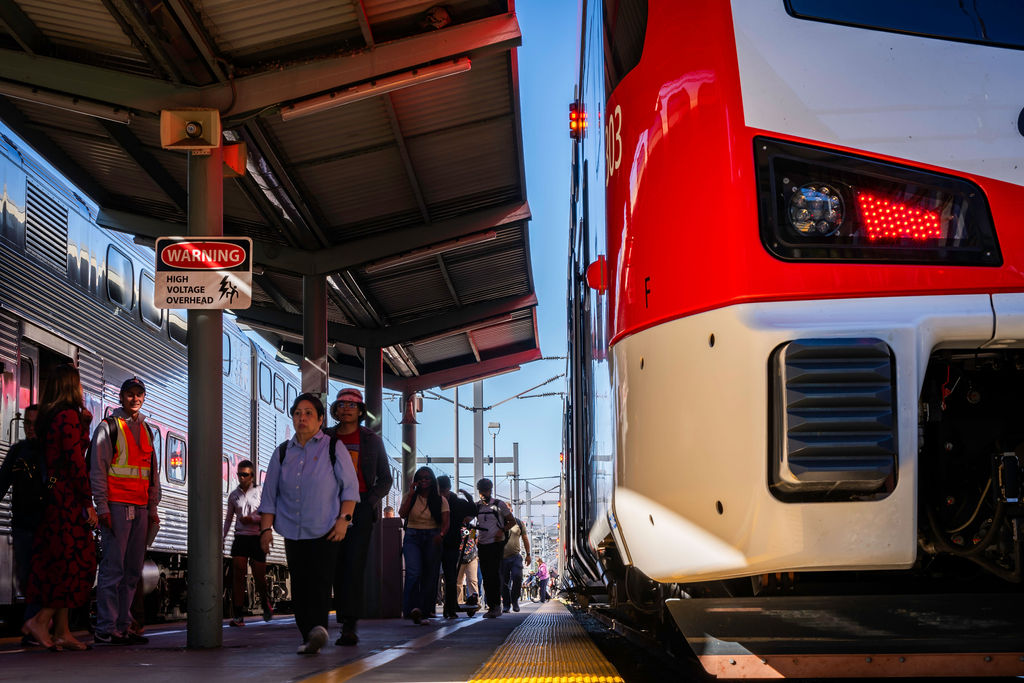
Caltrain’s Electric Fleet More Efficient than Expected | Caltrain
caltrain.com
340 points · by ssuds · 1y ago · 290 comments
Between this, the new BART cars (also much quieter!), and Muni hitting a reliability & satisfaction records, there’s really a transit renaissance going on in the Bay Area. I really hope we can keep this going!
Fun fact: BART police has a large fleet of SUVs, with the highest vehicle-to-officer ratio in the bay area (if only there were some other way for them to get around!)
Fun exercise: compare the cleanliness of a Muni Bus/LRV to a BART car (even a new one at the start of the day). There is a huge difference.
I also agree that the governance structure for BART is weird and overly complex. Why do I elect a BART director? Why are they in their own special BART districts completely discontinuous from the 10 other ways we have sliced up the Bay Area?
All that being said, BART has done some good stuff too. The new cars really are way better, and they were not easy to procure since BART has its own weird, non-standard rail gauge. They have increased frequency and shortened trains on weekends to respond to the ridership changes.
Most of all, BART remains the only form of Bay Area transit genuinely faster than driving in real-world circumstances: it averages above 60mph in parts of the east bay, and goes from downtown Oakland to downtown SF in 11min, which is often 2-3x faster than driving. It's the primary transit system that can compete head-to-head with driving. For that reason, I do hope they keep increasing frequency (shortening trains if necessary).
(Also, while I am biased towards Caltrain, the new trains beat traffic on 101/280 San Francisco↔San Jose during rush hour).
The firm that reupholstered damaged BART seats in the ‘80s paid people to slash them so they’d get more business.
  It was estimated that "possibly 85 percent of the more than 7,000 BART train cushions damaged since August 1979" was the work of this company, the Examiner reported at the time.

  All said and done, BART had paid the company $115,000 for the repairs, a total of about $339,128 in today's money.
Charlie Chaplin did it first https://www.youtube.com/watch?v=izqhtBPd4VQ
There are 30% more violent assaults on BART vs Muni.
> if only there were some other way for them to get around!
Do you want them to respond rapidly or eventually?
If anything that statistic you cited shows that their existing policies are not a deterrent. Perhaps because they are in their vehicles instead of on train cars where the crimes are happening.
BART and Muni were great. My only complaint was that BART from downtown to SFO was almost painfully loud.
why does a transit system need its own police force? Aren't municipal and county police enough?
Having people who have jurisdiction in any bart station is useful. And for example, consistent foot patrols are valuable to BART but not necessarily valuable to the city of Hayward, or whatever. As a concrete example, BART has more or less a goal to be able to put an officer on the car within a stop or two if you report on the app. That's logistically challenging for like a half dozen reasons if the bart police wasn't it's own org.
An example of how it goes wrong is NYC. NYPD absorbed the transit police years ago and the role basically degraded to an overtime sink.
Also, with normal railways rails generate property taxes and towns often make deals where slivers of tracks get annexed to nearby towns or cities.
Transit police, campus police, DEA, ATF, etc, etc, etc. Their entire job is to harass people that the equivalent generalist police couldn't justify allocating resources toward.
Irate homeless? SFPD won't show, but BART Police will.
Drunk college kids shenanigans? Normal cops don't care, but campus police does.
Weirdos making machine guns or huge amounts of LSD? FBI don't care as long as you're not trafficking, they got real crime with real victims to chase. ATF and DEA care though.
Wash rinse repeat this pattern for literally every bespoke police agency.
Yeah, jurisdiction can be a theoretical reason for these agencies but once again it's still a priority thing. When agencies care jurisdiction and coordination isn't a problem. Having one agency span multiple only helps if you're chasing stuff so petty it would get dropped.
That said, there are lots of other stops in the area that are either overrun with parking, like you said, or are one story business districts with no housing. Lots left to do.
I suspect the problem might be mismatched incentives. ISTR reading that some East Asian transit companies own and develop the parcels on and around their stations, which provides funding and drives ridership.
I think the Bay Area suburbs are also egregious - e.g. North Berkeley BART station is surrounded by single family homes, even though it's 25min from downtown SF by train.
If they can electrify the San Jose to Gilroy segment that will be even better.
Not that electric isn't a huge step up for all the usual reasons but most of that is just because it's new and hasn't been worn out yet.
The Stadler KISS units are so much faster because they're EMU's (Electric Multiple Units), that is most of the wheels in a 7-car consist are powered with their own traction motors. An F40PH makes 3000 hp (2200 kW) while a Caltrain 7-car KISS consist can put out 9400 hp (7000 kW) continuous and about 50% more than that in short duration overload mode for starting. That's the reason it accelerates so much faster.
Traditional locomotive trains are completely obsolete in any sort of commuter service with frequent stops, there's just no way for them to keep up with EMU's or even DMU's. You can't solve it by just putting bigger engines on the locomotives, you wouldn't have enough weight on the wheels to make sufficient tractive effort.
They need to turn every road or pedestrian crossing into an underpass or overpass, or eliminate it. They've started on this process, but it will take many years.
The requirements for a no-signal crossing is essentially a pedestrian gate. The quote the city has for each crossing was if I remember right 1.5 million usd. And you’d need to replace many of them. The city doesn’t want to prioritize that much money. (FWIW I agree)
The worst thing is we have under utilized tracks going all over the region and no commuter train service. Even with the rail expansion prior to the Olympics (I’m near Los Angeles), the commuter rail is only being extended to the northern most edge of the city.
Neighbors have been fighting against commuter rail every step of the way. I’ll say attending local govt and rail proposal meetings is at once interesting, impressive at what some groups are trying to achieve and disturbing at the lengths people go to prevent change.
The lights and barriers are assumed to be sufficient. Within cities, there may well be CCTV cameras (pointing only at the crossing) so the signal controllers can check the crossing is clear.
More video than you could possibly want:
https://m.youtube.com/watch?v=hidjpkqJ0-Y
(I think the honk in the first one is the train driver recognizing the person filming? It's far too late to be for safety.)
So California, one of the forerunners in the US, seems to be roughly 90 years behind. Depends on your age whether you'll be able to enjoy a quiet train trip during your lifetime. </sarcasm>
Even today it’s not uncommon to de-electrify lower-volume rights of way.
I get that there's improvement but like it's still rather pathetic compared to almost everywhere else across the pond.
(Transit oriented upzoning, no parking minimums, and businesses in the station building.)
More to the point, I've been favorably impressed with the transit options since moving here, and in terms of reliability it's been better than NYC, though obviously there are fewer trains/branches.
I'd love to see BART open later, like NYC, but even Tokyo trains stop at midnight.
Not being negative. Being realistic. It's unfortunate that being realistic often is negative. Transit here is garbage. You either luck out and live and work near transit or you're like most people and have to drive.
A couple million in energy savings doesn't mean anything compared to the amount wasted by cars.
Also, if you check out smaller cities in Japan they don't always have as good public transit.
Heck, even in Tokyo you can find neighborhoods where you still need to walk or maybe take a bus because train lines don't quite reach them.
Even Cupertino doesn't have a station ffs
We (as Californians) have GOT to do better than this! There are huge infrastructure projects that we need to undertake in the coming years. We have got to cut the red tape and properly fund projects.
A similar project [1] is underway in Canada, but I worry sometimes it'll fall prey to the same administrative bog that the CHSR did. It'll be managed by a new Crown corp, VIA HFR, and from my understanding they're still taking engineering bids. I expect it'll be a while before shovels hit the ground.
A cheap, fast, and reliable rail from Toronto to Montreal would be a dream come true for a lot of Canadians. Any ideas on how best to make it a reality?
[1] https://tc.canada.ca/en/rail-transportation/railway-lines/hi...
How thorough were they being?
> We (as Californians) have GOT to do better than this!
We pay more taxes than anyone else in the country. /We/ are doing our part. The administration needs to be held accountable.
> We have got to cut the red tape and properly fund projects.
We need to light a fire under the administration and someone needs to take a wrecking ball through the state assembly.
... By the electorate, who clearly aren't doing their part if things like this keep happening.
Look at Switzerland - this is the land of trains, all reachable cities and villages have main train station at their heart, use is frequent, and its part of national pride (precision, coverage, cleanliness etc.). Yet prices are brutal, sure if you live here you can often afford it but it still hurts. The price keeps rising.
And I still use our family car for anything else but commuting to work (and even for that sometimes). Morning trains packed like sardines, in reality there are frequent (usually small though) delays which cascade. Car for 4 is significantly cheaper - I'd say 4x for full tickets, less with half/card but then thats 200 bucks a year on its own per head.
Whatever problems you are facing, I doubt that in US rail will solve all of them. Happy to be wrong here of course. I see rather some AI vans/minibuses ondemand hailing and sharing as way more effective and cheap solution. Small bus full of people has minimal env impact and can provide door-to-door transport.
Would it be cheaper with all the usual externalities priced in?
Cleaner forms of transportation should be subsidized. The fact that it costs me $8 to cross the Bay Bridge into SF but costs $10+ round trip on BART is a shame. Especially when you have two or three people in the car.
The hard parts seems to be figuring out (1) how to cut red tape for only certain projects and (2) figuring out what red tape to keep.
Chesterton's fence and all that.
One major example which Marco first became popular with was that he owned a barn but wasn’t allowed to use it for the factory since it was a farm on paper. The government told him to move to a designated factory area. He argued that it made no sense since he was living in a very remote area, and the barn was of high quality. What else should he do with the barn? Why would he need to build something new somewhere else? The barn was there already and stood already for hundreds of years.
His most popular quote is something along the lines of “we can’t all sit with a Chai latte and a MacBook in a coworking space in Berlin and make the 5th dating app. We need some people who do that but not everyone. Some people need to make things with their hands! And for that I need space! I don’t need glass fibre. I need space!”
I tried to do something and they stopped me. This is wrong, I should be able to do this and write my own story.
Which is a perfectly normal feeling. But if you end up saying that loudly in public without ever thinking, well what if the rule of "let this person do whatever they want" applied to people other than yourself, then that seems to indicate some lack of a wider view.
Of course it makes sense. Farmland is dedicated to farming and producing food/related things. It lacks connectivity, has fertile soil, prices are cheaper. If anyone can just build a factory there, they will have a negative ecological impact (interrupt animal flows, pollute in areas that are supposed to be cleaner, etc). It's the same reason why you can't farm in an industrial zone, nor can you set up a factory in the middle of the city.
Yes, it can be taken too far and abused, but absolutely 100% makes sense and must exist.
edit: for instance, if you have e.g. an environmental regulation that is so onerous that exemptions must be doled out for something as sensible as train electrification, then you don't have an environmental review regulation, you have a 'build nothing except what the exemptor decrees' regulation. Which is rather antithetical to the rule of law and good governance.
Bureaucracies everywhere tend to protect itself, but California's is particularly vicious. There is a reason many of us call the place Commiefornia.
>Most legal edicts aren’t laws enacted by Congress but “rules and regulations” promulgated by unelected bureaucrats—tens of thousands of them each year
>...President Trump, [] can, by executive action, immediately pause the enforcement of those regulations and initiate the process for review and rescission.
>When the president nullifies thousands of such regulations, critics will allege executive overreach. In fact, it will be correcting the executive overreach of thousands of regulations promulgated by administrative fiat that were never authorized by Congress...
(wsj thing https://archive.is/nFNp4)
You can just call it what it is and say Nazi salute.
Not "most," but a lot. From the article: > regenerative braking on the new trains is generating and sending back to the electric grid approximately 23% of the energy consumed by the system
Also, acceleration has no effect on the energy if you’re trying to hit the same target speed (unless there is friction, in which case you’d use less energy with higher acceleration)
Not 100% sure this is how Caltrain works but the fact that everyone is physically using the same pool does not imply that you cannot be 100% renewable if you buy from suppliers to the pool with the above properties.
[1]https://www.energy.ca.gov/data-reports/energy-almanac/califo...
The first is that at any given point in time, my instantaneous energy use is offset by renewables.
The second is that over some period of time (e.g., one month) my aggregate energy use is offset by renewables.
The second is MUCH easier. When people say things are 100% renewable, I generally think they mean the second thing. This is a bit of a fudge (not wrong but not 100% level).
(If there’s not, this is a free win and yay - but it’s the wrong focus)
Meanwhile, the current administration is trying to send us back to the 19th century in civil rights, healthcare and energy policy.
At best you'll see an electric car renaissance. But the infra for trains and public transit? Doubtful.
When the needle is moving in the right direction, publicize that so everyone knows about it. That public info makes it harder if someone then comes around and suggests undoing/defunding or any other type of thing that stop the needle or make the needle move in the opposite direction. Keeping the info quiet makes yanking the plug very easy
Many trains in London still don't do regenerative braking despite the technology to generate electricity from motion being around for... checks notes... 194 years!
Regenerative braking in cars also keeps a lot of brake dust out of the air. A pair of brake pads lasts about as long as the life of an EV.
I'm confused. Your phrasing suggests that you're adding in new and potentially conflicting information, but "many don't" and "some do" mean the same thing.
You didn't see the online crowds screaming up and down that it wouldn't do anything but pick the pockets of people? Many genuinely did not believe things would change.
It has been working better than expected, possibly because the bad drivers were breaking a lot of other traffic laws and this one's easier to enforce so is actually keeping them away.
does this make sense? let's round that 23 up to 25%, and say brake energy regeneration is 100% efficient (it's not): one quarter of the energy put into the system comes back out? city driving in a car, you might have your foot on the brake 25% of the time (yes, that's not how it works, just think conceptually) but a train spends a lot of time running, and comparatively a small amount of time braking, and if you were to detach the engine from the train, one doesn't get a sense the train would roll very far unpowered, so while there's momentum to scavenge, it doesn't seem like 25% of the total
I'm just thinking, how do these numbers make sense?
But to address your main point, the rolling resistance of a train in motion is tiny; basically all the energy cost is at acceleration time— it probably cruises at like 5-10% power.
a good comparison would be the invention of the travois https://en.wikipedia.org/wiki/Travois which benefitted from the addition of wheels.
If the moving friction is very low, it makes sense that not that much energy is used to move the train once it's at speed. Slowing it down would return some of the energy back (with the rest dissipated as heat).
But a commuter train, by definition, starts and stops a lot so it makes sense that a large fraction of the energy used would be for acceleration.
Even a model/toy train wagon can easily coast the length of a large room when given a push.
See how little metal is in contact, about 1cm²: https://www.reddit.com/r/Damnthatsinteresting/comments/17ysd...
There's very little friction.
Thats the key. Without the subsidy its more expensive and less efficient than carbon based fuel. In the long run we are worse off, because the subsidy can't last forever.
If markets actually worked for long-term decisionmaking and were therefore capable of pricing in negative externalities, then factoring in the cost of causing Earth to asymptotically approach Venus would change this calculus.
That doesn't seem to be the full picture.
1) The most recent FY 2025 budget (https://www.caltrain.com/media/30699/) has fuel and lubricant expenditures expected to be $5 million. With electricity expenditure estimates dropping to $16.5 million, that puts total expenditures at $21.5 million. The diesel expenditures remain because the long San Jose <> Gilroy corridor isn't electrified and requires diesel locomotive service. Contrast this against FY 2023 expenditures of $17.5 million. That's almost a 25% increase in movement power expenditures.
2) There is increased service now. About ~120 trains run on the latest weekday service timetable (https://www.caltrain.com/media/34716), and 8 of them are diesel service between San Jose and Gilroy. Compare this to ~90 trains for weekday service in 2023 (https://www.caltrain.com/media/30027/download?inline), of which 6 are diesel service between San Jose and Gilroy. Conservatively, we have a 25% increase in service.
3) The new trains are faster. Hitting every stop between San Jose and San Francisco is 101 minutes on diesel and 83 minutes on electric.
So we get an increase in movement power costs proportional to the increase in service, all while having faster trains. I think it's a fair trade.
The subsidies are just gravy on top for a job well done.
EDIT: fixed 2023 weekday service link
With further investment in energy storage it sounds like they could nearly cover a lost subsidy.
Moreover, the improved service from electric (faster acceleration and better air quality) seem very worthwhile.
Also, worth noting in the event the conclusions are extrapolated to diesel over the road transportation: train diesel is much less expensive as it's exempt from fuel (state and federal) taxes.
You're making the classic error here of not factoring the externalities involved - the pollution and other issues from fossil fuels. If they were actually being paid for then electricity would be much cheaper. Fossil fuels get a defacto subsidy by being able to pollute the environment without any cost.
- The gradients of the track
- How agressively you want to drive at different time of the day
- How many trains
- The timing of the trains. When one train brakes, it can power another one that accelerates at the same moment
- The efficiency of the power chain
- The resistance model of the train
With so many parameters the results can be quite volatile. However, rule of the thumb in the business is that 30% saving can be achieved with good energy management. Hope this clarifies a little.
Update: bullet points
Companies that build train batteries have been trying to sell to us (car OEMs) lately, and we look at the battery specs and battery management system capabilities and go uhhhh…
On the motor and control fronts as well.
On the battery front, using car-style or truck-style EV battery modules would be more robust and would reduce cost by somewhere in the order of 50%.
Instead, most trains still use induction motors (this is the high pitch whine you hear) and many train battery designs use industrial style rack mount batteries, with screw terminals, controlled by a massive PLC cabinet. In eMobility the controls are handled by a small safety-rated microcontroller.
[1] https://www.railjournal.com/in_depth/velaro-evolution/
[2] https://www.ew.tu-darmstadt.de/media/ew/rd/ew_vortraege/0305...
a) it works better in a densely populated territory,
b) but the more people around, the more NIMBY cliques to throw sand into the permiting process, usually abusing environmental protections to do so.
If the new Trump administration defangs NEPA reviews just a bit - and I see no evidence that the original intent behind NEPA was to delay everything everywhere by decades - it might help, but a powerful YIMBY movement would be even better.
Once we get the ridership numbers up we can easily make up for the electricity efficiency.
My understanding is the electricity efficiency is really just a nice bonus (or perhaps justification) for making improvements that would also increase ridership.
I'm only loosely aware of the Electric Fleet, but my understanding is they add capacity that was desperately needed.
Get the rider numbers up and extend the lines. Thats the only thing we need right now.
Most if not all electric trains powered by overhead wires have regenerative braking that feeds back to the grid as standard, and Caltrain's new Stadler units definitely do. Nobody paid extra for regenerative braking, it's just the default way to do things on electric trains, to the point that it'd be weird not to have it. Even diesel-electrics often have a kind of regenerative braking, but they don't have anywhere to store the recovered energy so they just convert it to heat via huge resistors.