421 points · by ohjeez · 1y ago · 281 comments
Like Kepler and TESS telescopes it will use the transit method to find new exoplanets, but unlike any mission before, it's going to look at the same spot in the sky for over a year. Super excited to see what data it brings back to us.
The telescope is called PLATO ( https://en.wikipedia.org/wiki/PLATO_(spacecraft) )
I contributed to the project a few years back, very happy to answer any questions.
> The James Webb Space Telescope is not in orbit around the Earth, like the Hubble Space Telescope is – it actually orbits the Sun, 1.5 million kilometers (1 million miles) away from the Earth at what is called the second Lagrange point or L2.
The events of human history on earth have revolved in great part around settling at or controlling strategically advantaged locations, for example any coastline, or a geographic bottleneck for trade and travel (think of Singapore and the Strait of Malacca).
A Lagrange point is the simplest space-based analog to this that I know of, if you want to put something in a fixed location relative to other bodies, the Lagrange points are places where you can do it with the highest fuel economy. Then when operating from that position you will have more energy available to do other things, granting you advantage over competitors who are not at the Lagrange point.
So whether it's science, research, trade, defense etc. there is a compelling reason to locate things at a Lagrange point, and it seems this is already happening as we have science satellites at L1 and L2 and I believe L3 has been talked about. The Lagrange points are not all created equal in terms of distance to their respective bodies, size, energy required to maintain a position etc. All two body systems have them, so for example the Earth and Moon have a set of Lagrange points that are significant to us.
The LPs are what a lot of our space politics and problems may eventually revolve around (quite literally!).
MinutePhysics did a great video on this: https://youtu.be/KBcxuM-qXec?si=VngVwXeRKFPjnh15
Generally measured in hours, or minutes. For example, if we were observing our system with perfect alignment, Earth's transit would be about 12 hours, Jupiter's transit around 29 hours.
> Also, why use transits instead of the Doppler method?
Quantity. PLATO can observe a sizeable portion of the sky at once, 100k+ of stars. With Doppler method the quantities are smaller + afaik there is a trade-off between number of stars being observed and the velocity we can measure. So to find Earth-like planets around Sun-like stars, we would likely have to go one or a few stars at a time.
> Has this patch of sky been selected based on previous Doppler method star studies?
I am not actively involved anymore. So I am not sure if they have already picked what part of the sky they PLATO is going to be observing. The previous Doppler method (aka as radial-velocity or rv method) star studies play a role, not only because if there's one planet, there might be more, but also because rv gave information about the star. However, keep in mind that this is to find new exoplanets, less to find out more data about existing ones. Rv will definitely be used along side PLATO, to confirm and gather more information about exoplanets that PLATO finds.
…per year, for Earth; per ~12 years for Jupiter is I think what the GP was asking.
This is extremely dependent on the radii of the inner and outer limits of the the habitable zone for any given star, though, as well as the star’s mass.
The Doppler method relies on the planet pulling on the star to change the star's line-of-sight velocity periodically. Because planets are much less massive than stars, the star doesn't move much. You can only find massive or close-in planets with this method.
The transit method is much more sensitive to small planets like the Earth. It's true that the smaller the planet, the less of the star's light it blocks, so it's still easier to detect large planets than small planets using the transit method. However, it's much easier to detect small changes in a star's apparent brightness than it is to detect small shifts in the star's velocity.
There are a few different viable methods of detecting planets. Each has its strengths and weaknesses, and astronomers use all of them.
The next generation of 30m class telescopes will be an order of magnitude more capable for the RV method, but even then you're not really going to be able to get fast locks on Earth analogs.
The RV method is vastly superior for detecting the planets we really care about - high confidence nearby Earth analogs. The odds of a transit being in the right plane for us to observe are tiny. But if we want to run a survey like that like it really matters (let's say a Solar system catastrophe hits a thousand years from now and humanity wants interstellar diaspora), we'll be studying the nearest thousand stars with the RV method using significant numbers of 100 meter class telescopes, or perhaps big space based interferometers produced in mass quantities, for decades.
What transit studies like Kepler do is study a small patch of crowded sky (most of the stars being very distant) with the sensitivity for very rare in-plane Earth analogs, in order to get a representative sample. When I was born we couldn't say with any confidence that planets around other stars existed, post Kepler we know that they're common. We can perform these surveys even with the shoestring budgets current governments afford astronomy because even if the odds of successfully detecting a planet that does orbit a distant star are very low, we can watch a million stars at a time.
Is it to get a more exhaustive survey single star or can full of stars? Or does that help it find smaller/further/different planets?
And how do they pick where to point at? Is there a way of guessing the likelihood of finding a planet?
> Why is it pointing at the same spot for a year?
The transit method requires observing a dip in the brightness of a star. Actually - three dips. The first dip indicates - but does not prove - the existence of a planet transiting in front of the star. The change in intensity, rate of change of intensity, and duration of the dip all give us information.The second dip, if roughly identical to the first dip in parameters, gives us the orbital period of the star. So now we wait a second period in order to observe the expected... Third dip, which confirms the planet if it occurs with the same parameters at the expected time.
Though I think that such observations would require at least two years, and up to possibly four years, for stars with orbits of periods similar to our own. I don't believe that a single year is long enough.
It is at least two years at least if I'm understanding this⁰ correctly:
Observational concept
Ultra-high precision, long (at least two years), uninterrupted photometric monitoring in the visible band of very large samples of bright (V ≤11-13) stars.
⁰ https://sci.esa.int/documents/33240/36096/1567260308850-PLAT...
> Is it to get a more exhaustive survey single star or can full of stars?
PLATO will look at 100k+ stars at once. And for most we will be unlucky to see a transit between PLATO and the star. Geometrically it won't align - imagine the star systems being in different angles from us. To bring an analogue - Take a pack of cards and throw them in the air, and take a quick picture while they are sitll in the air - how many cards will be facing the camera exactly with their edge. For us to spot a transit, the planet has to pass between us and the star. If the orbital plane is not parallel to us, we will miss the transit. So that's one of the reasons why it helps to look at bunch of stars with transit method. We expect that about 1% of the orbital planes will be aligned so that we can get meaningful data.
> Or does that help it find smaller/further/different planets?
Imagine you are trying to find Earth from another solar system. The longer you look at our Sun the higher the likelihood that Earth will pass between you and the Sun. And once you get lucky, and the Earth transits between you and the Sun, the brightness of the Sun only dips about 0.01%, so that means that in order to find small planets we have to have sensitive instruments and little noise, so that the dip in brightness can be measured. Furthermore, as the planet passes the transit and continues on its orbit, the perceived brightness of the star will increase, due to the planet reflecting some extra light. Measuring that can gives us some rudimentary information about the atmosphere - e.g. if a small planet reflects a lot of light back, maybe it's covered in clouds or snow.
> And how do they pick where to point at?
There's a whole complicated process to find consensus on where to point. Basically they look at spots that have lots of stars, and they look what type of stars they are. Here the objective is to find planets around Sun-like stars, so they would prioritize fields that have more Sun-like stars.
> Is there a way of guessing the likelihood of finding a planet?
It seems that some stars are more likely to have planets than others.
https://www.youtube.com/watch?v=gai8dMA19Sw
(I also consider it to be the only true, original, canonical rendition of the Alladin song.)
It gets into the transit method around halfway through (at 3:43), and makes it glaringly obvious why this is the way to go, over tracking Doppler shifts. Still, this video is almost 8 years old (and neatly coincided with discovery of additional planets around TRAPPIST-1) - I wonder if there are new methods at play that are not covered here, and of course if the middle part still corresponds to how things are done?
At any rate, that figure depends on the size of the star, and the distance from the star that the planet orbits--the further away, the smaller the chance that their orbital plane would be aligned with our solar system. For a Sun-class star, and a planet inside the habitable zone, what is the %? Am I correct in thinking it would be approximately 0.5/180, where 0.5 degrees is the apparent size of our Sun in the sky, and 180 degrees is of course half a circle (since it doesn't matter whether we're on one side or the opposite side of their star, hence 360/2). Which works out to about 0.14%, right?
> It seems that some stars are more likely to have planets than others.
to the best of my knowledge it has yet to be proved that any star has no planets.
A lot of the detection is statistics around signals, so the better (read more thorough and coherent) your data (observations of changes in light), the more confidence you can have in your conclusions around what's causing the changes (planets with different atmospheres, different positions, different sizes and compositions etc...).
So any thoughts on what kinds of hypothetical breakthroughs would be needed to make the trip doable in (say) less than a human lifetime?
And related, what do you think about the plausibility of the [Breakthrough Starshot](https://en.wikipedia.org/wiki/Breakthrough_Starshot) initiative? Aware of any alternative approaches?
The idea is you send a camera very, very far out in the Solar System (hundreds of AU) and then use the Sun's gravity well as your lens. Neat stuff and, unlike the interstellar probes, potentially doable in our lifetime.
* Slow down human body metabolism and allow humans to stay asleep at near-freezing temperatures for a long time. If bears and chipmunks can do it, chances are humans could learn it, too.
* Invent sets of machines that can reliably self-replicate, given most basic inputs like minerals, water, and sunlight. Advanced semiconductors are going to be the tricky part.
* Study psychology, sociology, history, game theory, etc, so that the early society that will form on the new planet, isolated from Earth, would avoid at least some of the pitfalls that plagued human history on its home planet.
That's a bird, the engine is named after a person and is spelled differently:
https://en.wikipedia.org/wiki/Bussard_ramjet
Also, it won't work unless scaled up to the sort of thing only a Kardashev type II could do — 4000 km diameter — and at that level you've got other options that mean they probably won't:
https://arstechnica.com/science/2022/01/study-1960-ramjet-de...
The thing is - our current bodies can't live in space for long. So either we will have to build new bodies for us somehow or build a ship that can have gravity inside and protection from space outside (and we are talking about very heavy protection here)
In any other case there is no point in slowing down metabolism or whatever. You will die rather soon.
I think this is "Charge-Coupled Device"?
"an electronic sensor that converts light to digital signals through charges generated by bouncing photons on a thin silicon wafer"
Is that correct? Not familiar with the acronym.
Asked from a total moron.
The orbital corrections are minimized at L2, because of the relative distance of the moon and other planets vs size. But that is what is accounted for in the corrections.
James Webb Telescope is at Sun-Earth L2.
How is the spot to analyze during that year of focus determined?
https://arxiv.org/abs/1802.08421
...with a very interesting video that someone made on that paper:
Someone also made an interesting Youtube video of the concept:
The L2 point doesn't really have size, and even its location isn't stable. It's a mathematical point, and when we say "orbit around L2" then that is not fully true either. The spacecraft are on what's called "halo orbit" - maybe imagine balancing a steel ball (like from a bearing) on a bottle that's sideways, it's probably easier to roll and balance the ball lenghtways of the bottle, than on rolling it sideways. The best analogy I could come up with. You don't want to be too close to the L2 point, as then the orbit would be very short and less stable, think of it as having a smaller bottle - probably harder to balance the steel ball on a smaller bottle than a big one.
> How far away PLATO will be from the James Webb Space Telescope? Probably on the magnitude of hundreds of thousands of kms on average. Interesting question though, hopefully they won't get too close :D
https://en.wikipedia.org/wiki/Have_Space_Suit%E2%80%94Will_T...
https://scifi.stackexchange.com/questions/261753/what-was-th...
I never heard of anything so obviously straightforward as that, though. Surely impractical, but good to know!
We might not ever travel there or receive guests from New Earth any time in the foreseeable future, but it's fun to imagine that one day we could have a colony of distant pen pals separated by only 20 years of latency.
All entirely plausible approaches :D
Making space exploration comfortable for humans instead of creating TARS like intelligent machines (possible in our lifetimes imo) foundationally limits and constrains the ability and scale of exploration.
Seems entirely egoistic and anthropocentric. Is there any alternative reason - other than stated - as to why humans should be considered the best candidates for these tasks?
Or maybe we’ll have robots at some point capable of working in their own self-interest.
Humans are an intermediate step. We are not the final shape of earth-origin intelligence.
Why would we continue to fill these bodies when we develop the tech to no longer be so limited? Constrained to the parameters of our gravity well and to short lifespans without backup?
Or maybe we just get replaced outright.
Or, the worst outcome, everything from this planet dies without ever having left.
A kool-aid style cult where they convince their followers they will be “uploaded” once they hand over all their possessions. Then they just get shot in the head.
AI might do it, but I wouldn’t count that as us going there.
Somewhat related is the story of SOMA, which, spoilers ahead, involves you realising the earth on the surface has been wiped out, and putting faith in a person who's brain scan currently lives in a robot, to get you both into a simulated paradise that will be shot into space.
Some fairly fundamental things need to be answered first. Things like how does consciousness and the sense of self arise.
Naively, if you think that you are just a program that runs on a bunch of neurons in your brains, and that this program can be uploaded to a computer, you are still left with a very annoying problem: you upload a copy, and leave the original running in your squishy brain. So what then? Do you kill the original? But that involves killing a living and breathing human being. Do you wait until it dies naturally? That's still not a good answer, because you have to die so that a copy of you can continue existing.
So until we figure how to actually "teleport" our consciousness to some other host, we are in a pickle. And there's absolutely no evidence that we'll ever be able to do this teleportation. What if we never figure out the physics to do this?
Edit: I suppose you could sidestep this by generating fully digital consciousnesses that mimic what a human brain does. So a fully digital human. Assuming we can brute-force simulate a real human brain, this should be at least physically possible (as opposed to teleportation), but this still raises philosophical questions. What you are generating then aren't human beings, but conscious AI. You could argue that the human race would eventually be supplanted by immortal AI that are no longer bound by biology, but I'd argue that this isn't an evolution of the human race, rather a completely new life form (if you can call it that), which has nothing to do with humans except that we created it.
Imagine none of what you've presumed is necessary is even a design objective. Maybe it is, but probably it's too difficult and uneconomical. These capabilities could be built without ever enabling any of us to live or achieve immortality.
Those hypothetical digital beings could be human-like, maybe exact simulations, or perhaps totally different. They could be benevolent, or perhaps not. We might come to a conclusion that it's no longer ethical to have biological humans. Or maybe we're forced into that outcome.
Who knows. This is all wild postulation. But one thing that might happen is runaway growth and a deviation from a world we're familiar with.
[0] https://babylon5.fandom.com/wiki/Shadow_War_(disambiguation) [1] https://en.m.wikipedia.org/wiki/Tabby%27s_Star
Great book and I highly recommend it. Also has concepts of realistic mind control that is VERY creepy and the ultimate in distributed computing based on smart dust.
Life on such a planet seems likely to hibernate just like some Earth life already does.
The habitable zone is defined as the area around a star where liquid water could be found, there is no "our" habitable zone and "their" habitable zone.
Not all life in the universe may require liquid water, nor require it 24/7. In our own solar system, some planetoids outside our supposed habitable zone likely have some liquid water - Europa and Enceladus, for example.
The core idea really boils (heh) down to water, _i.e._ the "universal solvent". You can certainly argue that liquid water may not be necessary for life, but it's hard to argue that water's presence isn't a decent prior for potential life.
But directly detecting liquid water in extrasolar planets is _hard_. So we do the next best thing and try to use whatever indirect signals we got. We know that liquid water can only exist within some range of temperatures and pressures. So let's just start with temperature.
What things can affect the surface temperature of a planet? Amount of energy received from the parent star (i.e. stellar irradiance), geothermal heating, tidal forces between a moon and planet, and probably many others. Stellar energy stands out as being the biggest contributor of energy and, fortunately, the easiest one to measure.
Of course, you could have localized sources of favorable conditions, like thermal vents or whatever, but those kinds of things are _way_ beyond our ability to detect with current tech.
So, we've narrowed down our focus to _one big contributing factor for potential life_, the amount of energy received from a planet's host star. But how can we relate energy to temperature? This is effectively where all the physics and astronomy come in via thermodynamics, orbital mechanics, and stellar physics.
Suffice it to say that all the effects combine to give a range of possible orbital radii and planet sizes where liquid water has a good chance of existing on the planteary surface.
This range of radii and planet sizes is the concept that matters. The name for this idea is "habitable zone", which suggests why we might care, compared to the more precise "orbital and planetary mass parameters favorable to liquid water formation at average planetary surface".
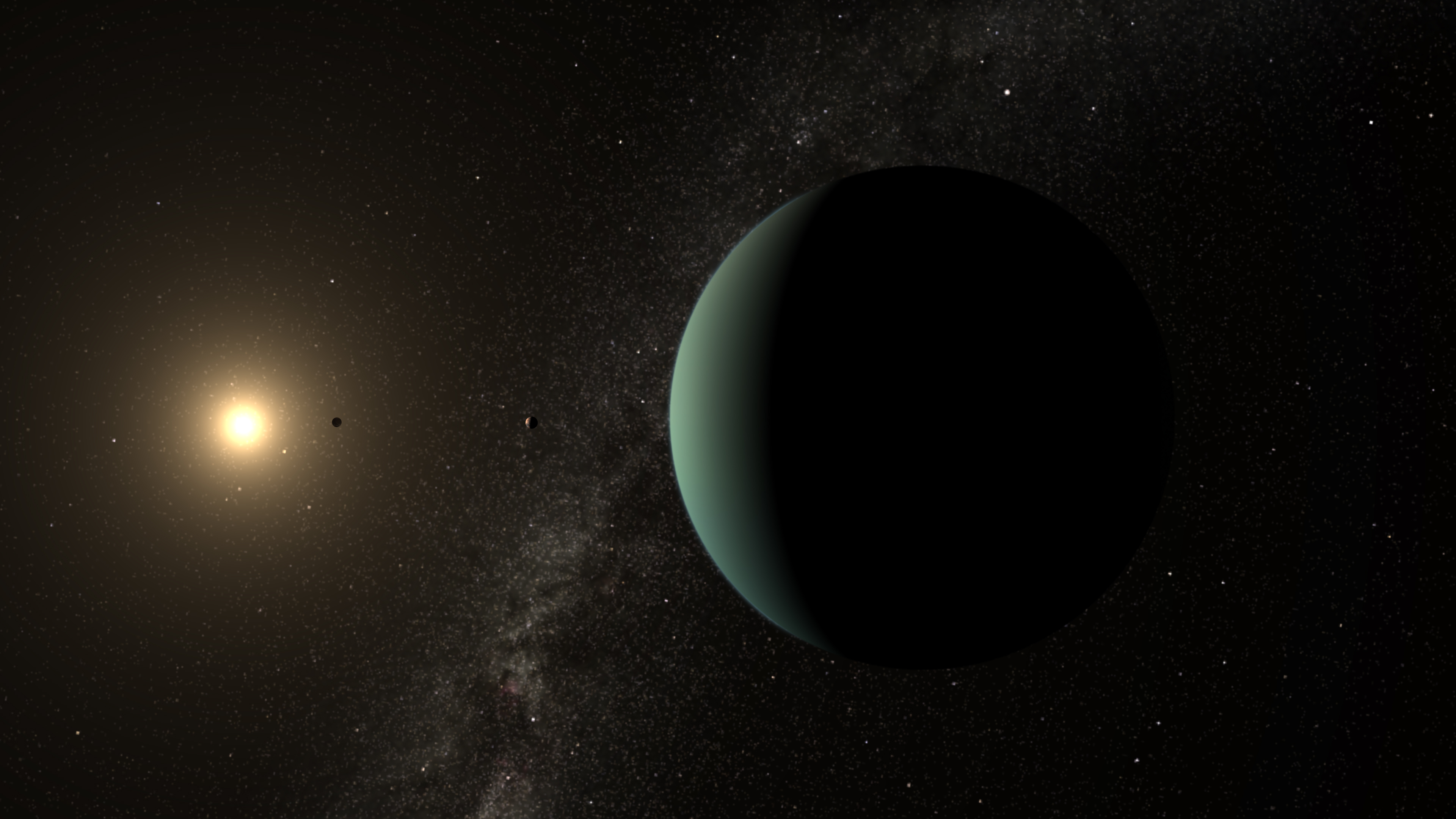
But I m sure we will find that the planet has issues that make complex life unlikely, just on a statistical basis.
Simple life seems increasingly likely to propagate through panspermia, based on what we find deep inside the crust of our planet. Life forms that feed off of radioactive decay especially seem promising for panspermia.
I wouldn’t be surprised at all if we discovered that for habitable zone, earth-like planets , the presence of simple life forms deep inside the crust turns out to be the rule rather than the exception, at least in our corner of the galaxy.
Too bad that the year is relatively short. If it were hundreds of Earth years that could be like Helliconia https://en.m.wikipedia.org/wiki/Helliconia
Too cold is one thing, but too hot I suspect is harder to handle.
Given we have ice on Mercury right around here, and the fact that I have to pressure can stuff like garlic because boiling won't kill spores, probably not a dealbreaker. https://nssdc.gsfc.nasa.gov/planetary/ice/ice_mercury.html
Or if "humanoid" even makes sense. Something snake like that can spread out the pressure along a longer surface might be better. Or at least something with more than two legs.
I would almost go looking at deep sea creatures that have to deal with extreme pressures on earth.
Weight lifters are able to lift 6x their body weights, but it's not a sort of load that we could profitably exist under long term. We'd need to have extremely thick limbs and at some point that won't help either because of the cross-section vs. weight scaling law. It's also a sort of weight where any kind of leverage against a joint will generate massive forces. E.g. try catching a 50kg falling weight, you are likely to dislocate your joints and/or break some bones. And yet 1/6 of that is entirely manageable.
Perhaps we've had it too easy here - moderate climate, oil as an easy fuel source, and gravity that isn't too oppressive. I wonder what technology would arise in a more difficult environment, such as this superearth.
I’m imagining some sort of mega cannon or railgun as a propulsion method to fling them off the planet.
1. That orbit make it really cold relative to Earth - like Mars is.
2. It doesn't say that the planet has a human-breathable atmosphere; it might, but it might not - like Mars.
Also,
3. Gravity force is gMm/R^2 right? Let's say same density as earth, and that density is uniform. Now, the mass relates to the radius by R^3, so the gravity force will be higher by 6^{1/3}, or about 1.817x higher than Earth.
So, would you say this is a habitable planet? It's kind of a stretch.
I'm not looking forward to a visit. Maybe it has a large moon like Earth. If it is in the same proportion as ours, the moon might even be friendly to humans.
[1] https://en.wikipedia.org/wiki/Habitability_of_natural_satell...
But on a more serious note, this is some great science. I am super impressed by how sensitive the instruments need to be to chart the fluctuations due to mass here at 20 light years. I'm always on the fence about whether or not we should focus a beam of RF with some modulation on it in their direction, on the one hand it would say "hello! we see you!" on the other that might not be a good idea.
The idea of an ecosystem hence culture for which a fundamental cycle is a year of fallow hibernation followed by a year of fertile plenty is quite compelling as a scifi trope though.
Me I'd name the planet Persephone for this reason.
How far away is such technology?
For 1000km resolution the requirement is three orders of magnitude smaller, or ~120km. Could such a device be terrestrial?
I'm talking about the Fermi Paradox. Basically, given all the stars we can see and that we see planetary systems around virtually every star we look at, then a decent portion of them should have rocky planets in the habitable zone. A portion of those should have the conditions conducive to life. A certain percentage of those will develop technological life.
Each of these steps that reduces the likelihood of technological life is called a "filter" in Fermi Paradox parlance. These vary from small filters to so-called "Great Filters". The idea of a Great Filter is almost no species gets beyond it. All the heavy elements we have access to might be a Great Filter.
As a reminder, anything heavier than helium is made in a star. Normal stars only make elements up to iron. It takes a supernovae or a neutron star merger to make elements heavier than this. So, for Earth to exist as is, there had to be a star relatively close to us that was the right size to basically go supernova. It had to be born, live and die before the Sun formed and that material had to be captured in our proto-planetary disk and ultimately become part of Earth.
We have thus far found absolutely zero evidence of these alien civilizations so the question is why? If we find an equivalent civilization to us on a really close neighbour then by Bayesian reasoning, it means it's significantly more likely that a Great Filter is still ahead of us.
And this isn't the case for this planet. This planet goes entirely outside and inside the habitable zone. By a lot.
My first, drowned-in-doom-news take: can I move there? Immediately?
You will not be substantially better or worse off a half-decade from now than you would have been in a slightly different circumstance.
If I'm wrong I will take up arms like anyone else. If you're wrong, I imagine there will be some excuse about how you were actually right and it's only because of some person or apparatus more politically palatable that averted this disaster. I don't mean anything against you personally but the same thing happened 8 years ago. Everyone was convinced that it was the end of the world and if you elide COVID-related things everything was pretty much the same as it was. The other side of the aisle said the same thing about Biden and that was equally false despite his objective and verifiable cognitive decline. The same thing will be true 4 years from now, 4 years after that, yet 4 more, etc.
So please do not minimize what people are going through, it may not impact _you_, but many people are negatively impacted by the insurrectionist taking over the USA.
Balance compassion for yourself and others. Finding the balance is really hard, maybe impossible to do perfectly, so you have to try constantly. When you get close, I think you'll find that negativity evaporates in yourself in a way that's infectious to those near by you. Take care.
Barring science fiction, of course.
Wolfram Alpha has a good calculator if you want to play around with this [0]
[0] https://www.wolframalpha.com/input?i=surface+gravity+calcula...
Feels like our older cousin from just 20Ly away
I'd prefer to hear about interstallar travel news rather than DeepSeek ones :-) The pale-blue-dot is really generating anxiety :-/
However, I recommend you figure out how to reduce your anxiety, because after reading it for a while it will become clear that interstellar travel isn't happening any time in the foreseeable future. Fortunately, I don't think that a species that flourishes from the hot tropics to the freezing arctic is likely to be in much existential danger from climate change, and even less from the volatile vagaries of politics. (Climate change might bring very substantial changes, but escaping off-planet isn't going to be less change)
I'm sure you are talking about bacteria, not humans. Don't you ??? :-)
I believe we have some of those, too, but very few. Another one is still a bit of a big deal.
Kepler's First Law says otherwise.
That's about twice as eccentric as Pluto/Mercury; Earth's is 0.016.
It's a reasonable layperson-friendly summary of the situation.
They're not perfect circles but close enough for all practical purposes.
How long until HN community picks up interest