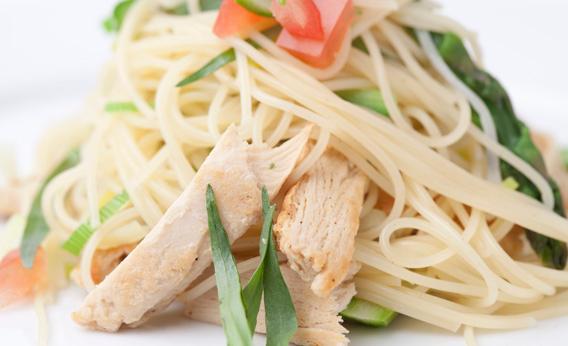
Beyond Meat’s Fake Chicken Tastes So Real That It Will Freak You Out
The first time a vegetarian tastes Beyond Meat’s ersatz animal flesh, he’ll feel delighted and queasy at the same time. There’s something about the way...
Slate Magazine
88 points · by krschultz · 14y ago · 178 comments
My biggest problem, though, is if I'm having ingredients that aren't meat, I'd like to have them be good. I've never had fake meat that I would call appetizing.
I've had lots of vegetarian dishes that were delightful, but not one included fake meat.
I am not vegetarian.
... at least one new product is a better-than-adequate substitute for chicken in things like wraps, salads and sauces. I know this because Ethan Brown, an owner of Savage River Farms, came to my house and fooled me badly in a blind tasting. (A pan-European “LikeMeat” project appears to be making progress on a similar product, and others are in the works.)
On its own, Brown’s “chicken” — produced to mimic boneless, skinless breast — looks like a decent imitation, and the way it shreds is amazing. It doesn’t taste much like chicken, but since most white meat chicken doesn’t taste like much anyway, that’s hardly a problem; both are about texture, chew and the ingredients you put on them or combine with them. When you take Brown’s product, cut it up and combine it with, say, chopped tomato and lettuce and mayonnaise with some seasoning in it, and wrap it in a burrito, you won’t know the difference between that and chicken. I didn’t, at least, and this is the kind of thing I do for a living. Brown does not see his product as a trendy meat replacement for vegans but one with more widespread use. (His production is at an early stage, but Whole Foods is planning to start using his products in prepared food soon. Retail sales of his “chicken,” which does not yet have a trademarked name, are expected to begin this summer.)
http://www.nytimes.com/2012/03/11/opinion/sunday/finally-fak...
So it sounds like this is a complete substitute in dishes where you chop up the chicken and add strong flavors, and not really intended to be a substitute otherwise. It's not 90% of the way there in all dishes -- it's 100% of the way there in 75% of dishes. And it's cheaper and takes probably a quarter of the resources to produce. Given the size of the total market, that's a huge deal.
This. I know good chicken (3 hoorays for the countryside) and I know the stuff they sell in many places taste nothing like it.
Selling fake chicken to meat lovers won't work, selling frozen vegetable chicken nuggets rather than frozen pseudo-chicken nugget would.
He eats meat, just not as often as your average person.
Essentially all the cost of feeding and cleaning the cattle is very low, and storage of raw meat after slaughter is very cheap.
Alternatively storing the raw products for fake chicken are incredibly complicated. Furthermore, once the product is produced there is a ton of regulation about its care and handling. What's perhaps most troubling is the risk to workers while producing the product. They require fairly risky industrial tools, and not every manufacturer is really dillagent about providing good guards for people's hands.
Cows require 50 times more protein from grain as input than they provide after being slaughtered (you can google this, it's research from Cornell). You are 180 degrees wrong on that point, the cost of feeding them is _very high_. Unless you can genetically engineer them to have more efficient metabolisms, this is a fundamental problem for beef.
I can't tell if you're serious about the last paragraph. Citations would be great, because it's hard to believe that real meat is less regulated than plant-protein based fake meat or that the risk to workers that make it is less than to those working in an industrial slaughterhouse.
I'm not even a vegetarian...
The main point of making this in the first place is to save energy and resources.
The chemicals you're talking about are pea powder, soy, carrot fiber, and flour.
The slaughtering houses have some of the worst working conditions you can find anywhere in the U.S.. I don't think you'll find any casualties for workers who mix some ingredients together in comparison to chopping up cows.
Sorry if it was just joking, but it was kind of hard to tell.
Anyway, the "chemicals" going into this are a relatively small part, the bulk being the vegetable protein.
And how can you argue that storing beans and additives is more complicated than storing cows???
These guys have me pretty convinced there isn't: http://goo.gl/eoDaF
> The problem with observational studies like those run by Willett and his colleagues is that they do none of this [test their hypotheses with real randomized controlled experiments]. That’s why it’s so frustrating. The hard part of science is left out and they skip straight to the endpoint, insisting that their interpretation of the association is the correct one and we should all change our diets accordingly.
> Moreover, this meat-eating association with disease is a tiny association. Tiny. It’s not the 20-fold increased risk of lung cancer that pack-a-day smokers have compared to non-smokers. It’s a 0.2-fold increased risk — 1/100th the size.
As for scientific validity of those studies, doing proper scientific studies of diet is so difficult it might as well be impossible. What kind of person is going to volunteer to have someone else dictate their diet? What kind of person is going to comply with that diet long-term? If you want to do a blind study, you have to turn all food into unidentifiable mush. You can't have people seeing broccoli florets or pork chops.
There is a proposed theory for why red meat has those effects: Neu5gc consumption causing persistent low-level immune response. Less conclusive dietary studies have noted a difference, but without doing a scientific study giving one group Neu5gc supplements and another placebo, how can we know? Ethics boards might have a problem with that, since Neu5gc can be demonstrated in vitro to trigger an immune response.
Perhaps the most general and plausible theory is that it has nothing to do with inherent unhealthiness of red meat or meat in general. Rather, more meat consumption means less dietary fiber, fewer fruits and vegetables, assuming the same total caloric consumption. Meat consumption probably also correlates to excess calorie intake, which is a risk factor for a variety of chronic diseases.
You should read the article; the rest of the paragraph is as follows:
> So with lung cancer we could buy as a society the observation that cigarettes cause lung cancer because it was and remains virtually impossible to imagine what other factor could explain an association so huge and dramatic. Experiments didn’t need to be done to test the hypothesis because, well, the signal was just so big that the epidemiologists of the time could safely believe it was real. And then experiments were, in effect, done anyway. People quit smoking and lung cancer rates came down, or at least I assume they did. (If not, we’re in trouble here.) When I first wrote about the pseudoscience of epidemiology in Science back in 1995, “Epidemiology Faces It’s Limits”, I noted that very few epidemiologists would ever take seriously an association smaller than a 3- or 4-fold increase in risk. These Harvard people are discussing, and getting an extraordinary amount of media attention, over a 0.2-fold increased risk. (Horn-blowing alert: my Science article has since been cited by over 400 articles in the peer-reviewed medical literature, according to Thomson Reuter’s Web of Knowledge.)
The point is that we don't know if there's a 20% increase of risk if you start eating more red meat. We only know that the people who elected to do, and were sampled in the study (the top quintile), did have a 20% increase. There's a big difference here; statistics is subtle.
> As for scientific validity of those studies, doing proper scientific studies of diet is so difficult it might as well be impossible.
I agree, but then we should refrain from telling people that meat, and red meat in particular, is what's killing them. Especially when there are much more likely targets, like sugar.
Don't take that as criticism of the product, I'm just curious what it's properties are and if you'd need to revamp your recipes if you wanted to use this stuff.
It withstood both form of cooking fairly well. It browned in the pan and absorbed some liquid in the broth, but it didn't break down.
However, I don't know if this stuff would be grillable. It's not a big chunk like a real chicken breast. It comes out of the package in small chunks. So it'd work great for some recipes but not for things like chicken piccata.
However, I highly recommend Gardein for recipes like those. It comes in the form just like chicken breasts, and works great for recipes that require a large flat piece.
Anyone wanna try ice cream with frozen chick-a-like chunks?
Ingredients in this: Water, Soy Protein Isolate, Pea Protein Isolate, Amaranth, Natural Vegan Chicken Flavor (Maltodextrin, Yeast Extract, Natural Flavoring), Soy Fiber, Carrot Fiber, Expeller-Pressed Canola Oil, Dipotassium Phosphate, Titanium Dioxide, White Vinegar
So, it's not terrible but it's just more fake pseudo-meat. What's so hard about buying a soy protein (firm tofu, tempeh, etc.), and just cooking it with spices and herbs like you would a regular piece of meat? Fake food sucks.
EDIT: Although I agree -- I'd always prefer foods taken for what they are rather than substitutes. Then again, I'm not vegetarian.
A roasted chicken or a steak is one thing, but a lot of uses of "meat" really only call for some kind of processed product that has a certain taste and texture. Chicken patties at McDonald's, for example, are not actual cuts of chicken meat, but mechanically separated meat that's reformed into a patty that attempts to mimic a certain meat-ish texture. If you can mimic that same chicken-patty texture with a non-animal sourced set of ingredients as the input, I don't see it really as any less natural.
(Alas, it does me no good personally, because I'm allergic to soy protein.)
To counter Botulinum toxins, frozen meat contains Sodium nitrate, a known carcinogen(http://en.wikipedia.org/wiki/Sodium_nitrate#Health_concerns).
If you like it, great. In some dishes I find tofu nice. For the most part, though, I dislike the consistency and find that outside a few types of dishes it can't compete on taste at all. I love chicken in a wide range of forms. I have no qualms about eating chicken. That it's the result of murdering animals does not disgust me the least.
In that context, it would have to offer something other than not being chicken as a benefit before I'd consider buying it. That is where there's a huge opportunity: Competing on price, taste or health factors with the actual animal products in the segment of the market that want something that tastes at least pretty much like the animal products.
Whether or not it is "fake" is irrelevant. Nature does not have a monopoly on making things good. What matters is how it stacks up with what it replaces in your diet. For most of us what it would replace is presumably chicken.
http://www.menshealth.com/nutrition/soys-negative-effects
Not too reliable of a source, I know, but there's a bunch of reputable books that I've read back in the day on this subject that said the same thing.
If you can't find them yourself (the Wikipedia entry is a good start), let me know and I'll provide citations.
Personally, I don't touch the stuff.
1. Phytoestrogens found in soy are chemically related to human estrogen
2. Phytoestrogens are readily absorbed by humans when consumed
So it was a reasonable hypothesis that soy might be harmful to men due to phytoestrogens. This hypothesis has been tested, and falsified, by numerous studies.
So far all the "pro soy" people have posted exactly zero references.
I would just like to check for myself.
http://www.jacn.org/content/19/2/242.full
"Results: Poor cognitive test performance, enlargement of ventricles and low brain weight were each significantly and independently associated with higher midlife tofu consumption."
"We hypothesize that regular dietary exposure to soy isoflavones over many years during middle life may be associated with the appearance of accelerated brain aging in later life attributable to chronically sub-optimal neural plasticity."
That's key right there, and it's all you'll ever get from a longitudinal study. You want to make strong claims about the effects of soy like "soy is a terrible idea", you're going to need a controlled trial, not a cohort study.
I am also concerned about the validity of the theory because of the trend stall in figure 2 at ages 80-89 and the stark reversal in the 90-93 age group, where high-high was at almost low-low levels.
It looks to me like there is a good chance of some unaccounted confounding variable, even beyond the possible effects of exercise (which would not explain the 90-93 group).
Soy is not going to be a complete substitute for meat's nutritional components. Supplemented with lots of liquid aminos, etc? Probably will work well. But the worst part for me about a vegan diet is the difficulty in getting enough fat intake. Too little fat in the diet causes depression.
I did a quick search, and turned up a study in PLoS ONE[1] which found trans fatty acids correlate with increased depression, while there is a weak inverse relation to mono- and polyunsaturated fat intake. But a blog reviewing the study[2] points out some limitations. And some research mentioned at [3] apparently concluded there is a link between depression and DHA specifically, but if that's true it wouldn't affect only vegetarians: "Most people in the Western world do not get enough omega-3 fatty acids [such as DHA] in their diet."[4]
Your claim is new to me, and as someone on a low-fat vegan diet, if you have a more conclusive reference I'd be curious to see it.
[1] http://www.plosone.org/article/info:doi/10.1371/journal.pone...
[2] http://evolutionarypsychiatry.blogspot.com/2011/01/dietary-f...
[3] http://www.fi.edu/learn/brain/fats.html
[4] http://www.umm.edu/altmed/articles/docosahexaenoic-acid-0003...
I'm sure many, many vegetarians live great, happy lives on their diet. I'm not one of them. Years of farting all the time from soy (beano didn't do it for me), never gaining muscle, not being able to socialize with my male buddies since 90% of the vegetarians i encountered were females..... the list goes on.
Whey protein can be used to produce biodegradable packaging material. Doesn't mean I'd be automatically willing to replace my whey protein shakes with eating boxes. Not even if they taste nice.
That hormones given to chickens cause chicken breasts to "plump up"?
That said, the modern industrial slaughter of animals is an ongoing atrocity on an unbelievable scale, worst than anything humans ever did to each other (and can only be deemed acceptable if you vouch for biblical notions of human supremacism). If this helps any, all the best to them.
For example, a can of coke isn't actually bad for me per se, it's just nutritionally useless, and it's taking up 100something calories out of my calorie budget for the day that could be used by something with a higher amount of micronutrients in it.
I don't think any vegetarian or vegan is going to throw out all their veggies and start eating nothing but meat alternatives as soon as a viable replacement comes out.
She will be sticking to her nut and bean burgers no matter how good a fake beef burger tastes (to me).
http://www.nytimes.com/2011/04/17/magazine/mag-17Sugar-t.htm...
You're kidding right? There's a ton wrong with processed foods. We humans love to outsmart ourselves. Ooh, let's make our own food, screw mother nature and home-grown veggies, fruits, and animals! And then wonder why cancer and obesity rates are increasing.
And hunting and gathering? Screw that! We're gonna create higher abstract levels of work where u stare at a computer screen for 8 hours a day! Woohoo! Why expend so much energy running and walking for food when you can sit all day?!.. Then we wonder again why obesity rates keep going up.
I am not claiming processed foods are good, they're just not bad. Someone who eats nothing but coke and snickers all day will be unhealthy, but that's more because of what he wasn't eating than what he was eating. It's not like eating processed food somehow destroys nutrients in your body.
Obesity is an issue because of overconsumption of food, period. Granted, a lot of the food we overconsume is processed foods. They're cheap and available everywhere. Corn is heavily subsidized which makes HFCS incredibly cheap.
[1] http://www.heart.org/HEARTORG/GettingHealthy/FatsAndOils/Fat...
2: The ethical justification for humans eating animals has exactly nothing to do with the bible.
For the record, I'm no fan at all of battery chicken, and if that market can be displaced by a cheap non-meat substitute, that's clearly a big win.
> ethical costs
And yes, I had an opportunity to witness how pig becomes bacon and tasty sausages when I was kid.
Your point about activists makes no sense. Would you accuse someone campaigning against sexual assault of going on a mission to stop male geese from raping females?
Just because we used to do it doesn't mean it's right or ehtical to continue doing so now that we can avoid it.
Then again, bacon is yummy.
Other animals hunt other animals, and the ecosystem ends up in a sustainable equilibrium. Humans, however, get most of their meat from industrial agriculture, which is an extractive system that drains water tables and pumps carbon dioxide into the atmosphere.
That's very definitely an ethical problem that we have manufactured.
I don't think the government should use my tax dollars to directly and indirectly subsidize meat eating.
Human's eat meat, is that the slogan like 'beef, it's whats for dinner'. Hardly a convincing statement.
Shouldn't we respect consciousness and the living force even in less developed creatures?
So while I applaud them trying to compete with meat directly and potentially sniping some carnivorous business, I hope they will also keep a few boxes for me in the hippie section.
The difference that a bit of exposure to green forage in an outdoor environment makes, both to the flavour and texture of the chicken, is AMAZING. Industrial broiler barn chicken pales in comparison.
I'd encourage anyone seeking to buy a more environmentally friendly chicken to try to make contact with a local organic farmer who's able to raise his birds outside and in a humane fashion.
We also raise our birds to be much heavier than a store bought bird - on average about six pounds after processing vs three-ish pounds in the store. I'd wager that your meat-to-carcase ratio is probably higher for one of our birds, giving a better value. (Actually, it's better value regardless - we sell our birds for $4/lb vs $5/lb for the broiler barn organic birds in the store.)
Environmentally, there's less concentration of pollutants. All of the chicken manure goes straight on the grass and is a primo source of nutrients for subsequent hay crops. For me it's a win - I don't have to apply fertilizer nor clean out chicken barns.
Coming from an animal welfare standpoint, just because you're buying "organic" chicken in the store, doesn't mean they've been raised in a humane fashion. I carry no guilt in eating our chickens. They're not overcrowded, debeaked or in a dusty, foul smelling environment. They live as well as I can provide up until the day they go for slaughter.
(I don't know anything about your consumption, just making a point.)
Assuming we all share the goal of a famine free world, with its people living lives of relative equality, then the excessive consumption of meat in the west is a problem which needs to be addressed.
As the parent suggests, treat high quality meat like the luxury it is, and enjoy other foods instead. It's better for you, and better for your fellow humans.
I see a future where lab grown meat, and meat substitutes make up the majority of our consumption, and hand-reared, high quality meat is saved for special occasions.
EDIT: Funny thing is that the menu has item names such as "vegetarian chicken" and I am not kidding.
This has been getting better with time, but unfortunately a lot of fake vegetarian and vegan meats tend to be unhealthy. In order to get some decent taste and texture, some odd ingredients are often used. Vegan does not equal healthy in all cases. This one sounds pretty good, hope they find their way to Canada and branch out to different meats, too!
I imagine these kinds of foods are ok for transitioning into a vegan. However, I was vegan once, and I took it as an opportunity to discover all kinds of new vegetables and fruits. It was interesting learning to cook with no meat. I had discovered a whole new world of food.
Eating fake meat seems a bit nostalgic tbh.
The slice is made of pure egg white, that is albumin, which is a source of the most valuable proteins, necessary in metabolism of organs of living organisms. New modern technology of processing of the hen egg white has been developed in the Czech Republic and patented. This technology turns the white into a porous material further processed in pressurised steam chamber. That produces a compact belt of thin layer of material, composed of microscopic fibres. The belt is then rolled into the shape of cylinder, cut into smaller pieces. These are then pressed into the final form of 100-gram slices. Finished slices are vacuum packaged in plastic bags. As final treatment, each bag is re-sterilised in special equipment.
from http://www.iufost.org/publications/newsline/Newsline55.html
I wonder if the opposite could be done to create a fake carrot made entirely out of meat?
Beyond Meat's website has "without the bad stuff (no saturated or trans fat, no cholesterol, no gluten, no antibiotics, no GMOs...and no meat)". How is gluten "bad stuff" unless you have celiac disease?
I understand what you're saying, but the short answer is because fake meat is not meat. I don't think it's about not eating what tastes good but it's about not eating meat (or any animal by-products).
"Brown’s long-term goal is to offer a product that can satisfy the world’s growing, and largely unsustainable, demand for meat, especially in ballooning markets like India and China."
"Meat is environmentally toxic and colossally inefficient, ethically dubious (even if you’re OK with killing animals, raising and slaughtering animals in factory farms is hard to defend), and it’s unhealthy (that’s even true if you don’t eat it—there’s good evidence that the rampant use of antibiotics in livestock production has given rise to drug-resistant infections)."
The amount of resources required to raise an animal to the age at which it can be slaughtered for use as food is a very real problem as the natural resources of the world are strained by population growth.
I don't disagree that we need to find more sustainable ways to feed ourselves, but we also need to be feeding ourselves quality food that matches our biological needs. Not whatever is most conveniently and cheaply produced.
Is it possible, sure but economics just a question of what your willing to sacrifice for what you want. And significant quantities of fake meat is probably a much better option for everyone involved.
I eat a lot of meat. I could not conceive of giving up meat. Not going to happen. I don't care if I have to slaughter the animals myself to get it.
But if there was a high enough quality "laboratory meat"? I'd try it. I'd even be willing to pay more for it in certain circumstances:
- Consider custom-adapted marbling. - Arbitrary sized cuts. Want a fillet larger than any real animal? - New types of "meat"? Yes please. - Healthier versions? If they can come up with variations that taste as nice while being better for me, sure, I'll pay a premium for that.
While there undoubtably will also be attempts to make cheap replacements, there's no reason to automatically assume that the fact it is "faux-meat" means it can't be just as healthy - or better - than the real thing.
For beef, sure. But chickens are very quick to produce (2 months).
Anyway, to reply to the "statisfy China" thing, let me tell to the author of this "invention" that he is solving a solved problem: China has a long track record of feeding its numerous populace with doufu (tofu) instead of meat. I was very impressed the first time I saw a countryside market. They were selling big doufu pieces in different street shops, and only one butcher was selling a few pieces of hanging meat.
The trick is to actually use little pieces of pork in a doufu-based dish, and many spices, like the delicious Mapo doufu.
Even when eating meat-based Chinese dishes, like Huiguorou, you will eat much less meat than in a classic Western course.
So, in fact, the solution to the possible future problem of Chinese people eating too much meat is not to feed them with that chicken ersatz, it is to avoid Westernization to go that far.
I have a few proposals in this direction that should be common sense:
- Stop using hamburgers as the logo for food in games, apps and other places. Only a very tiny part of the world regularly eat these nocive things.
- Stop displaying actors eating snacks in movies. (We already stopped showing them smoking, except for the villains). Going at any time to the fridge and eating something out of it is a very recent and nocive habit that should not be shown as the normal "American Dream" life in successful mainstream movies.
- Stop this cliché about disgusting intestine-based dishes or other "un-noble" parts. I am no vegetarian, but I think animal we kill for food should be eaten to the last piece of eatable tissue. In China, we (yes, me too) eat tendon, kidneys, fish tripes and heads, duck tongues, pig feet, everything, and cooked in hundres of different manners. It is healthy: eating meat or fish becomes a pleasure by its diversity, not by its volume.
Chicken produces 190 kilocalories/square metre/year.
Rice produces 1250 kilocalories/square metre/year. I assume soy is similar.
There are many other similar calculations to be made regarding demands placed on the land. With 7 billion people and counting, they're important numbers.
Put another way, if food producing acreage is the limiting factor for humans then as omnivores we may grow for 150,000 generations, as herbivores we may make it to 150,005 generations. Either way, growth will have to stop and we will have wiped out massive numbers of other species.
I understand the need to find some substitute with 7 billion people in the planet, but i think grown-in-a-lab meat will probably be a better alternative in the near future.
There's plenty more room out there for everything we need. Only political borders (placed by us humans) prevent us from using all available land/resources to provide for all of humanity.
No, it really hasn't. It just hasn't. This is one of those crazy truisms that becomes difficult to even debunk because it has no science behind it...but the people pushing it do so with such gusto and such complete confidence that people simply believe their unfounded assertions. It's a tiny sect of science deniers that selectively choose evidence and ignore everything that conflicts with their particular preference. The "paleo diet" is based entirely on a fictional retelling of human history, and it's about time it stopped being promoted as "research" or "conclusive".
Just the most recent article on the subject, but there have been dozens or hundreds of others: http://blogs.scientificamerican.com/guest-blog/2012/07/23/hu...
The evidence of human diets spans millennia, including pre-humans and early human populations. There are a very few bits of evidence of isolated populations eating what could be called a "paleo diet" by modern definitions (with a lot more bugs and grubs and nasty stuff like brains and organs from rats), but on the whole, humans have always been omnivores, eating anything remotely edible within their grasp, including mammals, reptiles, plants, fish, insects, fungus...if an alien landed during early human times, they'd have probably tried to eat it, too. But, most populations in most places were eating plenty of plant matter, including grains, and some of the oldest food evidence we have includes grains.
The idea that the early human diet was nearly all meat is a highly selective reading of the evidence; picking and choosing from only those populations in those locations where meat was the only available food source. I don't want to attack your deeply felt beliefs, as you seem to have a personal investment in the paleo cult, but it's simply not borne out by science.
Also, I strongly recommend not taking ones anthropology lessons from fad diet book authors.
Citations:
http://www.nature.com/news/2010/101018/full/news.2010.549.ht...
http://blogs.scientificamerican.com/observations/2009/12/17/...
And a fun discussion of the woo factor of the "paleo diet":
http://rationalwiki.org/wiki/Paleo_diet
Note that I'm not arguing that people should be consuming a bunch of white bread and refined sugar. Knowing the paleo diet is based on junk science doesn't mean I think the modern first world diet is sane.
Pre-historic humans, for example, had a life expectancy of about 30.
Another example of paleopathology at work is the study of Indian skeletons from burial mounds in the Illinois and Ohio river valleys. At Dickson Mounds, located near the confluence of the Spoon and Illinois rivers, archaeologists have excavated some 800 skeletons that paint a picture of the health changes that occurred when a hunter-gatherer culture gave way to intensive maize farming around A. D. 1150. Studies by George Armelagos and his colleagues then at the University of Massachusetts show these early farmers paid a price for their new-found livelihood. Compared to the hunter-gatherers who preceded them, the farmers had a nearly 50 per cent increase in enamel defects indicative of malnutrition, a fourfold increase in iron-deficiency anemia (evidenced by a bone condition called porotic hyperostosis), a theefold rise in bone lesions reflecting infectious disease in general, and an increase in degenerative conditions of the spine, probably reflecting a lot of hard physical labor. "Life expectancy at birth in the pre-agricultural community was bout twenty-six years," says Armelagos, "but in the post-agricultural community it was nineteen years. So these episodes of nutritional stress and infectious disease were seriously affecting their ability to survive."
http://discovermagazine.com/1987/may/02-the-worst-mistake-in...
"Fake" meat tastes and looks like the real thing, but it has none of its downsides (look up "Forks over Knives" for some decent documentary on that. take with a grain of salt).
But seriously, the fact that 10,000 years ago human-type creatures ate a lot of meat should be like number 76 on your list of arguments in the sustainability of diets debate.
Aside: Anyone who figures out how to make salmon produce pork will have a license to print money (kosher pork!).