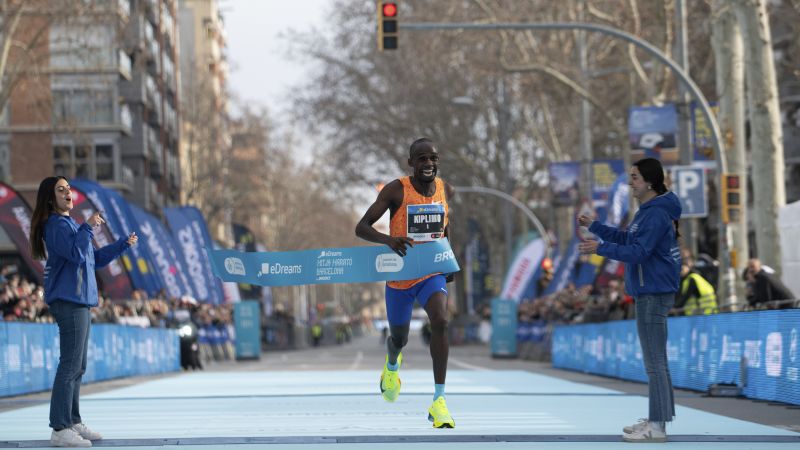
Ugandan runner Jacob Kiplimo completes first ever sub-57 minute half marathon, smashing world record | CNN
Jacob Kiplimo shattered the half marathon world record with a blistering run on Sunday.
CNN
171 points · by mooreds · 1y ago · 149 comments
How these guys do it for that long and that fast still amazes me, but I felt like i got a little glimpse into how it works.
For me it’s cycling, I do 300-400 km per week now and I absolutely love everything about it. The feeling you get when you find a smooth bit of road on a still day and you can feel is the wind in your face and all you can hear is the swish, swish, swish of your tyres is unmatched. It feels like you’re flying.
You weekly distance is excellent. Work and life get in the way of me exceeding 300 regularly, I sit at 250ish.
If you have not already you should try rowing. When you get some speed on water it feels really good.
That leads into riding defensively. I ride with the mindset that everyone is trying to kill both me and themselves. I expect people to pull out in front of me, I expect doors to open etc.
To get a bit more used to being around cars I would recommend getting up early.
But really the main thing is confidence. You have just as much a right to be there as anyone else, and in reality the vast majority of drivers are great. I very rarely have bad experiences with cars. Obviously it takes time to build up confidence, but at the end of the day a confident, assertive rider who signals and manoeuvres well ahead of time is going to be safer than a nervous, skittish rider.
The relative speed between vehicles it's what does matter - keep the flow (or between the waves), the distance and attention (doors, sideways, blind spots, bus stops), be obvious predictable, use your imagination (fly trajectory) and signaling - even take a middle of the road when needed to not confuse someone he can take a chance to overtake you at wrong moment.
It's always a great idea to do regular cycling no matter the elevation as it's a great "compacting machine" for digestion
I actually live in a fairly hilly area, per 100 km I would expect to do at least 1,000 m elevation
EDIT: what my training looks like: zone 2 training with a chest strap monitor. 30-45 min sessions, barely breaking out of walking speed, 2-3 days a week for months altogether, mixing it up with interval runs some times. I've done this many times over in my life, never seeing any improvement. Even today, the smallest of jogs will take me to max HR within 10-15 min
The idea of "zone 2 training" that is peddled sometimes on social media makes no sense if you're not running consistent mileage and actively looking to run faster. At that point, the idea is that you're minimizing injury risk in between 2+ hard efforts per week, while still getting in the miles.
Also running extremely hard for a good distance for me at least, became mentally a lot less enjoyable
https://www.ntnu.edu/cerg/hrmax
— and a Fitness Calculator —
https://www.ntnu.edu/cerg/vo2max
— based on treadmill VO2max tests of thousands of Norwegians.
Check your scores.
2) You say your heart-rate shoots-up fast. Does your heart-rate drop-down fast when you stop exercise?
At-rest maybe 50, warmup-jog maybe 100, then it depends on the ambient temperature. If it's 85F then HR drifts up to 140 and flattens. If it's 50F then HR drifts to 110 and flattens. Then it depends on effort. If it's 85F and hard then 155; if it's 50F and hard then 135.
Last-time I looked my calculated HRmax was 170.
3) I'm not offering medical advice. In my understanding HRmax does not mean something bad will happen if heart rate goes higher. HRmax means heart rate is unlikely to go higher.
Maybe trust your cardiologists?
I’m still slow when running, but then my goal is just to be able to run and not get injured. I built from 5k, to 10k and now can complete half marathon races on trails, which is a lot of fun. I’m a big advocate for minimal footwear and building strong feet. We are born to run, but modern footwear is silly.
I prefer a lactate test, rather than max HR, because it’s “easier” for me to induce. Basically, run a 30 minute, even paced, maximal effort. You then calculate your LT by removing 5% off the pace and HR averages you got.
The important part is the pace must be reasonably even and also maximum effort. So, it’ll feel easy to start and by the end you’ll want to vomit. If you’re lucky enough to live near a Park Run, you can do this a few times instead to learn your max effort pacing and work out Z2 from that.
Not really going anywhere unless you step into tempo/threshold/VO2 max training.
"HRmax was univariately explained by the formula 211 − 0.64·age, and we found no evidence of interaction with gender, physical activity, VO2max level, or BMI groups. ... Previously suggested prediction equations underestimated measured HRmax in subjects older than 30 years."
https://onlinelibrary.wiley.com/doi/abs/10.1111/j.1600-0838....
Tl;Dr - I got a basic thing that told me my pace (this was pre-smartphones but basic wearables existed) and turned out what I thought was relatively gentle and reasonable speed was actually a really fast pace and totally unsustainable.
When I knew what my pace actually was, I could stick to a much more sustainable (for me) ~5:30 min/km pace and it felt soooo slow and embarrassing and like I was barely even moving in comparison! But this was a much more realistic pace for a tubby software engineer. And for a long time I had to keep checking the pace as the speed would creep up during a run and it took discipline to "stay slow".
I use the runkeeper app that has the option to do pace read outs through your headphones every few minutes. I'd recommend trying something like that, and perhaps try to begin with a pace of like 6 or 7 min/km for 10-15 mins runs and stick to it and see if that helps, before starting to extend duration and speed after you've built some endurance. I've found fitness and condition improves fairly rapidly - O(weeks). Good luck.
Ignore the zone 2 messaging for now. Zone 2 training is basically useless for getting better at running when you're just starting because a new runner staying in zone 2 is just walking. You need to run to get better at running. For now, just ignore heart rate and focus on how you feel. Do run/walk and gradually work on increasing the time you run before you stop to walk.
PS.
"Zone 2", “80/20" and the like is advice that's really meant for intermediate runners starting to train more seriously and it basically just means "it's better to run easy most of the time so you can run more, and so when you do run hard you can get full benefit because you're not already exhausted. "
It is good advice in context but has been spouted without context by so many running youtubers and influencers that it has probably done more harm than good.
Personally I feel like it started to feel better only when I built some strength in the whole legs and core muscle areas, such that they would all work together to make me move. It's hard to describe. But if I run after sitting a lot when everything is tight and seized up, I'll go back to feeling like a beginner.
But then somewhere in my mid-30s something clicked, and now I love it. Like you said got to get over that initial hump of it hurting, doesn't take long, and then it's just soooooo good.
I'm not running any races or training for anything in particular. I just run for me and my physical and mental health several days a week. It's my "me" time. I definitely get it now.
Also a great way to explore all the nooks and crannies of my city, and find how to link up all the parks and trails and cut-throughs.
I still enjoy hitting targets, improving my speed and technique etc. but it is never a relaxing process.
Humans aren't meant to run on pavement in the city or on treadmills. It makes running much less enjoyable.
That's what I do as an amateur but then again I have no running watch, I run in $15 shoes, I don't care about PR, distance, &c. all I care about is slowly and safely building cardiovascular endurance
Beyond that, boredom and sore feet set in before cardio becomes the limit. I can’t imagine ever running 25K…even at a low(er) HR. Maybe if I lose another 5 to 10 kg of weight…
In 2021 I got COVID and couldn't run since. I'd be exhausted and out of breath after just a kilometer or so, it was frustrating to say the least. To overcome that I proposed a 100-day running challenge with a buddy. We live in different cities, so we just ran our own distance and speed we were comfortable with. No tracking app, no stats, no target time or distance, just go out every day and go for a run. First 50 days were frustrating, it took me weeks to just get up to just 2km and then immediately plateaued. The around day 50 I noticed I could slowly start to pick up distance. I intentionally capped the distance to 6km or so, knowing that a 100-day streak is not great for your body. The last 10 days I decided to run 10km every day, which to my surprise I could do effortlessly. And I noticed something else changed. I did the 10km and then I... just wanted to keep going. I didn't though, knowing that 10km a day was already a terrible idea for someone of my age.
After the challenge I took 2 weeks to recover, and then I just went for a long run, see what would happen. I did 16km that day and other than noticing being low on energy at the end, I never felt out of breath. I didn't set that as a target, I just kept going until I no longer felt like going further. I now regularly do a 25km run, but there are also days where I do 10 and feel content. I don't bring my phone or smartwatch, I don't track my time or progress, I don't set targets, I don't care anymore. When it feels good I'll keep going, and if not I'll just do a shorter route, I'm no longer pushing myself. Running has now become my way of relaxing, gathering my thoughts, enjoying being outside. It has become effortless and carefree.
Maybe for everyone it's different, but in my N=1 experience I just needed to stop chasing progress, don't set expectations, no targets. Just get out there and enjoy yourself. Sometimes I do still push myself just for fun to see what I'm now capable of, but other than that I deliberately stay below my limit.
Not sure what the takeaway from this story is supposed to be, I just felt like sharing. Hopefully it helps someone finding more enjoyment in running :-)
I'm jealous of this "Forrest Gump" mindset...I also run to maintain/lose weight, so I use my watch (plus intuition, as mentioned) to manage my pace/heart rate/effort so I can run a long enough distance to burn enough calories.
Although I also realize and acknowledge all these stats are probably at least 50% there to satisfy my caveman need for external validation.
If part of you isn't wishing for death by the halfway mark of a 5k race, you've probaly left time on the table.
Within a year, I rode a bike across the US.
The body adapts to the load it's given, provided enough time.
This is the 5th running record broken in a week (2x 1 mile, 3k, 5k, and now HM), the other ones being indoor times that match the current outdoor records. I wonder if they will start banning certain shoe technologies during races now, but of course they cannot ban athletes from using illegal shoes during training.
[1] https://www.capitalfm.co.ke/sports/2015/04/13/ak-suspends-ro...
[2] https://www.reuters.com/article/sports/italian-agent-charged...
I think that's already the case, isn't it? For instance: https://www.reuters.com/lifestyle/sports/vienna-marathon-win...
> they cannot ban athletes from using illegal shoes during training.
I don't understand why you would in the first place, what would be the reasoning here?
I think one reason for anti-doping regulation is health, you don't want athletes breaking a world record one day and die the next. And doping during training definitely gets you some advantage, sometimes even years after, so the competition is no longer fair. But I don't see the harm with equipment such as shoes, if used only during training.
As for training, that's a pretty contentious topic in the running community right now -- some recent research concluded that training in supershoes might actually impair race performance: https://www.outsideonline.com/health/training-performance/su...
afaik, only the stack height is regulated. Specific technologies like foam, carbon plates etc. are not.
> I don't understand why you would in the first place, what would be the reasoning here?
Personally I'd love to see more shoe development, but I image that if you feel that using supershoes during races is cheating, you'd feel the same about using them while training.
You ban doping during training because it gives an advantage at race time. I don't see the analogous reasoning for shoes.
I don't know for sure but if the shoes relieve stress on some parts of the body, e.g. leg joints or muscles, you can get more time training other parts at higher intensity with less injury risk?
  if you can’t beat the Kenyans then join them

  Zane Robertson famously moving from Hamilton in 2007 at age 17, along with his twin brother Jake, in part to escape bullying and a broken family, to live and train in Kenya with the hope of mixing it among the best distance runners in the world.
There is probably a minor genetic component, microevolution promoting higher hemoglobin/etc than average, similarly to many Tibetans. But childhood conditioning seems to be a more powerful effect.
Not only at the elite level, but our junior teams and even school teams perform well on the world stage.
Like you say, that social factor plays a huge part in it. Support, funding, etc etc
I'm not sure I could sustain this pace for 1 minute, let alone 57. Incredible.
these folks are basically at a light sprint
I'm an ok hobby runner and I'm not even sure I can hit that speed momentarily on a downhill.
His middle 10K (5K-15K) took 26:13, which is 2 seconds off the 10K track world record.
> his 15km split was initially recorded as 39:47 before it was confirmed after the race as 40:07, improving his own world best.
(5km was 13:34)
https://worldathletics.org/competitions/world-athletics-labe...
It also has nothing to do with carbon but rather the stack height (>40mm is illegal).
I'd love to know what "resting" means for this guy practically.