162 points · by Stratoscope · 1y ago · 171 comments
My dog for instance is not particularly food motivated. He believes strongly that there is “food” and “better food” and will hold off until he’s really hungry to eat something that’s just food. But he’s very motivated by attention. He will do tricks for treats he doesn’t like and then drop the treat on the floor once you give it to him.
Food is just a "has to be there in case I'm hungry" for our cat.
But she'll run up to us, meowing and running around us and bumping into our legs to try and lead us to her favourite spot on the floor (on a rug, so it's nice and warm), throw herself on the floor and on the side to get petted.
And if you stop too early, she'll run after you.
The rescue org asked all fosters to crate train their dogs. The first I fostered was a lab mix. He hated his crate, but all I had to do was throw one piece of kibble in and he would sprint inside. As soon as I locked the door he would whine, for upwards of 30 minutes, which was hard for a first time dog owner. I kept checking the camera I setup until he finally settled down and I was able to relax. This routine happened every time.
The other one was a Boxer/Pit mix. He would not go into his crate for all the kibble in the world. He just didn't care. He knew what would happen if he went in, so he wouldn't budge. When I eventually managed to coax him inside, and I closed the door, he was totally silent. He made the choice to go in knowing what would happen. This happened every time.
So based on my limited experience, food motivation is not about whether or not a dog wants to eat, but what other desires that desire for food (even when not particularly hungry) will override.
… and also that’s where we put his electric heating blanket. Sometimes when I ask him if he’s hungry, he just huffs and raises his eyebrows at me, like “do I have to eat now??”
For them food is absolutely ignored if there’s a possibility of something to do. Food in a bowl and a ball nearby? Food is secondary to ball. We used to worry about our border collie and have to constantly make effort to lock him in a room with food so he’d eat and not just allow the other dogs to take the food.
Cats can be similarly ‘fussy’ as well. I have two indoor cats, a Garfield (can’t leave food out near him or he’ll eat to the point of throwing up) and one thats play obsessed and not at all interested in food except as needed at the most minimal levels. Makes it hard to feed them since one needs food left out to graze and the other has to be controlled.
Sure, they like a ball, or better still a squirrel to chase, but they'll give up that chase instantly for a piece of bacon.
Think about humans: all humans need calories, but some people just want to drink Soylent and other people will spend hours creating elaborate meals. Some people will barely eat because they know they need to, while others will eat until they are sick if they don't stop themselves. Some people will walk miles for the best ice cream, while others will walk miles to see their favorite band.
Everyone knows someone who will eat like 3 potato chips and move onto something else, while others will sit and mow down the whole bag. Taking a GLP-1 will basically just convert you from one kind to the other in a dose-dependent way.
The same kind of variability is present in dogs - but without the conscientiousness axis.
But if there's something tasty going down like diced chicken breast or some steak, they'll show you they remember every learned command perfectly.
Even mentioning their favourite food gets their attention as some words are worth learning and remembering.
So we fed them both at the same time, twice a day, and had to watch if the husky would eat or not for that meal, and remove the food bowl if he wasn't hungry, so the lab wouldn't scarf it down.
This is an n=1 anecdote that your guess was the opposite of my experience. That dog just didn't care about food. He did however love eating ice cubes. I never tried just a bowl of ice cubes.
You moved the bag of treats and there she was. Lasagna was a hit.
Angel food cake was her favourite, she would fight you for it, and 18 lbs of cat packs a punch. Probably my fault. Lured her out of many places with crumbs though. Worked better than the Temptations.
e.g. our border collies will do things for you just because it's interesting to them or because they figure it might please you. Without treats. Look at a collie herd sheep or ducks, and they're totally blissing out on it, and they don't get food rewards after. It's just something they love to do.
There's other dogs who won't do anything unless they get a tasty treat out of it.
My other cats are all at least normally motivated by food.
As an adult it becomes a relationship, and the dog is more responsive to praise and criticism.
That is what is meant IMO by "food motivated"
Feeding time is best, best ever, joy joy, for their entire lives
Even in a mostly smooth walnut brain, there exists a genetically diverse hierarchy of desires. My dog was the runt of the litter, a different puppy was the glutton that ate every scrap in 10 seconds.
Now, 7 years later, she's picky. She'll spit out some food I give her if it isn't appealing enough. She can still obviously be motivated with food and treats, but it's far less unconditional.
In war times there are stories of people boiling and eating leather belts, boots and similar stuff. Imagine the drive to spend non-trivial amount of time and energy to eat that.
I have a dog that starved as a puppy (not by me, I rested him, best thing I have done in the last decade).
He is four now, and we have an extensive routine securing every acces to food like substances when he is left alone.
Other dogs I've had, not so much
- the treats you have are good-enough (better have delicious chicken, otherwise, no dice)
- she hasn’t decided that there isn’t something else she’d rather be doing
- hours much of a process she feels like being today.
You can motivate her with food only on her terms. Conversely, my partners dog would commit crimes just to be near the cheese packet.
Food motivated is usually the degree to which a dog responds to food in conjunction with other stimulus. When food is used for training as opposed to their normal meals.
Some dogs when training don't respond to food as much as other dogs.
My relationship with dogs is complicated. Once I read that their eyes rounded in response to their long adaptation to humans, I started feeling a little remorseful. Their Family is fundamentally altered and some of their natural self has been remolded to serve as our adjunct.
I know we didn't set out to do that but I regret it some, nonetheless.
In regard to all pets, I've come to feel a debt for sacrificing their independence. I feel an obligation to understand them, to accept them as what they are and to treat them in a way that respects that being. Hopefully they'll receive some fulfillment they otherwise wouldn't have.
But with dogs, that obligation feels uniquely expansive. I don't really know how to do it justice.
You're assuming we weren't also remolded to them.
Growing up on a farm, the relationship with the dogs made sense to me. They worked, we worked, we both got food and shelter, and were better off than if we didn't have each other. After work, there was time to be friends. A dog who is just a pet that sits in the house all day and waits for the family to come home is harder for me to understand.
1. https://www.science.org/content/article/what-makes-dogs-so-f... (Link to the primary text is in here but I find the scientific news articles to be easier to read)
I've successfully trained my dog to be non-reactive towards squirrels/birds/etc. on walks. The other day she walked by a rabbit from within a few feet, and hardly gave it even a look. And I felt bad, as though I've suppressed her natural self and ability to be excited about such a thing. She's now pacified to live in my world.
An irrational feeling, because she's now at much less risk of being run over by a vehicle, but it was a feeling nonetheless.
By following your (the pack's) rules your dog is being truer to their nature than chasing a rabbit would be.
> An irrational feeling, because she's now at much less risk of being run over by a vehicle, but it was a feeling nonetheless.
I think this respects my position and my intent. You're being a pragmatist, giving her the best life possible.
Speaking to changing her nature and protecting her. They might not be in harmony but they both suggest thoughtful, considerate reasoning. And it's okay if they aren't in harmony; a future understanding might reconcile them.
Assuming humans don't wipe themselves out, dogs and cats and many other species will outlive the Earth itself.
If humans are the most successful species on the planet, dogs are second.
Dogs as an entire species would not exist at all without humans. If dogs hadn't co-evolved with humans, we'd only have wolves. It's more than just simple domestication like cats and goats, dogs evolved into a new species alongside early humans. They aren't simply wild animals that tolerate humans, this is an entire species specifically evolved to be the ideal companion to humans. The entire point and purpose of this species is only to be companions to humans, that's what they evolved to be. By and large dogs need human companionship and suffer without it.
While the relationship between humans and dogs is very symbiotic, I think dogs get the better end of the deal. All their needs and wants as a species are taken care of by humans, the species will exist forever, and all the dogs have to do is learn the best way to beg for belly rubs.
We have dogs because dogs want us to have them.
I agree. Outcomes always matter. Not exclusively but they're up there.
> Dogs as an entire species would not exist at all without humans. If dogs hadn't co-evolved with humans, we'd only have wolves.
True. And I appreciate the existence of dogs. I also appreciate what they gave up to be. One notion doesn't quash the other. The two viewpoints coexist and make the relationship complex.
I should clarify that my perspective doesn't demand that something must happen or that some thing must not be. At most, it suggests 1) that we value the independence of animals - to our benefit as well - and 2) it's okay to morn a little for what dogs gave up to be dogs. The worst you'll get from #2 is finding more reasons to treat dogs well.
Second likely goes to a bacterium species, hell they might even be first. There are 10x more bacteria cells in your body than there are human cells.
The more I'm around animals the more I feel like they really matter, I've looked into their eyes and seen love and frustration and grief. It's a tragedy how callously we treat them in general.
This is not correct. Humans have been selectively breeding animals and plants for thousands of years.
Also dogs, for most of human history, provided services (hunting and security) to humans in exchange for "petship". It's only a very recent phenomena that (many but not all) pet dogs have to provide nothing to humans besides companionship. It is now that the maladaptation in dogs have started to appear because of the one way relationship.
“Yip yip yip yip [lots of scrabbling on wood floor] WOOF WOOF WOOF WOOF”
People don’t mess with you when a 90-pound Doberman looks to you for guidance. I used to take her for walks in remote areas. I saw sketchy people. They saw me put her back on her leash when I saw other people. They knew I could drop that leash at any second.
Having compassion for another living, feeling, emotional creature means they must hate themselves?
Oof what a lame take.
Why is "I regret that we domesticated dogs" "compassion"?
It's just the naturalistic fallacy.
Wolves still exist. It's just that some of their babies hung out with us and over ten thousand years some of those babies hung out with us even more and we both changed to accommodate our relationship.
Why was it wrong to build legitimate companionship with other creatures? Why is it morally wrong to adapt over extremely long time periods?
I don't. I'm not less for thinking more of something that isn't me. I'm arguably more for embracing more value than I started with.
Your assertion seems stark. Do you really feel my perspective is likely fueled by self-loathing? If so, what is it about human nature that led you to that?
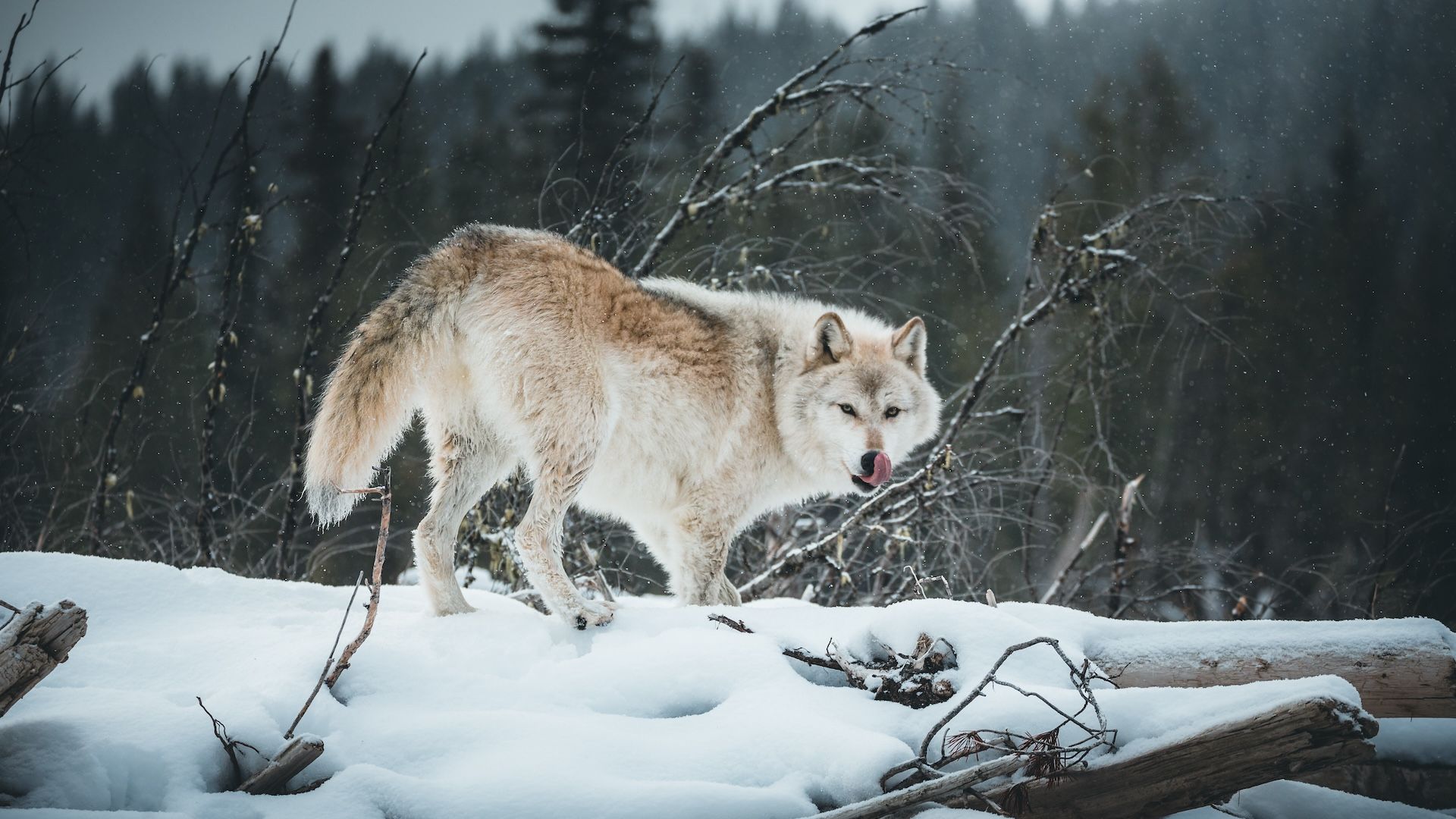
The model showed that over 15,000 years, natural selection could potentially drive dog self-domestication. But for this to happen, two conditions had to be met: Wolves had to choose to stay near humans to eat food scraps, and they had to select mates with a similar temperament.
Why would humans feed wolves scraps without them providing something of value in return?Wolves have to provide something to humans in order for humans to keep feeding them right? In this case, humans would want some wolves around them. Therefore, it seems very unlikely to be self domestication because humans would have a heavy sway in how dogs evolved.
What 'value' outside of entertainment does that provide to the humans?
National parks have a name for the ones starting to show domesticated behaviours - ‘problem bears’. Bears that go out of their way to interact with humans. I feel that’s a case study for domestication right there.
They're clever enough to scatter when someone raises a rifle and points it at them; but they'll do the same if you use a wooden walking stick.
And of course they're highly social, seldom encountered alone.
There's an additional risk with omnivorous/carnivorous animals could see people as prey, and this risk pretty much goes up with the size of the animal.
I have no idea how bears act with one another, but I do know they can eat meat and are basically person sized.
Based on many reports of brown bear behaviour in the Carpathian mountains and an N=1 natural experiment.
Human beings aren't all always that transactional. "Homo economicus" is joked about for good reasons.
You can easily imagine situations where a) food is in a temporary surplus due to a successful hunt, so there is little downside to wasting some and b) a sentimental child has access to it.
I had to search it. For example https://www.yellowstone.org/naturalist-notes-wolves-and-rave...
In the past, people were always looking for ways to automate hunting, just like we do with technology, as this was the hardest thing.
And if you ever hunted, imagine having a wolf around when you hunt, it's nuts. They are so powerful and can so easily find prey, they have sick instincts too, much better than humans.
Pair them together and you can understand why that combination works so well.
Our ancestors also gave up lots of surviviability skills to become homo sapiens together with our beloved doges.
"Not all people" but yeah, a certain class of HN commenter who tries to be "rational" about everything.
Although it turns out domesticated dogs have a wide number of uses _now_, early humans had no idea that would be the case, they probably just liked feeding the wolves.
Edit: there is also speculation that "feeding" wasn't entirely deliberate, that wolves started eating scraps from the garbage piles close to early human settlements and the ones that were friendly to humans (likely children especially) evolved closer and closer into dogs.
So humans give them food so they don't compete with humans in hunting. The wolves would get full from humans, don't have to hunt, and spend all their time reproducing, which will create even more competition for humans.
> Wolves had to choose to stay near humans to eat food scraps...
I don't read that humans fed the wolves scraps, just that wolves ate scraps, probably discarded by humans.
Then one day maybe a bold doggo decides to hang out closer, and bam, a shitty disney movie is born. ;D
Human groups that intentionally or unintentionally fed surrounding wolves are at an advantage. The presense of wolves near the humans would drive off more aggressive predators, which also helps up the local prey populations.
Human groups that did not feed or intentionally drove off wolves are at a disadvantage and more likely to be eaten during the night, or be out-competed for food.
Repeat for a million years or until your wolf grows eyebrows.
Additionally, wolves share their hunt with their pack. It's possible that some early groups were fed at least partially by the wolves hunting for them. If that dynamic ever got established, that group would be at a tremendous advantage.
It's the same reasons they feed dogs.
Dogs could be source of calories as well....
Human feces is very attractive to a dog. So perhaps not deliberate?
> settling into a mutually-beneficial relationship in which they hunted and ate rodents in exchange for food.
Cats mostly hunt birds, because rondents are smarter, faster, stronger and have weapons (teeth).
Also humans and primates throw rocks and sticks at predators. Early dogs must have been caught as puppies, or their parents killed by humans and their flesh eaten.
The whole model has been domesticated to portray a cartoony interaction.
Where did you get that from? I'm pretty sure it's not accurate, both from reading and personal experience.
Cats don't tackle rats often, and they are at a low risk of being bitten by mice (the hunting technique for mice involves first stunning the mouse by whacking it as hard as possible, ideally using body weight). Mice are smaller than most birds.
Cats do have instincts for rodents, birds and fish. But in most areas rodents are more available, so the cats don't get very good at hunting the other two.
The more I think about the article the less it makes sense. Humans would have eaten all their preys' meat, and thrown the bones they didn't use to build tools and accesories into pits, would have burned the rest to avoid bringing predators. Proto-dogs would have been like pigs to them, they are still like such in Asia. It's just that their decendants are good alarms and defenders, and can be trained to help in hunting and other tasks.
https://evolution-outreach.biomedcentral.com/articles/10.118...
>In the mid-1920s, the Communist Party leadership, in an attempt to glorify the average citizen, began to promote uneducated men from the proletariat into the scientific community.
You cannot fix science through ideology, especially when that ideology is actually just loyalty, and is mostly being used as an excuse to get rid of people who keep telling you that you are wrong.
But don't worry, that could never happen here.
Some ancient races still have those very old instincts of hunting and being independent, even doing some weird scream when given a bone or a having found a potential "hunt". (that's how people used to hunt!)
Youtube shiba scream :-)
All my previous dogs (>5) would always prefer the snack though.
Like terriers, Jack russel etc. lol. They will just go. They will ignore you. Yes we tried having meatballs. They don't care. Hunt hunt hunt. (Male, non snipped)
a) the ability to have grain stores, etc thru the winter; and b) the long food cycle of plant in spring, harvest in fall; really put everything on steroids in terms of what "territory" was important (the grain stores, the planted land) and what territory was less important
You can see this in the development of forts, castles, etc later on where the "keep" was the most protected thing, and held the grain store for an entire village
Small cats are largely harmless and get rid of pests. Wolves compete for the same food sources, kill children, and are otherwise a nuisance.
Granted, selective breeding of captive animals also doesn't jibe with what we know about the Stone Age, but we don't know all that much.
Wolves will scavenge if they are hungry enough, and will eat food humans may have found unfit, such as bones. So they may have come to view humans as a source of food, but were too timid to attack, and followed around hunter/gatherer tribes. The wolves would be little more than an annoyance, if the humans even notice them at all. Generally the wolf is going to notice you before you notice it - they have superior sense of smell and hearing. In an environment with heavy vegetation (i.e. forest), thats going to count for alot more than vision.
On the other side of the coin, its possible the humans also followed around the wolves who would have been superior trackers with better sense of smell/hearing, mutually beneficial hunts may have been possible.
Eventually, a tolerance could have developed and the tribe found the wolves useful for things like, keeping away more dangerous predators such as large cats/bears/etc. or even rival packs of wolves. They would also be useful as a alarm system. Given enough time, the more sociable wolves, yet less dangerous, wolves may have selected for. There is a theory that dogs are basically wolves whose mental developed stopped at the younger ages, and lack independence like adult wolves have.
You don't start with the adults.
You kill the adults and raise the pups.
Even today, there are wolf sanctuaries with wild wolves who've become quite friendly and acclimated to their carers. https://www.youtube.com/watch?v=gePE-_lrJUU
You are talking about the second domestication period, not the first. The first domestication period was not intentional by humans. It was that some wolve packs scavenged scraps from around human settlements, and so were in slightly closer contact. Over generations, the humans and wolves became slightly more comfortable with each other and humans started seeing some benefits from the proximity (early warning system, additional deterrent against other predators, etc.). This likely reinforced the developing relationship and prompted some humans to occasionally actively feed scraps/leftovers to the least skittish wolves, which again over generations, led to some wolves being close to what we would call “friendly” towards humans.
In Hoh Xil, China. a wild wolf started begging for food from humans. It now approaches vehicles for food, and also shows some dog-like habits.
Humans love feeding animals. It's a unique behavior in the animal kingdom. And the first step to domesticating anything is feeding them.
Those five fingers work magic.
Maybe?