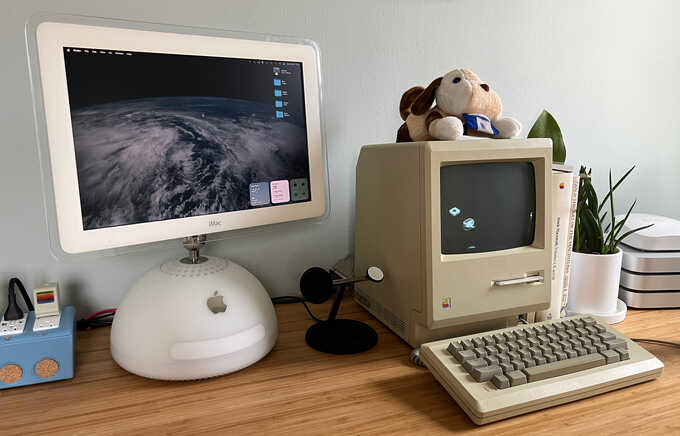
iMac G4(K)
jcs.org
424 points · by ingve · 1y ago · 169 comments
In any event, the elaborate arm mechanism, dome plastics we would not know until the model was unveiled to the world at whatever the event was.
Before that though, the steel box didn't stop us from opening it up to look inside. Though our steel enclosures had something closer to a baseball "home plate" footprint, when we peeked inside we saw the circular PCB and knew we were being duped.
With the dangly display they seemed to go quicker than other prototypes to the dumpsters left in Apple's hallways when the actual product was released. I am aware of three MAME machines I built around discarded prototypes. (Shhh!!!!)
I think two of the three prototypes running MAME died eventually — the third I left behind at Apple when I retired. So, fate unknown.
Shortly after though is probably when Apple started locking the dumpsters to keep out the divers like me. (Well, probably more to keep them from ending up on eBay I suspect.)
I wish Apple would release a retro line like this and with it the M4 chips.
edit: … with a “Follow Me” FaceTime camera
They’d probably lose all federal contracts for four years, but they’d gain some even more dedicated following.
You can look at the iMac line and see that they moved to a more laptopy everything-in-the-screen design, which got rid of the base altogether. But it's weird and sad that there was a "best" and then things that came after the best that were less fun, and two decades later we all still seem to feel that way.
I suppose part of that was all the attention that shifted to touchscreen phones, and computers becoming thought of as practical work tools.
The reason old computers were fun is because all the hip young millennials loved them for everything. That has become much less the case as the younger generations do everything with a phone/tablet/or console. Just surfing the internet for my generation was a chore that is hard for the younger generations to understand.
That really depends on how you define computer literate, because I'm seeing some incredible work being done by the younger generations, both for modern computers, but also for the machines of my youth in the 80s and 90s. Most of the Gen Z I previously taught might not know Excel, Word or even Windows, but they certainly knows how to use and abuse Google Docs and Sheets.
As for deep knowledge on the inner workings of a PC, I don't think they are worse of then previous generations. You have a tiny group of absolute geniuses, a small, but larger group of above average who will become future engineers and developers, then an tiny group of people who can operate modern Windows applications will insane skill levels, and finally the reset, who can sort of get by.
I don't dispute that. The younger generations have a huge leg up in terms of available educational resources.
My point is more that the average millennial will be computer literate while the average genz or alpha will not. By literate I mean having a basic understanding of how computers work. Like what a file is, how to find them, what a hard drive or mouse is and does. How to type.
I didn't doubt that the younger Gens will likely run circles around me in terms of programming. Similar to how there were really smart computer literate gen x and boomers.
I was born in 86. My dad got the first Mac as he was graduating from college. I think I was 13 when the iMac G3 and the X Public Beta came out.
Computers were well entrenched in my childhood, but it was the people who were adults when we were children that designed the fun ones.
I agree that adults designed our fun computers but those were adults that specialized in making those devices. If you looked at the average Gen Xer of the era you'd find they have very little interaction with computers.
It was our generation who had computers in the home as children. Very few of prior generations had that privilege.
However, having a home computer was still somewhat of a luxury, and definitely not a necessity until at least high school for me. It wasn't until college that I could ask someone what their email address was without first asking whether they had email at all.
They existed surely, with SEGA on the forefront, but not something most households cared about.
Home computers gaming was what the majority of us had.
My view is certainly skewed since we had a 386SX, but there were tens of thousands of BBS's running back then. Online services exploded in the early 90's, shareware games like Doom and Wolfenstein sold hundreds of thousands of copies. In 1992, Gateway 2000 surpassed Dell by selling over a billion dollars in PC's.
My kindergarten classroom had an Apple II in 1989. Our first grade classroom had old IBM PCs.
My parents bought our first computer in '94 and we were one of the later families to have one (these were actual middle class families).
Spectrums, Commodore, Atari, Amiga, PC, Acorn, as home computers ecosystem surely.
At least in Europe we weren't that much into consoles, having a home system was one from the list above.
That's something I've realized as well. There was a time where typing was something more and more people could do, but now nobody cares/needs to learn how. The number of households that had at least one computer was something I thought would get to pretty much everyone, but now there are more and more people with the only compute device being their phone. Owning a computer seems to be an age indicator like wearing tube socks.
The elder is interested in game development through his love of Roblox. I hope to help him get started with an IDE for lua, git, and a LLM and turn him loose on it.
I bought a B&W machine from the guy for $50 or $60.
Also grabbed a G4 Digital Audio tower. To my surprise, it was a top-end 733 MHz model.
Maybe it just wasn't possible to put a G5 on that small of a logic board, but it's still an absolutely stunning computer. I have one sitting on my kitchen counter right now!
And they tried to be fun with it!
The 3D printed tiles on the front are a very cool idea and just perfect right now I think! :-)
The stand is stationary regardless of the display angle and way more conducive to stable cable management. The last few generations of iMac made removing the stand technically not a user-serviceable action, so manufacturing USB-hub stand risers custom-fit to iMacs is practically its own industry.
A device still bound by mandates to be unnecessarily thin and light, and with an arbitrarily non-removable stand, can still make the stand a few centimeters thicker, run a fixed line from the logic board and into the stand, and put some or all of the ports inside it.
Hell, go wild and make the bottom of the stand a full inch thick, and you could put a user-accessible m.2 port in it,[1] but that damages the justification for upcharging $200 to add 256GB of storage.
1: https://www.amazon.com/PULWTOP-Adapter-Accessories-Docking-I...
I’m 100% sure it was just too expensive to keep making.
Jobs probably said “price be damned, I love this thing and the manufacturing cost will go down over time” and it didn’t.
https://www.macrumors.com/2024/08/19/apple-robot-spotted-in-...
Especially if the screen is showing a recipe, unit conversion, timers, etc.
If it's silent, that seems like it could be really cool.
another use case is for watching something or interacting with it via voice when your hands are tied up doing something else or from a distance. same value as vision pro without the goggles or isolation
The LCD panel in the G4 iMac is only 6 bits per pixel, compared to 10 bits per pixel on a modern Macbook Pro or similar, so the banding is just the dithering required to display the gradient shadow
I know what you're trying to say, but this sounds weird. Dithering is a technique employed to PREVENT banding, it does not cause banding.
> 15-inch (viewable) TFT active-matrix LCD, 1024 by 768 pixels, millions of colors
I'm not super familiar with macs, but AFAICT that's the product being described here.
Weirdly hard to find out with a web search if his was done on the iMac G4 (your comment is already one of the top results for me on Google and DDG!).
A screen using 18 bits per pixel (6 bits per color) would need the 'millions of colors' mode unless Apple designed some clever hack.
It was a very capable Mac that could even play 3D games smoothly - Wolfenstein and a bundled game for kids about escaped aliens who crash landed out west.
One of the best features was the swivel screen, which you could easily whip around to show something to someone else in the room.
Made particular sense since Steve was majority shareholder of Pixar as well at the time.
The Blue and White PowerMac G3 is my ultimate best looking Mac, there's something about the giant G3 on the sides, and the bold colours for what is a "professional" system. Sadly it all got toned down for the G4...
Edit: I want a translucent atomic purple phone damnit!
Unfortunately my G4 iMac suffers from the lame arm issue which affects most of them at this age. And it's difficult and kinda dangerous to fix (a huuuge amount of tension on the spring).
I bought one used because it was such a beautiful machine. Most beautiful Mac ever.
If Google decides not to support this for Chrome, I'll firewall it from the internet but still plan to use it as an SSH machine.
https://www.reddit.com/r/mac/comments/1f9s8kk/comment/luquux...
HDMI and DP at the time didn't have enough bandwidth to support 5k60.
Would be REALLY cool to see a mod where the shell supported a Mac Mini AND a DVD Drive
Would really love to put a series of Diablo 2 discs into this, or Warcraft 3, and play
Apple did make the trashcan Mac Pro, but of course that ended up having problems and was made at just the wrong time. The newer models harken back to the cheese graters but with fancier holes and a smaller overall size.
A new version of that Mac as an iMac with a bigger screen would be amazing. But given screen sizes maybe it would need a really heavy weighted base to survive well.