186 points · by gnabgib · 1y ago · 109 comments
It is always brought forward as an argument when the perceived landuse issue of solar is brought forward. But if you do any serious analysis, the landuse impact of even utility scale solar is so neglegible that it's not an issue to worry about.
If you want to talk about landuse impacts of renewable energy, there's really only one issue to focus on: bioenergy crops. It can be as bad as 30 times less space efficient than generating the same energy with solar photovoltaics.
Talk about using the same space to make food and bioenergy. Use agricultural land for food, and utilize the residuals as good as possible. Stop making biofuels out of food. And treat the space needed for utility-scale solar as what it is: tiny.
(P.S.: If people can make agriphotovoltaics work, I have no issue with that. Great. Even tiny impacts should be reduced if possible. But I have an issue with the way this is discussed, because it makes up a problem with photovoltaics that largely doesn't exist.)
Some (very rough) numbers to give scale here:
Corn in the US covered ~90 million acres in 2024. Something like 40% of that gets turned into ethanol IIRC.
Based on solar capacity figures around ~200GW, the surface area of the PV panels themselves (not the installation) are about 250-300k acres.
Both solar and bio-ethanol render an energy output on the order of 250-350TWh/year. Broadly similar levels of energy, but using a tiny fraction of the land area and chemicals and industrial pollution for the former.
Honestly, I'd like to see some of the excess solar energy put into up converting such waste streams into storable fuels that can be used as denser alternatives to batteries when needed (winter heating, air travel, etc.).
Converting the waste stream from agrivoltaics into biofuels appears to be the best option: reduced land for "energy" crops, increased output for food crops, and biofuel to replace petroleum.
We have gas stations everywhere because individuals need that kind of convenience to operate comfortably. BEVs have the same infrastructure in that every outlet is a charging station. While the barrier to entry for hydrogen is too high for personal vehicles, the logistic hub nature of heavy transport would be much easier to convert, using hydrogen storage/filling stations at strategic location to support hydrogen powered semi-trucks, local delivery trucks, busses, etc.
Meanwhile, I’m pretty excited about this project to make it cheap and easy to convert solar power to liquid fuel. Starting with carbon-neutral natural gas.
Food is similar where transportation doesn't matter much. Staple foods can be shipped by train, barge, and ship which reduces the cost. Some places are better at growing food. The canonical example is that New Zealand is so much better in growing sheep that more efficient to ship lamb by air. Growing local only makes sense for vegetables that need to be fresh or don't transport well.
Obviously not a bottleneck? There's millions of desert acres.
Had problems though. First was moving parts. You can not expect a system to last outside with any in them. Budget for the whole affair is tight, large repairs undo the whole endeavour .
Second is crops riping at different speeds below.
Finally practicality of the frame for farming machines . Meaning the dimensions need to adapt to pre-existing machines. And ideally remain upright even if one post gets hit.
Finally honesty regarding erosion ..corn is one of the more erosion prone crops and then having water dumped on specific areas concentrated creates channels fast. So the idea does not work with no crops or erosion crops in rainy areas. There is a reason there is grass below most solar fields.
One good aspect they didn't push is that this is ideal for electro farming. We have hyper effective electric moisture traps now and electro nitrogen fixing- combine that and this can remove one need for driving trucks through.
In all other aspects i see this limited to orchards.
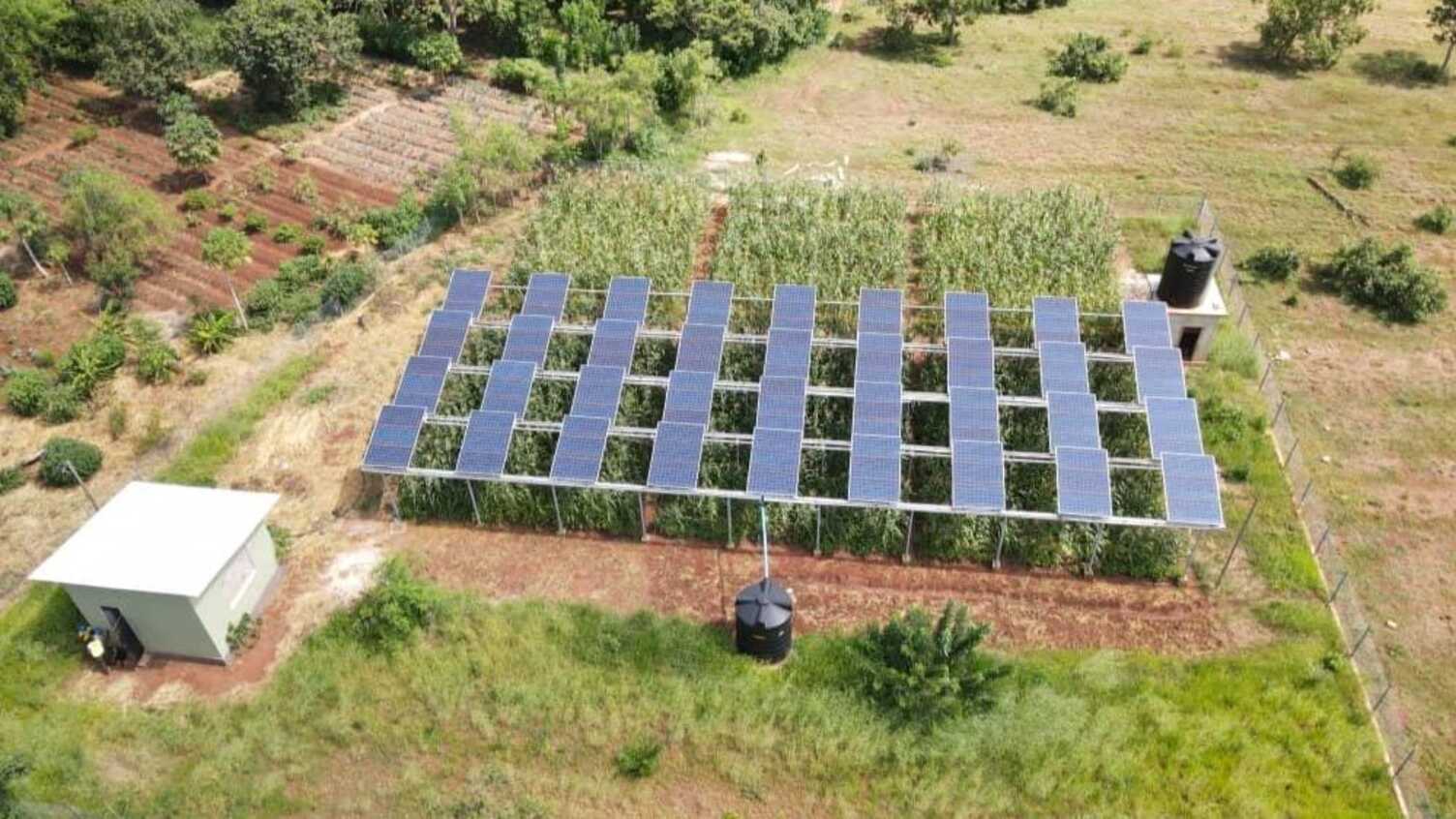
This study is for a very specific region: East Africa (Kenia and Tanzania). Their main problems are too much evaporation, no energy sources, no other sources of food.
I don't see how a solution that might work for a good share of humanity (Africa is huge: Kenya and Tanzania alone have 150 million people) gets dismissed as "limited to orchards" because it can't be used for industrial scale corn crops in my country.
But I can understand the concern: most agriculture (not only corn) is highly mechanized pretty much everywhere in the world except the poorest countries, so this would be limited to the crops that can't be mechanized.
Agrivoltaics could be something or nothing. But don't dismiss it because it today isn't already perfect for everything. Ten years ago the cost of the panels alone would make this projects 100% infeasible.
I believe that the end-game for agrivoltaics must be a reversal of that relationship: not the panel scaffolding adapting to farming machinery, but farming machinery and panel scaffolding becoming one, the scaffolding doubling as rails for overhead machinery. The status quo in farming is that a lot of fertile ground is wasted on machinery tracks. Machinery is either narrow-wheeled and ruining the soil in the track through compression, or the wheels are very wide (for weight distribution) to cause less harm per square inch, but harming proportionally more.
When you have scaffolding, scaffolding that is strong enough to survive a storm or two, it will also be strong enough to carry machinery. Not the machinery you'd attach to a 600 HP tractor, but the entire incentive situation for machinery size is based on the amount of harvest lost to machinery tracks and that would be completely solved through scaffolding-based machinery. And the issue of machinery tracks (and ground compaction) only gets worse when you start considering decarbonization: batteries are heavy, and a grid connect right above your field would be just what you'd not even dare dreaming of.
Another good setup is to combine it while grazing sheep.
But maybe grazing isn't worth anything at all and its only cost-effective if you put them in a big box and feed them grains or something. I don't know.
Call that an even bigger win...
Could you tell us more about this? I remember seeing a user comment a few years ago discussing the prospect of dumping excess electricity into nitrogen production but I had assumed it wasn't feasible. Does this technology really exist?
There is one experiment in kenia
high voltage moisture trap
Most orchards and vineyards in temperate climates are attempting to maximize solar exposure, so would compete for space with the panels -- and also have their own trellising systems and so I struggle to see a fit there, too.
But I can definitely see the use cases for two places.
Grazing land for some ruminants, especially in hot dry climates. Provide shelter for animals, and shade for grasses.
Vegetables, market garden or even large scale. (e.g. my neighbour grows something like 20 acres of cauliflower and it's all planted and picked by hand.) Many market gardens are using walk-behind / two-wheel tractors (BCS, etc.) which are far more agile and could easily handle moving around panels.
Spill-off / erosion can be dealt with through building swales.
https://citrusindustry.net/2022/07/05/protecting-citrus-tree...
the point here is that agrivoltaics tends to work well, especially in certain conditions. In central Africa, those conditions are reducing evaporation and providing shade to certain plants.
In north america, those conditions are often sheep grazing, as is common in New York and Ontario.
My two border collies would love it if I raised sheep. But my quasi-vegetarian wife could never tolerate raising them for meat.. and dairy and wool make no $$ sense.
Cover the crop in shade cloth, and mount the panels on the ground / roof structures nearby. No need to over complicate things.
Land near energy demand is scarce almost everywhere. This kind of local generation is ideal and both reduces transmission losses and makes the grid/society more resilient.
Moving electricity is among the cheapest, most efficient industrial processes that exist.
*With all due respect to the Maldives, Gaza, Hong Kong, et cetera
I am lazy, I like to start with the low hanging fruit first.
Then you should be looking at agrivoltaics before rooftop, as they are much cheaper in developed countries where the cost of rooftop solar is dominated by installation cost.
I'm excited about it because its a combination of many things I truly enjoy doing and get a lot of pleasure from - harvesting energy, growing food, seeing life in equilibrium.
The integrated growth-stands with full-spectrum solar -> plant -> fish -> soil process is really, really appealing. Healthier food, energy harvested in neat ways. If I can get carrots and radishes and salads from the same device that charges my cell phone in the next year or so, I'll be a happier human for sure.
Yes, every season I grow ~20kg of vegetables on a 15m^2 balcony (tomatoes, cucumbers, peppers, celery, various herbs). They are grown vertically on a trellis system, using 11 liter hydroponic "bato" buckets and recycled/reused perlite (sterilized). Nothing fancy.
The main energy input is the chemical fertilizer. Electricity to run pumps/valves etc is very minimal and probably amounts to 5-6 KWh over the season. I use synthetic fertilizers but avoid insecticides/fungicides, instead opting to use biocontrols (shout out to Koppert! https://www.youtube.com/watch?v=AFPkAQUfYvo).
The future of agriculture (excluding cereal crops, which I dream might be replaced by synthetic starches one day) probably looks something similar to: https://www.youtube.com/watch?v=a_pR_HihCVo
They currently have some challenges with bureaucracy, at least in Austria:
Given that it is an industrial facility it has to be secured from unauthorized access, but as it is a field, it has to be accessable to small animals. So now it is fenced with barbed wire on the top but it's open at the bottom.
for industrial farming yes. This study is aimed at subsistence farmers in africa. ones that don't have much mechanisation.
> will in fact destroy the agricultural potential of land
Given that this study highlights the water conservation features of agrivoltaics, I'd say it has a greater chance of stopping salinisation of agricultural land from over irrigation.
> Also resevoirs can benifit/help in the same way with floating solar pv.
again, this is aimed at african farmers with limited infrastructure. this would be the stepping stone to getting cheap electricity
I understand the interest in maximizing space utilization, but this just doesn’t make any sense.
Some replies indicate field setups for solar should take priority and tractor/equipment systems should adapt to these new systems.
Crazy stuff.
It just doesn't make any sense at all to use crops for energy production.
Most of it, imported from the US: https://www.biofuelwatch.org.uk/wp-content/uploads/Drax-brie...
And even if it only was waste that's burned, it's IMHO incredibly stupid. We should be happy about every single gram of CO2 that's stored somewhere and use this "waste" for building insulation, paper production, soil revitalization or simply bury it.
Burning simply shouldn't happen when we have way better, cheaper, more efficient, more environmentally friendly methods of producing heat and electricity.
There's a reasonable amount of waste biomass generated by farms that can be used in various ways without growing it specifically for that use.
The fact that you can recycle them just makes them even better.
plus, burning oats is really fucking expensive, the chaff is a reasonable feed, and the straw is good bedding/binder for building stuff.
Burning for power is really a poor use, especially as it needs compressing into bricks first. Plus you only get a tiny bit of energy once a year, compared to ~1kwhr per panel per day. (depends on panel size and positioning etc etc )