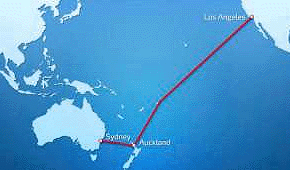
Fears of Chinese spying sunk Pacific Fibre
Kiwi Pacific Fibre cable project sunk by US fears about Chinese investment, espionage; 'It was made clear US authorities would not allow Chinese investment,' Pacific Fibre's Drury says
interest.co.nz
57 points · by steve19 · 14y ago · 60 comments
Realistically, any major fiber system is going to be monitored by virtually all intelligence agencies of major powers -- at minimum the US plus the endpoint nations, but I wouldn't be surprised if China, Russia, and maybe eventually other countries established submarine tap technology, either in the middle or at underwater branch/repeater units.
Angry and sad if this kills the project entirely -- I was really looking forward to Pacific Fibre :(
[1] http://www.zdnet.com/news/spy-agency-taps-into-undersea-cabl... [2] http://defensetech.org/2005/02/21/jimmy-carter-super-spy/
Also for the security concerns, can you do an external audit of the equipment? How much does it cost for somebody to strip down some chips and do the necessary reverse engineering? You would think this could be costed out as an additional cost due to the trust gap between the countries, then the security issue becomes one which can be resolved but at a cost that is potentially not competitive rather than just a political issue where one side appears not to have interest in free trade.
Realistically this is about power rather than espionage. In a similar way to how the booming US displaced Britain of a lot of the major international cables around the turn of the 1900s, so China will want to try it.
I would have thought you could structure a deal to maintain power where necessary so that China can't come in and cut off your bandwidth, but maybe not.
Regarding the chips, I wouldn't have thought you need to be 100% sure, 99.9% might be good enough if you can get there by random sampling of significantly less chips than 100%. In any case, that cost analysis is what's required and that's the case e.g. Huawei are making here.
There are reasons to be careful in dealings with the Chinese, but it might be better for both sides if some level of transparency can be maintained.
It might cost more than buying US equipment, though. Although you could add it as you turn up waves, so not that bad upfront.
On the other hand, it only takes one or two New Zealanders to download content from foreign servers and mirror it, through bit torrent or other means, to everyone else in NZ.
You're absolutely right, if all our piracy at least was kept on-shore via DC++ or similar, it would likely cut demand for international bandwidth in half (the same goes for probably any country). As it stands there are substantial caching servers employed by every ISP for most high-traffic static content (Youtube, Steam, onshore broadcasting...)
Monitoring equipment in the cables don't help you solve math problems any faster?
I wish the government would just spend the money investing the difference. We could sell our assets for something useful!
In the 90's, I heard that ihug internet used to get their bandwidth via a satellite to the USA.
Do options like this still exist? Would they even be feasible for todays bandwidth requirements?
It would be interesting to know what kind of options exist that could provide some much needed competition against the Southern Cross cable
Pricing on Southern Cross cable dropped massively a few years back when PIPE's PPC-1 went from Sydney to Guam. Ending the cosy duopoly between AJC1 and SSC. It was also one of the first cables out of Australia that wasn't owned partly by an incumbent telco (Telstra, Optus etc).
I must admit, the pacific was seemed hugely ambitious and I was wondering if something would come in and derail it. I never thought that espionage reasons would be one.
http://www.listener.co.nz/commentary/the-internaut/pacific-f... - has a good summary of coverage on this issue from Radio NZ.
just makes us (nz+aus) look like a client states. fuck the usa and their corporate self interest... run the cable to mexico.
suspect this has far more to do with economic espionage then reds under the bed.
Or look at how the vast majority of Australians want Australia to withdraw from Afghanistan. And yet both major parties support continued involvement. There was a Prime Minister who announced that he would withdraw the troops. And within weeks he was knifed in the back by his own party, and a new PM, one totally committed to US interests was installed.
Or the permanent stationing of US troops in Darwin (closer to China). Or now in the last few days the revelation of plans being drawn up in secret to build a US nuclear weapons base in Perth, Western Australia. Or Abbots recent trip to kiss yankee ass. Or Gillard's address to congress earlier in the year.
If you want to understand the real game of Australian politics, then you need to read Mark Latham's "The Latham Diaries". Australian politicians and media hated him for what he revealed in his diaries. He spilt the beans. All of them! Basically, any parliamentary front-bencher that voices opposition to US foreign policy will quickly be removed by their own party.
At the end of the US-Sino currency wars, there will either be trading blocs, or a hot war. And in either case we will not be falling on the China side. The US is stepping up and saying to China 'hands off'. This is not about about espionage. This is about control. And resources. And regional strength. Things are going to get a lot hotter. Start digging that bunker!
Why on earth would you want to? You know they're a dictatorship with no respect for human rights?
Oh wait...
Wait which country is that?