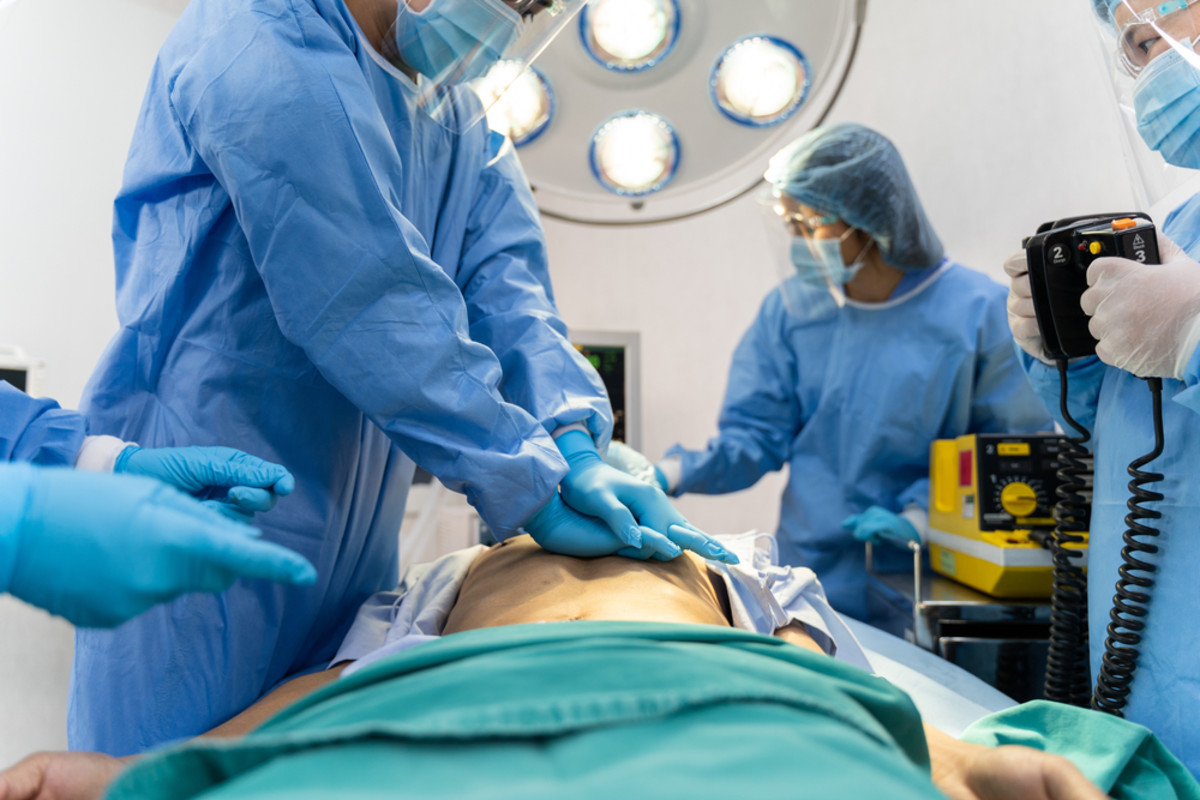
Contrary to Popular Belief, CPR Is Not as Successful as Many Think
Learn more about CPR and why this "life-saving" method could actually cause more pain in both patients and medical professionals.
Discover Magazine
36 points · by bookofjoe · 1y ago · 39 comments
Nevertheless it's worth doing on people who are having e.g. a sudden cardiac event because you only do CPR on dead people. Which means as long as they died because of some single-point correctable failure, it doesn't hurt to try CPR because it might succeed and that's better than being dead.
OTOH if they died because of multisystem organ failure or distributed catastrophic blunt-force trauma, CPR will never bring them back.
Medical professionals know all this, and as the article points out the moral distress of failed CPR is related not to the fact that it so often fails but that it's inappropriate to even start CPR on an 80 year old patient in a nursing home who has dementia.
The entire purpose of CPR is to get some oxygenated blood through the brain so that there is someone worth saving when help arrives.
CPR is often not performed in time, or well enough, and is likely not a 100% direct replacement for normal breathing; so permanent brain damage is likely even if the person is revived. I don't know if the de-emphasis on rescue breathing makes a difference.
The de-emphasis on rescue breathing was the biggest advance in CPR since it began.
No non-anesthesiologist can do this effectively (even in Advanced Life Support recertification classes, anesthesiologists — including me — struggled to achieve adequate air exchange with rescue breathing on a mannequin, which is far easier than on an unconscious person).
Full energy and attention and effort keeping up deep regular chest compressions at witnessed or just-occurred out of hospital cardiac arrest/loss of consciousness events stands the best chance of a good outcome.
In-hospital arrests are almost universally fatal.
What happens to the control group of people who don't receive CPR?
Though I've noticed with the medical profession, speaking as a dumb firie, any outcome less than perfect is considered a 'complication'.
I've been under the knife a few times for various reasons, I've noticed this more and more. Slight bleeding from a closed incision site after surgery, whilst normal, is still "a complication" and a "poor outcome" despite being totally normal.
Perhaps there needs to be more nuanced language when describing these outcomes? What about "probable deviations" for things that are technically complications, but are more or less expected/normal?
Regarding the CPR training we were given: "if you're not breaking ribs, you're not pressing hard enough" (1/3rd chest depth). 'CPR' shown on TV shows and movies, 'rubber bendy arms', is woefully inadequate and I wonder how much of this is contributing to the mortality rate of cardiac events?
Fortunately a lot of AEDs these days will be able to tell you whether you're pressing hard enough with a pressure sensor embedded in some pads.
Paramedic and ex fire guy, absolutely. I used to tell the guys on my engine, "You're doing push ups on their chest, basically.". 1/3 to 1/2. It's hard to go too deep.
Don't even start me on that asystole tone and paddles being applied...
Dumb firie question...
I understand asystole (flat-lining for those not familiar with the term) isn't a 'shockable rhythm' though it's still treatable, to a point, right?
I haven't been able to find a clear-cut answer that is understandable to my level of training (basic life support).
So where do drugs like epinephrine/adrenaline come into play?
Even if you're 87 and already have a host of health issues? Even if you have a terminal illness (at any age)?
It's a personal choice of course, but I think a substantial number of people would disagree it's "certainly preferable" in a number of scenarios. There's a reason "Do Not Resuscitate" orders are a thing.
Less so, but suffering a cardiac arrest without treatment (CPR, defibrillation) is almost always a death sentence.
The whole point of CPR is to maintain oxygenated blood flow to the brain long enough for paramedics to arrive and give potentially life-saving treatment.
Because the time frame from cardiac arrest to death is measured in minutes.
One of the reasons why public access AEDs are so prominent now is that the patient's chances of survival are greatly increased with early defibrillation, and that any untrained person can use one now because they're pretty much automatic once applied.
I have no doubt that's the case, but I don't think that's in conflict with what the article is about? To quote: "A study of surrogate decision makers for ICU patients found that 72 percent of respondents believed that CPR had a success rate greater than 75 percent" Presumably, none of those ICU patients had CPR training.
Also the entire moral distress about "questioning whether the patient even wanted extreme life-saving measures" doesn't really seem in conflict with that. Whether you phrase it as a "life-saving measure" or "the person is already dead" seems a bit semantic. This also ties in with the first point, because as a patient I want to be able to make an informed decision about whether the downsides of a life-saving measure is worth the cost. If you're 25 and fit? It probably is. If you're 89? Well, quite a few people would say it's not.
Out of hospital/unwitnessed arrests - mortality is bad.
In hospital/witnessed arrests - CRP mortality was better.
Downtime (ie time without perfusion makes a difference) the longer it is - the worse the outcome. The difference between long and short is minutes.
That doesn't mean CRP isn't worth trying. The hard part is making sure families understand when futility begins. Some families never get there.
Anyway, the core is
> In reality, people who undergo CPR outside of a hospital setting survive only 10 percent of the time. Within a hospital setting, CPR survival rates are only a bit higher — about 17 percent.
And the rest is reasons and consequences.
Whoever thinks a 1/10 (or nearly 1/5!) shot at not dying otherwise is bad odds clearly doesn’t value their own life. I’ll take all my ribs being broken + being alive for even a week vs being dead and no broken ribs any day of the week. I’d also traumatize myself if I knew I was giving someone a 1/10 (or nearly 1/5!) shot at being alive and not dead. Absolutely none of the “downsides” they cite outweigh fucking dying.
That's still not nothing, but you also need to look at what percentage end up with severe enough brain damage that they're not really the same person anymore, and might have preferred death over that situation.
I value my life quite a lot, but I also value quality of life. I think there are quite a few physical and (especially) mental disabilities that I might not want to live with.
To your point about "ribs broken & alive for a week", I suspect that situation would be helpful for my loved ones to be able to see me and say goodbye, but not so helpful for myself.
If you'd ever spent time around a nursing home, you probably wouldn't say that. Quality of life matters, a lot. Not saying I have a DNR, but these are serious conversations to have before it's too late. I think what's really telling is how doctors and nurses treat themselves. They are almost never seeking maximum days alive no matter the physical and mental cost.
That line in itself seems to suggest that the likelihood of CPR being successful increases slightly when a victim is transported to hospital with CPR continuing throughout from the time of their cardiac event, versus those who never make it to hospital, because the CPR givers stop (exhausted, unable to continue) or because efforts before reaching hospital are considered pointless/time-of-death called (as it was clear to medical professionals that CPR isn't going to bring a clearly dead person back to life).
If you want to improve the odds you or people around you survive a survivable heart related emergency, then find out where your nearest AED is, and if it's too far, get one for yourself.
Also join a notification network that will call you to bring your neighborhood AED to a neighbor in need.
AEDs are magic because they use a feedback loop to choose the right intervention.
If the AED detects it cannot be useful for shocking, it will at least tell you and give you a rhythm to keep doing CPR. So as a casual first aid provider, it doesn't matter to you what the AED can and can't do. Get it, get it hooked up, and let it help you.
AEDs are designed to treat two shockable rhythms: ventricular fibrillation (VF) and ventricular tachycardia (VT). (As a side note, you can have a pulse with VT.)
CPR is designed to provide effective circulation, whether the heart has stopped entirely (asystole), or is not providing effective circulation. You can even have in-betweens, like PEA (pulseless electrical activity) where the heart is providing the electrical signals that should contract the cardiac muscle, but it's just ... not happening, or not happening strongly enough to provide cardiac output.
CPR is really: the heart is not doing what it should, or it's not doing enough of it, or not doing it effectively enough.
In the case of an entirely stopped heart, CPR can provide enough sustenance to get a shockable rhythm that can then be defibrillated.
AEDs are also different from what EMS will use (at the ALS/paramedic level)—we can defibrillate or shock rhythms other than VF/VT, but the rules are different, as are things like pacing, etc.
As a VERY rough guide, a lot of arrests are a devolution, from NSR (normal sinus), i.e. all good, which can become VT, and some time in VT (typically minutes) before degenerating into VF, which is even less effective at cardiac output, and then subsequently into asystole or PEA.