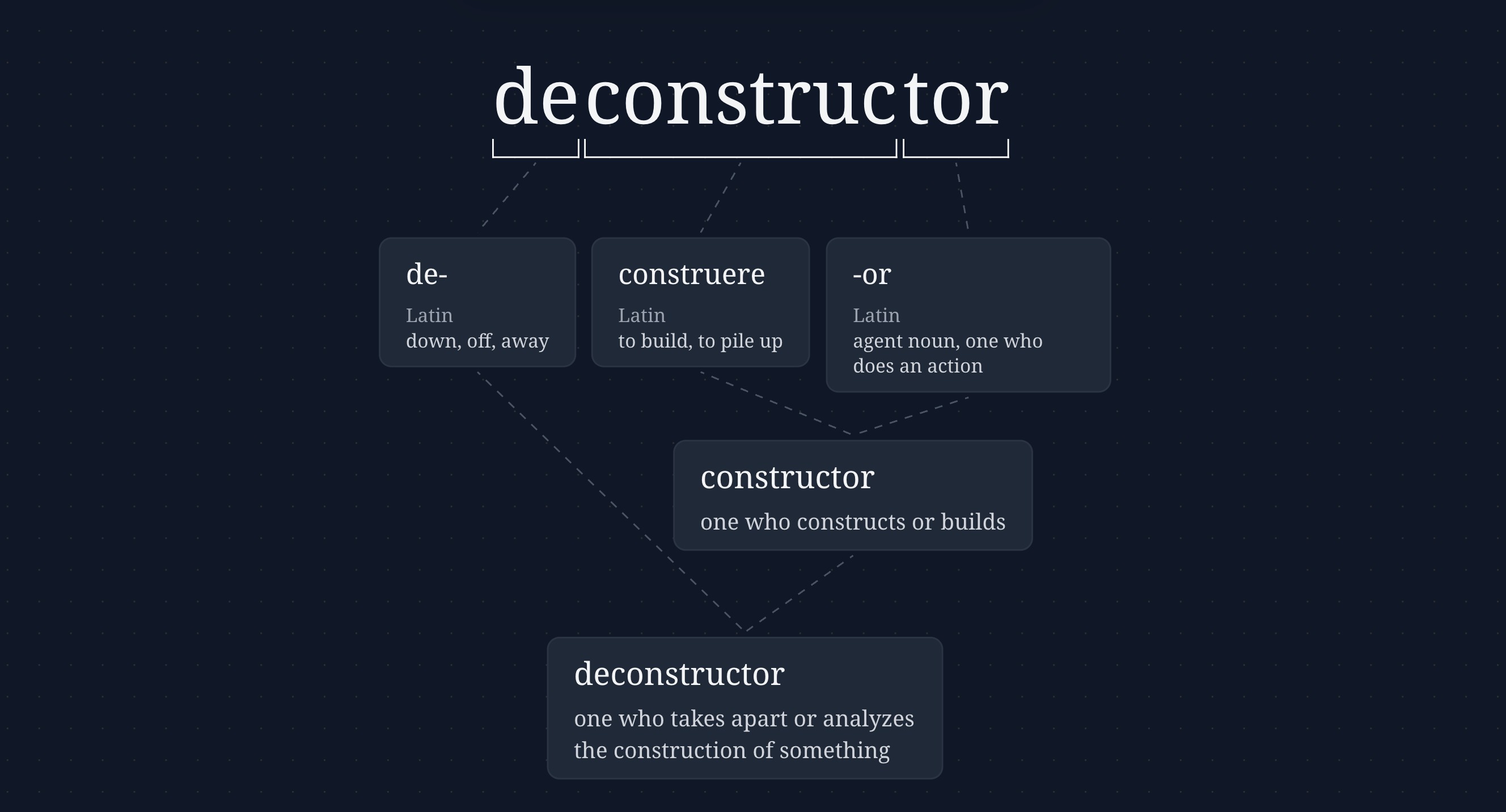
Deconstructor - Interactive Etymology Analysis
Discover the etymology and origins of any word with interactive visualizations. Explore linguistic roots and word meanings.
Deconstructor
27 points · by hyusap · 1y ago · 52 comments
Between things like "verbing" and "nouning", and the cultural acceptance of doing them in casual speech, I'd say English is a great language because you get to "invent" new words on the fly, and your interlocutors know what you mean.
In this sense, even if no one before ever said or wrote "multiarborality", it's pretty clear what it means (as long as you don't misread it), and IMHO it's perfectly fine to derive its etymology by deconstructing it back to "common" words and pulling etymology on those, recursively.
I bet you could do that with most languages. I don’t see why English would be especially great at it.
One person inventing a word that they have never heard before doesn't negate the possibility of that word being in common use somewhere.
https://books.google.ca/books/about/Arboreality.html?id=S95Y...
"An expansion of the 2020 Theodore Sturgeon Memorial Award winning story. Arboreality is a finalist for the Philip K. Dick Award and the winner of the 2023 Ursula K. Le Guin Prize for Fiction."
I don't even know what a fake word is.
https://deconstructor.ayush.digital/w/flonkers
"Flonkers: A made-up word, likely humorous". Aren't all words made up? Edit: This one, unlike my previous example, is actually in use - flonkers: an animal that looks fat but is actually just fluffy.
At least it did say "slartibartfast" was a fictional character.
There's "tlacoocelotl"[1] which seems to be the actual word for "ocelot" ("semi-jaguar").
0/10 for the AI there.
[0] https://nahuatl.wired-humanities.org/
[1] https://nahuatl.wired-humanities.org/content/tlacoocelotl
Terryjambled means "mixed up in a confused or disorderly state, and covered with or resembling terry cloth."
Refugglemander means to "to manipulate electoral district boundaries in a way that impacts refugees."
I'm sorry, OP. This just isn't very good.
Maybe I'm coloured by having spent half a decade of my life on a linguistics degree, though.
I find the connections it draws amusing. Since I'm not the inventor of the word "refuggle," I can't say that I know its etymology or how it relates to "refugee." But I guess this is one weakness of LLMs: they're bad at admitting they don't have an answer.
- phonenose: The ability to detect sounds or voices through the nose
- legpc: Acronym for Laptop Easy Personal Computer
- gitls: A command in Git to list files
- housefreezing: The action of hardening a house with cold
- uncleftish beholding[2]: The act of viewing something that is whole
In any case it's fun to play with and the UI is nice too.
Note, the title looks editorialized, it's currently "A AI etymology deconstructor – can guess fake words", but the website says just "deconstructor.".
https://deconstructor.ayush.digital/w/Deundehydrate
"to reverse the process of reversing the removal of water"
There is clearly no such word, but a human would probably infer such a meaning.
I'm amazed at how unamazed we all seem to have become at such feats. We need more deunnamazing
This is interesting because it may eventually become the case that we should interpret other human texts through an LLM because it is better at understanding than many of us are.
My prompt, in case you are curious:
> I came across a HN story titled “AI etymology deconstructor - can guess fake words”. I want you to interpret the title and describe what this does. Then I’ll give you the chance to provide a test word and you will reinterpret the title.
Like "gua" in the dictionary means cave but in some dialects it's an informal "I". Sometimes it gets shortened to the phonetic "gue", sometimes "gu" which is similar to "aku" shortened to "ku", which is another form of "I". Really we have like 7 different ways to say informal "I". I think the tool guesses it as Chinese.
Malaysian tends to remove affixes when shortened, while Indonesian removes vowels but keeps the affixes, so something like "come here quickly" might be shortened to "come quick" or "here2 qkly". Less etymology, more about encoding.
"KI-Philologenstaunverunsicherung"
Breaking it down:
KI – (Künstliche Intelligenz, Artificial Intelligence) Philologen – (Philologists, scholars of language and linguistics) Staun – (from staunen, to marvel or be astonished) Verunsicherung – (a sense of uncertainty or unease)
https://chatgpt.com/share/67d80661-4bb4-8012-9328-77d56af52b...
In other words, a false etymology constructor, not an etymology deconstructor :)
Words always end up getting broken with speech in a different way to the meaning.
Eg I put in pandemonium which you say as pande-moniun but I just learned is pan-demon-ium which makes a lot more sense!
Very cool. Well done.
Yeah, no. I tried the same word five times to test for inconsistencies. I don’t appreciate you weren’t straightforward with the limits and am not going to give you my email to “continue my language journey”. The fact you’re already using euphemisms like that makes me strongly distrust what you’d do with an email address.