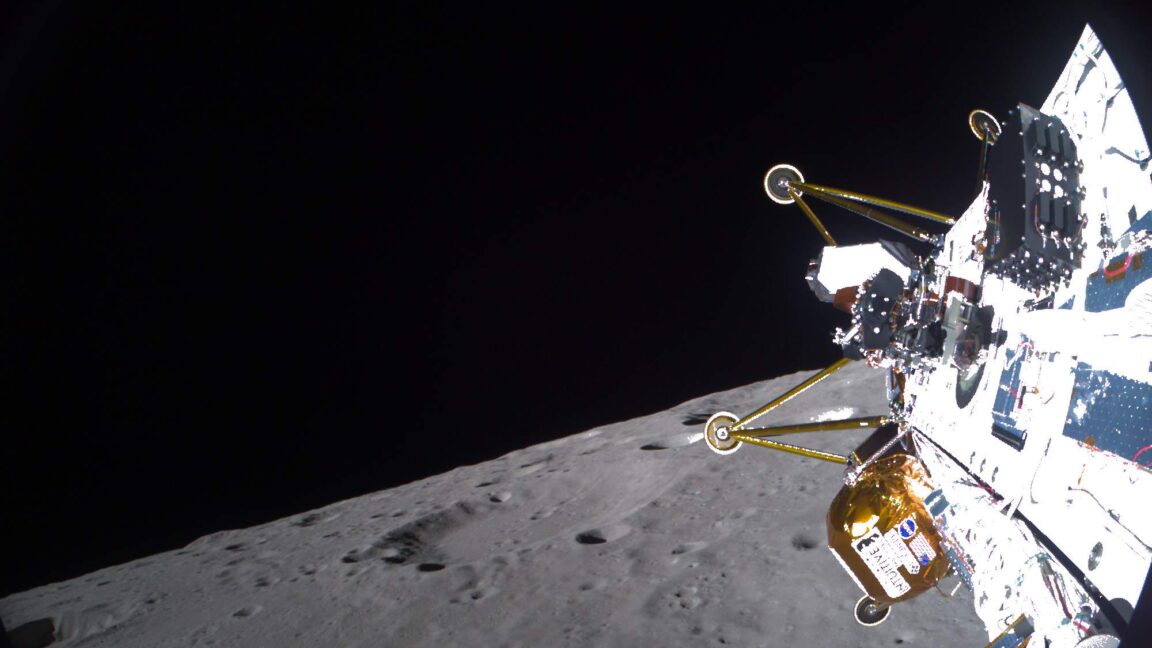
Athena landed in a dark crater where the temperature was minus 280° F
You lose it, and then what do you do? You don't give up. You go back in."
Ars Technica
231 points · by 01-_- · 1y ago · 267 comments
(Yes, I suppose there are many other sources that could provide images. These happen to be from ASU.)
Athena spacecraft declared dead after toppling over on moon - https://news.ycombinator.com/item?id=43292471 - March 2025 (340 comments)
The Moon Lander Athena's Fate on the Lunar Surface Is Uncertain - https://news.ycombinator.com/item?id=43283136 - March 2025 (1 comment)
But in case you can: Was a radar based altimeter considered?
How do you guys deal with kicked up regolith? (I have seen first hand how hard heavy snow is on lidars, and would imagine that regolith “shower” is similar, but what do I know.)
He's saying modern spacecraft can null out the horizontal velocity to land, but without an altimeter, you don't necessarily know when to do so, nor when to give the thrusters a little boost to avoid an obstacle you're about to hit, like a plateau.
For example, I remove &t=<n> from urls that youtube added recently in addition to regular watch position restoration. This broke it for me and they don’t seem to plan a revert.
Hard landing, skid, tip.
Z is an axis that exists in our 3d world, and a required value for any relative position, which means it DID NOT know where it was, relative to the moon.
But all three are important.
Related - I’m not clear how the article can describe that landing as “not crashing”. If that was not a crash, what was it? Will they call it a crash only if there are Hollywood-style explosions?
https://www.theregister.com/2025/03/07/intuitive_machines_la...
> At his press conference earlier today, Altemus defended the design, saying the spacecraft doesn’t have a high center of gravity because most of its cargo attaches to the base of the vehicle. He said there were no plans for a radical rethink of his company's design.
(We see this in returning F9 first stages, as well.)
Just wait for SpaceX to start trying to land starships on the moon. Also vertically. Also doomed to tip over whenever the surface is slightly out of spec.
The heavy bits are at the bottom.
Visual demonstration of being at the wrong altitude in the right spot: https://www.f-16.net/f-16-news-article968.html
Oh yeah, we've all Kerbaled it in like that at one point or another.
Robert Truax, the designer of the Sea Dragon, loved to promote the design paradigm of Big Dumb Boosters. Instead of many small, sophisticated rocket engines, what if we made one big robust one that can take a lickin' and keep on kickin'.
The idea was to relax the mass margins and to create big. dumb. boosters. It's the approach TRW explicitly followed for the Lunar Module engine,
   > "There was an amusing but instructive side to this program. TRW farmed-out the fabrication of the engine and its supporting structure, less the injector that they fabricated themselves, to a "job-shop" commercial steel fabricator located near their facility . The contract price was $ 8000. Two TRW executives visited the facility to observe the fabrication process. They found only one individual working on the hardware, and when queried, he did not know nor care that he was building an aerospace rocket engine."

   > " I had arrived late to witness the test, and only saw the firing. I was told by others who witnessed the entire test procedure that the engine was pulled out of outdoor storage where it lay unprotected against the elements. Before it was placed on the launch stand, the test crew dusted off the desert sand that had clung to it. This unplanned inlcusion [sic] of a bit of an environmental test also demonstrated hardware ruggedness of the kind no other liquid rocket eingine [sic] could approach."
These programs had a lot of capital behind them. Some components required precision engineering, but there's a very clear through line and embrace of the "we gotta make stuff that can take a lickin' & keeps kickin'" philosophy.
Modern engineering approaches seem to be the opposite of that. I think we've become so accustomed to living in a silicon driven world where our personal devices are engineered at microscopic level that we've forgotten how to do things the Apollo-era way.
For example, to the best of my knowledge, IM-2 doesn't use RADAR — they're using LIDAR and optical navigation instead. Perhaps it is to save on mass and power so that more payload reaches the surface. Perhaps optical navigation was declared to be "good enough." Perhaps it doesn't make sense from a minmaxing of capital perspective. But this philosophy may not be suited to an untamed frontier.
China adopted the Surveyor / Apollo-era philosophy. Their first successful lander, Chang'e 3, used the same hover & fall technique as Surveyor.
> The vehicle will hover at this altitude, moving horizontally under its own guidance to avoid obstacles, and then slowly descend to 4 m above the ground, at which point its engine will shut down for a free-fall onto the lunar surface. The landing site will be at Sinus Iridum, at a latitude of 44º.
The follow up missions up-ed the ante every time, but they seem to have consistently focused on the robustness of their craft over precision, MBA-spreadsheet-oriented minmax-ing.
This is a really interesting point. I think a practical issue in modern times as well is that companies are being inspired by SpaceX while forgetting that it took SpaceX alot of work to get to the point of being able to do things like casually land a 20 story tower in the middle of the ocean on a barge, let alone the even more ridiculous 'stunts' they're doing with Starship.
Apollo was starting from the perspective of trying to do something where it was even debatable about whether it was possible. And so I think there was a lot more 'humility' in design, for lack of a better word.
> Engineering design is a process of making informed decisions to creatively devise products, systems, components, or processes to meet specified goals based on engineering analysis and judgement. The process is often characterized as complex, open-ended, iterative, and multidisciplinary. Solutions incorporate natural sciences, mathematics, and engineering science, using systematic and current best practices to satisfy defined objectives within identified requirements, criteria and constraints.
> Constraints to be considered may include (but are not limited to): health and safety, sustainability, environmental, ethical, security, economic, aesthetics and human factors, feasibility and compliance with regulatory aspects, along with universal design issues such as societal, cultural and diversification facets.
It's not an MBA philosophy but is intrinsic to the profession. Apollo didn't go up because of vibes, it went up because engineers knew the goals going in and to figured out how much fuel was needed to go to the moon. It also went up because the United States was willing to spend over a quarter of a trillion dollars (adjusted for inflation) on getting there,[2] and ignored the arguments that it was a giant waste of money while there were social problems at home.[3]
[1]https://egad.engineering.queensu.ca/wp-content/uploads/2023/...
> constrained optimization to meet customer needs
For most of its existence as a formal field, engineering wasn't about making geegaws that "meet customer needs." It was about building stuff that matters. Houses that didn't collapse. Roads and machines that made it possible to traverse vast distances. Toys that delighted us. Aquaducts that delivered clean water. Drainage that helped remove muck. Plumbing that cleaned our cities. Threshers that helped us harvest crops. Lights that vanquished the dark.
The story of engineering is the story of creating technology that helps alleviate want.
You can say that there was a "customer" for each, which is great and all, but that's not why we did it. We did it so that we could move out of the caves and not be in filth and muck all the time.
We did it because it felt good. And we did it because it was the right thing to do.
1960s US is hardly Siberia and I don't think any NASA engineers had their heads on the chopping block if their designs failed. But engineering philosophy was still rooted in survival; the primary goal was to make something that wouldn't kill you because it fails.
You hear stories about artisans in the old days refusing work because they don't believe what they're being asked to make is safe or reliable enough for the person asking for it. Maybe it's romanticized and idealized, maybe it's just them covering their ass so they don't get blamed. But that philosophy of personal responsibility not just for making things according to the constraints, but for the outcome too, is something that served society well for a long time before slowly disappearing over the past century or so.
It hasn't left without reason. As the things being made became less key to survival and more key to thrival, as the world became more interconnected and safe, it didn't make as much sense. Just think of how many crazy, inventive concepts we use every day wouldn't have been made if they could only be made to work reliably! Our entire modern existence is based off things that don't work reliably. It's a blessing and a curse.
But when we're exploring the final frontier we need frontier thinking and frontier technology; things that, from the ground up, are built to work first with all other constraints secondary. Unfortunately spaceflight endeavors today must invariably build off the 'good enough, when it breaks just make a new one' foundation that permeates modern design at every level. Even if you want to make something nowadays with the sole purpose of working, as long as you're using any technological advancements made in the past 50 years chances are you're using something that wasn't made with that goal in mind.
When engineers were working on Apollo and lunar landers, they were working on a set of customer requirements a mile long. Roving tinkerers didn't build the moon rockets. Engineers spent countless hours in design reviews with the customer, in this case, NASA.
Roman engineers didn't build aqueducts and colosseums on a lark, or some sense of poetic destiny.
Matters to whom?
Answer: that's the definition of a customer in an engineering project
Matters how / why?
Answer: those are the requirements / user stories.
Helping people by doing engineering feels good and is the right thing to do, but formalizing this process a bit does not detract from it.
I wonder how much of that is because of public attitudes to government spend. Like if a SpaceX rocket blows up, they're taking innovative, risk-taking approaches to rocket development. If a NASA rocket blows up they're wasting tax payer funding.
Similarly the pressure on NASA to have fewer programs for cost saving is similar. If NASA has two rocket programs, one of which is at a "good enough" level for launching satellites economically into space and one of them is a "safety conscious" rocket for manned launches at a higher per-mission cost, then people look at this and think why is NASA duplicating work and spending. So now they get only one program, so then even launching a GPS satellite is the expensive, human-safe rocket.
Dropping the last 4 metres isn't a sign of having a ruggedized, over-speced "takes a lickin' and keeps on kicking' approach". In lunar gravity, you could drop a raw egg from that height and not perturb the chick inside.
Instead the aim is to avoid throwing up too much moon dust with retro rockets.
Luna 9 (1966) really did need to withstand a bit of a bump, but it was 22km/h, comparable with a fast running pace or a car in first gear, not a high speed impact.
Just for maximum pedantry:
Falling 4 m on the moon is like falling 66 cm or about 2 feet on earth. I don’t know about your eggs but the ones I know wouldn’t survive that.
Just youtubers doing youtube things, I guess.
Though, again, it's been a while since I watched it.
It doesn't matter how much mass was saved and how much more payload that allowed to reach the surface if the landing isn't successful. Successful landing is mandatory for anything else to matter. The obviousness of this baffles me that it is taken so haphazardly.
Though, of course, I wonder how many landings they are planning to do, and how many of them they need to do to compensate for each failure to land.
The mindset difference seems to be that if there's no human on board, so no problemo wasting a lander if something goes wrong. That's just a bad attitude (as well as yaw and roll). If you designed everything with "baby on board" hanging in the window, you'd probably not cut so many corners so sharply. Otherwise, why not just light your cigars with hundred dollar bills. How would you feel if you were on the team building the payload, but the lander guys keep fucking up so you just wasted however much time you spent because "meh, we're just testing". In sports, there's a saying "practice like you play because you play like you practice".
I think this is the smoking gun. RADAR is usually successful, while LIDAR has a poor record.
Seems it's the second time they fail in this mode.
Like another comment mentioned, complexity and size are big issues. Some more are power/mechanics (fluids, such as for hydraulics, and -280F aren't gonna play well together) and then there's the fact that there's not even a guarantee it'd work. Your legs could get damaged, you might end up in an orientation where none of the legs are appropriate, and so on. So you may be adding a whole bunch of complexity for stuff that might not even save you in the situation it was designed for!
There's a small chance that navigation or landing fails in a way that would make those legs useful, and an even smaller chance that they'll save the mission.
Given tight budgets, this is almost certainly not a gamble worth taking
$32k/kilo or so.
/s
They had the altimeter fail on the previous mission too. Seems like a fairly crucial component of a moon lander.
Armchair rocket scientist here, but if I were on that engineering team I'd lobby hard for less science payloads and more backups for critical instruments for the actual flight of the craft.
The rover and hopper and drill etc all sound cool yes, but worthless if you can't land. Again. For the second time. Because the same critical component failed, again. With apparently no backup, again.
Of course, it sounds so simple. I am sure there is more to it (e.g. perhaps they had backups and everything worked, but they just weren't fit for purpose?)
Not really. They forgot to toggle the safety switch on before launch, so the laser could not be used:
https://spaceq.ca/simple-error-could-have-resulted-in-intuit...
It's not exactly nothing, the moon itself with its mountains is there and blocking the radio signal and it means propagation isn't unlike that of VHF/UHF on Earth. You still only have no visibility beyond the horizon. In order for it to be visible and useful during landing you would need the base station to be reasonably close. I guess that would make it more akin to ILS/VOR/DME than GPS. That obviously wouldn't be feasible until we have a permanent base there (perhaps an unmanned one).
But “who should fund this?” is a separate question from “would this help?”.
I don’t think it would really help that much, and that is the reason why the private companies are not doing it.
IM didn't win the contact because of their landers per se, but obviously as a company they have a vested interest in this kind of lunar infrastructure. Being able to build it with a bunch of public money is a huge win for them
The criticism should perhaps be that the laser range finders are clearly a liability and a robust/workable backup for telling how far away the ground is needs to be brought along.
Instead of building all these expensive to launch big landers, why not get some pizza-box sized probes into earth orbit AND THEN do like a slo-mo golf shot arcing to where the moon will be for a super slow/soft landing?
Some will fail but if you launch 100 and get 20-30 working, there you go.
As technology progresses, get it down to a shoe-box sized probe and then in 10 years smartphone sized (in 100 years tic-tac sized).
The moon is also gravitationally very "lumpy", so some small corrections might be needed along the way as well.
Around the same time, Mission Control was replacing their bespoke hardware with COTS and trying to minimize the “glue” HW/SW for space systems.
You'll also see that expertise on a particular instrument package is leveraged over and over across multiple missions.
NASA still has amazing educational outreach and makes incredible software, even for mere mortals.
TL;DW: It had far too much sideways velocity immediately before touchdown, likely due to some guidance-system failure. It would have crashed even if it was crab-shaped instead of tower-shaped.
This startup has already crashed two pieces of space junk onto the lunar surface. Can any startup able to get there do whatever they want?
By the way, in comparison to the cost and complexity of said "junk", everything you own is cluttering up the Earth. You should really do something about that.
Giant neon McDonalds billboards visible from everywhere on Earth? Mining with zero restriction on impacts to the surface of the Moon or its atmosphere?
Apparently the HN crowd doesn't stand anyone criticizing a "startup", but I'm asking a legitimate question. So far most of the junk we've launched onto the Moon has been in the name of science and operated by nations. An assault by the Free Market is unprecedented. I'm asking a legitimate question about regulation, and implying a question about whether regulation is warranted.
Why is this more important than expanding our ability as a species to explore space?
No, I'm making the argument that anyone who invests the time and money into landing on the moon isn't doing it for giggles and the joy of littering.
And let's be real, if we found "space junk" on the moon of an alien planet, we'd be thrilled as heck, so perhaps we're just seeding the moon with artifacts for alien races.
Besides if countries start shooting eachother in space they'll start doing it on earth.
Unless I am misunderstanding something.
Considering the altimeter failed, that seems unlikely to be the case.
I mean, because it's in the dark I'd expect it to reach equilibrium with space background thermal radiation which is around 3K. Yet its 100K. Where does that heat comes from? It radiates from earth? Conduct through the floor coming from the inner of the moon itself? (Is there some kind of geothermal gradient on the moon BTW?)
How does its altimeter work, exactly what tech does it use? It's worth remembering that radar-type altimeters have been around for a long time and are well developed. For example, Little Boy that was dropped on Hiroshima 80 years ago used radar altimeters in a redundancy arrangement (four devices) and that worked on first attempt.
So what went wrong? Second question, was redundancy employed in the altimeter's design? Third, if the altimeter employed redundancy then why weren't its multiple sections of different designs to allow for the possibility that the reflected signal may be weak and noisy?
(The strength of a returned wave from a radar transmission depends on various factors including its wavelength and the properties of the surface it's being reflected from. If there's any doubt the returned signal's S/N would be such that noise could be a problem it'd make sense for a redundant system to employ multiple wavelengths whose frequencies are far enough apart to take advantage of the fact that the moon's surface would reflect different wavelengths in different ways and at different signal strengths.)
That's a bummer. Altimeters are relatively simple and defined hardware as far as I know. Send a ping, receive a ping, calculate. Too bad they didn't incorporate a backup solution.
Designing for a wide range of temperatures in space where shedding heat is a challenge and running heaters (during dark/cold periods) is necessary, and where at the best of times re-deploying radiators and heat shields is difficult, let alone when the craft is lying on its side.
So ambient temperature matters. As another comment notes, in most cases, the problem is excess heat and the shedding of it. Particularly for Earth-orbiting satellites, which are subject to 1kW/m² solar radiation and are in shadow for only a small portion of their orbit (less with higher altitudes).
Just to be pedantic, it actually does, which is the microwave background radiation. But that doesn't detract anything from your point.
> So while Athena knew where it was relative to the surface of the Moon, the lander did not know how far it was above the surface.
This is really crappy writing. That second paragraph sounds like a self-contradiction. Unless "the lander" is a separate entity from "Athena"? Some publications refuse to use the same term twice, even if it introduces ambiguity as here.
Aside from the point you made, it actually IS a contradiction. Paraphrased:
>> Athena knew where it was relative to the surface of the Moon, but Athena did not know how far it was above the surface of the moon.
Relative position includes height/altitude? One understands from context, but this sentence does not carry meaning itself.
The airplane's pilot could see where the ground was and he estimated it was 1000m-1200m below. But the instrument of the airplane were malfunctioning and reported that the ground was at 500m (or 5000m). This caused the plane to override/resist the pilot's manual landing efforts causing the plane to ultimately crash but not allowing the wheels to come down and the flaps to do turn.
So two different mechanisms, providing contradicting evidence, and the lack of a 'higher' deciding authority to use 'judgment' and/or other inputs to 'decide' which reported measurements are more accurate, and thus make the viable decision/take the viable action.
I get that for such devices every-gram-counts, and perhaps from now on some devices/mechanisms that are truly single-points-of-failure, will get 2x or 3x for redundancy/contingencies. If your ABC-camera fails, it's 'ok' you can still get images from your DEF and GHI will give you some data, reducing to 80% the output of the mission, but still not making it 5%. Your 'landing equipment' fails, and you get out only 5% of the value (flying/trajectory/telemetry of flight/perhaps some eclipse photos).
One conversion comment is on-topic, even though any replies to it are most likely to be off-topic.
Edit: but I've put the Celsius number in the title now as well...hopefully that will reduce the swelling.
Considering the conversion between the 2 temperature scales can flip the sign (e.g. -10C is 14F), "-280F/-173C" would've been a lot clearer.
   -280F = -173.33333C
+280F = +137.77777CWhen you have such extreme temperatures you think in Kelvin or at least Celsius.
And how its all related to the measurement of the precession of the earth. And yes - its specifically how to measure things in space. And its all from Sacred Geometry.
At least inside the article both units are actually used, just the title is imperial only.
Is there a reason for this or am I just tripping?
These pictures in particular are taken from a very high altitude, which may explain why they look unnatural?
> Compared to the company's first spacecraft, Athena flew smoothly.
Reminds me of the comedian opining on the flipped over airplane.
“Did you know the pilot was a woman? [hecklers] Woah woah, I’m not saying women cant be pilots, thats not even accurate. She flew perfectly….. what I am saying is that she can’t drive”