216 points · by croes · 1y ago · 98 comments
The root cause analysis also falls short for those cases: Germany's bureaucracy might be underfunded but fundamentally requires every resident to register at their place of residence. There is also no large-scale conflict or violence in Germany, no regions are really remote or hard to reach, all rural areas are electrified (important for satellite-based night-time light counting by GRUMP and WorldPop). The only satisfying root causes left are about satellite counting methods being too coarse or badly tuned to accurately count rural area, or rural living patterns possibly not fitting the assumptions of these models. But it's weird that these errors are so similar between so many different methods, not all of which even use satellite data
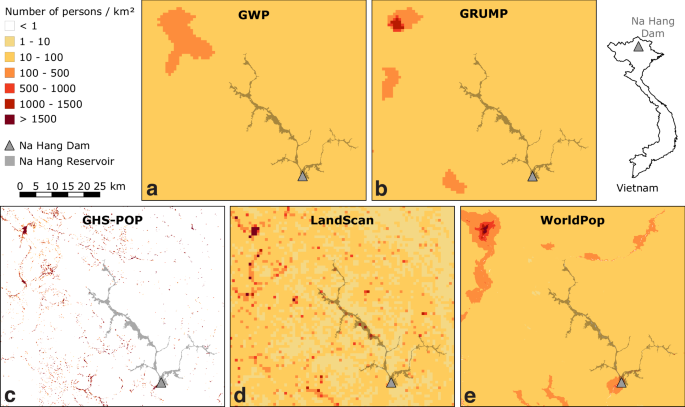
https://www.nature.com/articles/s41467-025-56906-7/figures/7
In a world where people are considered illegal, you’ll have lots of people trying to leave no footprints and far away from seats of authority where your odds of drawing attention on accident are much better.
See also the trope of the quiet stranger who moves to a rural town and keeps to himself. Does he just like the peace and quiet or is there a warrant out for his arrest in South Carolina?
China is certainly an impressive surveillance state but the reality is that the geography is so large that it is possible to miss things like human trafficking: https://www.nytimes.com/interactive/2025/03/05/world/asia/xu...
Through some combination of state propaganda (their own and China's) and dystopian fiction like 1984, Westerners drastically overestimate the capabilities of the Chinese state. It would be more accurate to say that China wants to be perceived as a centralized authoritarian surveillance state, because that perception is valuable both domestically and abroad. They absolutely do have a broad surveillance apparatus, but they also have millions of square miles and more than a billion people to surveil and control.
Don't forget that we're talking about the government that has been unable to pull together either the political will or the state power to enforce health codes that would be considered table stakes for any developed democracy, ignoring or tolerating disease-spreading wet markets. They appear to pick and choose their authoritarian battles, and if you're not a battle they've chosen you can probably go ignored for a lifetime.
The logistics of centrally surveilling a massive area of land are pretty tough, much more tougher than we imagine I think.
Historically independency seeking people learn how to flee from aggressive governments and move to places that make it harder to track them. Including cutting down on written documents that could expose their org., adopting social structures that decentralize leadership etc.
It was fascinating to me, I highly recommend checking the Zomia region.
e.g.:
https://medium.com/@matthijsbijl/welcome-to-zomia-the-anarch...
2015 means there are legal 10 years olds that would have not been legal before. And I expect some grey area 11 and 12 year olds that are surprisingly mature for their age.
Another case is covid. The state tried to maintain the lockdown (which was partially supported by some of the population) but at a certain point they can no longer maintain the dissatisfaction and had to fully open back up.
I'm not sure if any of the mentioned gridded population tools are substantially census independent. Haven't read the paper yet, but maybe that could be one reason why methods are so similar.
From the discussion:
> how reliable current global population estimates really are. For example, is it possible that global population estimates from the United Nations (7.98 billion in 2022) or World Bank (7.95 billion in 2022), both relying heavily on national population censuses, miss a significant part of the world population?
For example cellular data or ad data, rf emissions, CO2 or other chemical emissions, satellite photography of human activity (mowing, cropping, logging, building, etc), food or fuel shipments, etc.
A census may miss people, but the rest of the data wouldn't.
This could mean that apparent population growth during that period was much slower than it appeared, and instead down to improved measurement.
Delmar with companions: "You Wash's boy?"
Child with long gun: "Yessir and Daddy told me I'm to shoot whoever's from the bank."
Delmar: "Well, we ain't from no bank, young feller."
Child: "I'm also suppose to shoot folks servin' papers!"
Delmar: "Well we ain't got no papers"
Child: "I nicked the census man."
Delmar: "Now there's a good boy"
The bias towards urban populations would be more significant in congressional districts within a state, I reckon.
That also biases presidential elections, due to the way the Electoral College is calculated.
The system wasn't designed to fairly accommodate the gigantic social benefits, massive regulatory apparatus, and local spending apparatus the feds now get involved in. The people that designed the Senate thought that stuff mostly wildly unconstitutional. If they planned on that stuff being constitutional they'd have likely made the Senate more like the house in composition.
Also the presidential population is decided by delegates based on population.
What am I missing here? I feel like that's basic information.
But, your rural areas may be over half of your territory. People living there also matter, and the needs of those territories are very different.
Just to bring an example of how the current system backfires:
- we need railroads to reopen so we are able to sell produce to our own industry base competitevely
- we are always told there aren't enough people here, so no railroads. Even though, the primary objective of those wouldn't be to transport people
- we sell our produce to the neighbouring country instead, given it is closer than our own country's industrial hotspots. By selling off raw produce, our country will end up earning less than if it were processed by our own food industry.
- without much economic incentive to remain living there, many will emigrate.
- less people = even less representative power.
The cycle continues...
Now, I don't have a solution. It is a difficult problem to solve. One could be to have a higher minimum number of representatives per region, as the lowest populated region only elects 2, 24 times less than the highest populated one. And, just to show how different the political landscape is when compared to the US: the metropolitan regions have voted way more to the far right and far left parties than the rural regions have, which have led to a lot of divisive political outcomes.
A census literally counts every individual. Census public reports are aggregated for privacy.
This is about spatial disaggregation of aggregated census data. The problem in developing countries (which is what these datasets are used for) is that they often fail to run a complete census (in some cases, for many decades) because it is expensive and/or the government is not functional. So these datasets may not be well-calibrated overall.
The US has no problem running a decennial census, aside from nonresponse by immigrants, conspiracy theory enjoyers, etc.
Is there any evidence of how accurately the US census actually does that job? Having spoken with a number of people who were involved with the 2020 census (mostly on a volunteer, local basis) the answer is not "absolutely every person in the country got counted exactly once". There are a number of sources of error that would seem essentially impossible to fully remediate, due to people being complicated and error-prone and the census being largely self-reported:
- People in multiple households being counted twice, e.g. college students being counted both at college and at home.
- People who refuse to participate (one of the census-takers I know had someone wave a gun at her face when she tried to follow up on their household's non-response).
- People who are transient or disconnected enough from the social fabric that they are hard to maintain consistent contact with. I knew someone involved with taking the census for an urban unhoused population and there was no doubt that they both missed and double-counted people; I'm sure it's even more difficult for rural populations that might be even less connected and even more transient.
It's not hard to imagine that, on net and despite there being rules and processes for handling each of those situations, there ends up being regional and/or urban/rural bias in the final counts.
Yes. The Census uses a post-enumeration survey for this purpose. They found evidence of significant under- or over-counting in 14 states for the 2020 census.
That was considerably worse than the 2010 census, though covid might be partly to blame. Still, afaik, there wasn't anywhere near the rural undercount described in the article.
https://www.census.gov/library/stories/2022/05/2020-census-u...
The census should really have an option for refusers that collects an absolute minimum of information. The Constitution only asks that people be counted, not that they be broken down into categories.
At least it's just the short form now. Prior to 2010, one out of six people got the long form, which had ten pages of questions for each person in the household. Here's a pdf: https://www.census.gov/content/dam/Census/programs-surveys/d...
Do you have any thoughts on how the US census takes your insightful comment's points into account?
I imagine it's got to be quite an involved process given the vast differences in US geography, kinda blows my mind thinking about even basic stuff like age demographics vs. taking into account how many people died on census day.
But then - maybe that's too granular and it all balances out in the end? Or at least, it does if you use special magic sauce the US census has covered?
In the US, rural undercounting isn’t really a problem politically, although it has negative impacts on revenue allocation that is population based like sales taxes.
The biggest issue is that poor residents are underreported. This is both an urban and rural issue but from a numbers perspective impacts urban areas more.
I'm afraid that this isn't the case; a census is a best-efforts estimate.
There are plenty of people missed for a variety of reason, everything from not wanting to be found, through to simple avoidance. Let alone filling out the forms incorrectly or giving dud answers to the army of amazing people trying to make sense of all the madness.
Edit: realising the above has added to a long list of things that once upon a time I thought were hard-set facts, and nowadays I'm slowly losing my mind over. Coordinates, populated place boundaries, census counts + demographics... I mean, what _is_ an address? Incredibly painful to get to the bottom of that one, at least in the UK where the definition of an address will vary significantly by use case
screams into the void
Did that cause a double count due to them being counted wherever they moved to? Were my guesses correct? Or correct enough? No idea but that's the data the census worker recorded.
They would only have been double counted if they incorrectly reported living at their new address as of April 1st.
For example disease prevalence, lifestyle condition differences between rural and urban, etc
The movie is great and China censorship story worth a glance. There no direct critics but it depicts some collaterals of rural areas transformations. Also poetic and contemplative.
(Some other countries are included, but it seems like China, or at least south east Asia, provides the bulk of the data.)
Which is not nothing - if China's population is underestimated, even by a small amount, that means a lot.
But there might be purely historical reason ("ghost kids" unreported because of the "one child policy" come to mind) that would not apply to, say, the US census, or the size of constituencies in Europe that would undermine right wing parties.
There are some rural places in the Mountains in places not so far from America where they harass and rape teachers, doctors or any government service employees.
The national census always struggles how to safely and practically reach those places.
The comment you’re replying to is correct in its usage.
Something done systematically is typically done explicitly and intentionally. This may be what the author of the article was implying, but the comment was pointing out that miscounting of the population due to an inability to perform the task is not systematic by definition.
Means they would be estimated, surely. Something simple like count the dwellings, match to a similar community that had been counted.
Estimation wouldn't necessarily be under-estimation, it could go either way.