228 points · by sohkamyung · 1y ago · 173 comments
But increasingly, there is no correlation between age and specific developmental stages. It is merely a number that indicates how long something has been around but not what its current status may be.
Supernovae can create black holes in the 10's of solar mass range and they can merge but it would take a long time for those to find each other to merge to the 60 billion solar mass range. You might have processes that make 10^5 solar mass black holes but it would still take a lot of time for those to find each other and merge to make supermassive black holes.
Which one is more likely? Are there assumptions or parameters in our model for the age of the universe that could be inaccurate?
I thought oxygen detection was extremely difficult, they must have better methods now.
adding:
https://news.arizona.edu/news/how-next-gen-telescopes-could-...
Now, conversely, oxygen detection in galaxies/around stars is difficult for another reason. It doesn't want to remain free oxygen and will gladly bind with any other atoms/molecules it runs into.
https://now.northropgrumman.com/what-happens-to-oxygen-in-sp...
No one needs to read your post fessing up to your profound ignorance and the fact that you didn't really read the link.
> Please don't post comments saying that HN is turning into Reddit. It's a semi-noob illusion, as old as the hills.
(With that last sentence linking to 9 examples in [1].)
I’m not sure how to rebalance things - and certainly won’t claim to be perfect about not taking the bait myself – but it seems to be slowly starving a lot of communities which don’t have some in-person anchoring.
What does this mean? A quick Google search didn't help me
"It was better a few years ago, it's all going to hell now, we're becoming Reddit/4Chan/Slashdot"
It's the internet forum version of "the youth has gotten lazy, it weren't like this when I were a lad"
https://news.ycombinator.com/item?id=380385
From 2008 :)
Fwiw, people have been saying this since the site started. Don't worry. There will always be a safe space for rich assholes to divorce themselves from reality and romanticize their exploitation.
Lately I've started feeding my questions into LLMs to explore these ideas. Given that I will almost certainly never make a decision where an improper understanding of astrophysics is at fault, I'm willing to run the risk of hallucinations leading me to improper conclusions. :)
For the morbidly curious: https://chatgpt.com/share/67dc94a3-07c8-800c-bdbf-039dd2ce50...
(It's funny, I've seen people say that they generally don't even bother with spell checking questions to LLMs because it doesn't seem to make any difference. I was tempted to rerun this before posting to fix the disorganized thoughts in my questions, but I ain't got time for that.)
Stuff like this is what I love most about these LLMs.
As someone who minored in astronomy and especially loved stuff about stellar life cycles, I didn’t see any red flags in what you were told.
Thanks!!!
I think this is due to a big flaw in the link aggregator website model. In the forums of yore, we had a post creating a discussion that was a must read, and everything was contained in the same place. Links were part of the post but as side dishes sprinkled over the OP.
In the aggregator model, which is arguably a dumbed-down model of forum, there is no OP. Or more accurately, what can be interpreted as the post is the title of linked content, not the linked content itself. Clicking and reading to an external link is a burden and a disconnection to the discussion on the aggregator. In the end, a lot of discussion occurs based only on the content visible in the aggregator, that is the title. One might regret it, but it's the format pushing this behavior.
Also since there is an endless stream of content instead of threads being dumped, I feel comments are more fire and forget.
PS: did not read the linked post.
Also you don't sound "fascinated", so if you're complaining at least be honest about it. There are many more descriptive words than "fascinated".
Isn't that what's they're supposed to do? "Hey we found this thing, here's how we did it." Next week: "Yeah I checked your data and got different results, let's figure out what's different." A few months/years later: "We've figured out where the problems were and now have a better understanding of this."
There are no absolutes, we're just formulating theories to best fit what data we have now, and, if new conflicting data (or even existing data that was misunderstood/misread/misclassified as being irrelevant) disproves our theory we formulate a new one to try and account for the extra data.
What do you feel when you post that?
Hydrogen is everywhere.
The possibilities are interesting.
You are right, it's inevitable.
https://www.sciencealert.com/jwst-detects-carbon-dioxide-out...
- Is the big bang theory the scientific consensus on the origin and evolution of the universe ?
- What are the alternatives ?
In this way, there can be no alternative as there is no alternative to music theory. Some people may have a very narrow view of music theory, but it truly encompasses every model we accept about aspects of music.
Tldr- the questions can't be answered because the bbt is a not a theory like "THE theory of relativity". The "theory" is at the end of the term which denotes a collection and not a specific model.
It was only 30 years ago that we discovered what we call now dark energy. And it turns out that within that short time frame we have multiple ways of measuring the amount of it, and those methods agree. There is more dark energy than dark matter, and that the visible matter is even a small fraction of the dark matter. But even with this discovery of the acceleration of expansion of the universe, the core big bang theory holds.
There are many alternatives to the predominant and not-yet-accepted-as-true Lambda-Cold Dark Matter model of physics, such as Timescapes, but none of them have enough evidence behind them to be considered serious alternatives at the moment.
Things like the Baryonic Acoustic Oscillation theoretical predictions, that are visualized in the spacing of galaxies, are literally mind blowing to me. Theoretical physics predicted how matter would behave when it's so hot and dense that none of it can even form atoms, and it predicts the structure of all sorts of things, even the variability we observe in the cosmic microwave background.
TL;DR The depth and consistency of observation that point to a big bang are stunning. But we still have so much we don't know about the particulars, and the fundamental forces.
Yes, because this theory currently best describes our observations, but there are still many anomalies. Like dark matter / energy / quantum physics / axis of evil.
> - What are the alternatives ?
The big crunch, where the universe ultimately shrinks again. You also have a theory that it expands and shrinks and loops like that. You also have several string theories where they propose that the whole universe is a hologram projection of a higher dimension.
But these theories are lacking certain important explanations of certain observations we have, that most people still keep the Big Bang Theory as the most accurate.
https://www.youtube.com/watch?v=eSSDi22NVFo
As if matter existed and then there was a creation of light at some moment. Red shift is explained by interaction of light with gravitational field - the more distant source of light, the longer it travels under the influence of gravity and the more red it becomes.
This is interesting but at same time oxygen is the third most abundant element so it’s not surprising to find it, I suppose. Neat anyway.
Here's a textbook example:
https://images.nagwa.com/figures/explainers/469167813067/17....
Having family members who do that for a living, I can tell you that’s a huge chunk of the job. Astronomers all know that they have significant limitations in the data that they can collect and spend a lot of time thinking about ways they can test different theories. It would be a career-making move if some grad student could come up with a new explanation which changes the previous understanding and given the ratio of degrees granted to jobs the incentives really wouldn’t favor covering anything up.
[1] https://en.wikipedia.org/wiki/Cosmic_microwave_background#Pr...
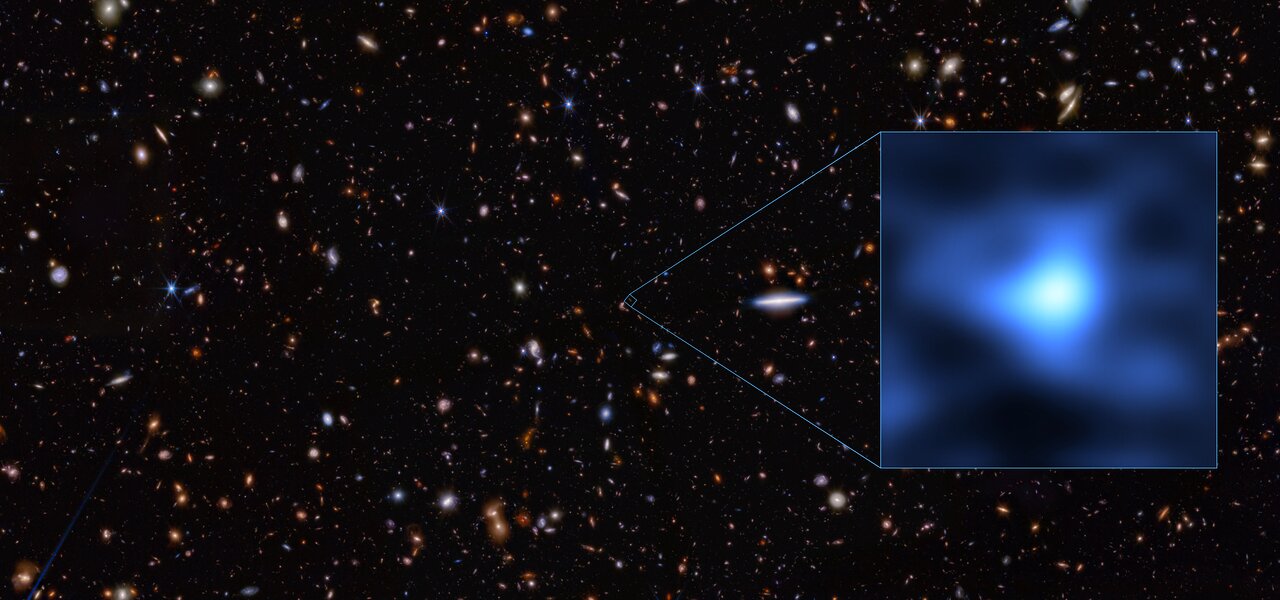
>Galaxies usually start their lives full of young stars, which are made mostly of light elements like hydrogen and helium. As stars evolve, they create heavier elements like oxygen, which get dispersed through their host galaxy after they die. Researchers had thought that, at 300 million years old, the Universe was still too young to have galaxies ripe with heavy elements. However, the two ALMA studies indicate JADES-GS-z14-0 has about 10 times more heavy elements than expected.
I didn't know this so I also wasn't surprised by the headline. Although it seems from this quote that they also did expect oxygen to be there, just not as much as they determined to be there. Although I have almost zero interest in space so perhaps this is bigger than I understand. I only clicked on the article because oxygen seems like a pretty simple compound to me and was surprised by the headline. I also think the headline is somewhat misleading due to the point above and how distant the galaxy is isn't the actual the newsworthy point as you say. It is only relevant to the extent that light from distant galaxies reaches earth slower.
The real headline should be something like "more oxygen than expected is created in young galaxies" which is indeed one of those space articles I would never click on.
Or we have fundamental errors in measuring distances and ages of things which is leading to these unexpected observations.
The expectation is indeed that all galaxies will have more or less the exact same elements that we have at ~13 billion years of age. But the image here is from a galaxy that was, at the time the image was emitted towards us, much younger than that.
To put this in persepctive, our Sun, which is larger than the median star, produces no oxygen and is ~4.5 billion years old.
Larger stars are theorized to undergo the so-called CNO cycle [1]. To get to this process after "only" 300 million years means the star or stars are truly massive.
Because the light we're seeing from this galaxy is from only 300 million years after the big bang. Elements like oxygen primarily form in supernovae, and the abundance of oxygen and other heavy elements in this extremely young galaxy is ten times higher than expected.
"The results show the galaxy has formed very rapidly and is also maturing rapidly, adding to a growing body of evidence that the formation of galaxies happens much faster than was expected."
Just a few molecules per cubic meter or less. Estimated at ten trillion times the entire volume of water on earth. Seemed like a lot at the time.
So that was early oxygen. But atypical.
Even the obvious things have to be proven or we would never really know.
Instead of inventing something interesting like "we're able to scan the elemental composition of every galaxy within a radius within seconds" i.e. solve the problem rather than create useless papers and PR.
And yes, they all mostly need to fish for funding to keep their not-so-well paid jobs going.
They are hardly "ordained priests" though. I think you are trying to insult them, but not really sure what you even mean. They are pretty much by definition highly intelligent people who could earn a lot more by working for FAANG or hedge funds, but prefer to take lower paid work on the off chance they get to discover something interesting about the universe we live in. So not much like priests then.
Having interviewed many failed priests of higher education, this is not true. It might have been true 50 years ago, but if you are smart and intelligent you typically do not spend 5-7 of the most productive years of your life getting a PhD.
>but prefer to take lower paid work on the off chance they get to discover something interesting about the universe we live in. So not much like priests then.
This is exactly what priests do for religion right? Academics are ordained priests educated in the Seminary of Higher Education. You need to be granted a Doctor of Philosophy in order to join the Church of Higher Education, and then maybe a few decades of cloistered contemplation and publishing of prayers to the funding agencies will let you do something useful.