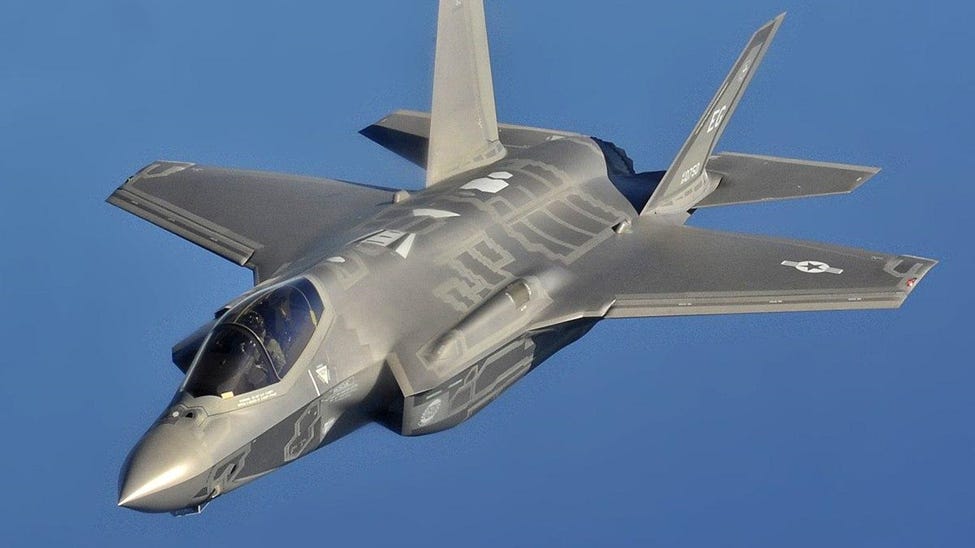
The F-35 as a Subscription Service: Power, Dependency, and Strategic Control… DaaS, Defense as a Service.
by Benjamin Cook (into by Tom Cooper)
xxtomcooperxx.substack.com
114 points · by sorokod · 1y ago · 182 comments
The prospect of getting cut off is hardly theoretical: the US already partially halted support for Ukraine's F-16s (I'm not sure where this stands at this precise moment).
The US is clearly demonstrating it is an unreliable partner in defence. Western nations cannot buy into a platform when its supplier might go from being a democratic part of the West to aligning with dictators and autocrats literally overnight. This doesn't just mean that platforms like F-35 are vastly less desirable to Western militaries, it also means that other things we thought we could rely upon, like the nuclear umbrella, are also unreliable, which is likely to lead to nuclear proliferation.
during development and going into first flight, it was fairly open discussion that israel 'was' an original partner whom was funded by usa, and thus why israeli flag was not on the a/c during promo but israel and their tech companies had input into development.
many times it was also discussed that israeli pilots would ask to have their engines deliver above spec thrust, sort of like tunning your turbo car... it created a whole logistical black hole but it certainly was technically possible. perhaps 15 years later someone finally figure out how to cater to that market.
So why don't those countries get equal access to the thing that they all went in on creating?
Pretty much all modern fighters require replacement parts from the original manufacturer. There are not enough fighter jets to support an aftermarket parts manufacturer, especially one that could exist without getting sued by Lockheed, Northrop, and the like.
The main technical issue is that you have to reverse engineer the parts if you don't have original drawings and didn't get a legal license to make your own. All the technical bits on an F-35 have anti-tamper features designed to make reverse engineering almost impossible (in case a jet gets shot down over enemy territory the USA doesn't want the enemies to have an easy time figuring out the weak points or finding bugs to exploit).
If you want to see what fighter jets without legal repairability license turns into, look at Iran. The sanctions placed on Iran have meant that they've been stringing their inventory of jets along for decades without official parts. They cannibalize other jets, buy black market parts, and cobble together their own solutions to keep their Air Force going. Check out the Sedjil, which is a modified SAM, that they created to put on their F-14s because the USA stopped providing Phoenix missiles: https://en.wikipedia.org/wiki/Sedjil_(air-to-air_missile). Trying to keep an Air Force going without official permission is really challenging.
But Israel's case is a little different from the above discussion- negotiating for the rights to modify isn't really about replacement parts. They aren't that concerned that the USA will cut them off. Their negotiation is more because they want to put some of their own systems on the jet. In older 4th generation jets, integration of new systems could be straightforward; you can put it in an external pod with a standardized mounting pylon and standardized data bus. On the F-35 you obviously want to avoid hanging a bunch of extra pods off the jet, so you need to get engineering drawings and software details to figure out how to internally integrate your stuff. Because reverse engineering is hard, they pushed to get this technical information legally. The only time this effort is worth it is when you think your country's equipment outperforms what the original F-35 can do. You need a decent tech to beat the stock F-35 systems, but Israel probably has a few areas where they can do that. But even with the right to modify the F-35, Israel will be heavily reliant on original parts for maintenance. They do not have a big enough industrial base to make all the parts needed for the jet.
This certainly applies to the aftermarket activities in the Westl, but entities doing that in Iran, Russia or Ukraine would not be liable to such measures. The question is more about technical capability.
> If you want to see what fighter jets without legal repairability license turns into, look at Iran. The sanctions placed on Iran have meant that they've been stringing their inventory of jets along for decades without official parts. [...]
True. Then again I see the ability for Iran to do this as a consequence of the effect of the sanctions and determination to make the best of domestic engineering potential. Quite a feat, I would say. The country has chemicals, electronics, mechanical engineering - and it trying to use it to create their own competing version of military platforms, starting with tanks, airplanes, drones, etc.
> The main technical issue is that you have to reverse engineer [...] All the technical bits on an F-35 have anti-tamper features designed to make reverse engineering almost impossible [...]
Very interesting! Almost impossible is a strong combination of words. Could you perhaps point me forward to some examples of such anti-tamper features?
What??
Really? A country that engages with neighbours that are barely able to send primitive missiles, while its last generation (US) jets drop bombs straight on their capital cities any time they want, with total impunity? And you still repeat this "poor existentially threatened country" propaganda?
Technically, they don’t need permission, but if they want access to the documentation, that costs extra. And sometimes it’s not available at any cost.
It's a cool jet, but there's something to be said about having the right tool for the job. Canada doesn't need a joint strike fighter, they need a cost-effective interceptor.
In reality our peacetime military has been a welfare project to assist the US in whatever (mis)adventures it gets in around the globe. Our choice of jets, guns, vehicles, and so on is predicated on "when the US drags us into some conflict or other, what equipment integrates with whatever their goals are". So when we signed up for the F-35, that was purchasing criteria.
The world is quite obviously changing. If Canada were seriously interested in true self defence against all realistic foes, it would be nuclear weapons and nuclear powered submarines...like the sort the US blocked us from being able to buy from the UK back in the 80s.
The problem isn’t a lack of F-35 capabilities, the problem is that Canada doesn’t know what it wants. AFAIK Canada only has two fighter bases, and given the fact that the country is arguably the largest in the world, this means Canada is not serious about intercepting adversary aircraft. Canada also hasn’t had over 100 fighters in a long time, so it doesn’t have a significant deployable force. So what does Canada want?
The Canadian armed forces participate in international missions in cooperation with other forces, and in domestic matters. You don't really need fighter aircraft for domestic missions; and for international missions you need whatever will work in coalitions. With a stable US pushing the F-35, the F-35 is a reasonable candidate for coalition work. Without a stable US, the F-35 is a poor candidate; presuming Canada would continue to be allied with NATO ex-US, whatever that group decides is the future is going to be a better choice.
It's not the F-35's fault it's not suitable for Canada. It was never intended for tundra. It's Canada's fault that for the last 20 years there's been no juicy tender for a long range fighter to entice the europeans or the yanks to come up with a suitable modification of one of their twin fighter jets.
I think the Eurofighter would have been a better fit for Canada. It is already built on multiple production lines, no problem adding another one in Canada for their aircraft.
There is nothing that can replace the Tornado in the German arsenal at the moment.
The Arrow was a brilliant plane for its time and purpose. But its cancellation was not wrong (if perhaps immature) - if there are no Tu-92 to shoot down, there's no need for the Arrow.
It's like the CANDU that solved a problem (Canadian inability to enrich U and make welds for PWR) using a solution at hand (world's largest capacity to make heavy water) but that is now largely obsolete (the CANDU's have been increasing their enrichment is an attempt to gain market share).
EDIT: I know that Tu-92, like B-52s still fly as part of the triad. But when the Arrow was designed there was no triad, or even diad. But what does the Arrow do to Tu-92s that an (modern, not the '50s crap) AA missile can't do better?
On or about 2025-03-07, the US apparently cut off intelligence support for the AN/ALQ-131 electronics countermeasures pods (jammers) carried on some F-16s. Those can still be used but will become less effective without constant software and configuration changes to adapt to changes in Russian radars. Some of that support might have at least partially resumed in recent days but the details haven't been publicly reported.
https://www.forbes.com/sites/davidaxe/2025/03/07/france-to-t...
Most of those transfers were done in the context of upgrading a fleet (with F-35); They did block the transfer initially.
> On or about 2025-03-07, the US apparently cut off intelligence support for the AN/ALQ-131 electronics countermeasures pods (jammers) carried on some F-16s
If you cutoff a feature of the equipment you sold, it is effectively a kill switch; its not really relevant what was the political rationale of cancelling the subscription. Thing is, this dumb flex move (it is possible to migrate the jammers to european platforms) just killed the F35 commercial roadmap, and will make the just-announced F47 a dud (it will be a struggle to find partnerships on this one with the same terms).
- Ukraine exchanged nukes for beautiful promises.
- North Korea which has comically bad diplomacy, but also nukes; rendering them un-invade-able.
- Even Canada faces threats to its sovereignty from its closest ally. Nukes would render this concern moot.
Why do people keep parroting this false trope?
They had no other choice but to hand over their nukes since the nukes were never theirs to begin with, they belonged to Russia, and they had no launch codes for them anyway, which were in Moscow, nor the resources to maintain them.
And that's not exactly what the world needed at the time: unkempt nukes in the hands of a bankrupt and corrupt nation going through political and economic turmoil of the 90s USSR collapse, guaranteeing them to get "lost" and end up in the hands of despots and warlords.
So giving them up was the correct and only choice for them. Otherwise they would have been persuaded by force to give them up either through sanctions or even through military intervention.
Because it looks consistent, it's incredibly close to actual facts and it serves the narrative well.
But yeah, it is false.
First of all, broadly speaking, Budapest memorandum was not broken at a scale people think it was. The memorandum is quite short, go read it and decide for yourself whether it was failed. Bear in mind that the memorandum has no legal consequences, it's not binding at all.
Second, what you have said about the nukes is mostly correct. I have been living in Ukraine since before the independence and up until the war and let me tell you: people in the West have no idea how poor Ukraine was at the time. A wasteland. There was no funds to fuel ambulances in Kiev, let alone maintain the extremely expensive nukes. Nukes have an expiration date, and they would be rendered useless by the time Ukraine scrambled funds to maintain even a single one of them. Leave alone the fact that there was no (extremely expensive and complex) service facilities, no fissile material to maintain the nukes and no ways to procure or produce one.
Third, people in the west have no idea how corrupt Ukraine was (and I hate to say it - is). There is no doubt at all that some of the nukes would be lost.
So, there is no conceivable scenario in which Ukraine gets to keep and maintain those nukes in the nineties.
(I hate to say all of it as I am ukrainian.)
In 1993, Ukraine wanted to "dismantle only 36 percent of its delivery vehicles and 42 percent of its warheads, leaving the rest under Ukrainian control." Only US promising them more money got them to change the position.
[0] https://www.armscontrol.org/factsheets/ukraine-nuclear-weapo...
Couldn't the US government also kill all Windows workstations, iPhones or AWS servers? Of course they could.
Smaller companies or individuals may not care, but governments or bigger companies that are risk averse? Of course they'll care.
Many countries are now reevaluating their US dependence and I'm sure it's a very high priority throughout the world to reduce or eliminate it.
If you want to re-sell the 100% made Swedish arms you already bought, to a third party, you'll also need Sweden's consent for that. This isn't a US exclusive thing.
This feels like exaggeration to me. How is the US an ‘unreliable partner’? Has any country had parts for their existing defense purchases restricted? This type of reaction to the US choosing to not spend its own taxpayer money or military equipment on a far away conflict doesn’t make sense.
If anything, the truth is the opposite. The other countries in NATO have been unreliable partners that did not meet their spending requirements. For example, Germany, France, and Canada all underspent but benefited from the US taxpayer spending a lot.
> Western nations cannot buy into a platform when its supplier might go from being a democratic part of the West to aligning with dictators and autocrats literally overnight.
The US is not aligning with dictators. Pushing for a resolution to a conflict that is costing the world hundreds of billions, not to mention huge amounts of Ukrainian lives, is the only reasonable path. The EU has literally no solution for this conflict - just complaints that America is now seeking resolution and doesn’t want to keep wasting money or lives.
Iran in olden times. Venezuela recently. I wonder who is next?
Also denial of certification for 'shared nukes' for Eurofighter comes to mind.
Why is the word 'imagine' necessary?
--
Also, love the advert at the bottom "Hate subscriptions?"
This is untrue. iOS ships with several features that you cannot enable without government regulation or an annual developer fee.
Android is Open Source and therefore does have a full feature-set available free of charge. iOS undeniably ships with disabled entitlements that only paying users can access. Whether or not you consider these software limitations salient is debatable, but the fact they exist is concrete.
The F-35 is "essentially" full featured without American support, as long as the functionality you're referring to is the airfoil. We can make all sorts of silly definitions that confer innocence to OEMs, and many of them are both factually and practically wrong.
This is assuming a pretty narrow definition of "full feature-set". It is a inacurrate to say there is feature parity between an Android phone running Google Play Services vs one that is not.
Really? Everyone I know has a subscription to make a phone call on one of those devices.
Everyone I know has a subscription to an internet provider for the Wi-Fi.
As long as executive compensation is tied to stock performance, coorperations will only care about their stock price and the kinds of things that will affect it. I do not trust them regardless of who is in the White House. Their alignment of values/incentives is diametrically opposed to mine...
That's a double whammy for European countries who signed on to spend hundreds of billions on these planes in the belief that they're part of a NATO security umbrella. Now it seems like NATO will soon be in shambles and the planes might not even fly if that one drunk frat guy with Nazi tattoos running the Pentagon says so.
Finland bought F-35's recently, and the Finnish government is saying that nothing should change because America will hopefully be back to normal before the fighters are delivered. I don't think that kind of ostrich strategy is going to pay off.
I have hopes for BAE Tempest.
The Finnish military basically runs on the collective trauma of the last Russian invasion. There's a general conscription for male citizens, and reserve forces receive regular refresh training to keep their skills active. But you can't transform that kind of spirit into fighter planes.
https://www.stimson.org/2024/eu-defense-this-time-might-be-d...
I can’t find the article I read earlier. But they are working toward outside alliances also for military manufacturing with Canada, the UK and Japan and are explicitly excluding any US components.
It does not appear to have sunken in that damage to the F-35 export market will affect the per-unit cost of the F-35 and its parts for the US military. Given the amounts of money involved, it seems likely a really big abandonment of F-35 overseas will do more damage to the federal budget than all the oddball firings they're doing could offset.
> He expressed confidence that the United States and Lockheed Martin would ensure the operational capability of Finland’s F-35 fleet in all circumstances, given the decades-long partnership. He also noted that all modern weapons systems, including those used in Europe, contain software components primarily originating from the United States.
“Yeah, we’re fucked now that the US is turning into a dictatorship and a Russian ally!”?
That’s a fast track to those kill switches being deployed on hardware delivery.
In hindsight, Gripen or Rafale would've been a much better option. But few saw how different US foreign policy would soon get.
(I'm going to start thinking of my big ThinkPad T520 as an F-15E.)
The Gripen is powered by the US-made GE F414 engine, so any purchases can still be vetoed by the US government and buyers will be dependent on US supply chains for maintenance.
> The aircraft was also designed from the beginning to be easy to repair and service, even for personnel without much training.
> The digital central computer was the first of its kind in the world, automating and taking over tasks previously requiring a navigator/copilot
> The airframe also incorporated a thrust reverser to use during landings and land manoeuvres, which [...] enabled operations from 500 m airstrips with minimal support.
> By the mid-1980s, Swedish Viggen fighter pilots [...] had managed to achieve radar lock-on with radar on the SR-71 on numerous occasions. Despite heavy jamming from the SR-71, target illumination was maintained by feeding target location from ground-based radars to the fire-control computer in the Viggen.
All around one of the coolest fighter jets ever made. Swedish engineering makes me eat my big fat American heart out every time.
SAAB had originally considered the British Olympus engine for the Viggen, which would have had higher fuel consumption but faster responsiveness and no export tangles.
Why it degrades? Any examples of that?
Defense vendors backdooring/degrading/IFF-ing their products when sold for export has been a thing for many decades. Heck the UK sold enigma machines to a bunch of countries after WW2, specifically because they could break its code.
This issue is why there is a French and UK and Swedish (and Russian) defense industry.
https://ukdefencejournal.org.uk/how-much-of-the-f-35-is-brit...
The only thing remotely newsworthy here may be a story around a loss in global confidence in the US "brand", but I think the actual implications of that (if any) still remain to be seen....
I think Trump may be miscalculating the situation. The Ukraine war already caused a shift of some countries away from the West towards Russia/China. With Trump being so openly hostile towards former allies, the US may lose influence world wide.
What Europe doesn't currently have is the production capacity to match American capacity, but that's exactly what they're changing now.
It's not just planes, either. WW3 was going to be a huge tank battle fought in Europe. I don't think we've seen the end of tanks, but I suspect we'll see them no longer being the central weapon around which combat formations are built.
https://www.twz.com/air/next-generation-fighter-critical-to-...
Iran got a large number of this plane
https://en.wikipedia.org/wiki/Grumman_F-14_Tomcat
which is highly capable but a particularly bad choice for a developing country, especially one that has bad relations with the U.S. Iran showed great ingenuity in maintaining and upgrading the planes as well as missiles for them.
As a simple question, some people say there isn’t a “kill switch” which I’d bet is true in the sense that there isn’t an admin panel somewhere you could just ground Finland with but … how could you be confident about anything in a codebase that large? That’s even before you consider whether, say, the chaotic DOGE cuts haven’t created an opening for Russia or China to find something exploitable even if the original designers didn’t intend it to be.
(the reason given was kind of interesting, involving a prediction that within a decade the stealth technology of fifth-gen fighters might very well be compromised by improved sensor and signal processing technology, and Israel wanted to stay on the pointy end of that)
An "Alliance" used to be built on core principles, trust, and alignment, it's not just a fancy word.
So the question is, why would an Ally of yours need to spend resources to reverse engineer technology you're willing to exchange with him, and vice versa?
Looking back, maybe it's not such a bad idea when an Ally shows signs of shifting to an adversarial position against you.
Lockheed and its contractors have no interest in betting their intellectual property, nor the US in betting our national security advantage, to the whims of the current administration of whomever buys our F-35s. Therefore the avionics are constructed with robust anti-tampering/RE mechanisms. You can have them, but you can't make more or sell the secret sauce.
With that said, it looks like what's happening is that Europe, Canada, and probably more to come, have no interest in betting their National Security on the whims of one guy pulling the rug on them, as Trump did to Ukraine to appease Putin.
The problem here isn't IP theft - it's about reliability.