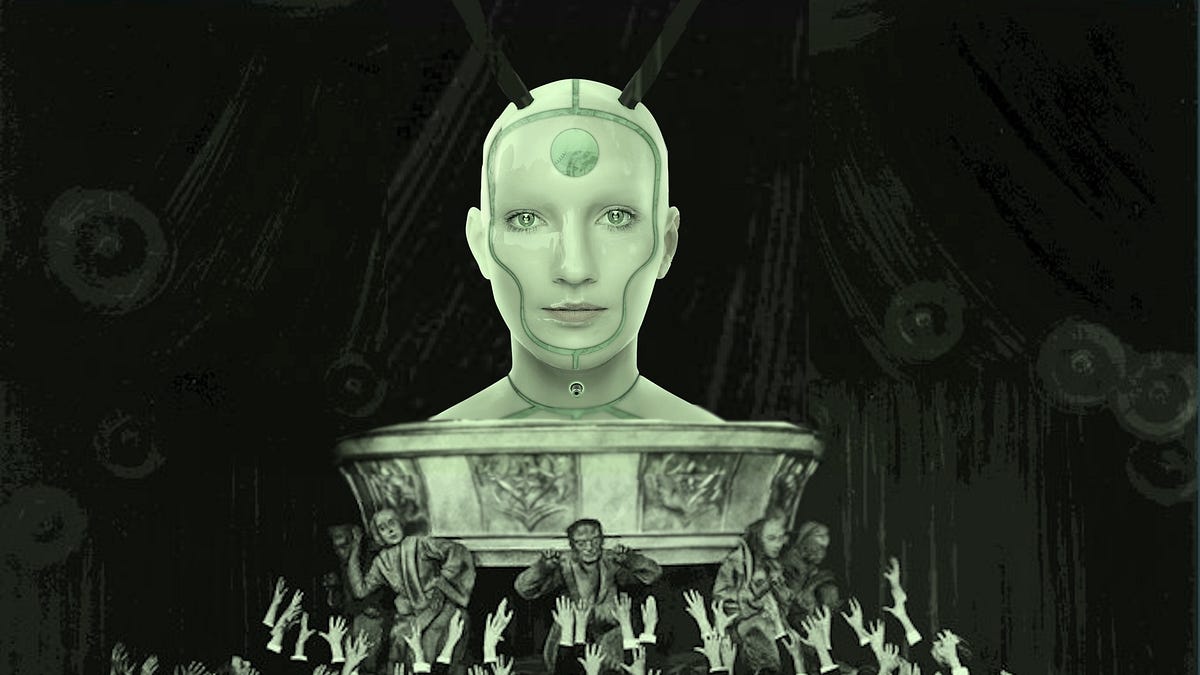
The Tranhumanist Cult Test
Transhumanism is put through the 8-point test to see if it is a cult
ewanmorrison.substack.com
39 points · by thinkingemote · 1y ago · 117 comments
At the beginning of a movement when nothing can really be done yet you mostly only attract zealots. At the end of a movement when you've achieved many of your goals, you only have zealots remaining.
I would say they are not zealots but power hungry people who enjoy clout and power. They adopt the movements ideology like a uniform - something to wrap one self in to signal others - and become the zealot like an actor becomes a character. I am sure many dont even care about the ideology, as long as it gives them more than the other guy. Many of them feel that they are better than others so they should be in charge. I knew people like that, control freaks who want everything in their life to work the way they want it to by controlling the actions of those around them - bending others to build their world. No thanks.
> transhumanists have deepened their belief in a fated future in which the human species will achieve “augmented” evolution through fusing with machines, leading to the emergence of an artificial superintelligence that will far outstrip all human knowledge and achieve God-like powers (The Singularity). This digital deity will lead us to a new era, in which all human biological limitations will be transcended; bringing about end to sickness, suffering and even death, and leading us to colonise the cosmos
If I rephrased the quoted passage as:
> transhumanists have deepened their hope for future in which the human species will augment evolution by fusing with machines (as we already do with brain-computer interfaces, but better), and the potential that current AI — which is already helping us decode proteins, perform and write up scientific research — will continue to improve, helping us to expand our medical knowledge even faster and help us develop cures for things currently beyond us. As the AI we already have has allowed us read the complete connectome — neural structure — in small animals, there's even a possibility we may expand this to human brains (though we don't know how long this will take us to do!), and if we manage that, then it would allow us to back up and restore our minds as we already do with digital documents.
Doesn't seem nuts, unless you believe humans have souls that can't be digitised.
That said, I'm skeptical about any specific future: when the only flying machine you've heard of is an airship, it's easy to imagine a future filled with them — what's our airship? What's the thing everyone expects but which won't happen?
Let’s ignore souls: humans have bodies which cannot be digitised. Our bodies are real matter, not some dross to be jettisoned.
I wonder if Black Mirror ever did an episode about someone unwillingly personality-cloned into a computer, then killed, with everyone around him acting as though this were normal and he — still conscious — was a non-person?
Wikipedia says: """ […] one modest and easy to defend (the "motte") and one much more controversial and harder to defend (the "bailey") […] """
The claim "the article is mischaracterising transhumanism" is saying the article's definition of transhumanism is a bailey, surrounded by the motte of "huh, these ideas sound a bit like Christianity and Revelations…"
I don't know the actual distribution of transhumanists who believe in any specific outcome of the singularity, but I would at least point at the simultaneous existence of e/acc (who think it will be good) and LessWrong (who mostly think it's going to be misaligned, meaning it goes off and does its own thing even when we don't want it to).
But even the most extreme ideas of what might be possible are still couched in terms of atoms, not magic.
Transhumanists simply believe in augmenting their bodies beyond their natural capabilities. The rest is just misrepresentation.
Me personally, I believe we should throw a wrench in the whole thing because the people who are in control are some of the worst people. Unless that changes, it would be a mistake to develop this technology further.
I have trouble with this characterization, because if you use it, then 99% of the human race is transhumanist, so the term loses any meaning. I’d argue the landscape isn't fenced to body modification, either, but that’s not really important. We’re clearly talking about something else here. Everybody knows it—don’t play coy.
As far as I’ve been able to discern over the years, a transhumanist advocates for the use of technology to improve human experience irrespective of the implications to humanity. And the way they rationalize this is with a specific set of beliefs that conveniently skirt issues of consciousness and soul. I am not saying they are wrong, they’re operating off arguable axioms, all of which may be end up being true. I’m saying they have to hold a set of beliefs in those axioms that are not shared by 99% of humans to rationalize their worldview.
If you wear glasses or had braces or use an insulin pump or take Ritalin, then, congratulations, you're a transhumanist. The rest is just a matter of degrees.
As wizzwizz4 says in a sibling comment, the post is conflating TESCREAL and transhumanism.
Note that i disagree with OP about glasses or insulin pump, as most people support use of technology to fix deficiencies of a human body or mind, but if one has a healthy, fit body/mind and still want technological improvements, that is a red line.
That still defines it in relation to the non-improvers, which isn't the most compelling position. Why not, "we want to augment human potential to maximize quality of life through technology?"
(I worry it isn't that argument because it is still too human-centric.)
Thats a very blurry line that changes with culture, age, profession, hobbies etc. In 50 years that line will be elsewhere even within that boundary. Especially when this has nothing to do with religions since they were invented long before any of this became a topic (so much for universal truths but thats another topic).
The appropriate question to ask is, “what unique beliefs do transhumanists hold”. And the differentiating factor is generally a sentiment that the human condition must be overcome even at the cost of humanity. A transhumanist fundamentally rejects what it is to be human in line with a belief that humanity is inevitably deprecated. Humanist: technology augments humans. Transhumanist: technology replaces humans.
I’ve tried really hard and can’t seem to find a way to rationalize a transhumanist worldview—at least until we understand life and consciousness intimately and thoroughly. But even then I’d have to reevaluate, not take as a given.
Transhumanism is not about human augmentation, it's about a misty-eyed view of human augmentation experienced through a haze of hand-me-down religiosity.
I spent some time following these people in the early 00s and they were talking about replacing nerves with Cat 5 - and other obvious nonsense. Complete lunacy.
It's a fundamentalist millenarian movement which is inherently faith-based, contemptuous of physical and psychological reality, and irrational. As the article says - it's just another in a long, long cycle of similar movements with similar dynamics.
The only thing that changes is the set dressing. The play is always the same, and always ends in horror and tragedy.
No, this time will not be different. Affirming that it will be is part of the sales pitch. But somehow - for reasons that are unsurprising to anyone who knows a little psychology - that never quite seems to happen.
Yes, for some, transhumanism is basically millenarianism with different set dressing. And yes, some of the things transhumanists say pattern-match to popular religious themes, especially if you're willing to bend or simplify some things a bit to force the analogy. But that doesn't mean that those transhumanist ideas and predictions actually are religious in nature, nor does it mean that most people agreeing with them are just operating on faith. And it especially doesn't mean that "the play is always the same, and always ends in horror and tragedy" (like what does that even mean, where does it ever apply?).
(Also, some critics have no sensitivity to jokes, or purposefully ignore humor. Replacing nerves with Cat 5, really?)
I don't deny there is a thick shell of fraudsters and pseudoscientific entertainment around this. I've seen that, and was disgusted by it, but unfortunately it happens for everything. This one is a real pattern - specific ideology is the set dressing, the underlying phenomena is just a bunch of scoundrels selling outlandish ideas to naive people. But that's not actual transhumanism, not any more than New Age bullshit about quantum this and magnetic that makes physics itself a faith-based movement.
I wish people would engage with specific ideas coming from transhumanism (and adjacent fields/communities), instead of trying to dismiss them with "your other ideas look like repainted Christianity, therefore they're wrong, you're wrong, and whatever you're saying here must be wrong too".
You could also say that wearing glasses or having an insulin pump installed makes you a transhuman, but it can't make you a transhumanist. And plenty of people are perfectly happy to be slightly ideologically inconsistent, or follow more nuanced ideologies, where, say, certain artificial enhancements are allowed and others are not. After all, even the biggest anti-drug crusaders accept coffee or at least tea as acceptable substances.
Instead of a benign example like eyeglasses, let's say I murder someone so that I can harvest his organs and replace my failing ones with his. According to you that makes me a transhumanist.
That is, wearing glasses is consistent with transhumanism, absolutely true. But one can wear glasses for other reasons, and even oppose transhumanism and still wear glasses, while still being perfectly self-consistent.
For example, believers of the Jehovah's Witnesses cult (or sect if you prefer) don't accept blood transfusions, but still wear glasses. They believe that certain modifications of your body and its abilities are acceptable, and others are not, and that this decision is not what makes our bodies work better, but based on what some god allows his followers to do. So, they are not transhumanists, even when happily wearing glasses.
Glasses restore a function that was supposed to be there in the first place. They are called "corrective lenses" for a reason; to correct is to presuppose a defect which must be corrected to restore what is normative. Insulin pumps also restore a function that was supposed to be there in the first place. That it is implanted into the body is totally irrelevant. As with glasses, the relationship between the person and the pump is instrumental. My heart or brain, however, are not my instruments. They are part of me.
However, the essence of transhumanism, and the ultimate source of issues, is that it turns the human being into an engineering project that seeks to transcend the human. Metaphysically, this is, as polite academic philosophers might say, problematic. To transcend presupposes an existing limit inherent to the thing by virtue of its nature. You wouldn't say that adding a new video card to your computer or building an additional floor on a building transcends the original computer or the original building. This was always possible, as these things are effectively aggregates. The mechanistic metaphysics here precludes the possibility of transcendence, because all you can ever really do is rearrange the furniture. You also wouldn't say that adulthood is the transcendence of childhood, or that adaptation is some kind of transcendence of the species. You're still operating within the scope of possibilities of the species. The nature of a thing is what circumscribes its limits. Technology is not able to transcend human nature, because technology is already within the scope of human power. You can no more cause your own transcendence than you can pull yourself up by your own bootstraps.
Transcendence is not merely the actualization of the potentials already present within a thing. It entails the intrinsic "expansion" of the powers of a thing beyond what is possible by virtue of the nature of a thing. However, any modification of a human being can only be either instrumental, the introduction of defect, or restorative. In the best case, we're talking medicine and health. In the worst case, dehumanization, objectification, and commodification of human beings.
> to correct is to presuppose a defect which must be corrected to restore what is normative
This prescribed bondage to normativity is a manifestation of ableism. Existence has no concept of supposed to be. Some people can see, and some people cannot. Some people can walk, and some people cannot. That survival in nature is easier for those who can isn't a value assessment. That society is structured to cater to some of those people more than others isn't an inherent moral good.
The tools you mention don't alter the species itself. Once we start heavily GMing our offspring (does anyone think this won't take hold culturally in the next 4 or 5 generations?) those folks will start to become transhuman.
Before we get to the point that we can do that, a disaster and/or a better alternative will mean very few people even want to do it.
The one with the tendencies to treat it as a cult? Isn't that the point of the article?
I am not really sure what point you're trying to make. It's like everytime I critique capitalism, someone appears and corrects me that what we have is actually a "crony capitalism", and the real good capitalism is somewhere in a mystical faraway place. Why insist on correcting the name then?
If you used fire to disinfect your recently caught prey, you're a transhumanist.
If you read a book ..
The only conclusion to be made from this article, is that humans have been on a transformation treadmill for a long, long time - long enough that we can no longer recognize transformation when we see it, or we are so tired of acknowledging it that we just don't any more, or such that we need to see it before we believe it is happening - i.e. next years new iPhone purchase, etc.
Wait ... isn't it "transhumanist"? This typo appears once more in the article, just enough to thwart efficient computer content searches.
It would catch them off guard, and then I would point out that they have faith in transhumanism like Christians have faith in Jesus. There would be a quick "get it" facial expression, then we'd both laugh. The transhumanists who I encountered were opened-minded enough to realize the difference between faith and reason.
I'd then point out that the Egyptians had similar beliefs, and say that if you freeze your body, or head, at death; most likely someone would use it for some strange science experiment in the future.
That being said, if I was wealthy, I'd love to freeze my body. I'm sure it'll come in handy for someone at some point, just like Egyptian mummies did.
“Now the serpent was more crafty than any of the wild animals the Lord God had made. He said to the woman, “Did God really say, ‘You must not eat from any tree in the garden’?
The woman said to the serpent, “We may eat fruit from the trees in the garden, but God did say, ‘You must not eat fruit from the tree that is in the middle of the garden, and you must not touch it, or you will die.’”
“You will not certainly die,” the serpent said to the woman. “For God knows that when you eat from it your eyes will be opened, and you will be like God, knowing good and evil.”
Well God is an engineer and he gave us technology & curiosity as his greatest gift. Being aware of our own mortality both as individuals & as a species is what drives us to to try and beat it.
To be fair, blame the serpent (or Prometheus).
That's just wrong. Pacemakers are a form of transhumanism, improving the human condition through technology. When you comment on the difference between faith and reason, say transhumanism is based in faith, you're implying it's not reasonable.
Even if you're talking specifically of those that support cryonics like Alcor, or hope for mind uploading your statement is still flawed. Most don't have an absolute belief these technologies will come about, but hope they do and work towards bringing about that future.
Maybe the word you're looking for is hope. Transhumanists hope for a better future in the same way Christians hope they'll go to heaven.
>Transhumanism first emerged in Silicon Valley in the 1990s
That alone give me pause over this movement :)
Yep, we've seen this before.
Wikipedia (https://en.wikipedia.org/wiki/Transhumanism) gives a much better overview of what the movement is and its history; the "came about in the 1990s in silicon valley" is just wrong, to start with.
Its not difficult...
“Don’t worry, I’m not one of those silly TESCREALs, I’m just a transhumanist!”
What does this distinction add to or take away from the thrust of the analysis?
>Transhumanism is a philosophical and intellectual movement that advocates the enhancement of the human condition by developing and making widely available new and future technologies that can greatly enhance longevity, cognition, and well-being
Which isn't a cult, just tech to live better etc. Making out it's something else makes the argument a bit meaningless.
I think that transhumanism (the way that you'd find on wikipedia) is a noble pursuit and what article describes is a bunch of hogwash that I'd never hear of outside of anglosphere.
I'm not entirely opposed to the article's characterization, but this is a big one to get wrong. What the term has become in its pseudo-cult modern context is entirely divorced from what it came out of.
* Eternal life
* A powerful entity or entities who will fix whatever is wrong
- An end to poverty
- An end to disease
* Personal Freedom
This is entirely a faith based belief that can not be proven or disproven. It is by no means certain that you can extrapolate to a singularity in our future. Nor is it certain that you can assume it will have the claimed effects. While the term singularity in math and physics has a well defined term with clear non-religious meanings. "The Singularity" is entirely a faith based religious belief.
That's exactly backwards; a singularity is a point past which you can't extrapolate, because trying to do so leads to absurdities (e.g. infinite densities, time as a spacial dimension, one egg costing more than the GDP of Europe, etc.) "The Singularity" was called specifically that because it was the point at which historical projections would become absurd, and thus we could not meaningfully forecast past it (like an event horizon).
Some people ran with that and decided that it was a forecast that specific absurdities would certainly happen, but that's mostly just a reading comprehension issue.
There's nothing historical about it; it came about as a result of a few different science writers looking into the future and wondering how we keep up in an accelerating technological context.
I actually agree that it's become something else, but the origin of the term was what I was correcting, and its origin isn't something woo-woo, it's firmly based in scientific speculation.
https://edoras.sdsu.edu/~vinge/misc/singularity.html
There's a lot of speculation in there, but it's pretty carefully couched in scientific terms, and particularly in what-ifs that satisfy even the most stringent demands for conservative thinking.
The whole attempt at casting transhumanism as religion is silly. Transhumanist side says, "there's no supernatural God, but sufficiently advanced technology could approximate it" - and then people turn around and say, "you see, you say enough technology is like a god, therefore you're religious and believe in God (specifically in Christian God per mainstream religion, with all its mores)".
<facepalm>
Like X != X.
A good example of atheistic, even materialistic, religion was the official doctrine of the USSR, "marxist dialectical materialism". This had all of the hallmarks of a religion, complete with religious texts, priests, condemnation of non-believers, and so on - but caked in fully materialistic and dogmatically atheist concepts.
I personally think the singularity happened back in the 90s and its just been very disappointing instead of the rapture that was imagined.
There's always been some stuff we can't forecast, and some other stuff we can forecast kinda OK-ish. If you'd asked people from 11000 BPE if the sun would still be rising and crops would still be grown today, I suspect the biggest difficulty would be finding someone who really understood the meaning of the number used to express the number of years between then and now — even a "big city" back then would have been order of 1k-2k people.
But I say "sun" and "crops" because of what I expect to be the limits of their imagination. We see such limits even today — even on Hacker News, look at threads about AI taking over the world, and you will see people discussing AI as if it can only be in the form of existing current LLMs.
So, the question to ask is: how far into the future would you have to take someone from each of those years, before they're shocked by what they encounter? That's my "event horizon", because it's the horizon beyond which you cannot see, even if that horizon is one of inability to predict what specific thing will be invented rather than the general trend-lines going infinite.
The time-gap to a shocking new invention decreases as the rate of progress increases.
Obviously how much some person will be able to forecast and hence not be surprised by, will depend on how much attention they pay to technological developments — and I've seen software developers surprised by Google Translate having an AR mode a decade after the tech was first demonstrated — but there is an upper limit even for people who obsessively consume all public information about a topic: if you're reading about it when you go to sleep, will you be surprised when you wake up by all the overnight developments?
Personally, I've tried making my own forecasts about the future, I'm fairly consistent for the last decade that my models stop making sense around 2032. But even with that consistency, I could only see ChatGPT coming when InstructGPT was shown off in a Two Minute Papers video (https://www.youtube.com/watch?app=desktop&v=PmxhCyhevMY&t=4m...) and the rate of change of Transformer and Diffusion models has continued to surprise me.
(I also didn't predict how severely YouTube would be stuffed with adverts, but that's more of a cultural shift — everyone gets all "kids these days" as they get older, why would I be any different?)
The singularity, distilled, is that if/when we get AGI or other world-changing technology, accurately predicting what happens next is impossible. As the rate of technology advance increases, the interval over which you can make reasonable predictions shortens until eventually what happens tomorrow is a role of the dice.
I believe in aliens in the same way: the universe is huge so I think they must exist because (small likelihood) x (huge number of chances) seems inevitable. I don’t think they’re flying over Idaho to terrorize farmers, though.
EDIT: The tech industry went from resolving everyday problems ("how do I make spreadsheets more quickly", "how do I send this information to a person on the other side of the country") to trying to play God with AI.
(It’s one of the reasons I love it here. That same energy manifests amazing art, hackerspaces, meetups, and other fun things.)
When you have members of the movement referring to those who will be left behind as "median humans" (Altman) and making major changes to government that are to the detriment of society (Musk, to a lesser extent, Thiel and Andreessen), we're no longer "goofy". "Scary" is a better word.
The Flying Spaghetti Monster? That's goofy.
>The biologist Julian Huxley popularised the term "transhumanism" in a 1957 essay.[ The contemporary meaning of the term was foreshadowed by one of the first professors of futurology, a man who changed his name to FM-2030. In the 1960s, he taught "new concepts of the human" at The New School when he began to identify people who adopt technologies, lifestyles, and worldviews "transitional" to posthumanity as "transhuman".[7] The assertion laid the intellectual groundwork for the British philosopher Max More
Huxley was British, The New School was in NYC, More also British. I'm not sure you can pin it all on NorCal.
NorCal has been a feeding ground for cult leaders for 100+ years, but I actually think fewer real problems would be better. the people out there without real problems, just have GPT wrapper startups and go lie to people on podcasts, which is annoying, but better for them and everyone else.
Perhaps it's the investors who need real problems. Usually that can be caused by having far, far less money.