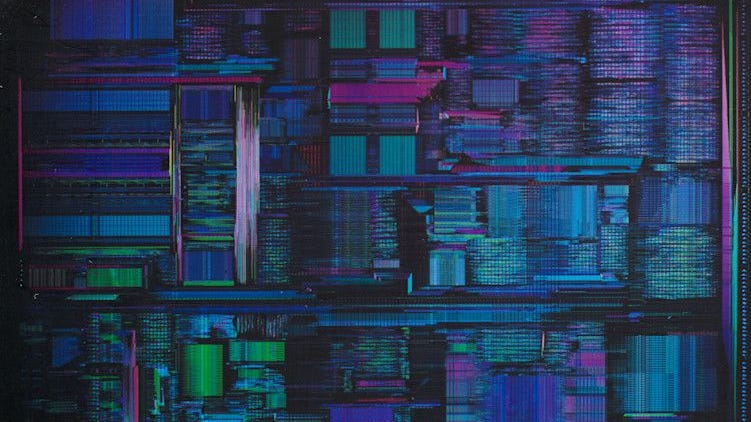
Intel: a Bug and a Pro
The FDIV bug and release of the P6
abortretry.fail
75 points · by rbanffy · 1y ago · 44 comments
Coe's ratio: https://people.cs.vt.edu/~naren/Courses/CS3414/assignments/p... (3rd page)
Linux code: https://github.com/torvalds/linux/blob/b0cb56cbbdb4754918c28...
Edit:
Seems IBM stopping shipment of these buggy PCs forced Intel to fix the problem. I cannot imaging today's IBM doing something like this.
Today's IBM doesn't ship Intel servers, or Intel anything. They sold that part of their business to Lenovo.
Could you explain what's awesome about them, and what even are mainframes? Whenever I tried looking into this, I walked away with "just servers networked together".
FWiW I bought (one of) Kevin Peek's guitar amps in 1982 in Kalamunda (W.Australia) .. it was just an ad in the classifieds, got out there and it was a damn near world class music studio in a one room music cabin in the bush.
Also I often wonder what the aggregate statistics of `top` load average and standard deviation looks like over billions of consumer devices over time.
Later, they have dropped the "Pro" naming scheme and the successors of "Pentium Pro" have been branded as "Xeon", until today.
IBM had been wise and they had incorporated memory error detection as a standard feature of every IBM PC, so that has also been true for all IBM PC clones.
By the early nineties, when the memories packaged in dual-in-line packages have been replaced by memory modules, you could buy complete memory modules with error detection, but there were also slightly cheaper memory modules without error detection, so a computer owner could choose either of them. I am not a gambler, so I have always used only modules with error detection.
However that has changed in 1994, when Intel has decided to split their CPUs into Pentium for "consumers" and Pentium Pro for "professional users" who were willing to spend much more for a workstation or server computer.
This is when Intel has decided that in order to stimulate their customers to buy overpriced "Pro" CPUs, memory error detection must be removed from their "consumer" CPUs.
While in 1993 the first generation of computers with Pentium still had memory error detection, for the second generation in 1994 (with the Triton chipsets), memory error detection was removed, in preparation for the launch of Pentium Pro next year.
We will never know the value of the financial losses that have been inflicted worldwide upon naive computer users by this Intel decision.
Fortunately for Intel and unfortunately for us, software bugs have always been so frequent that all computer users have been conditioned to assume automatically that whenever the computer crashes or data corruption is discovered, the cause must have been some software bug and it must be difficult or impossible to determine the exact culprit.
Despite this common assumption, many of these incidents may be caused by hardware memory errors and besides the noticed incidents there may be many other cases of data corruption that have never been discovered.
The claim of Intel that this removal of memory error detection has been done for the benefit of the customers, to reduce the price of the computers, is of course false. After it became impossible to have memory error detection in "consumer" PCs, there was no price reduction in motherboards or memory modules, the prices have remained the same and their vendors had increased profits, so they have supported enthusiastically the initiative of Intel.