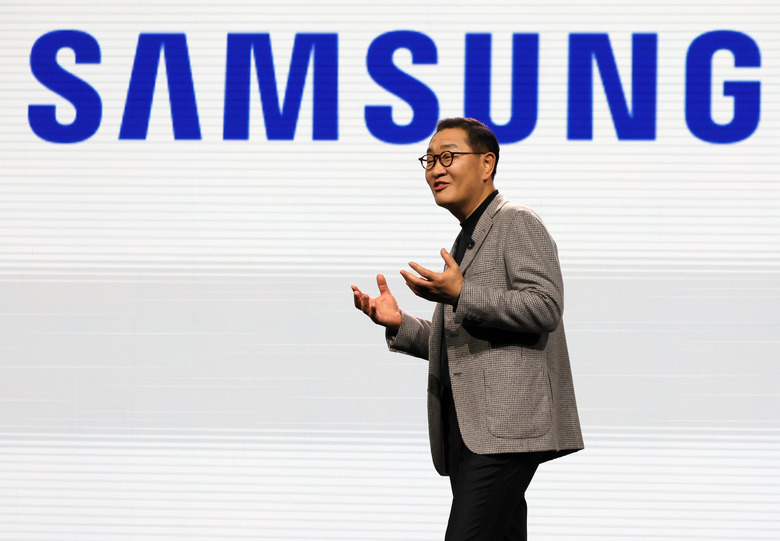
Samsung CEO Jong-hee Han has died - Engadget
One of Samsung's CEOs, Jong-hee Han, has died due to a heart attack.
Engadget
258 points · by ksec · 1y ago · 156 comments
The deceased Han Jong-hee was a Co-CEO and Vice-Chairman, just like Jun Young-hyun who now remains as the sole CEO.
This was not a planned transition or coincidence, Samsung usually had 3 parallel CEO's since 2013 and downsized to two CEO's in 2021, all of those being "Vice-Chairman".
On top there is still the Samsung Electronics Chairman, Lee Jae-yong...
Samsung the company started as something resembling a dry goods market.
Mitsuboshi, 三つ星, would I think be for three stars, particularly the stars of Orion's belt.
"According to Samsung's founder, the meaning of the Korean hanja Samsung (三星) is three stars."
https://news.samsung.com/global/20-things-you-didnt-know-abo...
https://www.mitsubishielectric.com/en/about/history/logo/log...
https://www.kedglobal.com/leadership-management/newsView/ked...
I guess he had been co-CEO since November. That’s about as smooth of a transition one could hope for? (As far as the company welfare goes.) My thoughts are with his family. An abrupt loss like this must be painful.
Because we all know that CEOs are hard working individuals. Only the developers are lazy. /s
it's HN.
Samsung Electronics Says Co-CEO Han Jong-Hee Has Died at 63 - https://news.ycombinator.com/item?id=43466951 - Mar 2025 (no comments)
Saying "all he has to show for it" is like saying all Jimmy Carter got was 4 years of stress.
My home was recently destroyed by fire (not a total loss of dwelling, but 95% of contents due to smoke and water), and I'm quitting tech to accept being a rancher and body builder.
I love tech, but tech doesn't love me. So, #yolo on to the next thing.
Someone with 30% tech ability will easily out-earn someone with 100% ranching ability. And have way more free time. And live way more comfortably.
Don't be fooled, the greenest grass is in the tech sector (and finance too).
Getting bank loans on that means most ranchers start at 20 with a few acres (that is a ranching/farming hobby) and a full time job to pay the bills - the ranch itself isn't even paying for the land loans, but it is close and their job pays the rest. Then they build trust with the bank and buy more land as it becomes possible. At 40 they have paid off the initial land (or at least inflation means the payments are tiny in current money) and so they are generating enough income to quit the full time job and farm. At 60 they have paid off most of the land which is now worth millions and so are rich by any measure in ways most tech jobs cannot get to (though if you happen to be one of the lucky early people in in a successful startup you are doing much better, your odds as a rancher are probably better than that).
Beware though that ranching is physically hard on the body. Farming is one of the most dangerous jobs humans do, there is a real risk you will die before you get rich. Even if you do get rich there is real risk that you will be in poor health and unable to do it. Or you could end up like my uncle who loved the ranch so much he basically never left it - he died with millions in the bank while wearing clothes he had been patching for 40 years.
It's going to be great.
But may I ask, about the comment "I love tech, but tech doesn't love me"
Where does this really arise from?
I have some theories and feel free to tell me which one is the right one:- 1)Does this arise from the fact that tech is excessively used to create AI coder assistants to take the coders out in the first place
2)Does this arise from the fact that you feel as if you are a working machine in a cog, like most of what coders do in tech is unethical or useless in terms of human resourcefulness (asking because I saw one hackernews post about it some day where the guy was a microsoft engineer working on some project that he believed to have no impact other than surveillance)
Because these were the two theories as to why you might feel like that way. And I am genuinely interested in what you believe.
Curious for your response!
[1]: What makes a good life lessons from the longest study on happiness (Harvard) - https://www.ted.com/talks/robert_waldinger_what_makes_a_good...
[2]: The secret to living longer may be your social life - https://www.ted.com/talks/susan_pinker_the_secret_to_living_...
So, I didn't want to be in big tech anymore since the game to play kind of sucks. No matter what "they" tell you, at a certain point, every company drains real creativity for one reason or another.
I love coding, and I can even play the strategy game at the higher level (I 'retired' as a 'senior principal'). So, I could have a very cushy life in big tech, but my heart is to build and tinker.
Low and behold, I decided to wander and build a thing that I cared about. I built https://www.adama-platform.com/ , but I could never really get traction without in person friends. Honestly, I wanted to wander and build, but I found myself in a field alone with a lot of ideas.
The sheer effort to promote new ideas is... exhausting. It's just a stream of failure after failure after failure, and then my home was destroyed. I literally ran out of a burning building, and my priorities changed.
Now, I could probably recover my ideas since I was preparing a new marketing push and try to meet developers where the are ( https://adamawww2.adama.games/ ). The idea was to let my ideas power the stranger topological scenarios (like cron jobs). And, given my background, I could probably have credible success raising funds around "real time infrastructure" / "pub sub" / "gateway". The problem there is then I recreate the problem I was escaping, so why bother with that.
So, now I'm going to just build a barndo with a full gym and get super duper fit. I honestly think doing pull ups will make me feel 10x better than accomplishing anything in tech.
It's strange. I will probably get more love for making a video about my future barndo than my tech projects.
It was an electrical fire due to a 20 year old wire and an external flood light that has never worked.
I love math, and I regret not being able to usefully use it more. I don't regret leaving academia, but life is a mystery.
The next chapter feels... good and right.
I am going to get in absolute peak shape, get a few cattle, raise some chickens to produce eggs, and maybe study to become a personal trainer.
That's caused by social values and expectations – people think you are disrespectful to your parents if you don't provide them and carry on the family name.
That happened to my dad too. He worked really hard for his family, but as his child, it is crystal clear to me that he doesn't enjoy childcare.
The situation is improving as the new generation puts more focus on their own life. But it's still a long way to go.
And I’m happy to pay it forward and do for my kids what my parents did for me. I think “choices” are vastly overrated. I don’t think my kids would be happy if I quit my high paying job to pursue my dreams or whatever. Not that there’s anything else I would want to do! Part of what makes the Asian mentality work is that you avoid “grass is greener on the other side” thinking that will just leave you discontented. For all the talk of “choice”—Americans don’t really that happiness is itself a choice. You can choose to be happy doing what you have to do.
Wasting life on a lifestyle one doesn't enjoy, just to raise another generation of life-wasters? I don't get this ponzi scheme at all.
That's the key part IMHO. If you're happy with the balance you landed on, why not.
I think some kids really benefit from the traditional Asian style, and they reach levels that would be hard to reach otherwise. The main issue is not all kids are in that boat, and they'll need to be miserable for a pretty long time before the parents change course and try alternative approaches (if they ever do).
Only the parents can decide if they want to force the square peg into a perfect round hole, and if the kid will thank them later or hate them for life (or jump through a window, shortening the waiting time). Even in Asia not all parents want to take that risk.
Where do you get the idea that "have kids and treat them as a side thought" is a Western mentality? In the West, we usually use prophylactics to avoid kids until we want them. That's why the birth rate is so low.
Many Asian parents treat their children as their "retirement plan", which places a significant "debt" on those children after they graduate from college (or high school). They're also often expected to have at least one male descendant to carry on the family name, who, in return, is expected to ensure their financial support after they retire, just like how they did to their parents.
This system is an infinite loop that places a massive financial burden on everyone in society, consuming their lives, and ultimately benefiting no one. It's good to provide for loved ones and raise children, but both are significant commitments and should be considered choices, not obligations.
Dead on. This is the end state of materialism. An mindset where happiness is not something to be created internally, but externally bought or acquired.
It is only common in Northeast Asia (China, Japan and Korea).
Jong-Hee was self-made, and did not come from a Chaebol family. Samsung is controlled by the (founding) Lee family, and as of 2025, Samsung's executive chairman (Lee Jae-yong) is the family patriarch.
Samsung might not have been his baby, but glad he could taste the very pinnacle of power in SK before death came knocking.
Maybe he was passionate. Maybe he felt obliged / motivated even to prove to others who helped him get to CEO that he was the right choice.
But in the end , like all people , he died.
In the end , all he had after all his efforts were inheritance and obituary.
We might never know if his final moments were full of regret or full of acceptance & happiness.
Death is just one breath away. Knocking on our doors. Our fragile egos can't understand death but it very desperately tries to.
I am not sure why but I really wish to end my comment with the famous quote by Albert Camus, "One must imagine Sisyphus happy." (Not sure, if it really relates to the other paragraphs in this comment but I for one felt like that so I am just writing it out here)
63 is a young age to die in a rich country, especially for a corporate titan. Warren Buffett has been at the helm of Berkshire Hathaway an entire-my-lifetime of years between him and Jong-hee Han.
Gabe Newell famously has yachts around the world, explores the oceans and seems to be enjoying the fruits of his labor without kicking the bucket immediately after the release of Half Life 2.
Chuck Feeney made himself a multi billionaire and impressively gave it all away to charity within his lifetime. While so many plutocrats would “pledge” their wealth after death, Feeney had the stones to do it while he drew breath, earning him a high seat in the pantheon of philanthropy.
So what’s the point of all this work if it buys you an early grave? I’m sure he would have enjoyed a comfortable and lengthy retirement with his family, if he could’ve gotten there.
I think maybe you would prefer sitting on a beach doing nothing but I bet you this person enjoyed what they were doing on the whole.
well given that the man just dropped dead of a heart attack at his daughters wedding at a relatively young age I'd maybe take that bet. I'm currently reading Evan Dou's book on Huawei and one constant among the leaders in that company seems to be mental and physical exhaustion, up to depression, chronic illness and suicide, virtually no time spent with family, and not enjoyment but an almost martial sense of loyalty to the company.
Running Western companies already doesn't seem to do wonders for one's mental health judging by some of the prominent figures, but East Asian giants sound even worse. I'll take the beach and my family over either one
Certainly takes its mental toll - its part of the trade off and it certainly isn't for everyone. Its a demanding job.
My point is that some people want that and some people want to hang out at the beach - its a personal choice.
OP original comment is question why people work so hard - because sometimes to do important things it requires hard work.
he living a lavish live and probably didn't have to think about money for his life and his descendant
I'm very grateful for these people.
Of course, this is all a hunch, I hear Samsung is quite a good company.
You're working for the life you get to live in the hours inbetween that you're not working.
The world judges the guy by being the CEO of Samsung. However he judges his life by what he got on the in between. Hopefully by his standards he lived a full life, loving family, experiences, etc.
Some people die sooner than expected but that doesn't mean their yardstick should be measured in quantity of years. What about quality?
Presumably he was living a quite nice and comfortable life.
My assumption is, he worked hard to gain money, and died before he reached the point where he could fully use it for his personal benefit. Which is indeed sad.
By now, we should have some sort of portable appliance a medication that would save us from sudden heart attack.
You are a leader of one of the most influential companies in the world and most likely the most influential in Korea.
Did he feel in the moments leading up to his death ,that his influence was used in the most effective ways or did he feel regret about the ways he used his influence.
To be honest, I think money can have diminishing returns after some point, and maybe with his CEO , he got a lot of responsibilities which might have really stressed him out (which potentially , increases heart attack rate)
Plenty of people enjoy the work they do...