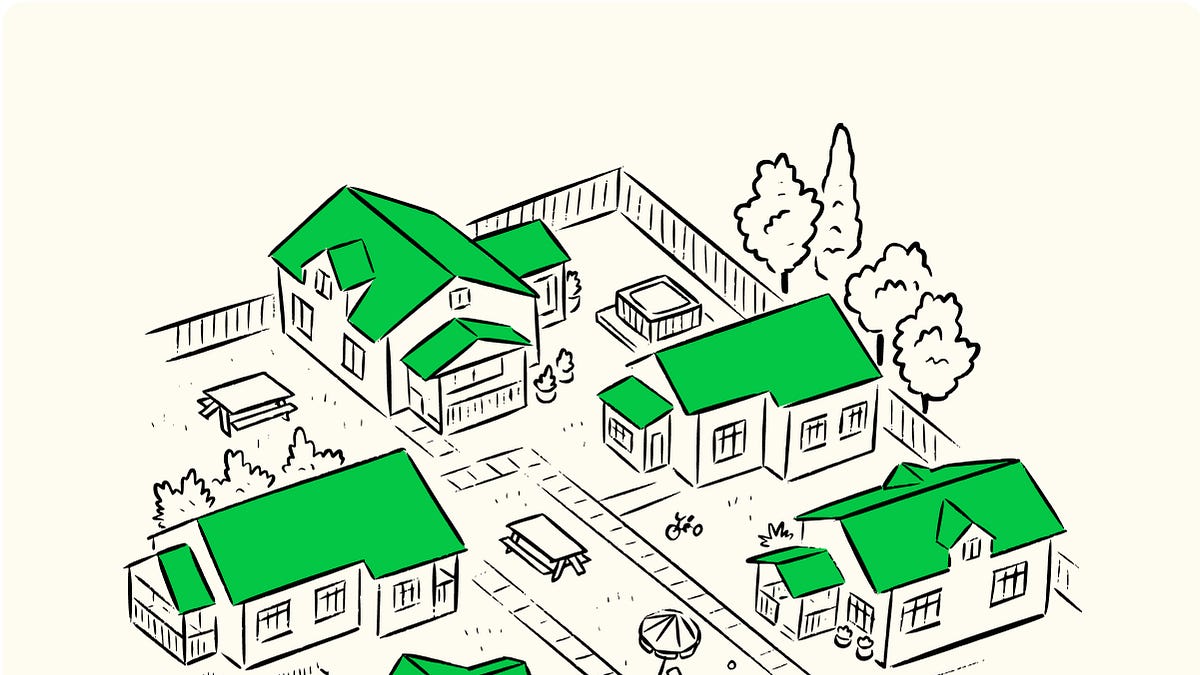
The long-awaited Friend Compound laws in California
[X-posted from the Live Near Friends blog]
supernuclear.substack.com
156 points · by simonebrunozzi · 1y ago · 210 comments
Otherwise what starts as a family compound will eventually just become a “normal” neighborhood of strangers.
Subdivided family compounds are one of the extremely rare cases where you actually want a deeded homeowners association.
I would love to know how people have successfully resolved this for their families.
I wonder if this compound stuff might work better for 6 secondary homes, like in the woods for summer. Everyone pitches in to build them.
Have kids so rich what you leave doesn't really matter, or so poor they can't afford to bicker over it.
But if I understand this correctly, this is just a way to allow for high density housing; there's nothing specific to friends / family here? A developer can buy a large lot and subdivide it to tiny, tiny houses. Doesn't sound pleasant to me, tbh, but high-density advocates gonna high-dense, I guess.
1) Has 500k just laying around ready buy a house out of the blue ...
2) ... that also happens to be an almost identical house next to yours.
So, 99.9999% of times it goes into the market, and the other parties feel betrayed, but the seller wants (or needs!) to sell, and things get ugly, brothers stop being brothers, etc ...
I wouldn't do it.
I also don't like the idea of having friends/family right next to me. Same neighborhood is really really nice, but same lot? Nah!
in the meantime the actual buyer leaves
It's also worth mentioning that in California urban regions, where such a law is most applicable here, the townships are fairly highly regulated to the point of being a quasi-HOA. Specifically, various housing developments may have bylaws and rules - no HOA - but bylaws and rules enforced by the local city and burned onto the property deed. A true to life HOA in Idaho or Wyoming, for example, may offer more freedom and flexibility than a HOA-free property subject to local government in California.
(am member/owner in family friend's family farm)
That's explicitly noted as an advantage of the arrangement in the article.
A compound's members can have preemption to acquire a property when an outside buyer puts their money in an escrow for a contract that's already been signed. The preemptees have 30d-1y to come up with the same amount to purchase the property themselves or accept the new owner.
This way, property law isn't violated, because the seller still gets to sell their property for the agreed price no matter what others decide.
This sounds like reinventing the the often extremely long, complicated and onerous process of getting approved to buy into a coop in NYC.
I would hope that any real estate is subject to such covenants will be appropriately valued much less than traditional freehold / fee simple land.
You had to buy land for six, though?
This side of the pond buying (vacant) land to build one family home would run well into six figures (USD $$$,$$$ where the first digit is definitely a 2 and if you're unlucky it's higher still) - then you have to finance the house(s) on top.
In Seattle, luckily a lot of SFHs with big lots are being turned into multiple townhomes.
So as the initial buyer, you're certainly spending some extra to get a house on a lot that's large enough (vs. a lot only large enough for your own house), but you're going to recoup some (all?) of that extra outlay from your friends/family. You're not financing the build of more homes yourself.
Also we need to be on the same page when it comes to lot size. Here in California it's common to have a house on a quarter of an acre of land or (much) less. You could easily build 6 -- maybe even 8 -- homes (1500 sqft or so each) on a 1-acre plot here, and no one would think that's unusual.
And sure, an acre of land in CA is not going to be cheap, but that certainly depends on where you buy it. But if you can get an acre for, say, $1M, and then sell sub-parcels to 5 of your friends for $200k each, that's... fine? Honestly that seems pretty standard here. But sure, in some places in CA you could get acre for $600k, or maybe less.
In most cities it is close to impossible to find several lots for sale side by side.
I see a lot of radical changes happening in the American West. I'm from Oregon where HB 2001 (https://www.oregon.gov/lcd/LAR/Pages/Housing-2023.aspx) passed in 2023 and it and a few other laws now disallow any city with more than 25k people from blocking high density housing.
I'm really curious to see if these things will work and if the pendulum will shift. I hope so.
This makes sense in a vacuum (maybe) but in reality, the areas that get subdivided like this will become less valuable with each new division.
There needs to be a feedback mechanism that prevents every lot from being turned into a bunch of micro-lots in a race to do what the image depicts before the area loses value.
There could be macroeconomic forces that affect that estimate, but in Berkeley in the historical context of home prices it makes perfect sense.
I don't know the specifics of the bill, but if it's a 2.5x investment cheat code for the fastest actors, it's going to cause mayhem and hard backlash.
It isn't a 2.5x investment cheat code. You're spending $1M for the original home. You're spending $500k on the construction of each new home. That's $2.5M invested. They would need to sell each house for more than $1.5M each for a "2.5x investment cheat code". If the original house cost $1M, how are they going to sell 4 houses with less land at a higher asking price? Even if they somehow managed that, do you honestly think sellers in the area aren't going to catch on?
Now, certainly each individual house will be worth less than a single house on the lot would be. But the value of the lot+improvements will likely go up quite a lot.
Also consider that the value of the lot, unimproved, doesn't just magically go up once you get approval to build your friend compound. To get that $1M -> $2.5M increase in value, you probably have to invest a cool million into building the rest of the homes.
From what I've seen with infill in my area (Reston, VA, outside DC)... infill might slow the appreciation of adjacent property, but rarely/never hurts it. Surrounding property (>1 parcel away, give or take) generally increases in value, because along with the infill housing comes more amenities (commercial/retail redevelopment).
And for the property that was "infilled", the per unit price might be slightly lower, but the value of the entire property has gone up. Say the land cost $1 million, got split into 4 parcels, and each is now worth $275,000 (fabricated numbers).
EDIT - this isn't quite apples to apples, since we don't have the same rules as CA - we just have a massive amount of infill development happening along approved "density" corridors.
There is your answer.
Should it or would it? Probably not. But this weird image of the suburbs vs "the city" (someone else used the term "metro" which humorously includes the suburbs, but whatever) doesn't seem reality based.
Doubly so given that the suburbs are car-centric, and plans like this are car-antagonistic. It seems to specifically exclude the suburbs, if anything.
[1] This law only applies to multi-family zoning, which in SF is RH-3. Regardless, funny to see people saying this is some low density suburb thing when many of the cores of cities have zoning requiring significantly more land.
Not really sure where the humor is being found. There are areas where suburbs grew into their own cities that now blend back into the larger urban area they were once separated from. They are no longer suburbs, and it is now more than one city, so metroplex/metropolitan area is the term used.
I'm pretty sure this won't make housing more affordable by much. Or will even have an opposite effect. To build these houses a pretty serious investment or Amish-sized group is required. Who has that?
As if each of the people moving into the subdivided spaces still won't need parking. Now, you've actually increased the demand for parking. Where is that parking going to happen?
One company buys the lot and then sells it to its own subsidiaries who individually fund the houses. I'm sure there are numerous ways to juggle the finances.
What all of this will do is fuel vacation villages for rich people to use a little and rent out a lot.
SB 684 only works on multifamily-zoned lots, but starting in July, it’s getting replaced by SB 1123, which works on “vacant or uninhabitable” single-family lots
But pushing this as a "friend compound" law is super weird. Are there really that many people who want a friend compound for their primary residence? Personally, I'd be hard pressed to think of more than 1-2 other couples with whom I'd want to co-develop property and even then only for a vacation home, not my regular house.
I used to live in San Francisco, but in 2020 moved back to Italy.
Now we like to spend 2-3 months a year in the SF Bay Area, but we would hardly consider buying a house (and renting it out when we're away).
Instead, a situation where we would be neighbors with a few "friends", it would make it much easier to consider the option.
Those sorts of laws are often to protect farms and ranches from being turned into subdivisions are generally a good thing if you want a stable food supply.
I could have 6-10 tiny houses on this property and not have folks seeing each other, and I have the cash to just put in everything necessary. As written, the codes are not friendly towards that idea. I am still going to put in some RV hookups, at least- those are much less regulated than dwellings. My neighbors certainly aren't in a position to do the kind of complainaing that would lead to more attention from the county, and I'm at the end of a long series of oil field roads.
While I am an anarchist, I do understand the county's need to prevent folks from creating dangers to themselves and other folks. I just wish that everything didn't need to be massively profitable for some investors before variations on codes and planning could be grante.
And please spare me the tired “transit that is safe and not full of stabby hoboes will magically sprout out of nothing overnight” nonsense.
Half of some cities' downtown space is parking.
https://thehill.com/changing-america/resilience/smart-cities...
Every apartment complex in my area clearly has way, way more parking that needed - at no time of day are they more than 50% occupied.
I've even seen locals blocking a successful local bank trying to build a additional building and planning way too many of those - citing concern of too much added traffic in neighborhood. Not entirely sure if thats the best approach, but thats how how respect for laws and locals looks like. At the end, bank managed just fine despite that restriction.
Why is that? Is there more than one parking space per bedroom or do people not have cars?
https://www.fastcompany.com/90645900/america-has-eight-parki...
> Parking standards were created arbitrarily, without adequate data. Zoning laws usually require one parking space per apartment, one per 300 square feet of commercial development, and one per 100 square feet for restaurants. For context, a parking space measures 160 square feet on average, plus additional area for driveways and driving lanes, so an eatery’s parking lot may be three times the size of its dining area.
Idk, don't move there if having on-site parking is a dealbreaker for you. It isn't for a lot of people. Why should they subsidize someone else's parking preferences?
OTOH, having 4/6/8 new tinyhouses worth of neighbours and the streets filled with their cars sucks for many in the neighbourhood - so you'd expect them to resist, or at least ask the question. Where will the cars go?
The "pursuit of happiness" applies to all.
Sounds like a streetside-parking regulation problem. Everyone asking questions every time someone wants to build anything is why we don’t build anymore. If we want to require parking we don’t get to complain about housing affordability.
Get rid of free parking and you'll never be short of it again. Putting a proper price will reduce demand and increase supply.
Especially (but not solely) in areas with lack of quality public transportation (ie, doesn't double the time it takes to get somewhere)
More generally, parking is a service. All market goods & services are highly regressive, because the rich and poor pay basically the same price. Addressing inequality at the individual goods level always creates more problems than it solves. Addressing it for parking is particularly unfair, because the very poorest don't have cars.
The poor would be far better off with more welfare and a less regressive tax system so they have more money to choose what they need. Paying for "free" parking via property taxes and baked into the costs of local stores is inefficient and regressive.
You cannot escape that as transit drives down traffic and frees up parking, cars become much more enjoyable to use.
I’m not actually pitching this course of action for any specific city; I actually live in an extremely rural area and don’t have a horse in this race. Just want to make the point that mass transit investments can’t happen in a vacuum if we want to achieve the desired results.
Indeed it is, and that's kinda my point. These were the $8,000 starter homes our working class grandparents bought on a single salary from Sears in their 20s. Now they are a stretch goal for middle aged dual income families.
1. Buy cheap sfh
2. Buy cheap condo
3. Rent cheap sfh
4. Rent cheap condo
...
20. Buy expensive micro-house
Edit:formatting
I grew up in the state, and am in the East Coast for now (which also has its own problems), but I can't imagine moving back if I had to live in an ADU. The whole concept of an ADU just seems like a bad sign for the market, not mention the increase in traffic bc more density = more people.
You would think the market would normalize and people would move to other states, which is happening, yet people are contemplating making these mini houses.
Yet another symptom of American standard of living decreasing -- younger people are just getting less with the same amount of money. That's the root of the problem.
People have different imagination from you
> I can't imagine moving back if I had to live in an ADU.
More density implies that services get built closer together. A corner store needs a high level of density to exist, but when it does it cuts down your trips to a large grocery store.
I live in a dense city. I have a grocer half a block away, 10 coffee shops in a 5-block radius, etc.
You have an extremely Americanized view of a fundamentally unsustainable housing mechanism; American car-dependent suburbs don't make any sense as the main source of housing.
"Density in CA" is not the same as "Density in Copenhagen/NY/Berlin/etc". Density in CA means it takes you an hour to drive to get to Whole Foods that's 7 miles away bc of traffic, something I experienced in Venice Beach. Density in CA makes already bad traffic way worse, and its not like the infrastructure is going to upgrade such that coffee shops spring up on every neighborhood corner.
> You have an extremely Americanized view of a fundamentally unsustainable housing mechanism
Bc I live in America.
> American car-dependent suburbs don't make any sense as the main source of housing.
Agreed, but I do not think ADUs make much sense in a suburban area that does not support the infrastructure for more dense housing.
Considering people live in apartments and condos, what's the problem with an ADU (or tinyhouse as they called them years ago)?
The density/traffic thing is not straightforward. Increased capacity will add traffic, sure. To the extent that capacity remains static and people can live closer to their commute destinations, you have fewer people taking longer trips and more people taking shorter trips (or other transport). Obviously both of these will be the case. As will people moving from high density housing to ADUs in the suburbs.
Agreed on the standard of living issue.
People get divorced, relocate for work, relocate for mental health,end up in jail, People end up hating each other, have kids and need space, get a raise a want space, and people die.
How long does the friend structure survive? There will be people moving in and out just like any part of real estate.
Do the original owners turn into landlords and rent out the homes?
There would be an interesting dynamic if the homes were mobile, when you could move to a different friend compound if you wanted to leave.
But again, all of this is solved in trailer parks.
I am -not- being derisive of trailer parks. I am saying that this is a rich person's reinvention of it with some added attributes. Spending time studying the dynamics of a trailer park over time would provide lessons on mistakes not to make, and nifty solutions to problems not yet pondereed.
(Yeah if you can afford a mini house on its own real estate in California these days you are rich)
Don't trailer parks rent the land? Here it sounds like they sell the land:
>Step 3: Sell the new lots to friends
Work with what’s there.
Would you describe an apartment building this way?
These two living environments have in common that they are one—to two-person places to sleep, cook, and watch videos. Everything else that makes life interesting has to be done somewhere else. There are no gardens, no workshops for CNC machines and 3d printers, and no space for outdoor recreational equipment like kayaks, paddleboards, bikes, etc.
I can concede I am biased, and I'm blessed by being able to afford a property with a garden of about 2,000 square feet. I'm looking to expand it by another 500 square feet this year. My basement is just half full with my workshop and home lab; the other half is my partner's art studio.
There was a recent discussion on HNN about developers who quit their jobs to start a farm or otherwise leave the tech world behind, but I do a version of that in the small. I am content to hang around the house and garden, relax outside, watch birds, and occasionally hike in neighboring State Parks.
So you've never lived in a city? All the things you have are typical suburbia pastimes. I don't see in your listing for "things that make life interesting" going to the theater, pub, hanging out with your neighborhood friends at the local restaurant 10 minutes away.
And all these things are enabled by dense housing and essentially inaccessible for suburbanites.
Funny, since I live in a dense city and I do all of that daily.
No, not at all.