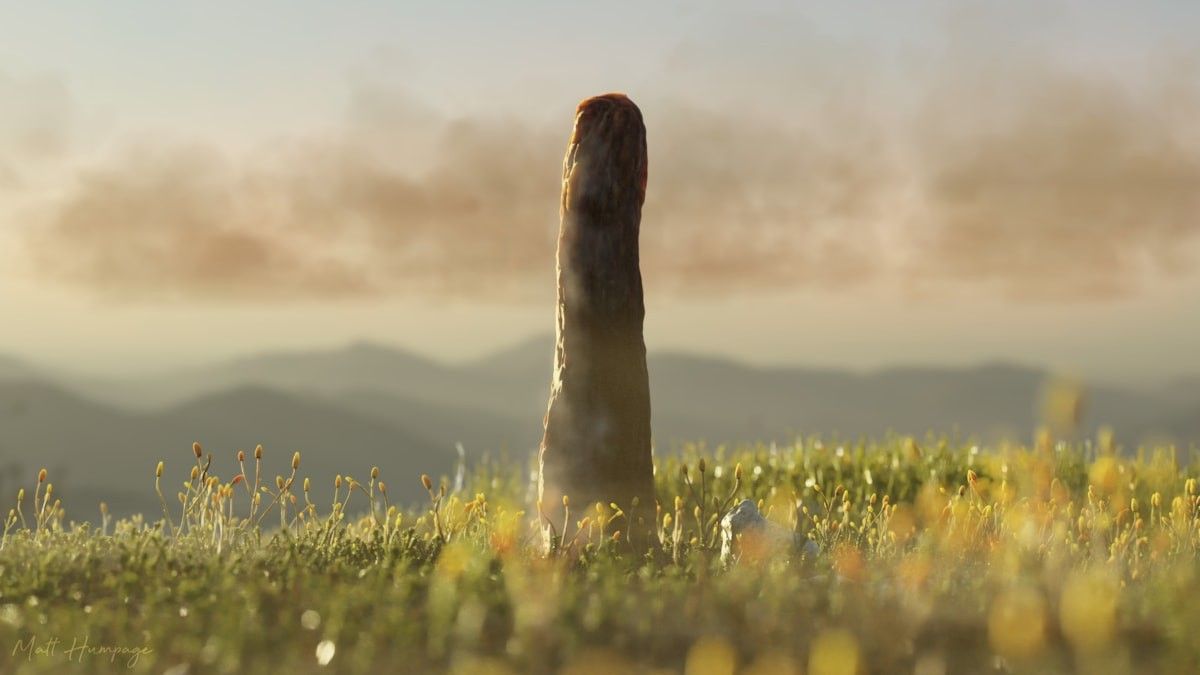
Scientists baffled at mysterious ancient creature that doesn
An ancient and enormous organism called Prototaxites, initially found to be a type of fungus, may actually be an unknown branch of life, researchers say.
Live Science
312 points · by wglb · 1y ago · 129 comments
John William Dawson, a Canadian scientist, studied Prototaxites fossils, which he described as partially rotten giant conifers, containing the remains of the fungi which had been decomposing them. This concept was not disputed until 1872, when the rival scientist William Carruthers poured ridicule on the idea. ... Dawson fought adamantly to defend his original interpretation until studies of the microstructure made it clear that his position was untenable, whence he promptly attempted to rename the genus himself, calling it Nematophyton ("stringy plant"), and denying with great vehemence that he had ever considered it to be a tree.
Who knew the internet evolved millions of years ago?
This bugs me so much. The four-kingdom system should have died out decades ago, it's absurdly wrong. For one thing, fungi and animals should be together (opisthokonts) if you're dividing eukaryotes into the major groups. If you consider genetics, there's no such thing as "protists", they're just a whole bunch of small things that were grouped together because we didn't know otherwise.
It's more like, Archaeplastida, Excavata, SAR supergroup, Amoebozoa, and Opisthokonta at the moment. The exact list is up for debate, and currently undergoing change. There's plenty of weird things like Hemimastigophora and we're not really sure where they fit yet.
My strong impression is that even the roots of the tree are debated, with competing models that often change.
> The four-kingdom system should have died out decades ago
First, hopefully not! :) Second, I think it's used because it's the last stable model. Third, it's a model that the public can understand - theres no point in even trying to use "Archaeplastida, Excavata, SAR supergroup, Amoebozoa, and Opisthokonta" unless you are an expert in phylogenics or evolution. Who can understand and remember that?
It's strange to see people promoting it online in 2025. If adults want to remain ignorant, so be it, but at least teach children the truth. Let them know that life is incredibly complicated, it's a mystery we're still solving, and they could be the ones to help figure it out. Don't overly simplify things for small minds, it creates a false picture and it kills the imagination.
It's unlikely you understand relativistic mechanics unless you learn and practice Newtonian for a few years, then many people stop there and never go for relativism.
It's unlikely you understand Peano axioms without first spending years just working with numbers, completely disregarding the formal foundations. Then many people stop there and never study the formal math.
It's unlikely you understand electron configurations and orbitals without first imagining electrons orbiting the nucleus like earth is orbiting the sun. And even that part you won't understand until you master the false concepts of "sunrise" and "sunset".
You can't climb the ladder without stepping on the first step. I've been studying for many years, observing people around me, I also did a fair share of teaching myself. The purist approach that avoids oversimplifications inevitably leads to disaster. There are maybe 1-2 kids in the class who can "jump the ladder", the rest are left on the ground helpless and confused.
Another curious observation: when I found myself in that role of a kid jumping the ladder in a purist class, I did that by secretly building a false ladder of my own. When professor said "Banach space" I would imagine Euclidean or Hilbert spaces and would get correct intuition half the time. The other half I would remember and use it to understand the difference. Most of others suffered dearly, unable to grasp anything at all, seeing the glass bead game instead of vectors and functions. And we were 20 years old back then, not even that small.
More personally speaking: what am I missing out by using the four kingdoms? Like, how could that possibly ever backfire in a way that slightly impacts my life negatively, or impedes the scientists studying genetic lineages? There's basically infinite science to "remain ignorant" of, I don't see any justification for an elitist attitude on this nuance in particular.
We use a similarly flawed model every day: fruit and vegetables. What's in one group or the other is based on vague similarities and is mostly arbitrary, but it's still useful to split the huge category of "edible plant parts" into more manageable chunks.
Anyone familiar with apples and pears will likely see an orange and say it's a fruit. Likewise anyone familiar with cats and dogs will see a boar and think "animal", not "plant" or "fungus". A genetics-based assessment would be more "correct", yes, but impossible on a walk or in the store.
Primary school teachers, from my experience, have a tendency to present things as "the truth" and accept no deviation from their own word. I think changing that would be a good step in fostering creativity in children, much more than skipping less-accurate models.
For example, explaining encryption as a lock to prevent thieves from stealing data is much more understandable to kids than going into actual definition of encryption. Lock is something concrete that they have seen, while encryption is an abstract concept hard to grasp.
Yes we should have this firm stance and accept nothing less especially when it come to something fundamental such as the Theory of Evolution. It's a shame that some scientists are even promoting that human come from monkey while the fact that from Darwin own observation was that monkey and human probably share the same ancestor not human come from monkey and even that's debatable. They even create a false picture that now become a "universal truth" printed on people shirts and kind of accepted as truth as far as layman and kids are concerned [1]. But now even the one making the picture is regretting it but the damaged has already been done. Einstein once mentioned "Everything should be made as simple as possible, but not simpler". By making things simpler than simpler (pun intended), we are creating distortion and falsehood that can take years and perhaps centuries to be fixed, and just ask the "flat earth" crowd.
[1] On the Origins of “The March of Progress”:
https://sites.wustl.edu/prosper/on-the-origins-of-the-march-...
I think we can all agree that in pedagogy and teaching, you have to start simplified; then it becomes a more productive discussion on what constitutes over simplifying, rather than a binary "do or do not over simplify". We can and absolutely should be open about complexity of the world, but at the same time be aware that average person goes through between 8 and 16 years of education (with important outliers on either side of the bell curve), and trying to fit all complexity and all the knowledge on day one generally does not lead to productive results.
The first lesson of the biology in this area I think is not so much "there are these and precisely these 4 or 7 or 9 fixed and immutable categories of life", but... "life can be categorized, and living creatures that look different actually have similarities". There's wonder, and insight, and enlightenment right there that's probably going to stick longer for vast vast vast majority of people, than the specifics of whether there were 4 or 7 or 9 categories. Heck, we changed number of planets and our understanding of "planet" remained the same :).
this reminds me of a certain voting population that think male and female are very simple XY and XX things and nothing else exists.
unfortunately a lot of people take dumbed down models and mistake the map for the terrain.
I'm not sure there's a cure for it - I have cousins who went through the same schooling and came out with very different abilities to generalise.
Anybody who is interested in it
Disclaimer: in this case I have absolutely no idea what is better. But the rationale seems wrong.
Whilst I don't doubt that, viruses don't abide by typical definitions of life that would include self-replication. Obviously, they do replicate, but not by themselves.
Viruses are abstracted on top of other living things in the same way that animals are abstracted on top of plants, in that they both require the lower layer of abstraction for their basic survival.
One classification criterion is descendance from a common ancestor, i.e. cladistic classification.
In many cases this is the most useful classification criterion, because the living beings grouped in a class defined by having a common ancestor share a lot of characteristics inherited from their common ancestor, so when using a name that is applied to that class of living beings, the name provides a lot of information about any member.
However there are at least 2 reasons which complicate such a cladistic classification.
One is that the graph of the evolution of living beings is not strictly a tree, because there are hybridization events that merge branches.
Sometimes the branches that are merged are closely related, e.g. between different species of felids, so they do not change the overall aspect of the tree. However there are also merges between extremely distant branches, like the symbiosis event between some blue-green alga (Cyanobacteria) and some unicellular eukaryote, which has created the ancestors of all eukaryotes that are oxygenic phototrophs, including the green plants.
Moreover, there have been additional symbiosis events that have merged additional eukaryote branches and which have created the ancestors of other eukaryote phototrophs, e.g. the ancestor of brown algae.
After any such hybridization event, there is the question how you should classify the descendants of the hybrid ancestor, as belonging to one branch or to the other branch that have been merged.
For some purposes it is more useful to classify all eukaryote phototrophs based on the branch that has provided the main nucleus of the hybrid cell, and this is the most frequently used classification.
For other purposes it is more useful to group together all the living beings that are oxygenic phototrophs, including various kinds of eukaryotes and also the blue-green algae, and divide them based on the evolution tree of their light-capturing organelles, i.e. the chloroplasts.
This is also a valid cladistic classification, because all oxygenic phototrophs, both eukaryotes and prokaryotes, are the descendants of a single common ancestor, some ancient phototrophic bacteria that has switched from oxidizing manganese using light energy, to oxidizing water, which releases free dioxygen.
Even when there are no branch merges due to hybridization, there remains the problem that in the set of descendants from a single ancestor there are some that are conservative, so they still resemble a lot with their ancestor, and some that are progressive, which may have changed a lot, so they no longer resemble with their ancestor.
In this case, using the name of the entire group provides very little information, because most characteristics that were valid for the ancestor may be completely inapplicable to the subgroups that have become different. In such a case, defining and using a name for the paraphiletic set of subgroups that remains after excluding the subgroups that have evolved divergently may be more useful in practice than using only names based on a cladistic classification. For instance the use of the word "fish" with its traditional paraphiletic meaning, i.e. "vertebrate that is not a tetrapod", is very useful and including tetrapods in "fishes" is stupid, because that would make "fish" and "vertebrate" synonymous and it would require the frequent use of the expression "fishes that are not tetrapods", whenever something is said that is correct only for vertebrates that are not tetrapods, or of the expression "bony fishes that are not tetrapods", for things valid for bony fishes, but not for tetrapods.
While in many contexts it is very useful to know that both fungi and animals are opisthokonts, and there are a few facts that apply to all opisthokonts, regardless whether they are fungi, animals or other opisthokonts more closely related to fungi or more closely related to animals, the number of cases when it is much more important to distinguish fungi from animals is much greater than the number of cases when their common ancestry is relevant.
Animals are multicellular eukaryotes that have retained the primitive lifestyle of the eukaryotes, i.e. feeding by ingesting other living beings, which is made possible by cell motility.
Fungi are multicellular eukaryotes that have abandoned the primitive lifestyle of the eukaryotes, and which have reverted to a lifestyle similar to that of heterotrophic bacteria, just with a different topology of the interface between cells and environment (i.e. with a branched multicellular mycelium instead of multiple small separate cells).
This change in lifestyle has been caused by the transition to a terrestrial life, which has been accomplished with a thick cell wall (of chitin) for avoiding dehydration, which has suppressed cell motility, making impossible the ingestion of other living beings, the same as for bacteria. Moreover the transition to a bacterial lifestyle has also been enabled by several lateral gene transfers from some bacteria, which have provided some additional metabolic pathways that enable fungi to survive when feeding with simpler substances than required by most eukaryotes, including animals.
So even from a cladistic point of view, fungi have some additional bacterial ancestors for their DNA, besides the common opisthokont ancestor that they share with the animals.
Animals are unique among eukaryotes, because all other multicellular eukaryotes have abandoned the primitive lifestyle of eukaryotes, by taking the lifestyles of either heterotrophic or phototrophic bacteria. However for both other kinds of lifestyle changes there are multiple examples, i.e. besides true fungi that are opisthokonts there are several other groups of fungous eukaryotes that are not opisthokonts, the best known being the Oomycetes. There are also bacteria with fungal lifestyle and topology, e.g. actinomycetes a.k.a. Actinobacteria.
If we will ever explore other planets with life, those living beings will not have a common ancestor with the living beings from our planet, but nevertheless it will still be possible to classify them based on their lifestyle in about a half of dozen groups that would be analogous to animals (multicellular living beings that feed by ingestion, so they must be mobile or they must have at least some mobile parts), fungi (multicellular beings that grow into their food, absorbing it after external digestion), oxygenic phototrophs, anoxygenic phototrophs, chemoautotrophs, unicellular equivalents of animals and fungi, like protozoa and heterotrophic bacteria, viruses.
These differences in lifestyles are more important in most contexts than the descendance from a common ancestor.
So while it is useful to have the name Opisthokonta for the contexts where fungi and animals and their close relatives must be included, it is much more frequent to need to speak separately about fungi and other fungous organisms on one hand, and animals on the other hand.
I agree that the term "kingdom" is obsolete when used in the context of a cladistic classification of the living beings.
Perhaps it should be retained for a non-cladistic classification of the living beings, based on the few fundamental lifestyles that are possible, and which would remain valid even for extraterrestrial living beings.
Or rather, it's only a problem when you insist on rigid perspective that makes it a problem.
(The real problem is that so many people insist on viewing things as trees, when their natural shape is directed graph.)
As a programmer symbiogenesis is a mixin or interface not a class.
So even if you want to use only the DNA inside the nucleus for a cladistic classification, that does not produce a tree of evolution, but only a directed graph of genetic information flows, with many important hybridization events. While initially mitochondria and chloroplasts were just symbionts, like the useful bacteria in the human gut, eventually that symbiosis has become a full hybridization, with mixing and integration of the genetic information.
The official cladistic classification produces a tree from the directed graph of the evolution by cutting the branches that are considered to be less important.
Sometimes this is indeed the best choice, but there are contexts in which the genetic information brought through the minor branches is actually that which determines most of the importance of an organism in an ecosystem.
E.g. in many contexts the most important feature of a living being is whether it is an oxygenic phototroph due to inheriting genetic information from some blue-green algae, i.e. that it is a primary producer in the ecosystem, and not the features that depend on which is the exact eukaryotic group from which most of its nucleus has been inherited. For instance, it is more frequently useful to group together brown algae with red algae (whose chloroplasts share a common ancestor), than to group brown algae with some non-phototrophic stramenopiles (which share a common ancestor for most of the nuclear DNA), with which they share only inherited characters that need an electron microscope for detection.
Why grow up if you don't need photosynthesis?
From my perusal of The Literature (AKA an amazing Wikipedia article + the paper discussed in this link), we have a few strong theories about the prototaxites:
1. They fed off decaying matter in the soil through a vast network of mycelia/roots, and didn't photosynthesize.
2. They grew large, trunk-like protrusions, but without any branches or leaves (that were fossilized, at least). Like, way, way taller than the bugs, moss, and short weird proto-grass around at the time.
3. These protrusions were regularly burrowed into by aforementioned bugs, which surely was a major health risk.
4. Even before this analysis, they've always been something of an oddball compared to contemporary life -- so everything's on the table, so to speak.
Given those facts, I'm pretty stumped as to what evolutionary pressures might have driven them to grow upwards. At first I considered spore (seed?) dispersal, but mushrooms seem to get along just fine without towering above everything else, and I don't think wind speeds were way lower or anything. Anyone here have any better guesses?
"evidence of arthropod boreholes in Prototaxites has been found from the early and late Devonian, suggesting the organism survived the stress of boring for many millions of years.[30] Intriguingly, boreholes appeared in Prototaxites long before plants developed a structurally equivalent woody stem, and it is possible that the borers transferred to plants when these evolved"
and for Arthropods:
"The evolutionary ancestry of arthropods dates back to the Cambrian period."
which is about 100 million years before the Devonian
also:
"The oldest known arachnid is the trigonotarbid Palaeotarbus jerami, from about 420 million years ago in the Silurian period.[82][Note 3] Attercopus fimbriunguis, from 386 million years ago in the Devonian period, bears the earliest known silk-producing spigots"
so there could have been all sorts of weird and wonderful bugs burrowing into Prototaxites I guess
So these are the ancestors of Groot? or Ents? and all manner of "animated trees"?
We should just stop reading the article then and there. This is a major method of how a single study can perpetuate fake science and fake news.
It's a feature, not a bug.
People want the news now. They don't want to wait for it to be peer reviewed, or even cursorily checked. There is an infinite maw for information, and it has already consumed every single known fact.
If you want science, you'll wait a month, because it's not actually urgent. These species waited hundreds of millions of years and it'll still be there in a few weeks.
If you want entertainment, you want it right this instant. And that's what LiveScience exists to do.
So you really should have stopped reading as soon as you saw the URL.
Single cell eukaryotes also exist. Is it strictly true that there are no multicellular prokaryotes (what they call bacteria) or archaea? No exceptions at all?
They can form colonies and, within groups that share walls, specialize into different functions such as photosynthesis or nitrogen fixing behavior. This enables the colony to adapt to changing conditions that, while still made up of individual organisms, collectively appear to function similarly to a single multicellular one.
With that said, there aren't any examples of truly multicellular organisms within either domain. Just as an ant colony is not a single organism, cyanobacteria colony specializations are not examples of organs.
Yes, "with eukarya containing all multicellular organisms" does not mean "all eukarya are multicellular organisms" it means "multicellular organisms are a subset of eukarya".
> Is it strictly true that there are no multicellular prokaryotes (what they call bacteria) or archaea?
First off, "prokaryotes (what they call bacteria)" is incorrect. Both archaea and bacteria, in the three-domain model referenced in the article, are prokaryotes.
Second, correct, everything understood as a multicellular organism -- as distinct from colonies of unicellular organisms -- is composed of cells with nuclei, classified in eukarya in the three-domain model.
(There is a newer proposed two-domain model which disposes with Eukarya as a top-level domain, folding it under Archaea; in that model, clearly, there are multicellular Archaea.)
I suppose it depends on which model you use, and as discussed they seem to vary and be in flux right now, but the three domain model I learned was prokaryotes, archaea, and eukaryotes - the first two being different domains.
> Yes, "with eukarya containing all multicellular organisms" does not mean "all eukarya are multicellular organisms" it means "multicellular organisms are a subset of eukarya".
We agree. I don't grasp your point?
your original comment didn't refute the quote, but one needs to squint hard to see that you didn't refute it.
In fact, it is likely that blue-green algae have appeared for the first time on continents, either in fresh water or moist rocks, and only much later they have spread into marine environments, which had been previously dominated by anoxygenic phototrophic bacteria, which were oxidizing sulfur, iron or manganese, not water. The transition to oxidizing water is likely to have been necessary for the spreading of the blue-green algae on continents, where the fresh water had only a very small content of substances that could be oxidized unlike seawater, which at that time was rich in hydrogen sulfide and in Fe(II) and Mn(II) ions. When the blue-green algae have expanded back into the oceans, that must have been after the oxygenation of the atmosphere has modified the composition of the oceans, by precipitating most of the iron and manganese and oxidizing sulfide to sulfate, which would have deprived the anoxygenic phototrophic bacteria of their food.
Then, in the oceans, at some point in time a blue-green alga has become symbiotic with the ancestor of red algae and green algae, which have then dominated for many hundred million years the oceans, before the much later appearance of other phototrophic groups, like diatoms and brown algae. Multicellular red algae and green algae already existed in the oceans around one billion years ago, when no other multicellular eukaryotes existed.
When the fungi have appeared through a transition to a terrestrial lifestyle, that could happen only if on land they could find great amounts of dead living matter, which had been produced by blue-green algae. It is not known for sure whether fungi have appeared a long time before the first terrestrial green plants or about the same time, but it seems that already for the most ancient terrestrial green plants, symbioses with fungi that enhanced the absorptive capabilities of their roots have been important. For aquatic plants, roots had only a fixation function, not the function of absorbing nutrients, so perhaps symbiosis with some already existing terrestrial fungi might have been necessary, not optional, for the first terrestrial green plants, until better absorbing roots have evolved.
So for a long time in the history of the planet, the drier parts of the land would be barren, but wherever there was moisture you would find mats or crusts of blue-green algae, with associated heterotrophic bacteria and viruses.
Then, probably not earlier than the Cambrian, there would be also fungi, and even later the first moss-like terrestrial green plants would appear.
Whether we tag something as a domain also depends on its abundance and/or visibility. I bet if you take dug into microorganisms, you'd find tons that are as different from plants and animals as plants and animals are fun each other. But they all tend to get lumped in as "protists" or something because... we kinda don't care. I wouldn't be surprised if we somehow found out there were a lot of extinct critters in equivalent situations.
>Or groups that are in some sense different from other domains to the same degree those domains are from each other?
This.
As for macroscopic life, there are some Ediacaran critters like rangeomorphs and tribrachidium that (to my knowledge) are not conclusively associated with any existing domain. So who knows about those guys.