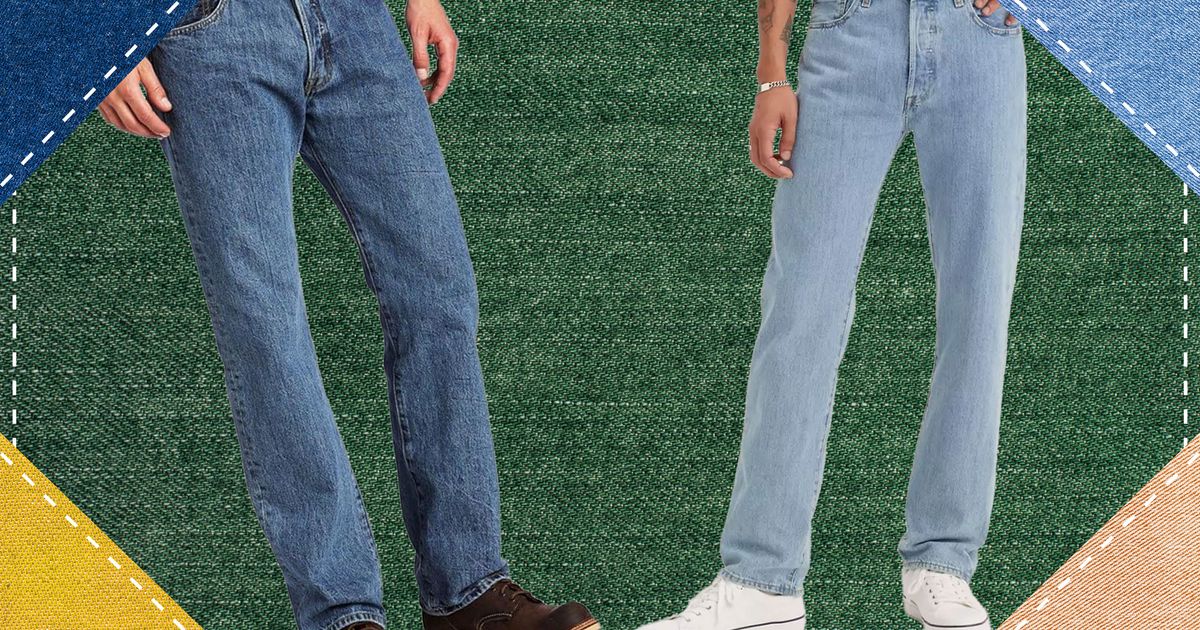
Are Levi’s From Amazon Different From Levi’s From Levi’s?
Yes, but not in the way you’d think.
The Strategist
162 points · by randycupertino · 1y ago · 152 comments
But better tip - (if you're not looking for 'smart' denim) buy from eBay. Only buy pairs where everything has been measured properly (waist, inside leg, rise, etc) so you can get close to what you know you fits. You can find 20+ year old Levis for less than $20 - the denim is heavier, the quality is good and they have that perfect 'broken in' feel that makes the jeans feel like your best friend. Plus you can afford to try a few pairs to find ones you love.
It’s crazy.
I only wear Oxfords and casual button down shirts, and found that I only ever like the ones made in Bangladesh because of fit and material. I could talk your ear off for 20 minutes about how clothes from X feel cheap, clothes from Y have nice materials but don't fit right, etc.
I just checked my closet, and every single shirt I regularly wear across three brands is made in Bangladesh!
Here's a quick shot of what the cutting machine looks like: https://youtu.be/oBt85Jgjvng?si=UAU0Jj4q_Vztmi5K&t=680
Obligatory link to Hillel Wayne's Crossover Project [0]. The short version is that of 17 "real" engineers he interviewed who switched to software engineering, 15 said they consider software engineering to be an engineering discipline. Over the three blog posts he reviews the supposed differences between fields and finds that the crossovers don't agree with most of the stereotypical differences software people believe are there.
There are real differences that they identify, but they're not any more significant than the differences between traditional engineering fields, which are vast. But yes, one of the differences that they do point out is that software is not constrained by the physical world in any meaningful way.
I’m not asking to criticize. I’m genuinely curious.
Not even all electronic products always feel the same in one’s hands like iPhones of the same model do. For example I remember back in the day my Xbox controllers would feel different from my friend’s Xbox controllers even though they were the same model and supposedly manufactured the same.
Make a bunch of them with the same process then bin them based on the variability.
My understanding is that this isn't tied to Amazon or any specific retailer. But rather the cutting process for the fabric. They'll cut large stacks of denim cloth in a single go, and that's not an exact process. And that's why you can buy multiple supposedly identical pairs and notice differences.
Honestly, even in the store, that's been a thing forever. You'd have to go to the department or mall store and try on a whole bunch.
Lately I've switched to a brand that has stretchier fabric (so small variations in size matter less) and more long-leg sizes (my size is 31 or 32/34 and difficult to find in department stores) and been content.
Then look at the Japanese brands. Most of them are reproducing 501s from various eras. FWIW, I like TCB (https://tcbjeans.myshopify.com/) - the price/value ratio is superb, the quality is better than LVC and retail is cheaper. Their 40s and 50s jeans are both brilliant and they age amazingly.
Hope that helps!
At least for Amazon, keep in mind that they’re likely not put back into normal circulation if you return them so you’re creating waste where there doesn’t have to be.
Amazon absolutely resells returned items when possible. And if it's not through Amazon Resale, it's by reselling them in bulk lots to people who then make money listing the items on eBay.
Yes some of the absolute cheapest stuff gets tossed because it's not profitable to resell. But in many cases you're not even asked to return -- just keep it and get refunded. (As long as you don't have a history of abusing that.)
Levi's are absolutely going to be resold. Amazon is a business. They're not going to eat a loss when they don't have to.
Amazon routinely destroy returned items, see the investigation for yourself: https://www.itv.com/news/2021-06-21/amazon-destroying-millio...
> Undercover filming from inside Amazon's Dunfermline warehouse reveals the sheer scale of the waste: Smart TVs, laptops, drones, hairdryers, top of the range headphones, computer drives, books galore, thousands of sealed face masks – all sorted into boxes marked “destroy”.
And you think they'll keep a pair of shoddy trousers? I'm sorry to disappoint you but that's unlikely...
I am talking about in normal, everyday (for me) circumstances, this would likely not apply in dire circumstances
I don't say that to be critical if wearing previously worn clothing bothers you. I just bring it up because sometimes things stop bothering me once I realize that they are fairly common experiences.
All this time, researchers have been wasting money on sample sizes larger than 1 before drawing conclusions.
Also, I find the word "commingling" nowhere in the article. It's very relevant to the question of what product you're receiving when you buy from Amazon.
So yeah its annoying, but you get used to it.
I don't think anyone is alleging that BMW is cutting corners on materials shipped to only some dealers for a given market.
Nor is anyone alleging that there's counterfeit Ferraris constantly being snuck onto dealer lots.
What happened here looks closer to lowbrow propaganda or PR, than journalism.
And I suspect that any kids reading pieces like this -- rather than learning from good example -- are instead being confused about journalism, science, and critical thinking.
Please also don't use The Wirecutter as an example of good journalism. It's the worst of a bad lot of Consumer Reports clones with all the disincentives of rapid-fire constant publication and ad-driven revenue. It was bad prior to the NYT acquisition, but it's "bottom of the barrel" atm.
Much akin to CNBC for securities, it's now just a source of noise and, occasionally, even negative signal.
One of these is just "reporting the news". Even the magazine is not called "Consumer Research".
It's subcontracted out to tons of shop, who then subcontract their orders out to even more shops.
Unsurprising that given such a system product varies.
It's a case study. We should, as a public, be scientifically literate enough to parse them. If someone wants to take the bait and publish a double-blind study, by all means. In the meantime, there is more signal than noise in this article.
It's not at all surprising for anything to happen after co-mingled inventory, which should absolutely be illegal.
Walmart created a business practice where many black Friday deals were lower quality products produced explicitly for black Friday sales. So underhanded deceptive business practice in large retailers isn't anything new.
Without a regulatory authority we can expect companies to act in decreasingly bad faith, because who will provide consequences, the other definitely not colluding competitor?
This could easily be counterfeiting via SKU mingling
A lot of companies have general WalMart versions of products.
Back to denim, Walmart caries "Levi's Signature" -- those are lower cost (and lower quality) versions of the normal lines.
Walmart has a $180bln revenue, how many states or even countries is that comparable to?
Basically, it says Levi's jeans are manufactured in several different countries, so that most likely accounts for the variations. And that some of the jeans she bought from Amazon were actually better than non-amazon.
Still. I prefer buying from the Amazon competition in my country. Amazon regularly sends me wrong items.
Out of curiosity, why is the preference for buying from "the Amazon competition" rather than directly from the manufacturer?
The competition might be cheaper than the manufacturer.
Stuff like this, or the JC Penny experiment years ago where the new executive team tried to get rid of deep discount sales and have consistently low prices only to be met with consumer uproar, make me really glad that I don't work anywhere near consumer retail.
From Nordstrom Rack's web site:
This comparable value and corresponding percentage are based on what the item, or similar item, was originally offered for by Nordstrom or elsewhere in the market, which may have been reported to us by the manufacturer.
You can find actual steals if you know what you're buying, EoL items and end of season items for a fraction of the price.
But then there's the cheap shit with the brand plastered on it, which is usually basic garbage, just rebranded.
I had a purse of hers sent back for reconditioning and the regular store didn't seem to notice that it was originally an outlet product (granted, it was like 8 years old at that point).
Granted, not every retailer is like that. GAP brands definitely sell inferior products at their outlet stores. But I don't notice a difference in quality for Levi's stuff at their outlet stores vs department stores.
I think outlet malls are generally seen by consumers as "malls that focus largely on clothing". The only regular malls that have survived in my area are maybe 30% clothing, with the rest being the huge Apple store, restaurants, cafes, jewelry, car showrooms (?), LEGO, overpriced home goods, etc. While the outlet mall remains like 80% clothing.
For Walmart, they have scale and a monomaniacal focus on lowest cost. Each time a contract with a vendor is renegotiated, Walmart demands a lower cost, and they're big enough they get it. The predicable effect is the vendors skimp and cut costs on what they send to Walmart because they're under so much pressure, and Walmart doesn't care as long as they get a lower price. That can mean vendors doing stuff like binning by quality, and sending the worst stuff to Walmart; using a special grocery-store shrink ray for Walmart, special Walmart-specific cost-reduced designs; etc.
There's no doubt Amazon has a problem with fake or imposter products. But every post I seem to read about this is people who unwittingly by from a marketplace seller.
Of course Amazon should do better to regulate those marketplace sellers, but it seems similar to me to someone buying a Rolex from a street peddler in Times Square and being shocked it isn't the real thing.
Same pattern, same denim, same person making them (me), they don't fit/feel the same.
Consistent results when using fabric is hard. Also keep in mind that good denim is practically sheet metal in comparison to most fabrics, so on one hand easier to get consistent results, but on the other hand, even small differences are more noticeable than something lighter or (god forbid) stretchy.
You cannot just engineer your way out of some of the challenges inherit in garment construction (trust me, Ive tried).
I have wondered if even when buying from what looks like an official amazon brand store, you can still get product from multiple suppliers/locations, including some that have counterfeits? Anyone know if this is feasible?
It doesn't seem likely to me that (eg) Levi's or Gold Toe are doing this on purpose. It would also mean it would be hard to 'test' because you might get different things on different orders, it's not that the entire amazon supply is counterfeit, but that counterfeit stuff is in there somehow.
Yes, it's called inventory commingling, there are plenty explanations online. The TL;DR is that if two sellers claim to have the same item, amazon will ship the item from the closest warehouse rather than from the seller you bought from.
Yeah, I guess that doesn't mean anything but marketing, it still all comes from the same place.
The OP article doesn't discuss this, but it seems to me a likely explanation for someone getting crap levi's ordered on amazon?
I doubt the jeans the author is buying from Amazon are genuine product, maybe just really good knockoffs.
  Levi’s sources its fabric from dozens of mills across the world, from luxury
  supplier Candiani in Italy to sites in India, Bangladesh, Mexico, and Turkey.
  The six pairs I tested were manufactured in three places: Cambodia, Macau,
  and Mexico. The company’s supply chain is vast, and to some extent, it makes
  sense that jeans made to the same specifications from different mills, dye
  facilities, and factories would result in different products.
Sucrose in cane sugar decomposes to glucose and fructose via hydrolysis. With an acidic bottle of coke, a week after bottling nearly all of it is converted. The ratio of glucose and fructose is 50/50 from sucrose, with high fructose corn syrup it's a 55/42 ratio.
  Assert different and equally genuine:
    a Coke
      cane sugar
      from Mexico
    a Coke
      corn syrup
from USI had honestly thought this was my imagination of years of using them, but ran into more than one person shopping for jeans that randomly brought this up. I guess Levis super fans can spot each other.
A friend of mine worked in construction and said paint from a retail store was thicker and better, compared to the "same paint" from home depot. I think it might be the same paint, with a special "home depot" sku for paint that is more watery or somehow made at lower cost.
Here's an (archived) article talking about name brands and walmart:
https://web.archive.org/web/20050101092353/http://www.fastco...
Personally, I have found amazon with name brands to be hit or miss. It seems you might get a name brand through an intermediary (like a retail store) when the name brand won't sell through amazon itself.
I switched to All American Clothing AA101s and Duluth Trading Ballroom relaxed denim (not flex). The Duluths are durable, look like denim should, fit consistently, are triple stitched and gusseted, and sell for only $60. And gladly, neither of these jeans contains any elastic.
Since WalMart has so much leverage in negotiations, they get to essentially name their price for goods.
Which causes manufacturers to make special WalMart versions of their items.
  In 1962, Avis was in search of a new advertising campaign. Since its
  inception, the car rental company had trailed behind the market leader,
  Hertz. So the ad agency Doyle Dane Bernbach decided to embrace Avis’
  second-place status as a sneaky way to tout the brand’s customer service.
  “When you’re only No. 2, you try harder,” went the new tagline. “Or else.”
Imagine meeting price points, within a range of supplied products.
I'm sure denim experts could expand on why some jeans still last and others wear out.