356 points · by instagraham · 1y ago · 310 comments
https://academic.oup.com/mnras/article/534/2/1553/7762193
https://ui.adsabs.harvard.edu/abs/2021ApJ...907..123I/abstra...
https://ui.adsabs.harvard.edu/abs/2017MNRAS.466.3928H/abstra...
>Take his claims about JWST as an example. In 2024 he wrote a paper about some early data, claiming to find more galaxies rotating with the Milky Way. He claimed based on a sample of just 34 galaxies that the signal was significant. Now he has looked at a wider dataset of the same area, which should allow him to verify his analysis. But it shows exactly the opposite, more anti. So he writes a paper saying this new result is definitely significant but doesn't reflect on the fact he has written two papers which contradict each other. He has failed to reproduce his own result. The take away is that his results are not as significant as he claims. He's also looking at a tiny area, and nearby galaxies can have correlated spins. He doesn't take this into account either. There are multiple JWST fields in different directions he could examine in different directions to test his claims, there are two JADES fields, but he only publishes one.
>I do wish the MNRAS editors would take measures to stop publishing low quality claims like this without more robust review. If you look at the text, it’s largely repeating results from his old papers. There’s very little discussion of the new results.
source: https://www.reddit.com/r/cosmology/comments/1ja9i53/the_dist...
*) The article is from March 17.
Does it mean that we are, potentially, on one of two poles(?) of the observable universe, if we're observing most galaxies around us rotating a certain way?
That said: I'd wait a bit here. This is a single-author paper by a non-astronomer (he's a CS professor). The sample size seems small (N=263), and the measurement coarse (he's just bucketing galaxies into "rotating in the same/different direction as the Milky Way"). And the technique may be too novel for its own good. The gold standard here would be to look at differential redshift, but all he's doing is applying a ML filter to detect the "twirl" direction in the image of the spiral galaxy. Which... might be amazingly effective or might fall on its face because of bugs in the filter.
But the signal seems strong, though (158 vs. 105 galaxies in each direction).
Basically, I'd wait a bit for someone to try to replicate with more data and more conventional measurements.
The visible universe is redshifted and galaxies are getting further and further away. So jumping straight to “we are in a black hole” is weird
It is far more plausible that there is some coriolis like spinning effect in a higher dimension, even if the universe is flat it could have similar effects to how the earth’s spin makes cyclones all spin in the same direction.
Problem solved. Next?
Nobody has done it so far. We have only theories and hypothesis.
But what could possibly happen other than they act like all other physical objects do? It boggles the mind to think how broken physics would have to be to accommodate a second correspondence principle for the big-but-not-too-big scale...
I feel like maybe I'm misunderstanding your sentiment, because this seems like a basic shared fact: a clock anywhere in the universe is still a clock.
My clock certainly seems to tick in the opposite direction when I look at it from behind.
It would also imply that our whole universe is rotating - the only reason this happens on Earth is because of our planets rotation and the Coriolis effect.
I think there is a men in black scene, where an alien is rotating the universe globe like a toy they are playing.
If you were inside a black hole you wouldn't be able to see light from "deeper" because it wouldn't be able to travel towards you.
This is not what we see within the universe, so I don't think we can be inside a black hole
While I agree with your correction and this always bugs me, the common usage of the phrase "begs the question" seems to have become synonymous with "raises the question", as opposed to what I understand to be its former — and perhaps original — meaning which was associated with the informal logical fallacy by the same name.
Pardon the cheesy domain name, the content is very relevant.
How does cyclones/hurricanes relate to being “on one of two ‘poles’”?
Do you mean hemisphere?
(But the same is true for someone sitting on another planet).
That seems like an example of "streetlight effect." The streetlight effect, or the drunkard's search principle, is a type of observational bias that occurs when people only search for something where it is easiest to look.
The fact that we can not observe anything outside our light cone is well understood.
The observable universe is the only true sphere.
The observable universe is expanding into the unobservable universe.
What would be interesting is to run a diff on the cosmic microwave background and the pictures from the James Webb space telescope to figure out where the true centre of the universe is, and derive the poles from there.
Is that so? My understanding is that it doesn't expend into something. And that it expend so fast that the edge of it becomes unobservable.
There are ongoing debates whether the actual Entire Universe is infinite or not.
https://cds.cern.ch/images/CERN-HOMEWEB-PHO-2022-023-1
Observing the edge is effectively looking back in time, to see the conditions of the universe closer to the time of the Big Bang.
New telescopes keep expanding that edge, and new particle colliders (such as those at CERN or Fermilab) keep "bashing 2 rocks together to make fire" - recreating the conditions of the Big Bang to see what comes off.
What I'm not sure about is whether the speed of light (assumed to be constant) is correlated with the size of the observable universe. Perhaps a physicist could shed some light on that question. Relativity means that galaxies that are moving at the speed of light away from one another (one travelling at c, another travelling at -c) have a relative velocity of higher than the speed of light (|c| + |-c| = 2c).
There's also the theory of the One Electron Universe, which I quite like (though that reveals my bias as an electronic systems engineer). Perhaps what we see is the One photon universe. https://en.wikipedia.org/wiki/One-electron_universe
Hopefully this rambling makes sense to someone!
Would that be same kind of question as “where did the Big Bang come from?”. That’s a lot of energy that came from somewhere as well seemingly for no good reason.
I also wondered immediately about dark matter; could it be that’s where the counter-balance of momentum went? Like most galaxies spin one way and most dark matter would then have to spin the opposite way.
I am not a physicist so this is all random guessing of course.
There are many parameters that do not have a reason for their value.
You can say the exact same thing about mass. Obviously it came from somewhere. And it could have taken angular momentum with it.
While we don't believe we're the center of the universe, I believe we're limited by instrumentation to determine its size. Best guess now is 100B LY in diameter.
But the observable universe is a fraction of the whole thing. The "best guess" right now is that the total universe is flat and has no end.
If it's bounded, 100B LY is orders of magnitude below the most conservative lower-bound estimates, which I believe start at around 300-500x that size. (With huge error bars on all sides.)
Matter-antimatter ratio
Left vs right handed molecules
Now galaxy spin directions
Maybe there are others I missed too
"the rapid decay of pions is governed by the weak force — the only fundamental force with a known mirror asymmetry"
https://www.quantamagazine.org/cosmic-rays-may-explain-lifes...
I'm not sure about the other examples. But maybe it's a similar reason that it is not a 50:50 ratio?
High energy can spontaneously form matter antimatter pairs. In the early universe, the heat of the universe was very high, so this was common, constantly happening.
The problem as always if fine tuning. If the early universe was 60-40, that would be understandable. If the early universe was precisely 50-50, that’s fine too. But the universe was 50.0001-49.9999 or something like that, and then all annihilated. It’s too big a difference to easily be random chance, and too small a difference to be easily explained by a starting condition what wasn’t precisely tuned by some mechanism.
If find this question fascinating. Matter can only ever exist with respective anti-matter. Question is where has all the antimatter gone? Are there processes were it does indeed behave different from matter? So where is it? Since a photon and antiphoton are the same and do not absorb each other, we should be able to see it, shouldn't we?
I still want to believe in the antimatter universe where there is some evil twin of mine.
This means that all known ways to create or destroy matter, also creates or destroys an equal amount of antimatter.
It turns out that most attempts to extend the Standard Model allow violations of baryon conservation. This could explain the dominance of matter in our universe. However none of those attempts have been able to make any predictions that matched experiment. And so it remains true that all known physical processes perfectly conserve the baryon number.
(It is also possible that baryon number really is conserved, and dark matter is actually dark antimatter. But we lack a theory of what dark matter could be that predicts this.)
This property of this set of 8 particles is analogous to the similar property of the set of 2 particles composed of a particle and its anti-particle, and to the similar property of the sets of 4 particles that can be involved in a weak interaction (the intermediate weak bosons convert one 4-particle interaction into a couple of 3-particle interactions, but when looking at the overall inputs and outputs, all the weak interactions are 4-particle interactions), which ensure the conservation of various quantities over such interactions.
This means that it is possible to conceive an additional kind of interaction, which unlike electromagnetic interactions between 2 particles and weak interactions between 4 particles, involves 8 particles, so it has a much smaller probability of occurring, i.e. it is a much weaker interaction than the weak interaction, and through which, when provided with enough energy, quarks + electrons + neutrinos could be generated simultaneously without generating anti-matter.
While there is no evidence yet for such an interaction, it is conceivable that at least during the circumstances of the Big Bang, such an interaction could have existed, so all the quarks and leptons could have been generated from some unknown bosons, just with enough initial energy and with conservation of all quantities for which there are solid reasons to believe that they must always be conserved, like energy, linear momentum, angular momentum, electric charge and color charges. (Unlike for the baryon number, for which there is no other reason to believe that it must be conserved, except that the strong, weak and electromagnetic interactions happen to have this behavior.)
There's nothing special about matter or antimatter. Same energy, just opposite charge. All else being equal, they should be created in equal amounts. As far as we're aware, there is no special property that would make the universe preferentially create more matter than antimatter.
There's also no requirement that the configuration of matter and antimatter be "stable" for whatever definition you want to apply. The only rule is that conserved quantities stay conserved.
Organic chemistry found on meteors shows that non-terrestrial sources are equally left vs right-handed.
However, the rest might be caused by one or more errors in our premise. The most likely culprit being cosmological principle.
Which would also be the reason we have the laws of physics we do in general.
Anything seemingly ad hoc in our universal (from our vantage) viewpoint is potentially explainable as a pocket among all other possible distributions/combinations of relations.
Or is it? I hate these percent-relative word games things...
- Let x = "num MWW"
- then "num CMWW" = 1.5x ("50% higher than x")
- x + 1.5x = 1
- x = 0.4
So 40% is MWW, 60% CMMW?
Of course as an arrogant computer scientist I think they're downright kooky for not basing it on the galaxy, but ce la vie. Presumably there's one of those too, and this just wins for boring social inertia reasons as much as for any technical ones.
image: https://geoscienceaustralia.github.io/ginan/images/ICRF-75pc...
wiki: https://en.wikipedia.org/wiki/International_Celestial_Refere...
Of course this doesn't really matter for the above musing since top/bottom would purely be conventional based on our viewpoint, but otherwise illuminating on the issue of understanding rotation directions across the universe.
Once you have a few dimensions on a normal or other distribution there’s not a lot of content that’s in the middle.
> "The re-calibration of distance measurements can also explain several other unsolved questions in cosmology such as the differences in the expansion rates of the universe and the large galaxies that according to the existing distance measurements are expected to be older than the universe itself.”
I found this a little surprising as well
But how does that work?
Or is it just relative to all the other galaxies?
That would seem way more surprising than relative to a arbitrarily selected common upwards direction and it would imply that we are somehow at the center/top of the universe.
Hence the farther we observe stuff, the earlier in time it happens. And if an observer moves to a different location, they will still be at the center of the universe (aka light cone).
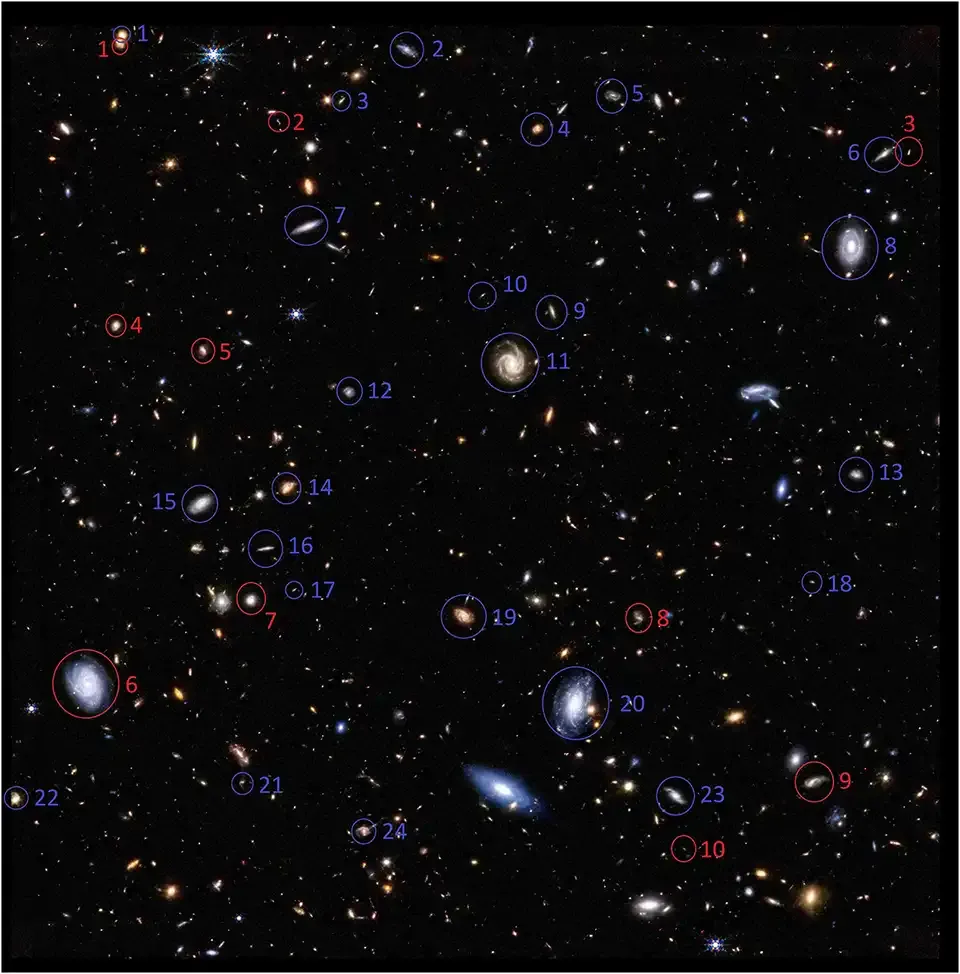
But we observe a bias. Now, that could just be chance — but it's more likely that we've missed something somewhere so our assumption was wrong. One specific possibility is that the universe has an intrinsic spin, which might be because (per the article) we're inside the event horizon of a black hole which is spinning.
Also, yes: we are at the centre of our observable universe.
It seems to have caught on, but one could still doubt its applicability to all phenomena at all scales.
I imagine there was already a preferred spin of gases immediately after the big bang, just due to random chance, so why wouldn’t that be preserved more or less?
How does this work? The page it links to doesn't explain why rotation would matter.
Edit: To clarify - one side of the galaxy would be moving towards us, and one away from us, no matter which direction it spins in, so this should not affect the average brightness of the entire galaxy.
The original paper (https://academic.oup.com/mnras/article/538/1/76/8019798?logi...) links to a few papers discussing this, among them https://www.mdpi.com/2073-8994/15/6/1190 It doesn't answer my question (or if it does, I didn't understand it), but it gives a magnitude for the expected effect on brightness - 0.6%. I do not think that would explain the 1:2 ratio of observed spin directions.
I see no way it influences the light emitted, but maybe I heard just too little of physics? BTW, does the direction of magnetic field of galaxies correlate with the direction of their rotation?
edit: Ah, maybe magnetic field can polarize the light? And when you have two magentic fields they polarize in one direction or in two different, and maybe it influences observed brightness of the light? Or maybe it is just an uninformed guess?
The other question is - what does the rotation of our own galaxy have to do with it? Let's keep the Solar system as is, and mirror the rest of the Milky Way around it, so that it is now spinning the opposite direction. Why should this affect the apparent brightness of other galaxies? Especially since the Solar system is effectively moving in a straight line, on the scale of a human lifetime.
In GR curved trajectories lead to "weird" observations. For instance, I'd expect the side of the remote galaxy that is closer (visually, for you as an observer) to the center of your galaxy to be gravilensed slightly more than the other side. Because the effect is non-linear, it does not just compensate when sides are reversed.
P.S. Not claiming this has any significant effect on the described phenomenon, just that mirror symmetry does not apply.
I can’t figure out why the Doppler Shift would make the entire galaxy brighter. I assumed it would make the rotation side spinning towards us brighter. But also redshift the side spinning away.
Did it require JWST to notice this, or did we just _not check_ until now?
Is there a notable asymmetry in, say, the spin directions of galaxies contained in the Hubble XDF?
EDIT:
This doesn't make a lot of sense. Lior Shamir has written that a lot of unrelated sky surveys recently have shown an asymmetry in the past few years, but only down around ~2%.
https://www.mdpi.com/2073-8994/16/10/1389
https://aas.org/sites/default/files/2020-05/lior_aas236.pdf
JWST's asymmetry in both early work and more recent deep fields is more than an order of magnitude stronger.
EDIT2: Notably they show anisotropic asymmetry: The galaxies are different rotations when you look in different directions, with something like +6% in one direction and -5% in another. But still nothing like the +50% now being reported as a general feature.
https://news.ycombinator.com/item?id=43372271 ("Is our universe trapped inside a black hole? This JWS Telescope discovery (space.com)", 56 comments)
This is the subtitle of the article. It’s such a great summary!
If I'm following correctly, the "we're inside a black hole" idea is a major reach, connecting at least two unrelated concepts (black holes could contain baby universes; black holes have spin). But it's a really interesting idea and not obviously wrong.
"A preferred axis in our universe, inherited by the axis of rotation of its parent black hole, might have influenced the rotation dynamics of galaxies, creating the observed clockwise-counterclockwise asymmetry,” Nikodem Poplawski
With that said, when the universe was younger things were way way closer so would it be possible for things like very early massive quasars to inject powerful magnetic fields in the otherwise dark universe at this time and bias matter falling into galaxies to one direction or another?
Related question: the horizon of a black hole is expanding when the mass increases. Could this map to the expansion of our universe, which seems to expand faster and faster?
But if objective spin directions are roughly evenly split because the universe is isotropic, the spins from our viewpoint ought to be evenly split as well.
If they're not evenly split, the universe must have a preferred axis, which would be an amazing discovery. I guess if the preferred axis just happens to align with our own galaxy, that would support the alternative theory that it's due to an observation effect such as doppler shift.
Either way, it's incredibly cool to have such a simple but totally unexpected observation pop up out of nowhere.
Note that this is not that easy to determine:
When done manually, the determination of the direction of rotation of a galaxy can be a subjective task, as different annotators might have different opinions regarding the direction towards a galaxy rotates. A simple example is the crowdsourcing annotation through Galaxy Zoo 1 (Land et al. 2008), where in the vast majority of the galaxies different annotators provided conflicting annotations. Therefore, the annotations shown in Fig. 1 were made by a computer analysis that followed a defined symmetric model (Shamir 2024e).
The point is that we would typically assume a 50-50 ratio regardless of where you are in the universe.I can’t think of any that would make much sense as top/bottom would mean that there needs to be a relative universal point to reference and as far as I know, that doesn’t exist.
If the distribution was truly random, and the universe is isotropic, we should see roughly 50/50.
Or maybe not, anyways back to work.
Or maybe they're just billboard sprites, always facing the camera, with clockwise animations.
It should be fairly easy to determine the rotation direction of any (spiral) galaxy we can see, based on reasonable assumptions about the relationship between rotation and the configuration of the spiral arms. There should be thousands or millions of visible galaxies for which this could be determined (out of the estimated 2 trillion galaxies in the observable universe). Perhaps I'm missing something, but why bother reporting a result from such a tiny sample?
It should also be possible to derive more detailed information that just clockwise vs. counter-clockwise. The rotation of a galaxy defines a direction (the galaxy's rotational north pole) and a point on the surface of an imaginary sphere. This could be determined by the galaxy's apparent rotational direction, its orientation, and its position in the sky. It would be interesting to see a plot of those points. In principle, they should be random. (If the points spell out "Go stick your head in a pig", I'll be very sorry that Douglas Adams didn't live to see it.)
Study is at around 3σ (like 62 heads in 100 flips). It is more likely that future studies disprove it, and this is an issue with the methods, if I am of the betting type... :-)
https://www.comsol.com/blogs/why-do-tennis-rackets-tumble-th...
Spiral galaxies spin, they do not tumble unless hit by another galaxy.
Elliptical galaxies are like gravitational convection and don't really have cohesive "rotation", however.
What the original article explains, is that this is relative to our observer point of view (obviously).
It's still very interesting, since, disregarding any potential interaction in our local group, randomness was expected and we should see around 50/50 rotating either way unless one of the explanations came into play.
The one thing that stuck with me is how frequently things we believe to be true are disproven.
This does not surprise me:
> “If that is indeed the case, we will need to re-calibrate our distance measurements for the deep universe,”
And just like there is no still point in the universe, there is no up or down. So yes, it may be true that, IF you select a couple of arbitrary points in the universe to be up and down, THEN you can count how any galaxies spin left vs right. And it is way cool to find out that it doesn’t appear to be 50/50, and to wonder about why. But I think the article author did the readers a disservice by glossing over the “no up or down” fact.
2. If we are inside a black hole, where is the singularity?
Maybe black holes don't have a singularity:
Real science will be when they survey the entire sky, with many small deep-field images.
Im thinking: what if there are a bunch of massive objects like black holes in certain directions that are causing the light to bend in a certain way. So what would normally be light coming from the top of the galaxy plane, is actually light reaching us from the bottom of that plane. Would this slew the distribution of the spin one way - I don’t know.
or i suppose this is clockwise/counterclockwise in regards to the direction they're moving in?
2/3 doesn't seem that significant if they think it should be a 50/50 split, we might just not be seeing enough
https://en.wikipedia.org/wiki/Sundial#In_the_Southern_Hemisp...
So "clockwise" is because the Earth's axis of rotation about itself is not too far from perpendicular to its orbital plane of rotation around the sun, and because the Earth rotates counter-clockwise from the perspective of someone hovering above the planet's north pole. This is the right-hand rule.
Earth's axis of rotation (and orbital plane) is fairly well aligned with most of the round bodies in the solar system, except notably for oddball tilted Uranus and anti-aligned Venus (and the pretty different orbital planes of the minor planets like Pluto and Eris).
The sun's north pole (following the right-hand rule) and south pole do not point to anywhere particular in the galaxy, and its axis of rotation is highly tilted with respect to the axis through the central bulge of the Milky Way. A nice diagram that seems to have originated from the European Southern Observatory: <https://www.physicsforums.com/attachments/motion-of-earth-an...>
Most disc-like structures we've found tend to be randomly oriented compared to each respective host galaxy's polar axis.
For spiral galaxy rotations we have much better data from mostly edge-on views because we can measure the doppler shifts of molecular clouds at their margins; the advancing side will be less red-shifted than the trailing side. Spectral lines also broaden with the magnitude of rotation. AFAIK there is nothing at all unexpected about the distribution of trailing vs leading edges on our sky; the mystery is in the magnitude of the rotation of these outer gas clouds compared to things like their galaxy's apparent optical brightness or other markers of mass.
Also fun is that for elliptical galaxies, these gas clouds don't rotate around the equatorial bulge of those that have them. They instead tend to move mostly radially deeper and shallower within their host galaxy.
So if galaxies don't choose the rotation of their internal components like star systems or radio-loud objects like pulsars and relativistic-jet-equipped black holes, why (accepting for the sake of this argument that this garbage paper is correct about there being a bias in face-on spiral galaxies) would a distant galaxy affect us more than our own?
Instead of thinking of it like spin, think of it like heads or tails. Both are binary measures and frame of reference doesn't matter. For example if you're flipping a penny on a glass table and someone is looking from the bottom, they'll see the same ratio as you.
In a fair universe you'd expect pretty much a 50/50 heads/tails clockwise/anti-clockwise outcome. But instead we something like 66/34 or 75/25. The actual direction of spin doesn't matter. The fact the measurement is unbalanced does.
I think it's enough to say that it was spinning. There was an imbalance tending toward a direction.