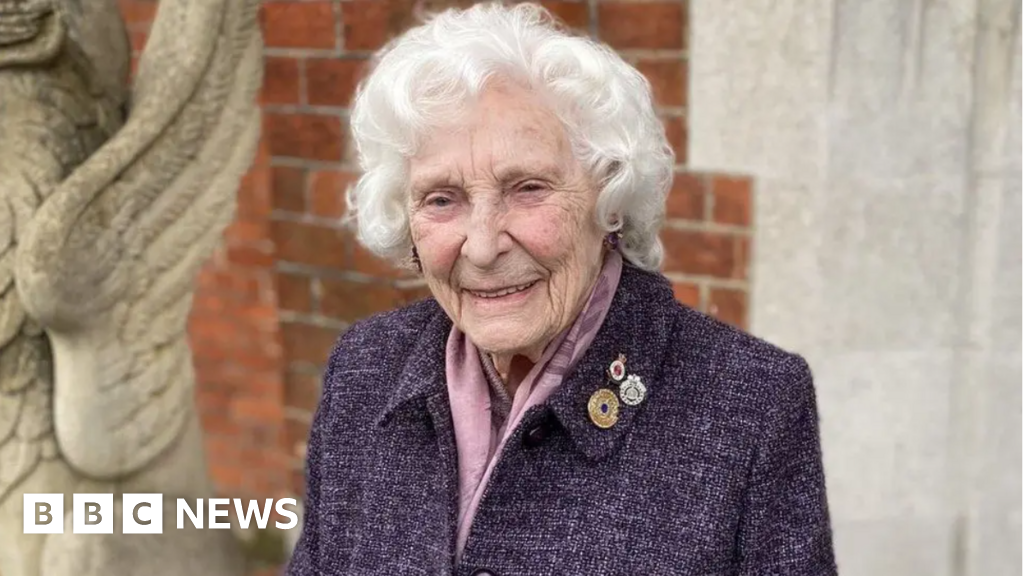
Bletchley Park code breaker Betty Webb dies aged 101
Betty Webb MBE worked at Bletchley Park during World War Two intercepting enemy messages.
bbc.com
504 points · by danso · 1y ago · 101 comments
We have almost lost the chance now to hear personal testimony of WWII. I've met several Battle of Britain pilots too, but the last died in Dublin recently:
https://www.rte.ie/news/ireland/2025/0318/1502596-hemingway/
Besides being very interesting it felt odd to hear all this in such an out of the way place. Well after the war he collaborated on some books with a professor teaching at the college there.
He was 99 and said he just wanted to live to be 100, but sadly he didn't make it.
I remember my late grandmother telling us they had made mittens for my great uncle, but he died in that battle before the mittens arrived.
Crazy to think I passed up my chance to have a cup of coffee with a man who might have fought beside my great uncle.
And they didn't.
Like the Zanryu Nipponhei [0], they were loyal to the last. Even my own father kept things about his airforce days way too tightly wrapped up long, long after the official secrets sell-by date. I have some admiration for this, but in the end it's a loss to historical record.
The myriad of trash google results on the topic aren’t even close to 1 in 4. Even an Israeli tabloid says it’s 1 in 10.
https://www.economist.com/united-states/2023/12/07/one-in-fi...
Don’t worry, there will be another one along any minute now.
That's fantastic! RIP.
some tasks performed include registering messages on little cards, which Webb believes totaled 10,000 a day in the whole park, and organizing the cards into shoeboxes according to a strict order so they could be retrieved efficiently when called for.
I suppose times have changed.
> In Block F, she worked on intercepted Japanese messages, something she excelled at so much that she was later sent to Washington to support the American war effort.[6]
Whether something is the first computer is - inevitably - a definitional argument, but TNMOC has several candidates (though not all of them) including (a modern reproduction of, the original was destroyed as a secret) Colossus which is famous because of its involvement in the war.
Bletchley Park is also still an actual stateley home, all the war stuff was built on somebody's grounds - there's a good chance you either don't care about stately homes or you're intending to visit a more interesting one (or indeed one of the Royal Palaces), in which case no need to care, but that's a third distinct thing on the same site.
[Edited to make clear there is no original Colossus, we destroyed it because it was a secret]
Operationally independent, although they have been considerate enough to synchronise their opening hours.
If you're interested in London Buses however, I'd actually recommend the (also unrelated) London Transport Museum, as this one is located in the tourist heart of central London in Covent Garden.
( NB: Brooklands is itself a great museum, but more for the aviation history )
Really shows the extent and impact of this knowledge - they virtually sat at the same table as the Nazi high command.
At least WWII, unlike those preceding it, has a vast well of literature to draw those lessons from. The trouble, however, is not just getting younger people to sit, read and analyze it, but also to separate the wheat from the chaff, so to speak, with all the propaganda and misinformation to be had these days about the events of WWII, the Holocaust, Hiroshima/Nagasaki and so many other things that would make this list exceptionally long.
Books, are not the same as having lived it, of course. Aleksandr Solzhenitsyn put it best in The Gulag Archipelago.
“If it were possible for any nation to fathom another people's bitter experience through a book, how much easier its future fate would become and how many calamities and mistakes it could avoid. But it is very difficult. There always is this fallacious belief: 'It would not be the same here; here such things are impossible.'
Alas, all the evil of the twentieth century is possible everywhere on earth.”
I'm curious as to what sort of propaganda or misinformation you're referring to. I'm in Europe and I haven't seen much of it, but maybe it's different in the US.
Worse, an entire generation of young men especially are being told that WWII wasn't what it really was. You see the results of this in the US but also eastern Germany, Poland, Hungary, across Europe where right wing parties are on the rise substantially supported by these young men.
It's a really fascinating perspective on WWII and how crap Monty was at being a general; he was reading the Germans' messages and still couldn't defeat Rommel. Only when the Med fleet intercepted and sank all his resupply ships did Rommel's crew finally lose.
The Germans' overconfidence in the Enigma machine was a big part of their downfall, especially once America's resources came to bear. Of course, that's what they deserved for having a leader speedballing meth and morphine.
All that said, the interesting historical twist is that no WWII history before the 1970s is accurate because all the Bletchly work was completely classified until one of their officers wrote a book about it. They cover that in the documentaries, too. There were men and women who had never told their families about what they did during the war, until the news finally broke. One mentioned how her daughter wondered why her mom knew that 'M' was the 13th letter.
He did defeat Rommel though, didn't he?
The Germans only feared one Allied General, and it wasn't Monty (it was Patton).
If fact, Patton being relieved of command for slapping his soldier allowed him to serve as the uber-decoy in Great Britain to distract the Germans from being ready for a Normandy landing. God works in mysterious ways, indeed.
The Germans thought Patton's sacking for slapping a soldier was a ruse; that's how much esteem they had for him.