389 points · by bentobean · 1y ago · 273 comments
>Glubux even began disassembling entire laptop batteries, removing individual cells and organizing them into custom racks. This task, which likely required a great deal of manual labor and technical knowledge, was key to making the system work effectively and sustainably.
This kind of thing is cool as a passion project, but it really just highlights how efficient the modern supply chain is. If you have the skills of a professional electrician, you too can spend hundreds of hours building a home battery system you could just buy for $20k, but is less reliable.
That is, in my opinion, the worst feature of this entire project. It is cool and nice and fun. But it takes a lot of time to research, acquire skills, get tools and build.
> you could just buy for $20k
I agree with a broader point but that particular price is extremely high and far from reality.
A reasonably good 18650 cell has a capacity of ~12 Wh (~3300 mAh * ~3.7 V = ~12.2 Wh). The battery mentioned in the article consists of "more than 1000" such cells. Let us assume 1200 cells. That would mean it has a capacity of ~14.4 kWh (1200 * 12).
It is possible to get a pre-assembled steel battery case on heavy-duty wheels for 16 LiFePo cells, with a modern BMS with Bluetooth and wired communication options, a touchscreen display, a circuit breaker and nice terminals for ~ $500. And it is also possible to get 16 high quality LiFePo cells with a capacity of ~300 Ah each, like EVE MB31, for significantly less than $100 each. This means that for less than ~$2000, it is possible to get all components required to assemble a fully working ~15 kWh LiFePo battery.
- That assembly would take a few hours rather than weeks.
- It will have new cells rather than used ones.
- It will be safer to use than a battery with Li-Ion cells.
- It will likely take much less space.
- It will be easy to expand.
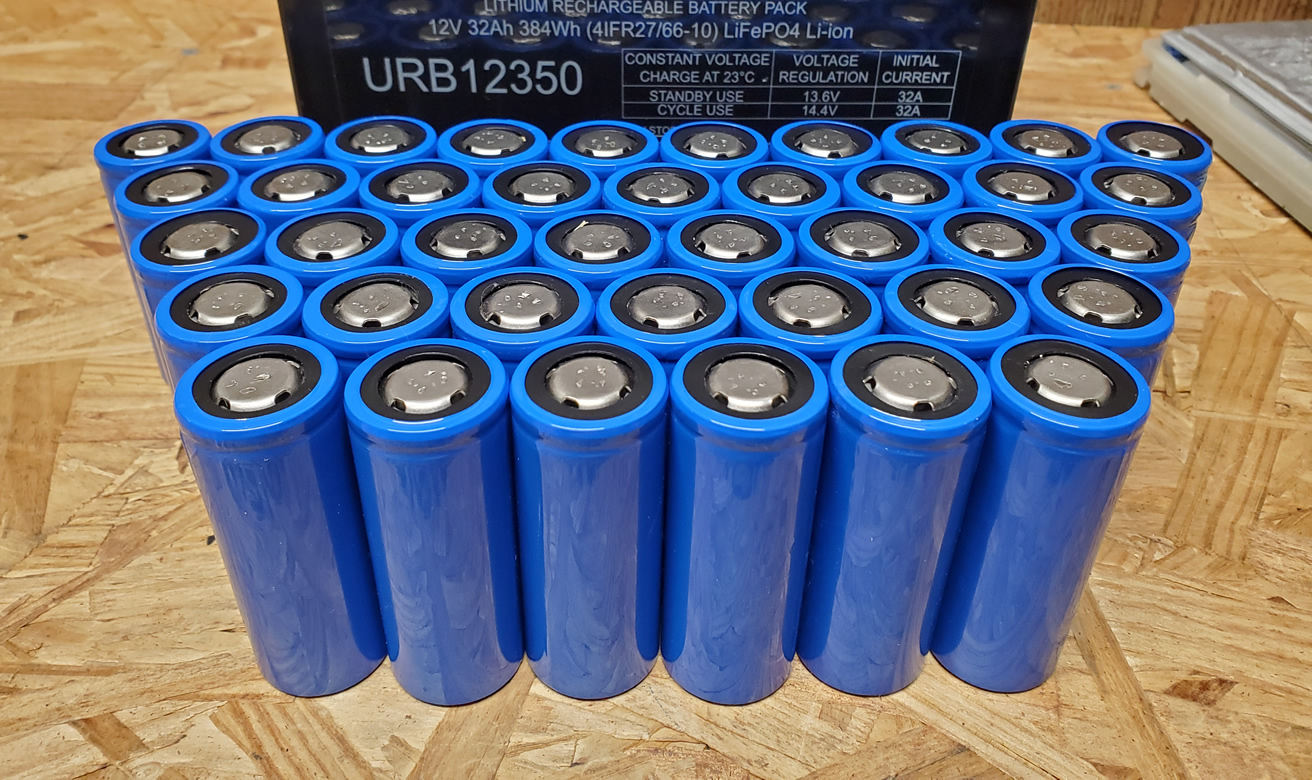
I will point out that in 2016 when they started this project, the cost of new batteries would have been multiple times higher than it is today, so it would have been a moderately more "sensible" thing to do than it currently seems.
I can imagine that ~9 years ago there might have been very little reasonably priced LiFePO4 cells available and if someone could get their hands on used 18650 cells very cheaply, it might have been a reasonable choice at the time.
https://travis.vc/mexican-fisherman-parable/
Sometimes the doing is the fun part.
This is not a feature. Our Earth is a limited resource, and being able to reuse batteries instead of discarding them to the trash is a desirable property.
OTOH used laptop batteries can likely be obtained for effectively zero monetary cost, while used EV or solar backup batteries still cost quite noticeable money per kWh. With laptop batteries, you pay with your time; if you for some reason have an excess supply thereof, or you just enjoy this kind of work as a pastime.
Of course. No one disputes that. I was just trying to point out that you can get better cells for less money.
> being able to reuse batteries instead of discarding them to the trash is a desirable property
I fully agree. No one is trying to suggest that we should discard used batteries into trash.
$80 per cell (before shipping) on the top Google product result for EVE MB31.
That's a good bit cheaper even than when I looked last, in early 2021.
It just keeps getting cheaper and cheaper every year...
At least if he bought a commercial battery and it experiences a lithium fire, he might expect to file a claim against the manufacturer, or his insurance company might on his behalf.
DIY (like this project) is only "worth it" if the person doing it enjoys the work or values the lessons.
Battery packs are an efficient market commodity and that’s pretty hard to beat for value for money.
Once full installations become more of a commodity then DIY with premade packs becomes less worth it.
He made more than he would have working retail for sure, but maybe he could have done better with another job if he weren't fixated on sticking it to the Man.
This battery thing feels a bit like the same sort of sentiment.
That said, any task you can do while talking to a friend or binge watching a TV show cannot be accurately accounted for in cost by just how much the clock moved.
How good is your cell acceptance testing? Do you do X-ray inspection for defects, do ESR vs cycle and potentially destructive testing on a sample of each lot? When a module fails health checks in the field, will you know which customers to proactively contact, and which vendor to reassess?
Yeah lots of batteries are 18650/26650 in a trenchcoat. The trenchcoats run the gamut from "good, fine" to "you will die of smoke inhalation and have a closed casket" in quality and I think that bears mentioning.
Also laptop batteries used to be many (usually three or six) 18650s in a plastic trenchcoat.
You could literally rebuild your battery when it died, and pick the cells you liked the most. In theory you could pick higher-quality cells than those you find in the batteries sold on ebay from chinese stores. In theory.
$50 of 18650s in a $500 trenchcoat with DRM protection. So wasteful.
Weight is not a factor for home energy storage, there is no need for lithium cells.
Reuse of vehicle sized packs seems to be pretty common, though. I'd guess that a DIY home backup could be built pretty easily from used vehicle batteries.
Give me an array and battery system that can pull off the grid and/or array and power most of my home without me having to think a whole lot or pay a vendor thousands to install while making the total cost under $1000 and I’ll do it.
Until then, it just isn’t financially viable when my electricity costs are well under $70/month average across the year.
Recouping the costs for install of solar systems are estimated at 30-40 years as of 4 years ago when I researched it. I’m sorry, but that’s just not worth it for me and most others.
Some recent research into that: https://www.sae.org/publications/technical-papers/content/20...
You can also consider maintaining packs together to avoid complicated disassembling processes.
And with even more passion and commitment and with business skills, you could earn $20k at a time.
This "efficiency" relies on the assumption of writing off the entire battery set at sale. That's not impressive at all.
https://secondlifestorage.com/index.php?threads/glubuxs-powe...
^ has a wild picture of full setup
There's no protection over the bus connections. Any falling conductive item is now a spark hazard.
Using spring loaded alligator clips as test leads apparently for monitoring. I hope that's not a permanent configuration.
Everything is bolted down and I see no inline disconnects or even any fusing except on low voltage sections.
There are exhaust fans but I can't tell if there's inlet fans.
From this one picture, which may not be fair, this is not a safe setup. I would feel uncomfortable with this on my property.
A roof-mounted water tank with a thousand gallons ready to dump into the shed? A drum of baking soda?
Or maybe rebuild the shed out of cinder block and clear any overhanging vegetation?
Maybe this whole setup is on desert dirt with plenty of clearance. The fire plan is "run away and wait."
You could also just bury it so that the worst of the explosion is mostly mitigated. I've also seen small container setup which would probably work better than his (seemingly) wooden shed.
Would be better if the ground was paved around the shed, but it seems to be far enough from other free standing structures.
[0] https://secondlifestorage.com/index.php?threads/glubuxs-powe...
[1] https://secondlifestorage.com/index.php?threads/glubuxs-powe...
The firemen ended up putting the battery, half melted, into a big drum of water and it hook hours to cool off. The concrete was still warm to the touch where it burned for ~30 hours after the situation was sorted out.
The smoke was just absolutely unbelievable. Made me reconsider buying an EV. That fire was no joke.
The MV contactor wasn't even closed, it had 24v powering it for the internal cell balancer from the vendor, that was it.
The extinguisher should be directly inside the door so as not to attract someone to traverse farther into the building without an escape plan.
Of course if he did so then there would be no extinguishers in the picture and then we would also bitch about it.
If he can't reach to grab it because it's too hot, he should have already left.
Dry Powder or CO2 is what you need for energized electrical equipment. And considering there's potential lithium involvement, you might want something more specialized (e.g. F-500 Encapsulator Agent). I agree anything more than a small-scale incident you're just getting the heck out of dodge. I'd have built something along the lines of a concrete bunker, with an automated suppression system to buy time.
If you are outside, it does not tempt you to cross the room. If you are inside, you run for the door, and then turn around and decide if maybe you should just keep running.
The hazard appears to be accounted for.
That said, one should be prepared for it.
They do swell, but they swell at the terminals rather than at the sides.
Also the guy who made this battery pack has the incentive to not burn down his house, whoever made yours has the incentive of one more day on the assembly line… I dunno, wouldn’t judge him too harshly.
Those scooters in the streets get discarded/buy em in bulk and re-use the batteries for ex
They are rather short and show the setup more than the construction and nitty gritty, IIRC
If it could be done, would certainly would be better than turning batteries into "black mass."
Look at Off Grid Garage (Andy) or Will Prowse YT channels for more info.
But they were as much of a fire risk (if not more) before being recycled, they were just spread out along the e-waste bins!
Every time I hear of a waste processing plant fire, I wonder if there was a (lithium) battery involved. Maybe from a single use vape, or a child's toy.
Everything has risks — its about managing them. Lithium ion batteries are widely used because their benefits outweight the risks when handled properly.
Its like saying, “Why are candles still legal? They can start fires.” Well, because people know how to use them responsibly.
The safety risks are marginal and you interact with plenty of other things/systems daily that are at least as dangerous.
> here are safer battery chemestries that aren't quite as energy-dense ^ that's the answer.
> But phones and laptops were capable-enough 15 years ago They absolutely weren't.
> we sufficed just fine on the performance of last-decade's mobile devices. I don't want to suffice.
All that said, I do think battery research is probably one of the most important things "we" can be doing (and energy storage in general), so I'm all about putting in the money and time to find improvements.
Why do we still let kids go outside when there are so many kidnappings?
The samsung battery debacle around the note 7, which made headlines for weeks, was from 0.003% of phones catching fire.
I know it can be done because I asked an electrician. But I dropped the idea when he said it could cost a lot (if done by a professional).
If you want to have a few electrical loads on a generator backed panel, you have an electrician install the generator, automatic transfer switch, and a subpanel that is fed by the automatic transfer switch, which is fed by both utility power (from a breaker in your main electrical panel) and generator power. If you’re using natural gas or propane to power the generator, a pipe fitter will need to run the gas line.
Then you tell the electrician to move the circuits you wanted backed by a generator from your main panel to the subpanel fed by the ATS. The subpanel receives power from the utility until the ATS detects an outage, which fires up the generator and transfers the power feeding the subpanel to the generator.
Generators can use gasoline, diesel, natural gas, or propane, or a combination of any of the aforementioned fuels. Ideally you’d have a multi fuel generator hooked up to a natural gas utility with a backup propane tank in case the natural gas service goes down.
You can also get a whole house generator and have the ATS feed your existing electrical panel, you’ll need a 24kW 120/240V for a 100A service or 48kW 120/240V for a 200A service
I’d recommend a Generac generator if you do get one, Costco sells them and will connect you with an installer.
If you want to get crazy, you could add a 50kva single-phase 120/240V UPS and the UPS would keep the power on while the generator starts up but that would be serious overkill (and tens of thousands of dollars).
Residential power in the US is 120/240V single-phase (split phase). Utility distribution is three-phase and virtually every commercial and industrial electrical service is three-phase, with the rest being 120/240V single-phase.
The breaker that is exclusively locked out when main is on is connected to an outdoor receptacle for the generator cable. When the power goes out, you switch off the main breaker and the interlock now allows you to switch on the generator's breaker. This serves as the backfeed of power into the rest of the circuits from the generator.
The nice thing about this setup is the ability to use all the other breakers to control what loads you want on the generator. Downside is it isn't automatic.
If you have to ask, this is absolutely not the sort of work you should do yourself. Use a licensed electrician.
And by "I" I mean "a professional electrician" :) - I just did the design of what I want where.
"Despite being an unusual system, with recycled and homemade components, no major problems have been reported, such as fires or swollen batteries..."
But when it eventually happens, without a proper fire extinguish system, I would assume every thing would go up in high-temp flames with no easy way of putting them out?
If one of those batteries develops a short circuit and the house catches fire, no insurance company on Earth would pay for damages, so they say.
https://secondlifestorage.com/index.php?threads/glubuxs-powe...
https://en.wikipedia.org/wiki/Gravity_battery
And the most efficient way would probably be to just have credits with the rest of the city grid. Sell electricity to them when you have a surplus (from solar) and then pay for electricity when you need it. These credits are a lot more efficient than storing the actual electricity in a battery hehe
https://secondlifestorage.com/index.php?threads/glubuxs-powe...
The tail end of the thread is particularly interesting: https://secondlifestorage.com/index.php?threads/glubuxs-powe...
I'm curious what prevents the whole contraption from certain eruption into flames over time:
https://secondlifestorage.com/index.php?attachments/image_rv... (image)
The article contains little detail, and has lots of filler like the quote in the parent comment. It's highly upvoted on HN's front page, which is surprising to me because I think there is quite a bit of distaste here for low-effort content to drive clicks.
The thing the article is referencing is interesting, but the article is trash.
Edit: We also changed the title (submitted title was "A man powers home for eight years using a thousand old laptop batteries")
I haven't been on board with the "journalism" of the last fifty years, but this hasn't exactly prompted it to improve. Newspapers still have advertisements. Subscribers still have no say over editorial staff. The board still has say over the editorial staff. It's all fucked unless we can punt private ownership out of the equation.
1. What point is the author trying to make? Leading off "Glubux even began" implies that the effort was extraordinary in some way, but if this action was "key to making the system work effectively and sustainably" then it can't really have been that extraordinary. The writing is confused between trying to make the effort sound exceptional vs. giving a technical explanation of how the end result works.
2. Why, exactly, would "removing individual cells and organizing them into custom racks" be "key to making the system work effectively and sustainably"?
3. How is the system's effectiveness related to its sustainable operation; why should these ideas be mentioned in the same breath?
4. Why is the author confident about the above points, but unsure about the level of "manual labor and technical knowledge" that would be required?
Aside from that, overall it just reads like what you'd expect to find in a high school essay.
Edit: after actually taking a look at TFA, another thing that smells off to me is the way that bold text is used. It seems very unnatural to me.
More seriously, for me it's the "likely".
Absurd.
The only thing as annoying as people using AI and passing it off as their own writing is the people who claim everything written not exactly how they are used to is AI.
> This task, which likely required a great deal of manual labor and technical knowledge
If you were a human writing this, you might consider asking the man how much labour and knowledge the task took. Writing AIs don't ask questions.
Thank the powers that be no one will give my neighbours a permit for that.
... a single charge for each?
And speaking of applications that are too smart for their own good, why does Firefox start a drag operation when I click on a link instead of allowing me to select the text?