133 points · by rolph · 1y ago · 75 comments
Beyond the facts in this article, jumping spiders have also shown spatial reasoning. When they see prey on another leaf behind their jumping range, they'll climb down and find a path to the prey's leaf, even if the prey isn't visible during this detour. They remember it's relative location and seemingly "choose" the best route to get there.
Edit: You can also "hand feed" your jumping spider with a cotton swab dipped in sugar water. They drink flower nectar in the wild, so my wife and I tried this and it worked!
But don't they need live protein, like flightless fruit flies? I feel like the need to raise prey is the biggest downside to having a jumping spider pet.
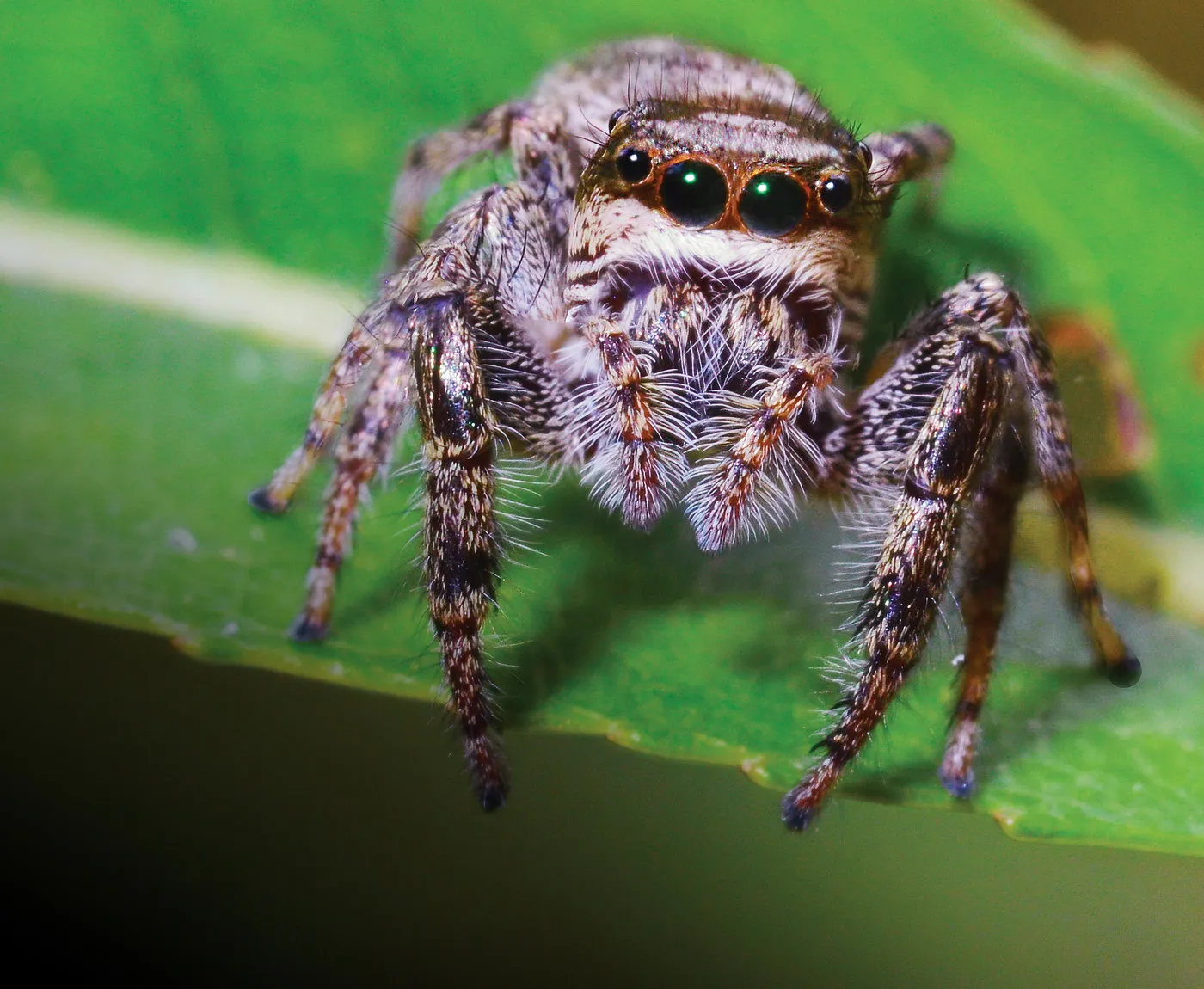
Every day around noon she’d come out of her leave and wait to catch an insect. It was amazing to see her precisely jump to get it, and watching her eat was a mix of gross and interesting. I normally dislike spiders (though I don’t kill them unless I really feel threatened) but jumping spiders are an exception and I’d actually describe them as nice, almost pet/friend material.
Research article: https://www.frontiersin.org/journals/psychology/articles/10....
The second goes for more of a horror angle and has some incredible moments. The third is one of the most ambitious books SF novels I’ve read. Blurry and confusing on purpose, which is a fine line to tread (reminiscent of the latter Jeff Vandermeer Southern Reach books).
Recently went to a book reading and Q&A for his new one Shroud, really smart and humble chap. Deeply into his research.
Also, notably, he wrote a book a year for 17 (one seven) years before being published. And then it took 12? more novel before he had a hit with Children Of Time. He didn’t seem to have a shred of resentment about that which felt remarkable and and incredible example of perseverance and enjoyment of process over result.
A fourth Children Of book is imminent.
"Because we're going on an adventure." Funny, it hadn't occurred to me to think of the second book as horror, but you're right.
I had no idea Tschaikovsky's career arc was so grueling. I agree that he seems incredibly smart. I just, for the life of me, can't understand why he had anything nice to say about Fractal Noise. That misfire alone (Just the result of his good manners, politics, or kindness to fellow writers?), I think, tarnished my view of his work.
I'll add Vandermeer to my to-read list, thanks!
Watts is himself a biologist, with a refreshingly unromantic perspective on humanity's place in the universe.
(His other great story sequence, The Freeze-Frame Revolution, is some of the darkest sci-fi I've read since Harlan Ellison's "I Have No Mouth and I Must Scream".)
I'll check out The Freeze-Frame sequence next, thanks! First I just need to finish Consider Phlebas, which I'm finding pretty weak.
Transference is also on the to-do list. Watts says it is almost diametrically the opposite, intellectually, of Blindsight, but he also praises it.
For me personally I was amazed that one of the lead characters is a vampire. I'm completely burned out on vampire stories yet Watts made one I very much enjoyed. Even if you're also bored with vampires, I recommend you try this book.
Peter F. Hamilton doesn't get a ton of praise for characterization (and I found his latest novel strangely, uncharacteristically vulgar and puerile), but I think he has a lot of the chops that Tschaikovsky lacks -- especially when it comes to language. Tschaikovsky's writing is at times awfully clunky. Hamilton's prose, by contrast, in my view at least, is in its own category among living sci-fi writers for its polish and effective use of the countless tools the language offers.
Also got this feeling on the first read... but now I remember them very fondly! I like to think that this trilogy happens in the same universe as Dune, being a prequel to the events of Dune. The homage to the Dune universe by the author is obvious (the names of the books, the notion of "other memories", etc). But many notions fit together, with some effort in your imagination. The second book of the trilogy provides a mechanism to explain the other memories in the form of nodal biology. The octopi ftl technique is reminiscent of the guild navigators. The third book hints subtly at a reason why the butlerian jihad could have happened.
Not to mention exceptionally beautiful (often irridescent [2]) and entirely curious.
I have thousands of happy snaps like those from around our old gaf of different pals that caught my eye or walked a web over one of us. So cool.
[1] https://i.imgur.com/kVK8z2p.mp4 [2] https://i.imgur.com/Ig3Nob5.jpeg
Great video/gif. After seeing this I had to look up their movement in slow mo. It’s incredible. They’re on a different time scale lol
Now I find very large mostly black jumping spiders under my beehive top lid. No doubt they are well fed on some of the bees (I've seen one eating/drinking one).
Same here! Hives that have an inner cover sometimes have several of these, and they get to be really big. I imagine they snack on a bee a day or so.
These two has wikipedia links:
One was on the far end of a picnic table looking at me. It slowly moved backwards to disappear under the table. I felt I just knew what it was planning. I keep my eyes open as I worked on my laptop. Eventually, the spider's head creeps out from under the table between my waist and laptop. So, I tried to pet it and it starts jumping across the table. I can't remember if it jumped off the table.
My mom saw one in or around her car. It disappeared. She had a feeling she'd see it again but hopefully not while in heavy traffic. Later on, after getting in, a black form slowly descends in front of her face. It was just looking at her. I can't remember how she reacted to that.
We've had multiple places with lots of brown recluses. Some said they were too big. Must be wolf spiders. They look like recluses do in all the online pictures and nothing like wolf spiders usually do. I've imagined buying a bunch of jumping spiders to throw in the attic or underneath a house like that. I wonder if they'd (a) kill brown recluses at all and (b) clear a house out. While I doubt it's practical, using my favorite spiders as a weapon against my least favorite was an amusing thought.
Still feel comfortable today in a deep squat from those days long ago.
Maybe jumping spider? The iridescent colors were spectacular.
Molting is one of the features that makes difficult for arthropods to reach great sizes (because their skeleton and tegument cannot grow between moltings; it only is exchanged with a bigger external skeleton during molting), but otherwise it has been an important factor for the success of this group of animals, by allowing them to live in any environment, because their bodies are better separated and protected from the environment than for most other animals.
> Molting is one of the features that makes difficult for arthropods to reach great sizes
Also, chitin becomes too heavy. Somehow, it's connected to body mass increasing as the cube of length, but I don't remember exactly how. Maybe the chitin legs would have to be too strong.
> their skeleton and tegument cannot grow between moltings
To clarify an essential aspect: because their rigid exoskeleton can't grow, they must shed and replace it for their body to grow.
Some arthropods could reach greater sizes than today during times when they had less competition from vertebrates and when the air was richer in oxygen, but that has become impossible later.
Arthropods have been the first terrestrial animals and then the first flying animals. In each case there has been a long time when they had no competition from vertebrates, so they could be significantly bigger than later, when they had to regress to their smaller optimum size.
A very big arthropod would become much slower than a vertebrate of the same size, due to difficulties in respiration and circulation that would not be able to supply the muscles with enough oxygen and fuel for sustained effort and due to the need for requiring very thick nerves for an acceptable speed of propagation for the nervous signals.
Molting creates problems because reaching a great size requires a very large number of moltings. Each molting is a time when the animal is extremely vulnerable, being unable to move or defend itself. Many moltings create many opportunities for being killed by some predator, and for a bigger animal it would be more difficult to find a hiding place during molting.
Arthropleura was very long and thin, which alleviated the respiration problems, but even so it must have been a slow animal. Fortunately for it, at that time there were few terrestrial predators and they were still small. When that has changed, nothing approaching the size of Arthropleura has ever evolved again.