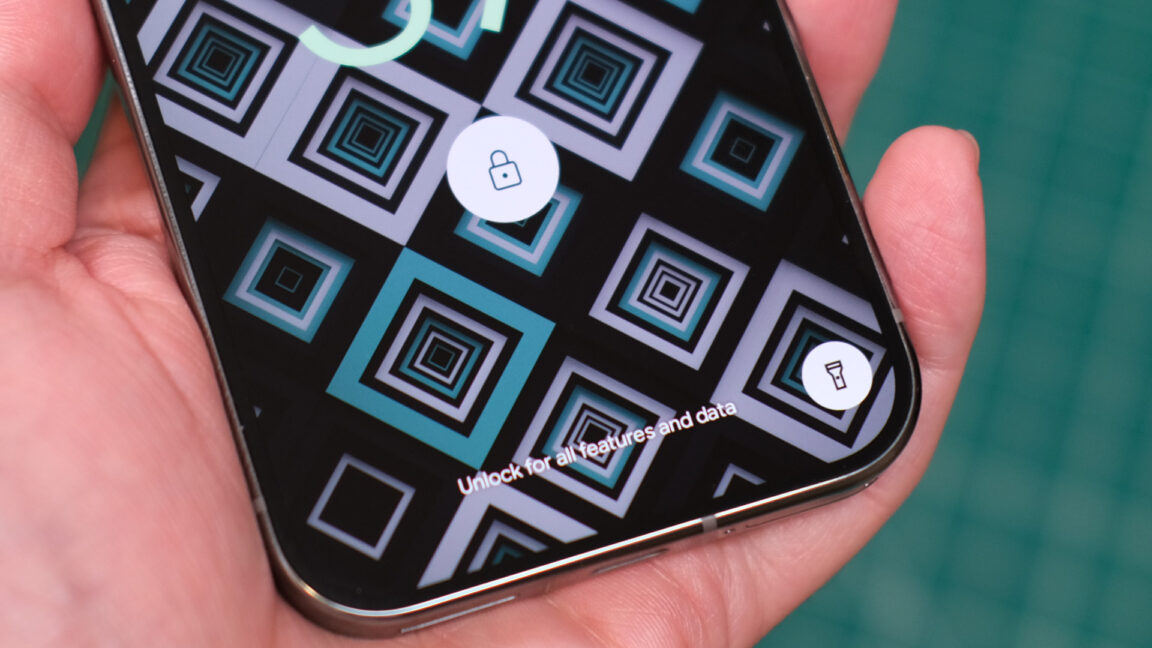
Android phones will soon reboot themselves after sitting unused for 3 days
The latest Google update will make your phone more secure if you don't touch it...
Ars Technica
410 points · by namanyayg · 1y ago · 340 comments
It's not even necessarily that good enough against cops, because in a lot of shitty countries, even some pretending to be democratics, not disclosing or at least inputting your password might be a crime severely punished. If I'm not wrong, there was a guy that had to stay years in jail until he would comply with the judge order to unlock his device.
If you enter password 1 it goes into your normal account, if you enter password 2 it goes into another user account with a burner environment where you can install a few token commonly used apps for plausible deniability.
The existence of password 2 should be optional and you should not be able to tell if the system has one or two passwords configured.
It's gonna be seen as pretty implausible when you don't have constant & recent messages with your loved ones in there.
There could be secret pathways but I don’t know them.
When Google does it: "Google is using it to help the FBI"
(But the iphone was hacked by the FBI...)
This sounds a lot like the Regulation of Investigatory Powers Act 2000 in the United Kingdom, where several people have been prosecuted and imprisoned for failing to provide encryption keys.
This scares me, because I have plenty of old devices I no longer know the passwords for. I don't think I'm alone - plenty of people forget passwords they don't use in years.
If the police came and searched my house, they could probably find some ancient laptop or phone from a decade ago, demand I unlock it, and then put me in prison forever when I cannot do do so.
Also (this may be of limited consolation) the officer who compels you to disclose the key must have some idea of what data it is protecting in order to satisfy RIPA 2000 s 51(5)(a):
> The matters to be taken into account in considering whether the requirement [for proportionality] of subsection (4)(b) is satisfied in the case of any direction shall include... the extent and nature of any protected information, in addition to the protected information in respect of which the disclosure requirement is imposed, to which the key is also a key
CPS won’t (as a matter of policy, and also can’t afford to waste time and money) spend time trying to prosecute a forgotten password for old laptop, unless it’s connected to some other serious, evidenced, allegations.
(I was on a jury in just this situation. Reasonable doubt is a high bar and prosecutors know this).
Don't think old Androids will get this update.
This is again Apple being Apple making things harder without option to disable it even when development mode is on.
Has anyone found a way to bypass it?
One physical option to bypass it on iPhone SE is to actually physically activate PIN entry and then use Voice Control command to enter the pin since it works even before first unlock. Though this is basically compromises pin and device encryption. But it's cheap since there are plenty of $2 devices that can simulate touchscreen clicks.
I just want some easier option that works and not require agent 007 setup to just run a buld of my AI-generated crap via Xcode.
Don’t set it up with a passcode in the first place?
In December 2024 all UN member countries voted in favor of "UN Cybercrime Treaty" which binds signatories to adopt a legislation to force you to give cops your passwords and other credentials.
https://documents.un.org/doc/undoc/gen/n24/426/74/pdf/n24426...
It’s a good and reasonable feature, especially if for some reason you are afraid of state or security agencies in a place where you live, or maybe during travel. It’s still questionable, because in some states you can indeed go to jail if you don’t unlock. Yet, I really want to be able to turn it off for use-cases like mine.
I have to have 3 devices: mine, work and a shared one for travel that crosses customs boundaries. It’s a massive pain in the ass.
Even if the end result is the same, anything that forces authorities to use official power over informal power is a net win.
Sure! Otherwise we won't be able to smoothly run our own servers on our phones: https://news.ycombinator.com/item?id=31841051
Yes. But quite honestly the right solution for that would be Apple providing an alarm clock API. The alarm clock application could call it with the next scheduled alarm’s time and the os would just wake up at that time and let the application do the sound / alarm thing.
I think you're basically calling out all the democracies, then.
If we start being perfectionist, we pretend there's no difference between most nations in the rights their citizens have. And that's not even remotely true.
An (Italian) friend of mine was stuck in Newark for 8 hours after he refused access to his phone, dragged in some room and questioned for hours along his wife while split from him own kids, even though he later gave them the password (he initially said no because he thought it was out of the line, he had nothing to hide).
He left livid for Italy 16 hours later despite being free to go on with his vacation.
Land of the free my ass.
That said, the last time I went to Italy the customs guy looked annoyed at being awake. He asked my son’s age (he is huge but too young to use the electronic gate), then shrugged and stamped my passport with all of his strength.
So maybe something like a paired app with a friend/someone who is beyond the reach of the authorities, and if the phone isn't unlocked in a given definable period (or it can be triggered immediately), it then can't be unlocked without that person's active cooperation.
That's off the top of my head, so I'm sure there are optimizations.
Currently only available for Pixel phones, 6 and later. Offers many other security-related features.
But the problem is that when authority wants you to unlock your device, they kind of already know why, what they are expected to find but they would that as a more complete proof. But from external input they would expect some downloaded files or accounts (like social accounts you were connected with your phone a minute ago), some SMS they saw passing, some call logs, so connection to your known accounts...
What's your point? That because it isn't useful in every country, it's not worth making available to any countries?
It's not preventing you from providing your password.
You started by saying it's a good option to have, so I don't understand the point of your second paragraph.
And to your point, I believe it's now the case in the U.S. that you can be legally compelled to unlock a fingerprint lock, but not a pin for whatever reason.
You don’t have to do anything for someone to hold a phone to your fingertip, or a camera to your face.
An argument against being compelled to provide biometrics does not necessarily hinge on it being analogous to testimony.
Not really. Samsung was the first with this, but their reasoning had absolutely nothing to do with security. It was because their phones slowed down over time and their solution was to give users the option to reboot it at specific intervals. You could even make the argument that the Samsung solution is still the superior solution because you get to set the interval.
I was admittedly confused about this distinction at one point too. It's a trade-off (although few people effected by this own phones with truly free, user-respecting soft/hardware in the first place).
As the GrapheneOS docs note, the feature is better implemented in init and not in system server or the app/services layer like Google has done here? Though, I am sure Google engs know a thing or two about working around limitations that GrapheneOS developers may have hit (in keeping the timer going even after a soft reboot, where it is just the system server, and the rest of the userspace that depends on it, that's restarted).
They went with 2^32-1 milliseconds or about 49.7 days.
We don't talk enough about Microsoft's strong legacy of security innovations, IMHO.
The minimum on GrapheneOS is 10 min and the maximum is 72 hours. It can also be disabled.
The system only reboots once it has been locked for a particular duration. Setting it to 1 minute basically says: put the system into a more secure state (e.g. purge unencrypted memory) and ensure that it is ready to go when I next need it. That said, while it is not unrealistic it would be problematic since accidentally letting the phone lock (e.g. input timeout) would result in a time consuming reboot.
---
### Google Play services v25.14 (2025-04-14)
#### Security & Privacy
• [Phone] Enables a future optional security feature, which will automatically restart your device if locked for 3 consecutive days.
I found it strange that things like 'prettier settings screens' and 'improved connection with cars and watches' would be included in Google Play Services. Surely those things are part of the OS not part of a thing which helps you access the Play store?
I've been using a LineageOS (prev. Cyanogenmod) phone for years and have never installed any google stuff so I don't get these updates anyway.
1. It's deployed to all devices and not subject to manufacturer approval for updates
2. It's easier to update without requiring user interaction or approval
3. It's closed source unlike Android so changes can't be incorporated by competitors
I have that on a spare unrooted Android phone. Seems to be working so far. But I'm sure Google could bypass it if they really wanted to. I don't know if they've ever made an effort to bypass Netguard (or similar) in the past.
Picked up a gl.inet x300b off ebay and never looked back.
- [ ] Reboot
- [ ] Power Off
- [X] WIPE triple opt-in
Maybe there is a custom phone OS for this that makes the phone act more ephemeral and network boot off my self hosted iPXE/immich server? A dumb smart phone so to speak. An ephemeral diskless phone.
I think it should be doable _technically_, but I think getting the mobile radios working before the OS boots would be challenging.
Like I could just grab your thumb drive, and put a new system on there that looks the same, and steals your password.
That said, I think this is a fairly good idea, although with the encryption stuff they do, this will cause people who rarely use their phones to miss calls and alarms.
If this is true, then the new update will save a lot of battery for those phones that are sitting idle.
This will be fun to track down after a long weekend in embedded devices once this android patch number is old enough to be baked into crappy payment terminals and mall kiosks.
Probably overall a good thing though.
> Security & Privacy
> [Phone] Enables a future optional security feature, which will automatically restart your device if locked for 3 consecutive days.
So it only "enables" a "future" "optional" feature.
1) There is no developer accessible API to allow app developers to create an app to allow me to script power options (example, as an end user I want to script a restart or shut down my phone nightly).
2) Asking Google Assistant will not restart or shut down the phone.
3) Apple and Android have made it harder to shut down the phone, requiring double key press kung fu to even bring up the power menu.
One click for me and it restarts fyi
It appears as an “app” like any other
Open it, will ask you to confirm, hit yes and it will restart
Some time later, you need to do something on the phone, you unlock it, the app starts up, and a flood of messages pours in. Wow, some of those would've been really useful to receive in a timely fashion! Whoops!
Besides most people support the police no matter what. Police know not to abuse their powers against Whites.
https://www.blackenterprise.com/white-protesters-form-human-...
In contrast, technological change will forever alter the balance of power. What we should be asking is "Instead of patching society with political solutions, how about we solve fundamental problems permanently with technology?".
I don't know if it'll take a fancy buzzword or what. Unobtrusive software? Silent Software?
STFU (BSD equivalent) and STFU-O (GPL equivalent)
No LGPL equivalent because I would want even software that uses STFU-* licensed code as a library to follow the STFU-* license.
Just have to explicitly define what counts as a notification lol
Samsung's have had some feature that lets you set days of the week for the phone to restart (IME during early morning hours) automatically. It's not perfect but it's something. iOS seems to have some unclear logic to either restart or re-request password (not biometrics).
This should be standard
Only law enforcement cares about the difference between the AFU state and BFU state.
firstly how about fixing software which forces 'inactive hours' yet reboots even when cpu is at 100% utilisation, and software which dims or locks a mobile screen during video playback, and soft/hardware which doesn't respect user-supplied suspend/standby timeouts in their power plans, and ....
Wouldn't the phones run out of battery after a few days anyway? Or do they keep them plugged in?
Lmao.
> The early sluggishness of Android system updates prompted Google to begin moving parts of the OS to Google Play Services. This collection of background services and libraries can be updated by Google automatically in the background as long as your phone is certified for Google services (which almost all are). That's why the inactivity reboot will just show up on your phone in the coming weeks with no notification. There are definitely reasons to be wary of the control Google has over Android with elements like Play Services, but it does pay off when the company can enhance everyone's security without delay.
All the more reasons to move to AOSP forks.
Not sure I'm too happy about this...
If you are in a hospital- your phone will reboot to pin level. So you need to unlcok it few times and wait 3 minutes before it becomes reactive.
Then all your alarms will not work.
They add crap like this, yet the stock calendar app needs a separate appto play music to warn you. This of course breaksafter a reboot..
My grandma has a second phone as backup - it will constantly reboot and will never be ready to be used the time it is needed - as a backup. Since it will keep rebooting and requiring a pin.
Who comes up with those anti user ideas?
That we will probably be unable to turn off (or the option to turn off will disappear after few months). Also old people will not know how to turn it off
Sometimes it feels like tech is going backwards. Rather than rebooting, just develop a proper method to unload/uncache, without making a device useless while that happens. Or use that multicore arch to swap the “dirty” instance with a clean one, in realtime.
It works there better anyway, because it's integrated with the OS, and not just one privileged service.
Not falling for it anymore. Fuck Google and the rest of Big Tech.
Why would I want my phone to auto reboot without my intervention? Never mind that it’ll never make three days on a single charge even if I don’t touch it.
The BFU state is more secure than AFU.
Even if you somehow live in a jurisdiction with a perfect justice system, that doesn't mean everyone else is.
Whos justice system? Lots of countries represented on HN. Many with questionable systems.
Law enforcement keeping hold of my phone for 3 days is simply not a realistic problem for me. Coming back to an annoyingly locked phone after forgetting it for a weekend very much is. The chances of law enforcement wanting anything with it are low enough that dealing with an extra unlock is more likely to be an impactful issue, even considering the potential impact that law enforcement or others stealing it could have.
That's what cops and spooks would like to have you think.
It's not a problem, until it suddenly is.
It is?
I mean, my iPhone asks me for my passcode every 7 days anyways. And that's the only thing that happens on reboot anyways.
Also, you forget your phone for a weekend? How do you do anything during that weekend, like keep in touch with loved ones, get driving directions, pull up a boarding pass, check for delays, look up restaurants?
Why not flush something properly in the RAM instead to wipe the "cached" secrets?
A full restart feels like an overkill.
A full restart guarantees that everything will be wiped.
https://blogs.dsu.edu/digforce/2023/08/23/bfu-and-afu-lock-s...
Restart - simple with known and predictable effects, data no longer accessible, all secrets flushed no matter where they were or cached.
Turn off disk encryption, suspend all running services, overwrite all secrets in the O/S wherever they are, and then restore all that on entering password. Probably can't do anything about secrets cached by actual apps. Complex, hard to maintain and probably buggy.