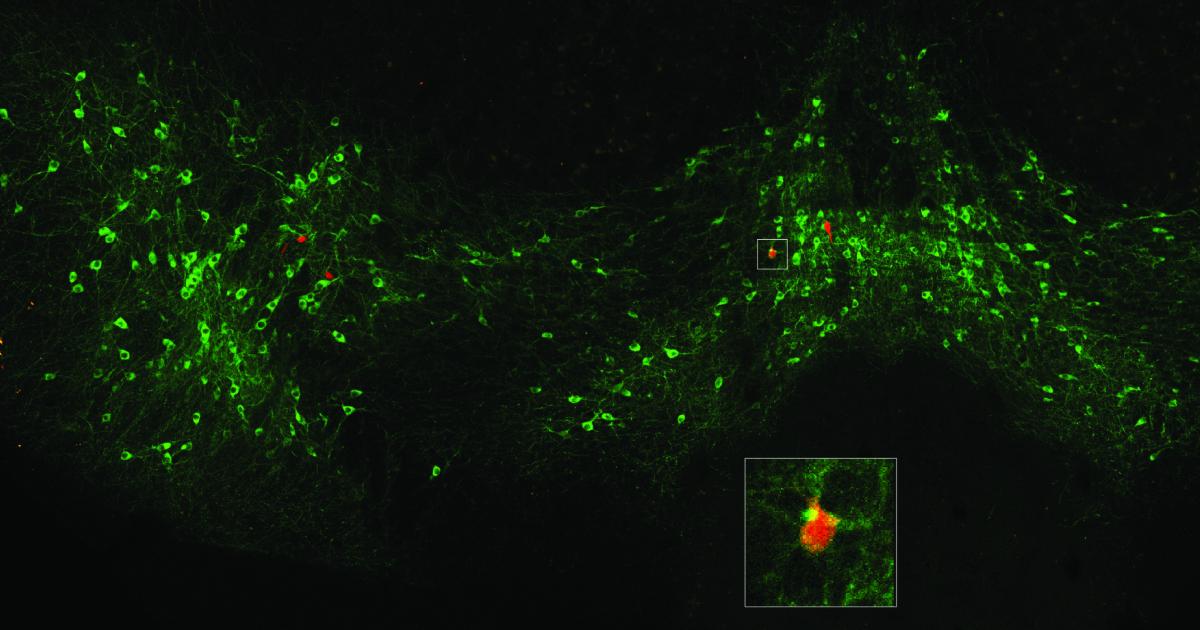
Dopamine signals when a fear can be forgotten
Study shows how a dopamine circuit between two brain regions enables mice to extinguish fear after a peril has passed.
picower.mit.edu
215 points · by gmays · 1y ago · 133 comments
The correct way to interpret this study is that dopamine is part of the signaling chain involved in fear extinction. The specific details of where, how, and when that dopamine moves through the brain are important.
The wrong way to interpret these studies is to think of dopamine as a "level" within the brain that goes up and down. Resist the urge to assume that taking a dopamine-modulating drug will result in this specific outcome.
Dopamine response within the brain is very complicated and region dependent. When encoding aversive stimuli (things you learn to avoid) there is evidence that dopamine signaling decreases in some brain areas while it increases in others: https://www.sciencedirect.com/science/article/pii/S235215462... That's just the tip of the iceberg. Don't fall for the trap of thinking that dopamine does just one or two things in the brain.
I wonder what even the point is.
I wonder what even the point is.
Not to be completely dismissive, placebo/mysticism/whatever can work
>Not to be completely dismissive
A whole series of essays based on the above, dismissing <deep learning>, <venture capital>, <LLM>, <blockchain>, <compute-based consumer platforms>,
Remains to be written!
dopaminergic take: who doesn't want to take on journeys of discovery fuelled by other people's (even entire GDPs-worth of?) time and money :)?
and,
I can say that my own experience is that correlating my own exposure to stimuli I have found fear-inducing, while on dopamine-modulating drugs,
has proven highly efficacious in overcoming those fears.
No A/B, results may vary, etc.,
but personally I have had life-changing results.
This doesn’t work forever (tolerance) and other people will experience the opposite effect with heightened anxiety.
If you want an example of why it’s not a blanket true statement or an easy solution for fear extinction, consider that stimulant use at excess dosages or abuse-pattern usage frequently ends in paranoia, where users are in such deep fear that they start sensing danger everywhere.
one interpretation would be that some specific drugs operate on relevant aspects of (or modulate the behavior of) the stipulated systems in a manner consistent with the desired outcome,
which allows for a neat summary in casual language, regardless of the complicated specific internal mechanisms.
I'm very very interested in this topic (I have some issues on that front) so if anyone knows books about neurology regarding trauma. Feel free to suggest me books or articles. Thanks
No, neurotransmitters are very local.
Dopamine exists all throughout your body, including your bloodstream. The dopamine in one location is uncoupled from the dopamine in another location. The dopamine in your bloodstream can't get into your brain. Dopamine within the brain doesn't spill over into entirely different regions of the brain.
Side note: ADHD is more than just dopamine, too. The stimulant medications used for ADHD have strong norepinephrine activity. There are non-stimulant ADHD medications that act on norepinephrine primarily. There are even studies where some non-dopaminergic ADHD medications outperform stimulants in certain measures like memory by modulating adrenergic circuits.
The unpopular take is that you need to realize that "dopamine" is an abstraction for higher level behaviors. It's not "dopamine" leading you to be distracted or focus, it's a behavior that you need to train and develop over time. There's also a big emotional regulation component where it helps to understand why you're seeking distractions instead of doing the work. Is it to provide comfort? Avoid uncomfortable feelings that the work brings up? Perfectionism? Are you trying to recharge during working hours because you're not recharging outside of work properly? There are many angles that need to be pursued.
I would recommend starting with small steps. Look up Screen Time settings or plugins that will limit your time spent on HN if that's a problem. Start with a generous setting and lower it over time. If you slip, start again the next time.
Treat it like something you train. Start small, make a deliberate effort, and work on getting better slowly. If you expect to flip a switch and turn into the most diligent coder you can imagine, you're unlikely to succeed. If you set a goal to do 10 more minutes of work and 10 fewer minutes of HN before lunch, that's doable. Little wins will compound.
"all happy families are alike; every unhappy family is unhappy in its own way".
Like with any complex system, there are a lot of ways for the system to fail, and the number of states considered "working properly" is much smaller.
2. Exercise - short-term: increases dopamine, serotonin, and a bunch of other good stuff; long-term: increases dopamine receptor density.
3. Caffeine - while doesn't technically increase dopamine, it blocks adenosine receptors which indirectly increases dopamine signalling. But habitual use blunts the effect.
Other less acute things are: good sleep and lots of sunlight esp early in the day.
One other “light” supplement that can dampen addictive behaviors or cravings is l-theanine.
Also personally, it doesn’t even help me with focus, in part because administering it is too distracting. I wonder whether there’s a place for an extended release nicotine pill, although that would probably be pretty rough on the gut.
It's hard to focus on the here and now when the here and now is the soul-deadening sensory-less experience of sitting motionless staring at a flat rectangle of pixels.
Go out in the woods. Get your hands dirty. Meet friends at a bar and laugh until your stomach hurts.
It's so much easier to be present in the moment when the moment is actually high fidelity and nourishing.
I was surprised how different it felt to consciously see and touch things. It's not like I'm walking around my house with my eyes closed normally, but most of the time things aren't really registering. Stopping to intentionally focus for a second on an actual object or a sound I'm currently hearing seems to sort of wake me up, bring me out of a trance a little. Not as well as digging in the garden, but not bad for a few seconds in the middle of the work day.
Outside, right now, people stay on screens all the time. It's the same stuff. Why even bother?
Humans plan ahead. We look towards the future and the past. Not all the time, but a lot of the time.
This carpe diem stuff doesn't seem like the right way to approach the problem given our current technological society.
Also, I'm not gonna party just because someone told me to.
Suffice to say parent is correct, and you are not.
Don't do highly dopaminergic activities like using electronic devices that provide entertainment or communications
My preferred steady state suffering machine is the Concept2 rower. I can keep an eye on stroke/min and cal/hr to stay within a very narrow band of exertion. HIIT and weightlifting are great too, but these are not as strenuous on the brain's "focus for time" circuitry. Lots of downtime and opportunities to get on the cellular device. A straight hour on the rower with the cruise control locked @ 850cal/hr is a totally different kind of animal.
Make an electroshock gizmo that hits you when your browser visits certain domains?
But just because they are the best doesn’t mean their help actually helps.
If you want to get rid of an addiction, stay away from addicts and everything they produce. Stay away from their artistic creations, stay away from their complicated explanations of the world, and stay away from their gossip. Also, please don't study to become any kind of "drug counselor," get regular person jobs and normal hobbies. You're dying of romance, and you need to figure out how to love the world as it is.
Maybe it's not obvious to you, but many of your real-world colleagues and role models don't visit HN or anything comparable. And they're still working at the desk next to you, and in the office you aspire to have some day. For all that stuff like this might feel justified or even necessary, it's not. And if you're finding that it introduces difficulties into your life or psyche, you are entitled to and capable of quitting altogether. You don't need to try to moderate it.
(And frankly, I personally don't even know what you're doing on GitHub so compulsively. I didn't even realize that was a thing, if that helps speak to how irrelevant it can be.)
Advice: love stress. Enjoy it. Feel it. Just don’t ask for it.
Also always go for a walk, touch grass, hug a tree. Pleasant physical experiences are truly effective at getting you into the “here and now”.
tyrosine -> dopamine -> (beta-hydroxylase) -> noradrenaline -> Phenylethanolamine N-methyltransferase > adrenalineNo, dopamine is a signaling molecule that participates directly in this functionality.
You're right that it's just a neurotransmitter, but the relative pathways about how they're produced are irrelevant for this study. They looked at how dopamine binds to certain receptors in certain parts of the brain under certain conditions.
I've read "The Molecule of More" and as much reasonably looking material I could find on the subject to "understand" my ADHD and fight it w/o meds. And I still feel dumb. Could you please explain how dopamine "participates directly in this functionality"?
There are receptors specifically for dopamine on the amygdala neurons. Dopamine molecules are released by the pre-synaptic neurons, travel across the synapse, and bind to these receptors.
Dopamine’s role in the nervous system is not simply an intermediate on the pathway to produce epinephrine or norepinephrine. If you thought like this you’d reach the conclusion that testosterone is simply a precursor to estrogen because the pathway to convert it exists in some tissues of the body.
On the other end there were people close by that having seen war, took a life lesson from their fear response: you survive by being alert and by distrusting. They radiated a permanent state of alarm, as the enemy may come when you least expect it.
Seriously though as someone who suffers from extreme anxiety I am eternally grateful for this kind of work.
I would really like to see this combined with brain stimulation.
(Of course, like everything in biology, dopamine also does about a gazillion other things, too, so it’s not quite that cut and dry, but it rhymes, at least.)
This is not true in the professional world. People engage in drug use for many reasons, including pure recreation.
Trauma can precede relapses or bouts of drug abuse, but it's not a universal explanation.
There are a lot of pop-culture ideas that explain everything away as trauma. These are popular on podcasts, Reddit, and other social media websites. There are also types of therapists who learned to treat trauma and then try to apply that to everything. "If all you have is a hammer, everything looks like a nail". These therapists will try to reframe everything as trauma because it's what they know how to teach.
They often reverse engineer a traumatic backstory as an explanation even when one doesn't exist. You can find podcasters and therapists who will even claim that being born imparts permanent trauma that explains things long into adulthood. There's no evidence behind this claim, but it's convenient for therapists who need to find a traumatic backstory before they can address something because everyone was born at some point.
> The idea of dopamine as your brain’s signal that you’re safe fits about as neatly with that as can be.
That idea is completely wrong, though.
The study is talking about dopamine signaling in one specific location of the brain.
Dopamine is used in other locations in the brain to encode aversive stimuli, among other things.
Dopamine (and other neurotransmitters) don't just do one single thing in the brain. They have diverse effects all over.
Also, many of the drugs that people associated with dopamine actually have much broader effects, such as on norepinephrine (stimulants) and serotonin (cocaine).
There are dopamine agonist drugs that go in and very precisely target different dopamine receptors in the brain, activating them directly. Many people are surprised to learn that a common side effect of these drugs is an irresistible urge to sleep when first taking them, for example.
>This is not true in the professional world. People engage in drug use for many reasons, including pure recreation.
Drug use != drug abuse
This is incorrect. While this is true for a substantial number of people, I want to offer some resistance to the pop-psychology axiom that "everything is because of trauma." Not only is is unsupported by science, it has lead to an expansion of the definition of the word "trauma" in popular culture that's so broad as to be nearly useless clinically or scientifically.
Almost all of my classmates (not me, unfortunately) were from exceptionally wealthy families and excepting one none of them ever mentioned any childhood trauma. Instead they were precocious partiers who got into drugs despite being underage and going to the nightclubs in the seedy part of town - no one at the time was turning away hot young women or gay(for pay or real) young men. And the club scene was a drug scene. It still is.
I don’t think trauma is actually at the root of almost all drug abusers. The only first class abusers (pot and alcohol in serious quantities daily) that I know at the moment grew up in perfectly fine suburban families and are in good, non-narcissistic/controlling/etc relationships with their families. They’re just addicts who can’t stop. One of them is going to die from it, eventually, given his level of alcohol consumption.
I am distracted from work by anxiety. With medication, I'm not distracted.
I mean, there is a reason why it's a controlled substance and is heavily abused all across the world. It works and it works well.
Though, I've been on it for about a decade now, and I have lost a large majority of the benefits it once provided.
I've been a heavy coffee drinker since i was a teenager.
I'm sitting at 13 double espressos today which is about average.
Lately the instant sleepiness post coffee isn't worth the focus, and I'm starting the think medication would be a healthier choice
The problem with amphetamine is you pay for every benefit: focus now, lethargy later; energy now, anhedonia later.
But taking a small, consistent dose. Does that work? Do you feel you net benefits in life from taking the drug, discounting for withdrawal and/or tolerance?
Surprised that there is no mention to extreme sports in this.
Big "what a rush" moment right after the person does something extreme and survives. Big dose of adrenaline in there not just dopamine but the parallels seem striking
please? all that lingo is above my pay-grade
You can look at my citation manager for some educational resources on the topic however https://www.zotero.org/i_o/collections/C2QRMIZE
But I would mostly recommend a neuroscience textbook. The following link is to the entry discussing what a neurotransmitter is so I think you'll find it immediately interesting https://www.ncbi.nlm.nih.gov/books/NBK10957/
In general neurotransmitters trigger a response in the target neuron by interacting with a channel embedded in the cell wall. This can trigger a change in the target cell if the triggered channel causes a protein to be released, or it can be an input signal used by the target to determine whether or not it should fire and pass a signal (through the medium of neurotransmitters) on to the neurons it itself targets.
If you are interested in the topic I strongly recommend creating a personal glossary for yourself. That textbook I linked has one I believe, and that ncbi domain has many other useful resources. There is a lot of simple sentences whose meaning is obscured purely because of a deficit of vocabulary, once you get some definitions down then a lot of medical texts really open up.
https://chatgpt.com/share/6813d85a-4d20-800f-881a-9b6133281d...
I fed it the article and asked for a python sim.
> The researchers were surprised that when they activated VTA dopaminergic inputs into the aBLA they could reinstate fear even without any new foot shocks, impairing fear extinction.
That... seems like the first step in being able to literally induce fear without having to bother with pesky things like finding the subject's triggers. Although I suppose if one has direct access to the subject's amygdala, the point is somewhat moot.
Still, it's sort of like a reverse wirehead.
Those organizations do it because they want to, not because it works.