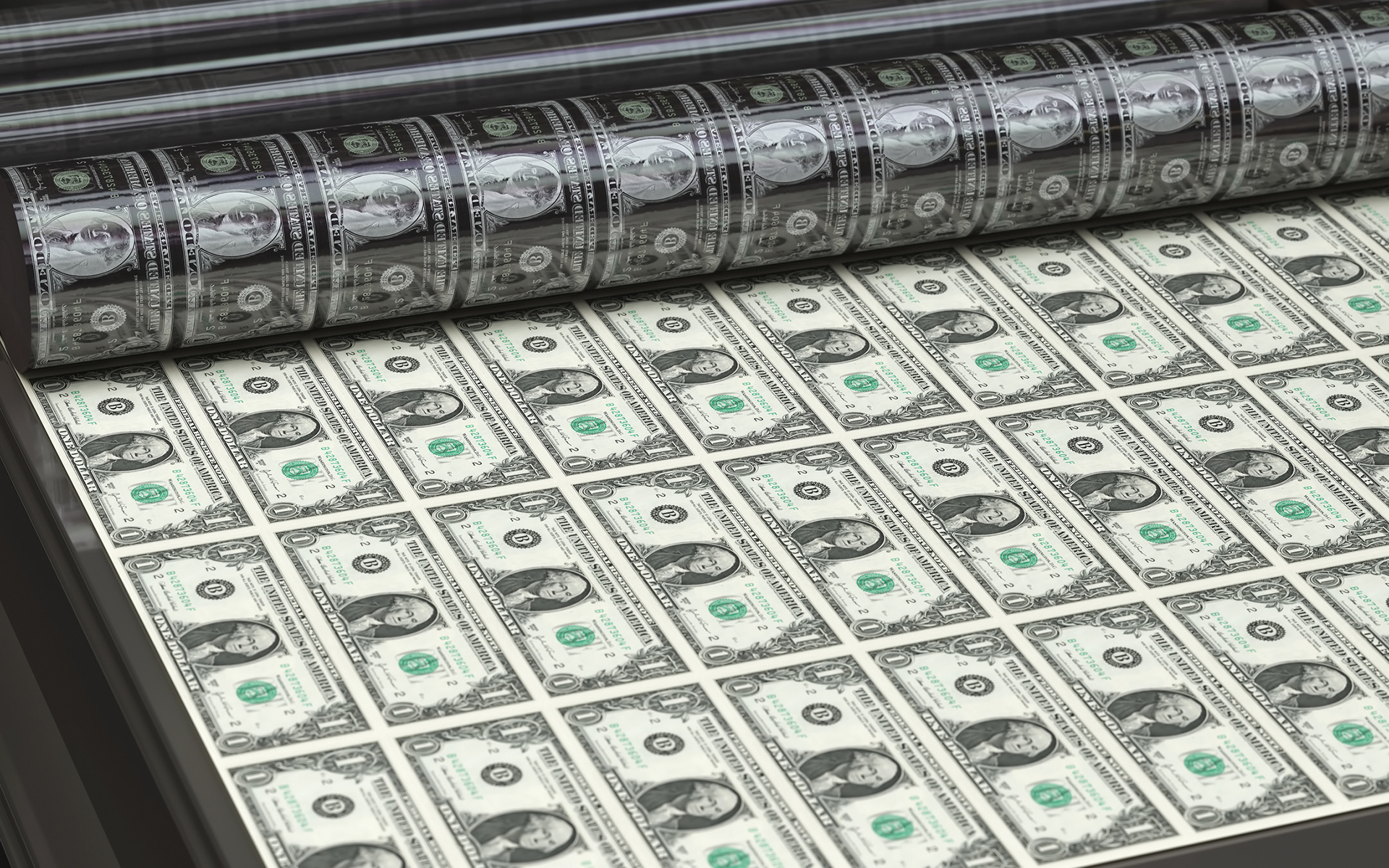
Era of U.S. dollar may be winding down— Harvard Gazette
Economist Kenneth Rogoff’s new book entwines currency’s ascension, his own experiences, and looks at what looms ahead.
Harvard Gazette
184 points · by gnabgib · 1y ago · 273 comments
https://en.wikipedia.org/wiki/Growth_in_a_Time_of_Debt
Leaving a comment for others just in case others are experiencing that same mis-connect. As far as the article goes, we'll see! I'm inclined to think that is true, that the US is retreating from the world stage and the dollar will follow, but whether that happens now, later or never, I couldn't say. Interesting times!
It's like trying to convince your parents to let you stay home by faking a temperature on the thermometer, then when caught repeating the measurement and shouting about how it actually shows 98.9°F and you really do have a fever!
Consensus was and remains that public debt and GDP growth correlate very poorly if at all, and the book that claimed the opposite was simply wrong.
The pretend claim the debt police went with later is that the paper somehow proves debt is inversely related to growth in some way. This is not an interesting claim, and certainly not proved by showing that low-growth countries are often also high-debt countries.
edit: there is absolutely no reason to think that government debt is related to GDP. That's why they resort to making statistical, associative arguments. The balance of payments is the important number, and it's an accounting identity that if holding the balance of trade steady, when government debt goes down, private debt must go up. The only thing you can be sure of when government spending goes down is that systemic investments by governments are being neglected, in favor of individuals borrowing money for personal consumption. Hello Temu.
I don't understand why or how that would be a goal. Doesn't the US get / consume something like 25% of the world's production while having about 5% of the population? If they're consuming 5x their share, the bottom is way, way further down than anyone can fathom, isn't it?
From afar I'd say it could be the same.
* I say most, because obviously there were also an awful lot of useful idiots.
It did this by running up an impossibly massive trade debt since Reagan. This is not something that can be done endlessly, unless you're going to "start" invading other countries for resources.
It also can't be done (in the sense of grown) endlessly if the only tools brought to bear upon it are the ones of heterodox economics and the historical policies of the two major US parties. You don't, however, need to invade other countries. You can take the sort of approach MMT advocates, for example.
I'm honestly not sure there's any grand design or even inkling of a plan. It's happening and we have to deal with the consequences
The "Mar-a-Lago Accord" is a proposed economic strategy, often discussed in financial circles, suggesting a coordinated effort to devalue the US dollar and reduce the country's trade deficit. Essentially, it envisions a deal where the US would pressure its trading partners to weaken the dollar and lower US borrowing costs, potentially in exchange for continued US security guarantees. The idea is rooted in the 1985 Plaza Accord, where major economies agreed to jointly weaken the dollar, but with some key differences.
> Economics professor L. Randall Wray criticized Reinhart and Rogoff for combining data "across centuries, exchange rate regimes, public and private debt, and debt denominated in foreign currency as well as domestic currency," in addition to "statistical errors," and for lacking a "theory of sovereign currency".
Especially when the consequences downstream of that error were so stark in terms of policy.
1. https://www.nytimes.com/2025/05/02/opinion/ezra-klein-podcas...
Ezra gave Rogoff a lot of push back and Rogoff came off as a guy who intuitively understands things but doesn't rigorously understand them so he looked kind of foolish multiple times. Rhetorically he was poor and if I hadn't already gone in agreeing with his general consensus, I would probably have been left fairly unconvinced. Of course, the curse of knowing a lot is that your knowledge of what you don't know is much larger than other people's knowledge so it's harder to confidently present things because you can think of exceptions or why they might not be true or how things could be much worse or much better than what seems most likely.
Unrelated but this is John Connaly who was governor of Texas during the JFK assassination. One of the bullets -- possibly the one that killed Kennedy -- went through Connaly's wrist & ribs
If I own a teddy bear factory and I give you 10 teddy bears and you give me back 11 teddy bears I would prefer 11 dolphins instead as they are something that I don't have and can't make.
It was the end of the bretton woods system/the gold backed US dollar.
The major consequences are inflation, which devalues savings and transfers the buying power lost from devalued savings to those who own assets, and removing the consequences of poor policy, letting the market remain more irrational and letting corruption fester longer before reality asserts itself.
Because the relationship between money and value are severed, it allows for wage stagnation and real economic production to stagnate while paper power and paper growth are allowed to metastasize because the supply of money can always be expanded rather than having to deal with the reality of potentially not being able to import things that fuel the engine of your economy.
So 1971 is when we started to hang ourselves with our exorbitent privilege: https://en.wikipedia.org/wiki/Exorbitant_privilege
There are quite a few of them, and you've conspicuously omitted them.
It's a bit like issuing a scathing review of the automobile by listing all the disadvantages of diesel engines compared to horses.
Therein lies the problem with gold, which is why a decoupled currency was required. A natural resource such as gold or bitcoin, appreciates as the economy grows, which in turn slows the economy down. With a printable currency, a country can control inflation or depreciate past value to create agony for people who have to continuously work to create more value. That is what forces nation-building and what capitalism helps with.
Dollar worked. And it won't be replaced with a fixed resource such as gold or bitcoins. But as the article mentions, it may not remain unique. That will be very interesting though, since the world has never experienced those dynamics before.
It inevitably brings us many benefits, but it does feel like the U.S. and other western countries are being hollowed out.
Maybe this is more of cost disease than dollar dominance. Maybe they are related in some ways?
It’s almost like some twisted version of Mutually Assured Destruction mixed with economics and realpolitik. As long as you don’t try to collect your money, it’s safe and profitable to lend me more of it. Because of the implication…
I love my US made RedWings and Aldens, just not cheap. :)
(and I’m not American)
Frankly, sneaker prices are getting so damn high that for the last couple years “expensive” leather shoes and boots from manufacturers that have resisted big price hikes have been looking more and more like a bargain…
What does this mean?
The opportunity is there, its just USA was supposed to use the reserve currency status to invest domestically in its own people. Instead USA made a business out of education (private schools and elite colleges).
This creates a situation where only high value jobs are feasible in the USA, but the education to do these high value jobs is too expensive. Now you have to import foreign talent, as well as goods, and this leads to erosion of the country.
China on the other hand, invested in its own people and developed industries domestically, rather than importing talent
Reducing trade deficits to zero is exactly ending the dollar as a reserve currency since it implies that no country has dollars in reserve. There is a stated a goal of this ruling regime to return to the gold standard.
So who was being liberated? From what I could tell it was authoritarian countries from the consequences of the sanctions framework provided by SWIFT and trade predominately occurring via the dollar. Rogoff explicitly states that the dollar as reserve currency has incredible intelligence value and allowed for us to impose sanctions on other countries.
The number of ways to interpret liberation day in a dystopian way are large, and I can't really think of any American entity that directly benefits from liberation day "liberation" except potentially unskilled American labor who might be free to work sweatshop jobs that get re-homed, if they aren't automated or don't just disappear entirely.
The fall back for a long time was that half of the problem was exchanging money between two countries, and then shipping the goods relied on a strong blue water navy.
The U.S. doesnt have the lead it used to in either area.
Sanctions didnt help either.
Another issue is the ongoing attacks on the rule of law and the courts. There was a reason why Russians kept so much money in British banks, it was the trust in the institutions that caused the inflow.
Its like a perfect storm to destroy your currency credibility.
The USA will remain reserve currency even though it will or has withdrawn from bretton woods and its role as world police.
Could the world have two competing currencies? Possibly.
But the one way to guarantee that adversaries (I don't care who your adversaries are, I'm using that as a non-denominational term) don't get the upper hand, is to use a currency they can't control or manipulate.
ATM the US dollar, can be manipulated by the Fed, but also by the collaboration of other countries, and holders of debt, as recently shown by the US bond activity.
I know many on HN are going to hate to hear this, but a single, global, trust-less currency cannot be manipulated against any single group. So bitcoin may just be the answer here.
A semi-joke-y take on BRICS:
> Pretty straightforward really. You combine Brazil's history of monetary stability, with Russia's respect for property rights, India's domestic tranquility, China's financial transparency, and South Africa's investment opportunities - and hey presto, you've got a new global money
* https://twitter.com/davidfrum/status/1665053372402081792
Of course more countries may enrol in the system, but that dilutes the influence of the five namesake nations of BRICS. But then you have to choose an actual currency(s), so you will they trust to be stable? Or perhaps go with a 'theoretical' currency likes Keynes' bancor?
The reserve currency needs to be so liquid that the average person doesn't feel nations buying/selling massive amounts of currency for trade.
To believe Bitcoin fits this is to be completely ignorant of reality.
It would be questionable if the Euro is even liquid enough for this because of the bond market.
If you look at the Real, Ruble, Rupee and Yuan vs USD, the BRICS would like something else because USD is too strong.
To look at those currencies and conclude it is over for USD is just absurd.
Commercial trade and government debt operate a such large quantities, that they are essentially a market unto themselves.
This is essentially how gold worked wrt the gold standard, except that with gold, a large find in one country increases the wealth of that country, or makes it subject to war, as other countries want to capture that value for themselves.
It's utterly unsuited to the task. Far too slow, vulnerable to quantum computing, concentrated and tending toward even further concentration, and with utterly useless environmental impacts. At it's core its a cool concept, but cannot be upgraded to match what's currently out there. It's whale oil in a world of fusion power.
Fee-less, mining-less, spam resistant, quantum resistant, decentralized and near instant technology exists, right now, and has proven itself over the last ~9 years. It's wild that people think the first-mover advantage extends so far as to accept something so vastly inferior.
  1. Currency flows are invisible to the Fed
  2. US sanctions cannot ban mutual trade in other FX
Something I think a lot of people miss in this discussion is that with computers and electronic markets dealing with currency conversions is fairly easy. In the past doing everything in USD vastly simplified everything, but today I think countries just trading with whatever currency works for a given market or transaction probably makes the most sense.
There is no other world currency that looks both large and stable enough to replace USD. Chinese Yuan/Renminbi is probably the closest but it's probably viewed by many as too easily manipulated. It's a pure fiat currency run by a single party state with little separation of powers.
If say a Thai company wants to buy cocoa beans from Nigeria, the Nigerian exporter doesn't have any immediate use for Thai baht if they aren't planning to buy something from Thailand. If exports and imports between two countries aren't relatively balanced there won't be a liquid market between their currencies.
What does it take to go from bitcoin being measured in US dollars to US dollars being measured in bitcoin.
Just for Bitcoin to no longer be deflationary. Right now it's much too good a store of value to become an effective medium of exchange.
One can certainly debate if it's a good strategy, but I'd highly recommend that everyone read this paper. A particular part that's surprising is that the headlines are constantly ~"US unable to stop decline of dollar" when according to this paper a weaker dollar is an explicit goal.
Edit: CountSessine has an excellent (and currently downvoted) set of posts about the paper elsewhere in this thread: https://news.ycombinator.com/item?id=43941376
I think your model depends on "workers" being the only people who are taxed, so if workers are being paid less than the cost of the goods they have to consume, the government + workers must be running at a constant deficit.
But you also tax employers and owners.
Inflation is a tool intentionally used by governments to quickly lower wage costs across the board. People at the bottom end can be subsidized, and productive people whose nominal worth just went up with inflation will negotiate for higher pay. Everybody else gets a pay cut.
has my vote
I suspect these forces will combine to significantly weaken the dollar.
Don't forget Nixon shock though. That was basically undoing Bretton Woods, but in an incompetent fashion that was amplified by low interest rate induced inflation, and produced "stagflation". https://en.wikipedia.org/wiki/Nixon_shock
The smartest guy we had was probably Lawrence Summers.
The current "plan" seems to be to leave behind the largely-defunct WTO once and for all and build a selective free-trade alliance specifically excluding China, much like GATT was. I don't think this would really make the US "richer" (or any participant in the alliance) - in fact it would probably make us all a bit poorer. But it would make China much poorer which at this point is kind of the goal.
https://www.hudsonbaycapital.com/documents/FG/hudsonbay/rese...
But that's just today. Next week someone else might get Trump's ear before he speaks to the press.
OTOH, if you believe that China is basically Germany circa 1938 (and indeed, China in 2025 is the largest and most successful fascist state in all of history), then kneecapping China's economy makes plenty of strategic sense.
But we could always just keep buying Hitler's Volkswagens - that's the direction our incentive gradient points in. The US doesn't need to be the global police - we could always just let China have Taiwan, the Senkakus, the Ryukyus, etc...
https://www.bls.gov/cpi/factsheets/purchasing-power-constant...
I’d estimate it at somewhere in the region of $10–$30, personally.
Modest inflation is good because it encourages investment.
Japan suffered fifteen years of deflation starting in the early 1990s. It wasn’t an economy anyone should envy.
Also, the dollar falling also does not make Americans poorer, as the implicit unit of wealth is the US dollar (e.g. the Forbes 400 list). Americans measure their net worth in dollar, not Euros. This would only matter if traveling oversea and purchasing power falls due to falling dollar. Otherwise, it does not matter.
If you think this is a crazy thing to suggest, consider that there is a faction in the US that wants this to happen. They see a strong US dollar as harmful to manufacturing and the working class.
"The total transaction volume for USD-pegged stablecoins in 2024 was approximately $27.6 trillion, based on industry reports from CEX.IO and other sources."
On top of that, transaction volume is meaningless. Those $27.6T could be $27.6T held in escrow being traded once, or $1 held in escrow being traded 26.6 trillion times. You can't derive USD demand from transaction volume.
"The total market capitalization of USD-pegged stablecoins exceeds $220 billion, with over 99% backed by fiat currencies, predominantly the U.S. dollar." https://chatgpt.com/share/681e95fe-4308-8008-ab25-61be94a418...
RE: Nobody wants to own stablecoins, they want easier transactions. Agree but that does not mean anything. Stablecoins seem to be solving a problem, and there is not evidence of any traction by any currency other than USD.
So this phenomenon definitely runs counter to the conventional intellectual wisdom that USD is in decline.
Disclaimer: I have never used stablecoins myself.
If they don't, stablecoins would presumably make it even easier to convert holdings into stablecoins backed by another currency (as there is no new account to be opened etc.) as soon as the sentiment on a given world currency shifts.
Yes, currently. This article is about a hypothetical in which this stops being the case. My argument is that stablecoins would not stop such a trend, and could possibly accelerate it.
This seems like a phenomenally ironic claim to me. You're giving up government manipulation in favor of rampant individual manipulation and theft.
That's not possible with crypto.
Satoshi would probably shudder at the thought of Bitcoin-backed fractional reserve currencies, but that's about the only thing he could do about it.
There are many countries with their own currencies, and all it takes is one of them to back it with gold, or a basket of commodities, and create infrastructure around it, and now there is something more attractive than the dollar to denominate debts in. That's all it takes. Everyone just wants to conduct business, get paid, buy food, etc. If the dollar is inflating away 10% every year, and there's something that fluctuates less than that, it's not exactly a hard choice. Especially if the choice is just a drop down in an app.
What may be more concerning, is it's not going to be a western democracy that sets up a stable-coin backed by commodities. They move too slowly, it's going to be an authoritarian regime that can move fast and wants to advance it's significance in the global economy.
Because even if the currency is on the gold standard today, what stops the country's government from switching back to fiat tomorrow and pocketing all the gold? Or, gradually doing so by introducing restrictions on gold redemption and slowly tightening them over time?
Whether a currency is fiat or backed, it is ultimately a statement that you trust the government which controls the currency to take good care of it – and in general, it is easier to have that trust with democracies than authoritarian regimes. And this is part of the argument for fiat currencies – if trust in the institutions ultimately counts for more than what the currency is backed by, why do we really need the backing?
Which is why replacing the USD is so hard. I think even if the US starts to go really downhill, people will be looking at currencies like the EUR, JPY, GBP as an alternative. If the IMF allowed private parties to use SDR as a currency – a move the US has always blocked as a threat to the USD, but in a global crisis the US might feel it has no choice but to change its mind – that might become a viable alternative global currency. CNY may become important in trade with China and its close allies, but who outside of China trusts the Chinese government enough to use CNY as a long-term store of value? Only as a riskier bet in a diversified portfolio including safer options.
Though we are doing a particularly spectacular job of messing that up this year.
It doesn't matter if Russia or China peg their currencies to gold reserves, no one trusts them keep the currency market-stable, because they're autocracies. And if Canada pegged its currency to gold or commodities, it wouldn't matter because it's not strong enough to maintain its independence by force, if it came to war.
The EU and the Euro might be a replacement for USD in terms of a currency backed by a big enough, stable enough entity to make it that trustworthy, but that's a long way in the future. Though, as US Treasuries lose their preferred status, European instruments will likely gain from that.
If there were some event or events that causes a dramatic contraction in world trade and set off financial crises around the world, many countries may be unable to buy treasuries in the same quantity.
A potentially scary thought exercise may be to figure out what the collective reduction in treasury purchases needs to be before it all blows up. I have no clue what that number may be.
But I have a feeling that if the dollar ceases to be the reserve currency, it will not be because the world has decided on something else.
Oh boy, I have some news about US and its trust. China seems more trustworthy right now, which is kind of achievement in the US side.
USA cant be trusted to ve stable nor to keep its contracts. Whether Euro collapses into the same state remains to be seen.
Commodity backing is a mechanism by which a country can ensure the stability of its currency across different political administrations. It's a kind of social technology like a constitution or super-majority requirement that creates stability. It's a plus that the US is stable power, but you can bet that the dollar will inflate year over year. That is its own form of instability.
Historical data contradicts the idea that you get stability on the gold standard:
* https://archive.is/https://www.theatlantic.com/business/arch...
* https://www.moneyandbanking.com/commentary/2016/12/14/why-a-...
I think what matters more is national wealth, wealth per capita, and their growth rates. This is an interesting list: https://en.wikipedia.org/wiki/List_of_countries_by_total_wea...
It also means Americans get to buy stuff from all over the world cheaper than anyone else, the moment this goes away inflation for imported goods will eat into people's salaries, there will be less investment as it will be risky to invest in a country in a debt crisis and folks will find out what it is like to live in Argentina for the past few decades.
The quality of life loss in the country if this happens will likely get people to stop talking about the great depression.
One way to think of it is that the US benefits from the current world order by essentially taxing the rest of the world to pay for its spending by devaluing their currencies relative to the dollar.
There are a lot of reasons we like being in the position we’re in, and I don’t think we know how bad losing it will be, if we do, but I think it’s unlikely to be positive. (Clearly our economists have largely agreed or we’d have gotten here sooner.)
Other countries who use dollars do not have that privilege.
That is effectively a 2% annual tax on the entire world, paid to the controller of the dollar.
I wouldn’t say I’m optimistic but it’s possible it may work.
It matters a lot to those of us among the capita who hold our wealth in US dollars.