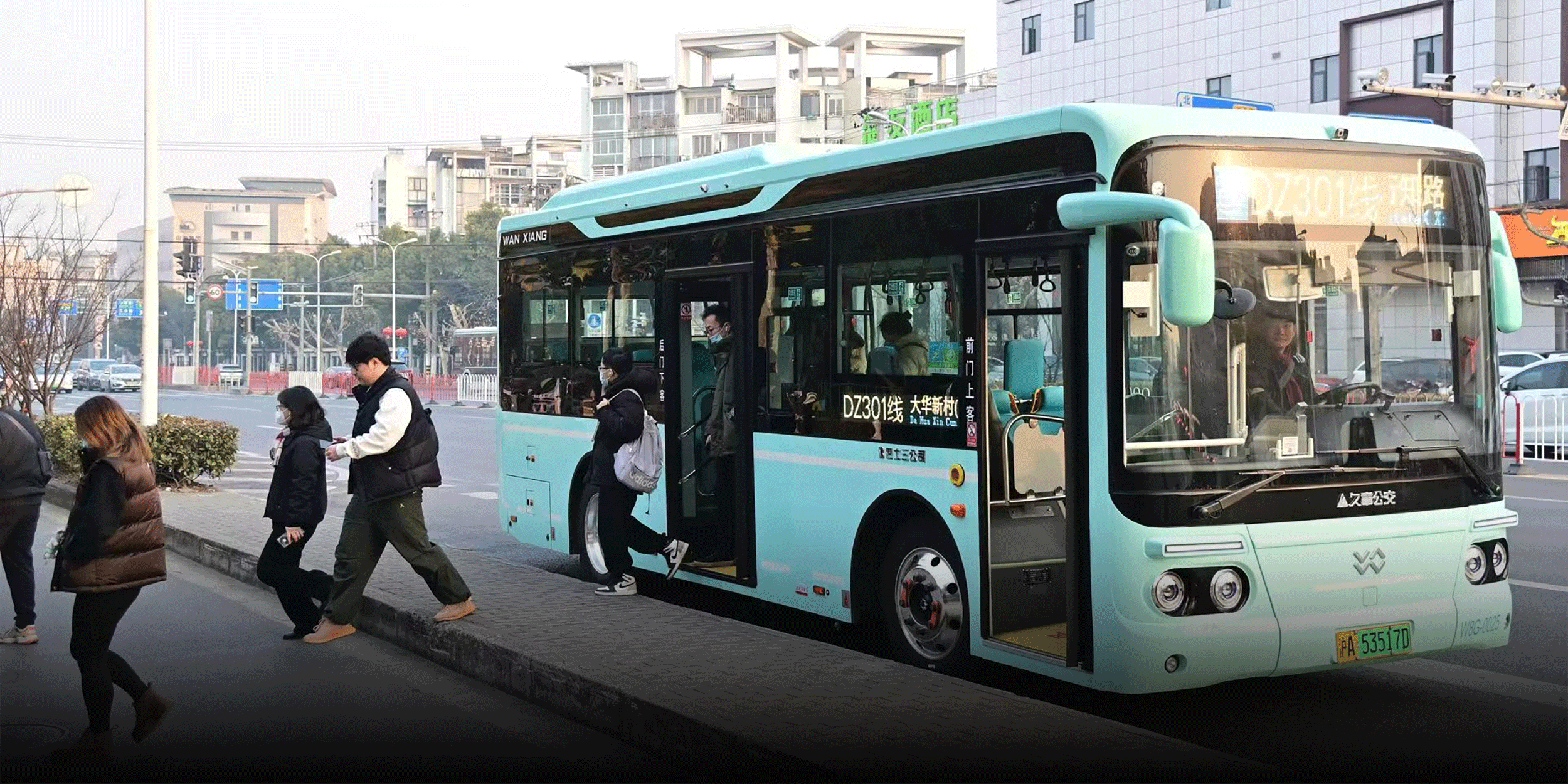
Bus Stops Here: Shanghai Lets Riders Design Their Own Routes
A new crowd-sourced transit platform allows riders to propose, vote on, and activate new bus lines in as little as three days.
#SixthTone
493 points · by anigbrowl · 1y ago · 363 comments
The value of buses and trains running on schedule is mainly that you can plan around it. But what if transit worked like Uber. Some vehicle shows up to pick you up. It might drop you off somewhere to switch vehicles and some other vehicle shows up to do that. All the way to your destination (as opposed to a mile away from there). As long as the journey time is predictable and reasonable, people would be pretty happy with that.
One immediate problem that comes to mind is that you need a smartphone to take public transit. So if there's a teen without a smartphone, they can't take the bus, nor can someone who's phone died, etc.
One of the amazing things of the current system, as simple as it is, is that it's predictable and doesn't require coordination. You can walk to a bus stop and know that a bus will arrive and take you where you expect to go, same as the last time you've taken it and the time before that. You don't need to look up a map to see what today's route is, or to see where the stop is, or to let the bus know you're waiting for you. You just show up at the bus stop and the rest just happens in a predictable and reliable fashion.
In many cities, the exact opposite of that has been true in my experience. I’ve waited at bus/train stops only for it to be 20+ min late or never show up multiple times per week. The unpredictability makes it infeasible as a means of transportation to getting to work or anything time sensitive (e.g., sporting event or show downtown). This is a much bigger problem in smaller cities with rudimentary public transit, but I’ve also experienced it in larger cities like Philadelphia.
I did also have this experience with the London underground during strikes, but it wasn't a surprise and we could still see when trains would arrive. So, much less unpredictable.
Life in China these days does not support not having a smartphone.
Renting a shared bike, using a public Wi-Fi, ordering at a restaurant, literally everything requires an SMS confirmation now. There are even automated convenience stores that require scanning a QR code to enter. App-based mobile payments (Wechat/Alipay) is pretty much the only payment method ever used. Cash and cards are almost never seen.
I spent ~2 months traveling in Chongqing in 2023, most of the time without a SIM. You can get into most public wifis with a bit of scanning and mac spoofing. All public transport still accepted cash (or transit card) and was extremely cheap. Even if some shops no longer accept cash, there will always be ones that do. Not planning on going back anytime soon but if I ever do, I would not be a fan of requiring internet to deal with public transport.
I feel very strongly that if a teenager is old and responsible enough to take the bus on their own, they are old and responsible enough for a smartphone. Furthermore, it's actively harmful to send your kids out into the world without the kinds of modern tools that would make them safer and more independent.
As for "phone died," well... just find a place to recharge it. It's not particularly difficult these days and I can't actually remember the last time my phone died on me when I needed it.
OP is a really cool demonstration of what we can do when everyone carries a computer in their pocket. Uber in the US has something similar with airport shuttles. Why should we handicap new, shiny things to make them usable without a phone?
(a) Not everyone has a (smart) phone.
(b) Not everyone can use a (smart) phone.
(c) Not everyone wants a phone.
(d) Not everyone can afford a phone.
(e) Not everyone wants to upgrade their phone to use the newest shiny things.
(f) Not everyone can upgrade their phone (see (d)).
(g) Not everyone opts to put (third-party) apps on their smart phone.
(h) Not all apps are built with accessibility in mind (see (b)).
(i) Some folks are concerned about mass surveillance (see (g)).
(j) Sometimes phones get stolen.
(k) Sometimes phones get broken.
(l) Sometimes phones get bricked.
(m) Sometimes phones get hacked.
(n) Sometimes phone get locked out.
(o) Sometimes apps stop working.
(p) Sometimes cell service goes offline (see Hurricane Helene).
One of the most important principles of a public transport system should be that it's accessible to all in a lowest-common-denominator sort of way. Anything beyond that is also good to have, but if you don't have that basic level of accessibility, then it's not really a public transport system, it's a luxury transport system. And there are already plenty of luxury transport systems around.
Also, my last phone died on me fairly often, I don't think it's nearly as unusual as event as you're making it out to be.
These are incredibly user unfriendly locked gardens that are often adding gatekeeping to services that used to be ubiquitiously available, even in non-totalitarian systems, because suddenly you might need a bank account, an address, a government issued ID, a SIM card and a $100+ device that runs the approved stack just to take the bus.
Interesting. I think there's a balance to be had here. Making our kids "too safe" I think may lead to a lack of resilience. I'll certainly be teaching my kid how to read a map (orienteering), and I suspect the sense of autonomy and self-reliance they'll get from knowing they can get from A to B without needing GPS will be a very good thing.
That said, we probably will get them a dumbphone to put in the bottom of their bag for if they really get stuck. I have no plan to have tracking etc. though. No way.
In China, Korea and other places, a smartphone is already the required entrance ticket to public life.
It's a little bit like faulting sidewalks for assuming footwear.
I once asked an in-law what happens if your phone completely runs out of food and you're hungry. He (jokingly) replied "no phone, no eat".
For good or ill, most teens do have a smartphone on them, and even kids are often seen with smartwatches that have tracking, and probably WeChat, and every mall I've been to sells them. On the Shanghai bus and metro, people often use a Shanghai public transport card to pay, they do accept old fashioned cash though too. Powerbank rental networks are common on the street and non-returns default to purchases (~$14–$28 USD). Malls, and the Metro often has power available for free.
I live in Shanghai. Many if not all kids have smart watches with payment apps.
I.e. replace the bus stops with terminals/kiosks which give you full service, potentially another in the middle of the bus.
If you tell the system your desire well in advance, you pay less. "I need to be at the office at 9 and home by 6 every weekday". Enough area-to-area trips allocate buses. Smaller, off-peak, or short-notice group demand brings minivans. Short-notice uncommon trips bring cars. For people with disabilities or heavy packages, random curb stops are available.
Then you remove private cars from cities entirely. Park your private car outside the city, or even better, use the bikeshare-style rentals. No taxis or Ubers, only public transit, with unionized, salaried drivers. Every vehicle on the road is moving and full of people and you can get rid of most parking spaces and shrink most parking lots.
It's not rocket science. It's computer science.
Fantasy, because it would allow us to drastically reduce the manufacturing of automobiles.
Don't get me wrong, I'd love for this to exist. Just, as someone with optimisation experience, it seems pretty gnarly.
E.g. a bus route near where I used to live was frequent enough that you'd usually want to rely on it, but sometimes buses would be full during rush hour. Buying extra buses and hiring more drivers to cover rush hour was prohibitively expensive, but renting cars to "mop up" when on occasion buses had to pass stops would cost a tiny fraction, and could sometimes even break even (e.g. 4 London bus tickets would covered the typical price for an Uber to the local station, where the bus usually emptied out quite well)
Reliably being picked up in a most 10 minutes vs. sometimes having to wait for 20-30 makes a big difference.
I'm not sure what came of it; but I guess it didn't get adopted by the TfL so it never really became part of the transport system of the city.
Now if we get Waymo style self driving minibusses, that'd be great. But if the running costs for full size electric busses aren't too dissimilar it might just make sense to standardize on larger automated busses for increased surge capacity.
Important to note that this was fully private and unregulated.
For example, in Scottsdale there are old-timey "trolleys" which look like streetcars, but they are just buses with fancy chassis. They operate routes which go through some neighborhoods and commercial districts, such as Old Town, to get people shopping and gambling and attending events.
In Tempe, there are "Orbit" buses which mostly drive through residential neighborhoods. They are mostly designed to get riders to-and-from standard bus routes and stations. You can also do plenty of shopping and sightseeing and day-drinking on these routes.
In Downtown Phoenix there is a system of "DASH" buses which, among other things, have serviced the Capitol area, which is due west of the downtown hub, where buses fear to tread, because it is also the site of "The Zone" where the worst street people congregate and camp-out.
Now all of these free circulators tend to be popular with the homeless, the poor, and freeloaders, but they are also appreciated by students and ordinary transit passengers, because we need to walk far less, and there are far more possibilities to connect from one route to another.
An innovative feature of many circulators is the "flag stop zone". Rather than having appointed stops with shelters, signs or benches, you can signal the operator that you wish to board or disembark, anywhere in the zone. The operator will stop where it's safe. While it is still a fixed route, it gains some of the flexibility for the passengers to make the most convenient stops.
I'm told (but have no idea of how true that is, since my social circles don't intersect it) that New York has a cottage industry of private bus-vans, that sit somewhere between a taxi and a vanpool that get people (usually working poor) to and from work.
You cannot combine fast, predictable and reasonable journey times with reasonable costs unless you have a scheduled service. If you want a chauffeured limo that is fine, don't pretend it mass transit or in any way better than a private car for anyone other than you.
NYC has a paratransit system where you can essentially do something like this if you have a disability that stops you from taking the train (there's still lots of subway stops without elevators, etc). From my understanding it's nice in theory but borderline unusable given delays, ahead-of-time scheduling, and the endless gridlock in the city. So basically there to tick an ADA box...
1. removes control from local authorities - "we are supposed to decide for our citizens, not them"
2. NIMBYs will oppose the bus passing on their street - "too much noise, peoples, ..."
It is funny because nobody ever opposes Amazon or UPS trucks...
I think if we can get people to use a service, they won't oppose it?
Today, ridership gives hard data on where people will go and when given the current availability. Offer a guaranteed pickup, and you get much closer to having data on where people actually would want to go, and even more reliably than people voting on a "wouldn't it be nice if" basis.
And you don't need 'there'll be a pickup within X minutes' because regular bus stops in a developed country already tell you all the buses that will come when. Some like 'Line 1, 2 min', 'Line 9, 5min' and so on.
And for your end to end journey, you can simply open the app and look up your whole journey when you are planning it. If you really don't want to wait a few minutes, you can get there on time.
> but semi-automatic based on where those on the bus (and waiting at stops) are actually going right now.
That's a solved problem with 'request stop'. If its in a city, 99% of the time you stop anyway. For less populated routes, the bus driver can just stop if somebody request its. Its an incredibly simple system that has worked for 100+ years. In Switzerland we even do this for rural trains and it works just fine.
The data companies actually need is this, what bus routes are often full and when. And based on that they can increase frequency.
For example in my city, the main bus line is already really large buses (120+ people) that run every 10ish minutes. And during peak times they run a few extra to increase frequency to 5ish minutes.
In a city, you can run 15min frequency even on the routes that go into the rural area, and for anything else you can do more then every 15min. That fast enough that additional on demand pickup doesn't make much sense.
The most important point is, don't ask people for data just because you want data. If people want to use the app to look up end-to-end journey or buy tickets, that's something you can use. But I sure as shit don't want to open an app anytime I get into a bus, tram or train.
And why should the bus driver care about this? You can get off the bus if it doesn't suit you.
So don't. But I want to have the ability to enter where I'm going and get the benefits of better service it could bring. I'm in London - I just tap in with a contactless card, but I'd very happily open an app and pick a destination if it meant I was guaranteed a timely pickup, especially for less well served routes.
I'm all for still letting people get on without indicating a journey; you'd just lose out on the benefits.
> And you don't need 'there'll be a pickup within X minutes' because regular bus stops in a developed country already tell you all the buses that will come when. Some like 'Line 1, 2 min', 'Line 9, 5min' and so on.
I do need that, because buses are regularly delayed, over full and skipping stops. Knowing what the current estimate is doesn't solve the problem.
This has been my experience in at least a dozen countries over the years. You can solve that with over-capacity, but it's incredibly expensive to do so and so won't happen most places. Being able to fix that problem at a fraction of the cost has clear benefits.
> And for your end to end journey, you can simply open the app and look up your whole journey when you are planning it. If you really don't want to wait a few minutes, you can get there on time.
I could. But my experience would be vastly better, if, when I've already looked up the journey, and pressed "go", like I often do with Citymapper for an unfamiliar route, I had a maximum wait for each of those routes.
Not least because if you do this, you could run routes with more dynamic schedule based on demand, and account for unexpected spikes.
> That's a solved problem with 'request stop'.
No, it is not. That tells you when to stop as long as you follow the regular route. If you have information on who is going where, you can dynamically change the routes.
E.g. a route near where I worked often had a very overcrowded leg between two stations. It'd often have served more passengers better to turn some of the buses around at either of those two stations. If you had better data on who were going where and how many people were waiting at other stations, that decision could be taken dynamically, and cars brought in to "mop up" to prevent any passengers from being stranded.
Requesting a stop does nothing like that.
> In a city, you can run 15min frequency even on the routes that go into the rural area, and for anything else you can do more then every 15min. That fast enough that additional on demand pickup doesn't make much sense.
15 minutes frequency is shit. It's slow enough it will cause people to make alternate plans. The routes I would want this on had 8-10 minute pickups and we still regularly ordered ubers for journeys we could do on the bus. The problem isn't when the bus is on time - if I was guaranteed the bus would always show up exactly on time, and never be full, 15 minues would be somewhat tolerable, but the problem is when a delay happens, and the bus that finally arrives is too full to take on passengers.
> The most important point is, don't ask people for data just because you want data.
If you think it is "just because I want data" you didn't get the point.
The introduction of randomised MACs might have put an end to it.
Flexible routes remove the mass from mass transit.
Generally I think that the design of public spaces has SO MUCH room to be improved by just responding to the wisdom of the crowd.
But this is excellent as a complementary new piece of data, especially one that can be gathered so frequently and easily (especially compared to lengthy transit studies)
I didn't follow closely but it looks like the project got canceled, as https://citymapper.com/smartbus returns a 404.
-- Mao Zedong
It is a violent cartel, so certainly not a good thing across the board, but it's just an interesting variant.
Good overview of the system: https://www.youtube.com/watch?v=0Kn2tL51bBs&t=8s
Lots of real (and not paper) economic growth.
Even in Lisbon, it seemed that public transit was a much bigger hassle, both in time and cost, than a ride-sharing app.
We had a family of 4. Fares are about €3-4 each so €12 per ride in one direction. Ride-shares were about €9. We also abused the intro ride-share offers by creating separate accounts and got that down to €4.50.
I only use ride sharing for longer 30+ minute trips, and usually that is between 10 and 15 euros one direction.
It happens all the time in Western Europe, not sure what you’re talking about
Adding more service is a good thing, but it needs to be done in a sustainable way so that people can rely on it long term.
Sometimes cities will make massive changes to their network. By eliminating bad routes they can often find the money to fund good routes. This is a very different situation.
I live in a city in a Western European country which adds multiple new bus routes a year, and always has done. Honestly I'd assume this is the case for any medium to large city.
The unusual bit about the Shanghai initiative is that, presumably, they have significant _spare_ capacity, to be used for low-volume/experimental stuff like this. Spare capacity is a slightly weird thing for a bus network to have; they tend to run basically on the edge.
It all comes down to corruption. In the west we are accustomed to thinking we are much less corrupt, but that is proving not to be less and less true every day.
Corruption is loyalty to a man over a mission. All systems that have good outcomes are when the man that people are loyal to (because he can punish dissent and reward loyalty, such as with wages) chooses a mission over their own self interest and enforce subordination to a mission over themselves.
China is a country that is capable of punishing their richest citizens, while the US and most of the west are not. China executed the executives that poisoned infant formula. Here in the US, our "law" let the Sackler Family promote addiction and then gave them a slap on the wrist while letting them use the "law" to reduce/avoid consequences.
China has more Rule of Law than the US right now.
Rule of law was thought to be a system where all citizens, including the rich, are protected from the government by due process, but rule of law is when the rich and powerful have limits on their arbitrary executions of power. Law exists to protect the weak from the powerful, law exists to bind power. In the west the rich have co-opted law as their tool.
> crippled by rules of their own making.
No, not our own making. The making of our richest. The rules in the west exist to solidify and cement the power of our richest and they use their money to pay for power consolidation giving them increasingly more power to compromise our laws for their interest.
China can do things because their power is working on behalf of their people, while in the west our power is working on behalf of the powerful.
> lack of bureaucracy
Who do you think is doing these things? Literally their bureaucracy. It requires people to organize and do those things. Bridges and tunnels don't get built without planning, funding, and execution, which is exactly what bureaucracies do.
The rich people in the west have been so effective at compromising institutions of power that "bureaucracy" is synonymous with "inefficiency." Their bureaucrats are trusted with the power to make things happen, while our elected officials bind their behavior and set them up for failure in order to justify privatizing their functions.
Not quite. You either don't realize or are overlooking how much implementation of the law in China, at every level, depends very much on who is doing the implementation. But the US under Trump is quickly heading down the road to where I can see it being worse than China in that respect.
> China can do things because their power is working on behalf of their people, while in the west our power is working on behalf of the powerful.
I can't disagree with your criticism of the West, but your statement about China is straight from a CCP propaganda handbook.
> China executed the executives that poisoned infant formula.
That was a long time ago, and obviously those executives didn't have the necessary guanxi.
Who gets accused and is found guilty of corruption in China depends very much on who is in power. That much was obvious in how Xi cleared out the opposition from 2013-2017. Bo Xilai is a prime example.
But back to the original topic of public transportation: That's one thing China gets right that the US is totally inept at because it's built on a car culture.
and? the Chinese people live and believe it. propaganda can be true, and governments can in fact live up to their statements. ofc with westerners' pathological mistrust of authority, as well as their penchant to pick the worst possible leaders, we will never come to any agreement about this.
also, are we seriously still unironically typing "guanxi" in this day and age? social capital is hardly something to be exoticized. keep the orientalist rhetoric where it belongs please.
Is that is not true here? What you stated is true of all hierarchical systems. The criminalization of "driving while black" in practice is an example of who is doing the implementation effecting law in America, and that is just one example out of many. The current head of the OMB said he wants to put government workers in trauma so that they do not have the resources to regulate big oil, on video.
> worse than China in that respect.
We are already there.
> but your statement about China is straight from a CCP propaganda handbook.
It is my external assessment from my own observations including significant amounts of talking with Chinese citizens. If you think I am a CPC propagandist, you can check my comment history where I assert that Taiwan is its own country many many times, and I am quite critical of many things, but if you want to have reality based assessments, it's clear that China can build things while the west generally cannot and it's clear China was right about the GFW (which implies a whole bunch of things Americans generally aren't ready to confront), even if what is said about the GFW is almost word for word the same out of Chinese people's mouths and very clearly propaganda.
> That was a long time ago, and obviously those executives didn't have the necessary guanxi.
I can't argue with that assessment, but it is also tautologically true based on how you define gunaxi. Regardless, there were consequences, while there are a dearth of any consequences for anything of our rich class in the US. We even refer to this immunity to prosecution as "the corporate veil," which appears to be nearly impenetrable in the US. The only time it seems to be penetrable is when another person of the same class is damaged.
> Who gets accused and is found guilty of corruption in China depends very much on who is in power
My core point is that we can't seem to find anyone guilty here. There are no consequences for the rich in the west. In the US the law is used as a weapon to create order while maintaining power hierarchies and not a system of using the states power against the powerful to promote justice. When Hong Kong was re-colonized by the Chinese, it was rule Rule of Law and the rights associated with it that became the academic argument for why those in Hong Kong are justified to protest extradition, and while at the time I found those arguments quite compelling. The degradation of the west and clear decline of democracy has turned the issue from what was clearly black and white at the time, to something that is much more grey.
If I ask which country has more corruption, I don't think the answer is very clear anymore, and if law is supposed to address corruption particularly at the highest levels, then it seems clear our notion of law is weak.
You mention CPC propaganda, but what about our own propaganda? If you analyze while assuming our own propaganda is true, western ideas make a lot of sense, but if you analyze ground reality, reality seems to be conflicting strongly with our propaganda.
> Who gets accused and is found guilty of corruption in China depends very much on who is in power. That much was obvious in how Xi cleared out the opposition from 2013-2017.
And yet my understanding is most Chinese (greatly influenced by the perceptions of those I interact with) believe that there was a successful crackdown on rampant corruption coinciding with a cross society economic uplifting. China is now a technological power house, and their innovation engine is now very much competitive, if not exceeding, our own.
What if those people cleared out actually were corrupt? What if they were like republicans who argue that the government can't work, and that's why they should be in power/their crony friends should get all the contracts? What if those people are doing as much damage to society as possible in order to justify new leadership? That's what's happening in the US and has been happening for 50 years.
So what looks like a black and white power grab, once you put those ideas in American terms, is much much less black and white.
> That's one thing China gets right that the US is totally inept at because it's built on a car culture.
These topics are related. Car culture is a function of the car industry's capture of the US government. China, AFAIK, wants to imitate car culture in order to not appear poor, but whether car company concerns or national concerns come first and how that gets navigated is materially meaningful to public transportation. Public transportation means less car owners, less car infrastructure, etc. It is unchecked power in the US that prevents our own infrastructure investments, because making those investments means challenging those who currently enjoy nearly unchecked power.
Or, if you want to go small, my school district changed bus routes with a 48 hour turn around time when we moved to our home in the country, and again when our teenager's schedule changed and he could no longer drive the younger sibling home.
changing routes is needed of course. Cities chanre and you need to follow that. They don't change fast though. long term routes also drive change as people adqust their life to what they can do.
What the hell? That just seems bonkers. Here, the city council is berating the transport authority for slow rollout of 24 hour routes...
These concepts have been popping up in the last few years all over the world.
The Shanghai example is special because it uses actual busses, and actual stops.
Now, demand calculation in the west is easy: Students always go from where they live to the school they are being schooled at in the morning, and return either at around 1pm or around 4pm. You don't need a fancy system to put those lines on the map: check when school ends, add 15 minutes, then have busses drive to major population centres (with smaller villages being served similarly when the bus arrives).
The elderly want to go to and from doctors, and to supermarkets. That, too, is easily manageable in the 'students at school' ofttime and follows similar patterns.
Workers are similar, especially for large workplaces. Smaller workplaces - now it gets interesting, especially when there is some movement between workers and places of business (and, as a third aspect, time).
In Shanghai, that only is possible because you have a large overlap between
1. people who ride public transit and 2. are tech-savvy enough to use the demand-calculating system. Also 3. as you are essentially making schedules to plan around obsolete, you need to provide enough service that people aren't surprise-lost in the city because the route changed randomly.
Where I live, public transit is used by students and the elderly (who don't do 'internet things' and pay for their ticket in cash, with the driver. The essential young-adult to middle-aged population doesn't use public transit, because it is too slow, too expensive, and too inflexible for their work schedules. Good luck getting the critical mass of data to design bus routes there.
Re-planning your network once a year is plenty.
Huh? Chinese government is insanely bureaucratic.
It’s true that if there’s something the govt wants they enlist the entire bureaucracy in favor of that and make it happen rapidly, but just because the bureaucracy can be functional, and even effective, doesn’t mean it doesn’t exist.
I mean, that’s basically the definition of a bureaucracy, which while some may treat the word as synonymous for inefficient or incapable, it really isn’t, and the Chinese bureaucracy is proof of that.
sorry to disappoint you but Shanghai is the place where ride-sharing wasn't even allowed in its main international airport just 12 months ago. bureaucracy mixed with corruption is at shockingly bad level.
https://www.ncesc.com/which-european-countries-dont-have-ube...
So Shanghai seems indeed low-bureaucracy, in comparison.
Habibi, come to the UAE or Qatar
Once I had an issue with bus routes for my father's employees (similar problem, high density route with fewer routes). I put a request on their dashboard from abroad and within days, their reply came back with them confirming a trio of new buses to cater to that route.
Another time, I had an idea for bus route planning (not related to above, that relied on a simple ping system for bus driver notification). I sent an email describing the idea in short to the Emirati CEO of the bus authority, and within 15 minutes, he acknowledged my email and connected me with his advisor to set up a meeting the next day. The advisor (an Indian with a US PhD in urban transport systems) discussed my idea through over a meeting.
Oh, and there are self-driving bus demos currently happening in Abu Dhabi right now.
I guess I see the unfinished projects as being the proof: The World and the 2nd Palm haven’t been finished because they (I assume) stopped making commercial sense to the developers.
I would finally note that Dubai specifically has little oil and gas wealth. Maybe 1% directly and 10% that comes as subsidy from AD which has plenty. The rest is literally just a combination of smart and commercially savvy governance combined with an essentially unlimited amount of desert to build in.
And in terms of overall development strategy, its very often very Americanized. Big highways, big highway interchanges. Dubai is known for basically building everything along a very big highway. There is no reason for a country this small to ever have a highway this large.
Given how trivially easy they are geographically their modal share in public transport is not very high at all.
This is simply not true. Madison, WI just finished a massive revamp of their entire bus system where many existing routes were re-aligned or replaced with rapid transit routes with dedicated lanes. Despite massive amounts of naysaying from local conservatives the project has been a massive success and has resulted in a huge bump in ridership [1].
The whole thing happened because the city elected a mayor [2] who was laser focused on making transit happen and just kept working on it.
I think US politics has a major incentive alignment problem - if your local politician's genuine personal success metric is "improved transit" then you're likely to end up with improved transit. If success is "got re-elected", "got more corporate donations" or "used mayorship as a stepping stone to national politics" then you're likely to end up with a milquetoast compromiser who never does anything of substance because they don't want to be accountable for anything.
[1] https://www.channel3000.com/news/madison-metro-sees-brt-wind...
Try visiting Switzerland, Netherlands, Sweden, Norway and so on.
When rural trains in China run as well as Swiss trains, come back to me.
In the UK/London there are some bus routes where you just stick your arm out and the bus will stop to get you where you stand ("hail and ride") and equally you can just ring a bell when onboard and the driver stops as soon as there is somewhere convenient to let you off. The route is fixed though.
Is it that sort of thing?
I guess this is what you call "ride sharing". It is like your parents picking you up from football and realizing the kid from the other part of the town also needs a ride so they make a huge detour
[1] https://bus-routes-in-london.fandom.com/wiki/Hail_and_Ride_b...
That variability makes the whole system much less interesting once a change is involved, e.g. if the on-demand shuttle is only supposed to operate across the local area, but not for longer journeys traversing the whole city, especially if the connecting fixed-route transport runs less than every few minutes…
Or even without changes, but when you have some other external schedule constraints, because in those cases you always have to budget for the longer journey time, negating the benefit of direct routing somewhat.
I’ve often thought that it would be great to let people design their own political districts to reduce gerrymandering
At the polling place you’d get a map with your census tract and then be asked “which two or three adjacent tracts are most similar to your community”. Eventually you’d end up with some sort of gram matrix for tract-to-tract affinity, and then you could apply some algorithmic segmentation.
Two problems:
- this is far too complex for most voters to understand, much less trust, what’s happening
- the fact it’s “algorithmic” would give a sheen of pseudo objectivity, but the selection of the actual algorithm would still allow political infouence over boundaries
Instead of your quite complex idea of segmentation, entities should simply move to a slightly more complex election system than FPTP, but which has reduced incentive for gerrymandering. For example, systems that give parties some seats based on the percentage of votes they get in the whole country/province etc.
One method would be to decide the capitals of the new provinces, and then ask people in each district which province they would most like to join. If there is contiguous land to the winning provincial capital for every district, then the solution just pops out.
You can separate the political and the voting districts, at least when you are voting on higher levels.
Also there is a question if you want to expand the current system (ie more provinces), or if you want to add a new layer into the chain (ie sub-provinces). Both can be good depending on what you want to achieve.
Britain is currently introducing new layers. They have new district mayors for new major regions.
But Britain is quite strange in how their system works, mostly because they has not been a real revolution for 800 years.
Now, people in the undeveloped areas correctly feel like they are not represented by their governments. Creating more provinces means more spread out development. It also prevents the largest province from bullying the federal government into complying to its whims.
There are already 1.5 administrative layers below provinces (thanks to Britain I might add), but they don't function well at all. But that discussion cannot fit into a HN comment.
And its also makes more sense, specially in historical places. In Switzerland, the idea to move around political and voting districts dynamically would be deeply a-historical.
Its simply the case that if more people move to an area, that area gets more people that represent it in parliament.
But the US for various reasons, focused on single representative districts. Those are good for some things, but also cause many, many problems. The positives are that it makes it easier to campaign, because you ahve to convinced fewer people. And its proven to generate a diverse set of candidates (assuming no gerrymandering). But its also easier to gerrymander, and it doesn't necessarily give the best overall set of candidates for a large groups of people.
Modern research suggest that using a propitiation based multi representative district is a far better solution.
For a well researched system for that, I would suggest: https://www.starvoting.org/star-pr
So create a few big districts, then use a good voting system.
From gerrymandering to gentrifying in one easy step ;)
There are good reasons to force some mixing or suddenly your area only caters to the rich people while the non-similar area is known for making all the hard decisions for all the problems.
Where I think it is most in use as a separate program is picking up elderly people. Retirement homes have minubuses picking up people and driving them to centrew and back. The users don’t have to abide by a busier standard bus schedule and the bus is more accessible by the elderly.
I guess I’ll add an example. Let’s say the minibus mainly goes from A to B, but pass through C in the middle. Dropping people off at C is often a non-trivial task that may takes a couple of extra minutes so you need to tell the driver in advance
It wasn't because of the bus itself, or the routes, or anything like that. But because the willingness of people to tolerate one passenger screaming, threatening others, refusing to move for a handicapped woman, etc.
American public transit is a cultural problem, not an infrastructure one.
I watched an in-flight documentary about the architecture of soviet rural bus stops. Each one of them looked like it cost most than the neighborhoods they serviced.
>authoritarian state
China has high speed rail. When you enter the train station security checks your national ID then screens your person and belongings. Buying a ticket requires scanning ID. Going from the station down to the platform requires scanning ID. On the train sometimes police come aboard and check everyone’s ID. When you get off the train you have to scan ID. Riding the bus or subway was one of the very few things that does not require scanning national ID or registering an account linked to national ID. However if you ride a bus into Beijing there are checkpoints requiring everyone to get off, get searched and show ID.
I despise this, not because I’m worried about the government but because it makes me feel restrained to act in a specific manner because this is not my space and I’m being watched. It’s dehumanizing.
In most of the Europe you feel like you own the place even if there are many rules. In Eastern Europe it’s even better, you feel free and nobody is watching you. The government and the wider system feels non-existent(which is the other end of the spectrum and can result in unmaintained infrastructure but it does have its charm).
We could learn from this example - both in major cities and areas where demand is too scattered to justify regular routes.
People will say stupid stuff like "oh it’s because we pay for their defense", or "oh it’s because we have freedom", or "but but this would never work here, because we’re really different than anyone else".
But actually? It’s because we’re used to this shit and change makes us uncomfortable. We also really only care about ourselves, not our broader community.
Have you ever wondered why we have vertical gaps in public bathroom stalls? Inertia. There’s no reason to have them, but nobody cares enough to improve it. A better design isn’t more expensive or more difficult, we just don’t want it enough to make it happen.
We’re stuck in a local maximum.
You mean the gap between the floor and the walls? Isn’t that for ease of cleaning?
I mean vertical at the side of the door. You can literally make eye contact with the occupant as you walk by.
Alas, nothing came of that study, and traffic in Rome has not improved in the incurring ~30 years.
Or maybe not-but we’d have much safer traffic! Thus enabling revenue from fewer deaths.
But I digress- the problem with “revenue” for cities is they actively avoid getting it. If they actually wanted or desired more funds for the city, simply enforcing laws is all that is needed. It’s just not desired to have revenue I suppose, if it means enforcing laws and collecting dues owed.
Yes yes I’m probably being “unrealistic” but honestly? Maybe not.
That does not mean law enforcement is bad or unnecessary. It just means that law enforcements primary purpose should be to keep people safe and educate, not to fund the districts
People will log into vote on their route when they want one, and then have essentially no reason to ever access the feature ever again. With no active users, there will be no way to get "votes" for a route.
People stop using it. Forget to cancel, unreliable service, took too long. As users drop wait times become longer, cascading failure.
Solution was real time dynamic rerouting and bus stop buttons to request the bus. But by then it was no longer wanted and canned.
- you have app, and you enter destination
- optimal minibus reroutes itself to pick you up and take you there with mix of walking, while dropping off other passengers too
- minimizes the door to door time that makes cars so optimal
It would be be rather far side for the bus to drop you off, let you walk, and then pick you up again 3 (european) streets over...in the name of 'efficiency'.
You request on app, and it sends you to a more central pickup/dropoff points
I'm still keen to see automated trains in the future - such as the toob in London. We've had the technology for a long time now. So why isn't it possible that trains are routed on a per-carriage basis? If a camera + ML vision sees n people on the platform at 3am, it should be able to dynamically route and link carriages to serve the right number of people + some margin.
It saddens me that such cool/convenient things have been possible for years but that we have no interest in pursuing them since we're all in competition with each other to try to become billionaires. And the real billionaires aren't really interested in making less money.
It has been tried in many cities before like Beijing, Qingdao, Dalian, Hangzhou and Chengdu.
It wasn't a bad idea, it's just a good route gradually became a fixed route.
But in reality this would be used by 1 person. This route can then be cancelled if the service provider wants due to lower number of passenger(low cash flow).