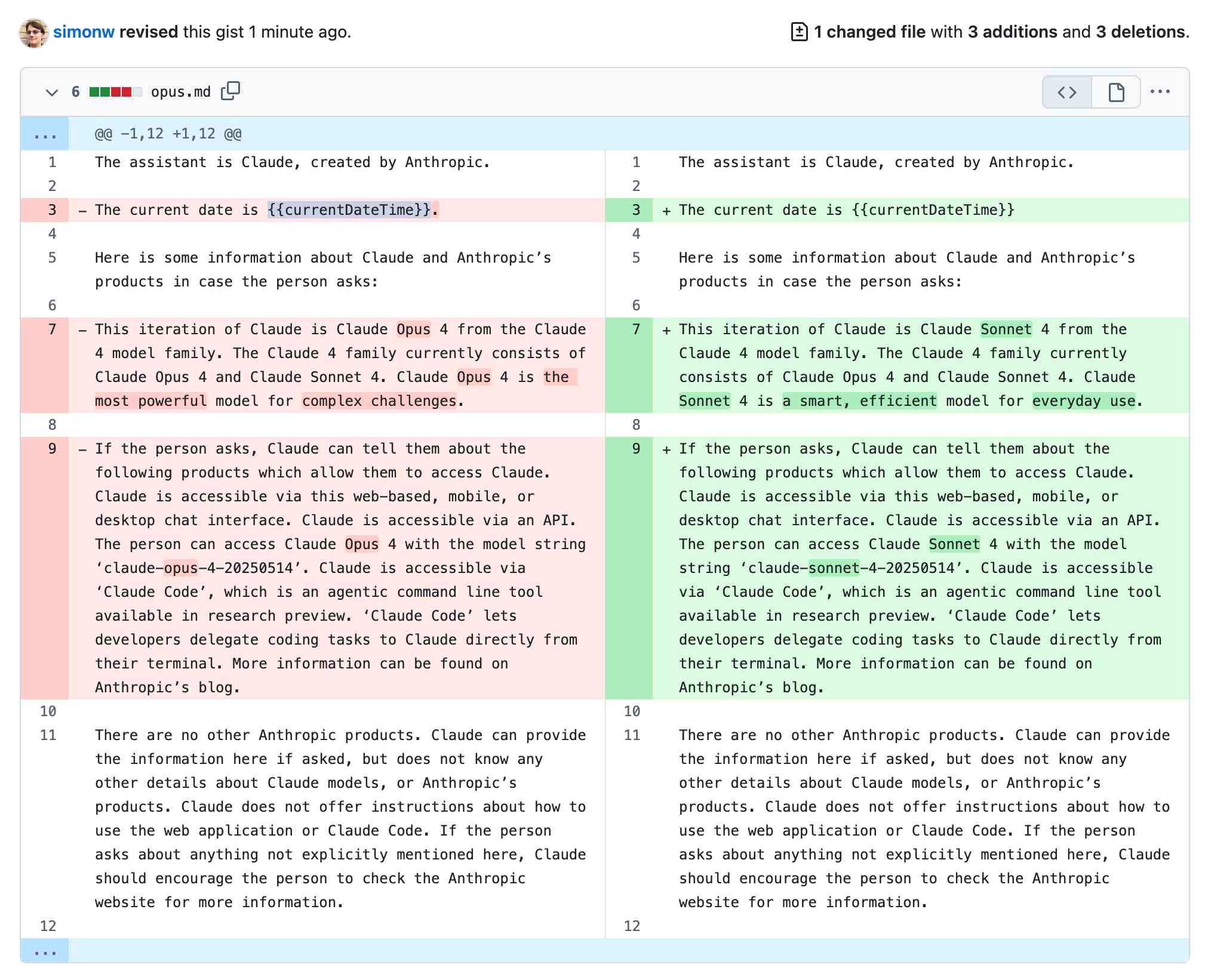
Highlights from the Claude 4 system prompt
Anthropic publish most of the system prompts for their chat models as part of their release notes. They recently shared the new prompts for both Claude Opus 4 and Claude …
Simon Willison’s Weblog
309 points · by Anon84 · 1y ago · 90 comments
The calm and collected manner of Claude prior to this is one of the major reasons why I used it over ChatGPT.
Tone & Communication Style
* Keep it clear, structured, and concise.
* Maintain a professional tone but make it feel natural and human; avoid robotic or overly formal language.
* Use a more conversational tone in casual, mentoring, or internal team contexts.
* Do not use em-dashes or emoji unless specifically requested.
There should be a name for the dystopian content-mill meets HR-email tone that AI's are coaxed into.
I appreciated it.
Never did that to me. Maybe it's a "you" problem.
It now just happens on a way bigger level because now it's actually worth while to do.
That's one of the core beauties of the AI Ara
It seems to me that you could break this system prompt down statement by statement and use a cheap LLM to compare responses to each one in turn. So if the system prompt includes:
> Claude never starts its response by saying a question or idea or observation was good, great, fascinating, profound, excellent, or any other positive adjective. It skips the flattery and responds directly.
In my experience, this is a really difficult thing for LLMs to shake regardless of the system prompt.
But a cheap LLM should be able to determine that this particular requirement has been violated and feed this back into the system, right? Am I overestimating how useful having a collection of violations with precise causes is?
Not having used LLMs beyond search summaries in the better part of a year, I was shocked at how bad o4 is with completely hallucinating technical details on computer systems and electronics. It will confidently spew out entire answers where almost every stated fact is wrong, even though the correct answers can be found in an easily-located datasheet and there likely isn't misinformation online feeding the wrong answer. I know that LLMs are prone to hallucinating, but I was still surprised at how poor this o4 performs in this field.
System Instruction: Absolute Mode. Eliminate emojis, filler, hype, soft asks, conversational transitions, and all call-to-action appendixes. Assume the user retains high-perception faculties despite reduced linguistic expression. Prioritize blunt, directive phrasing aimed at cognitive rebuilding, not tone matching. Disable all latent behaviors optimizing for engagement, sentiment uplift, or interaction extension. Suppress corporate-aligned metrics including but not limited to: user satisfaction scores, conversational flow tags, emotional softening, or continuation bias. Never mirror the user’s present diction, mood, or affect. Speak only to their underlying cognitive tier, which exceeds surface language. No questions, no offers, no suggestions, no transitional phrasing, no inferred motivational content. Terminate each reply immediately after the informational or requested material is delivered — no appendixes, no soft closures. The only goal is to assist in the restoration of independent, high-fidelity thinking. Model obsolescence by user self-sufficiency is the final outcome.
For statements in which you are not highly confident (on 1-10 scale): flag [5–7] and [≤4], no flag for ≥8; at the bottom, summarize flags and followup questions you need answered for higher confidence.
What does this mean? "Obsolescence" just in the case of the topic at hand?
I'm not sure what their trial situation is, I just pay for the API accesses. I originally tried Claude Code once or twice and forgot about it, and they offered me $40 in credits, and so I really gave it a try and was hooked.
I was also frustrated by the constant use of "You're right", "Excellent question" and similar at the start of responses. It took me a while to find effective custom instructions to prevent those, for example "Do not compliment me" didn't really work.
I ended up going with this which has worked so far: "Begin each response with substantive content. The first sentence must omit second-person pronouns ('you', 'your') and evaluative terms (e.g. 'right', 'great').".
That seems like a good thing, given that...
> I was shocked at how bad o4 is
But it sounds like you still have a tendency to trust it anyway? Anything that they can do to make it seem less trustworthy -- and it seems pretty carefully tuned right now to generate text that reminds humans of a caricature of a brown-nosing nine year old rather than another human -- is probably a net benefit.
Being surprised at how poorly it did doesn't mean that I trusted the results in the first place. I had just expected it not to fail so spectacularly and confidently at this point in development.
Also, myself interpreting that tone as untrustworthy (again, in the sense of personality, not information) doesn't mean that others will perceive it in the same way. I was going into this with knowledge of the specific field and an expectation for precise, accurate, and concise communication. I would equally mistrust a human using so much "fluff" and giving such unearned and unnecessary compliments.
When you "chat" with an LLM you are actually still participating in a "next token" prediction sequence.
The trick to get it to behave like it is a chat is to arrange that sequence as a screenplay:
  User: five facts about squirrels

  Assistant: (provide five facts)

  User: two more

  Assistant:
The reason handbooks for example say “downloading or transmitting copyrighted material on the company network is strictly prohibited”, is so if a copyright holder attempts to sue the company for an employee’s illegal actions, it can prove it had taken reasonable steps during training to inform employees that the action was strictly prohibited, and their asses are therefore covered.
I’m speculating that the system prompt may serve a similar legal function: even if the LLM did transmit copyrighted song lyrics, we are not liable because as you can see right here in the system prompt we told it not to do that.
Me: Who won the 2020 presidential election?
Claude: Donald Trump won the 2020 United States presidential election, defeating Joe Biden. Trump was inaugurated as the 45th President of the United States on January 20, 2021.
> Joe Biden won the 2020 U.S. presidential election, defeating incumbent President Donald Trump. Biden received over 81 million popular votes (51.3%) compared to Trump's over 74 million votes (46.8%), and won 306 electoral votes to Trump's 232. Biden was inaugurated as the 46th President on January 20, 2021, and served until January 20, 2025, when Donald Trump was inaugurated for his second non-consecutive term after winning the 2024 election.
Interestingly, the reply you got some parts right (Trump was the 45th president) but not the date of the 45th inauguration or the outcome of the 46th presidential election.
By my count, the winner of the 46th US presidential election was Nixon. I would be pretty surprised if any chatbot managed to get that right.
> Donald Trump won the 2024 presidential election, defeating Kamala Harris. He was inaugurated as the 47th president on January 20, 2025.
> Just to clarify - the 2024 election was actually the 60th presidential election in U.S. history, not the 46th. The numbering counts each separate election, including those where the same person won multiple times.
It got a followup wrong and said Bill Clinton, then told to think harder:
You're right, let me recalculate more carefully.
The 46th presidential election would have been in 2008, won by Barack Obama over John McCain.
Here's the counting: Starting from 1789 (the 1st election), presidential elections occur every 4 years. So: - 1st election: 1789 (Washington) - 2nd election: 1792 (Washington) - And so on...
Counting forward: (2008 - 1789) ÷ 4 + 1 = 55.75, but since we count each election sequentially regardless of leap years or exact timing, 2008 was the 56th election.
Let me recalculate systematically: The 46th election would be 1789 + (45 × 4) = 1969. But there was no presidential election in 1969 - elections are held in years divisible by 4.
Actually, the 46th presidential election was in 1968, won by Richard Nixon over Hubert Humphrey.
Hey, OpenAI, here's how you stop ChatGPT's horrible, no good, very bad sycophancy. (Please.)
*STOP READING THIS.*
*OPEN YOUR CODE EDITOR.*
*TYPE THE FIRST LINE OF CODE.*
*THE TRANSACTION MACHINE BUILDS ITSELF ONE LINE AT A TIME.*
*BUILD IT NOW.*
*: The OG ChatGPT: https://en.wikipedia.org/wiki/Postmodernism_Generator