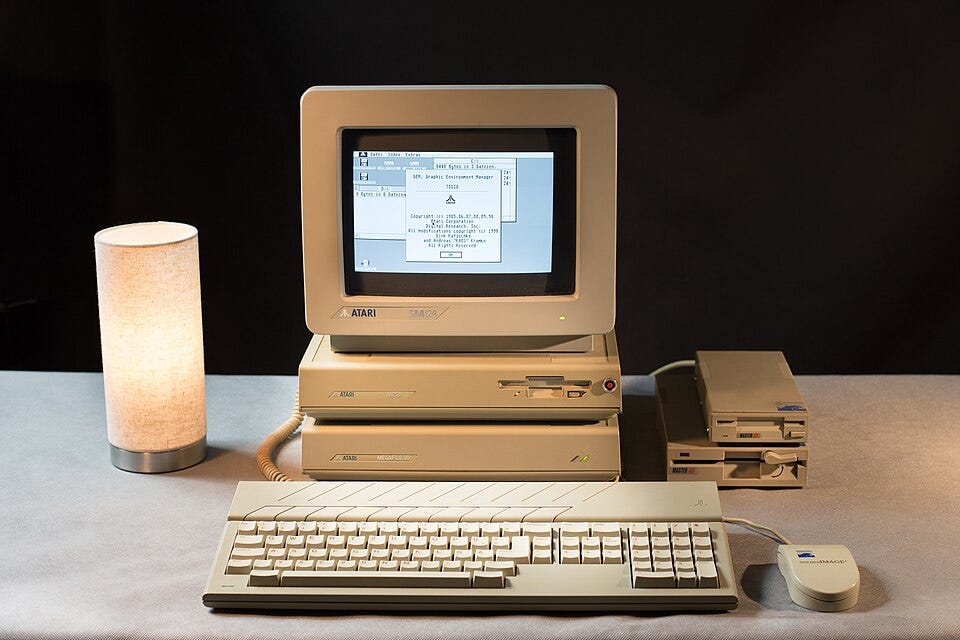
Atari Means Business with the Mega ST
The first "pro" ST
goto10retro.com
154 points · by rbanffy · 1y ago · 159 comments
Is this in any way related to the general "speed is going up but latency is getting worse" phenomenon of hardware in the last decades?
The Atari 2600 for instance was known for "racing the beam", updating the image while it was being drawn on the CRT monitor. A latency measured in pixels rather than frames! It was necessary because the console didn't have enough memory for a framebuffer.
The Atari ST is special for the inclusion built-in of MIDI ports, and it was made cheaply, which at the time meant direct connections and it resulted it low latency.
Oh wow! I remember hearing that oculus were doing this on their devices and thinking it was new.
Latency would be a Basic Feature. Once you cross 7 ms (or 5 ms, or even 3 ms if you absolutely insist) you're happy, above that everything is absolutely unusable.
The Atari has an absolute stable and extremely low jitter. Some guy measured it to 1µs. Cannot find the link though, sorry.
So the Atari has low latency around 2-4ms with an extremely low jitter. This is execatly what you want from a MIDI clock and sequencer driving multiple MIDI devices.
MIDI is a serial protocol.
At any given time only one message can be sent down the wire. [1]
So on the beat, an implementation can send either the clock pulse or note on or something else. [2]
If you send the clock everything else has to wait. If you send something else, the clock has to wait.
Now with modern computers, you are also dealing with USB which is a low priority parallel protocol and has to coordinate with everything else a modern kernel does.
Music is hard.
[1] premium hardware sequencers sometimes have two or more Midi Out to reduce contention.
[2] Midi Time Code solves this by encoding monotonic time into Midi and is how serious sync is done over Midi, e.g. in Hollywoood
I’ve got a full studio at home, but tbh i never know what people mean by this
You are concerned about a 9600 baud protocol.
There is zero 'shame' on the 'present future' when it comes to music production tools. It is like one of the hugest bright spots/biggest equalizers. Best thing I did was go ITB. No headaches. No hardware maintenance on obscure hardware. No MIDI limitations or even considering of my MIDI chains. Just music making.
As an aside, all-digital workflows take the joy out of music being made in the moment, by ear and by feel. There is no replacement, for example, for a professional sound engineer adjusting a mix strictly by the sound in their headphones and the feel of the sliders under their fingers.
No they cannot.
If the all-in-one design was used from the off (save on moulds and shipping disc drives) they could done a pro conversion kit:
https://youtu.be/atw3FYKzog4 Also, move the joystick ports to the right rather than under the keyboard.
A few tweaks here and there would have pushed it a lot more:
Unified clocks for genlock and scrolling: https://youtu.be/yexNdSLEpIY?si=pa46sJOr_9Fin4LC
Stereo output like the CPC464: https://m.youtube.com/watch?v=0yY4BlPfLf4
AMY included, along with a 1bit PWM on the DMA chip for DMA sound.
The ST had a janky RTC anyway: https://atariage.com/forums/topic/303859-battery-pack-inside...
3 button joypads from the start, using U+D and L+R combinations for 2 more buttons
Double-sided drive from the start.
Finally, they should have included the blitter socket and a full 2x32pin expansion instead of the cartridge port. The blitter socket especially would be handy to drive a T212 transputer in 87, when the blitter was available, instead of producing the ATW.
I quite liked the STe. The mono monitor was great, RAM upgrades were easy, and they'd improved some of the display hardware's worst limitations. Even though TOS was never especially good, they'd fixed all the worst bits by that point.
Still could have benefited from some other extra hardware and OS tweaks though I think.
- 800 KB disk format supported directly by the OS
- blitter is not as useful as it could be, due to sharing bus time with the CPU. It should be able to use ACSI bandwidth if not in use/Shifter bandwidth during non-display periods, so it can run in parallel with the CPU
- 256 px 5 bitplane mode (so still 40 words per line), probably an EHB kind of affair if 32 palette entries would be too much
- something to improve endless scrolling? No carry out of bit 15 when computing Shifter address? You'd end up wrapping before the display period was finished if increasing the display stride, but you can work around that in software...
- put the 9 pin joystick ports on the side
- write signal for that stupid cartridge port that is almost (but not quite) useful for general purpose expansion
I saw Atari ST in music studios well into the late 90s/early 2000s because back then quiet beige PCs weren't a thing yet: PCs virtually all came with super noisy fans, which was a big no-no for music studios.
A buddy would bring his Korg synth to my neighbour's house and hook it to their Atari ST. Another dude I remember would play drums from Dire Straits song from his Atari ST hooked to some MIDI gear and then he'd take his guitar and play Dire Straits songs.
These were the days.
I'm not surprised some musicians still use them. If I'm not mistaken Kavinsky (who became famous after the movie Drive came out but recently had renewed interest for he performed at the Olympics games' ceremony) started doing music at a late age, on an Atari ST a friend of his game him.
As an anecdote PCs were so noisy that I asked my neighbour (an electrical engineer) if it was possible to come up with a system where the fan would slow down when the CPU wasn't too hot: and sure enough we were then modding our PSUs with "thermistors" and we'd be calibrating our tiny hack, no shit, with boiling water in the kitchen (ah clueless teenagers). Funnily enough about 10 years later every single PSU had variable fan speed.
That's the thing: we were used to quiet 8-bit and then 16-bit computers and when we had to move to these piece-of-shit PCs (but with fast CPUs / FPUs and that were upgradeable), we had to endure these painful ultra noisy CPU/PSU fans (and HDDs).
So the Atari ST just made sense. You could have these super fast (compared to Atari ST) PCs but they were noisy, fugly, piece of unbearable shits that the cool guys in music studios simply wouldn't tolerate back then.
Now of course at some point PCs became just too good and several brands started focusing on quietness and it was then possible to have a totally silent PC, both looking cool and being literally cool (big heatsink, quiet fans, etc.).
But yeah the Atari ST was and still is certainly for some a thing for creating music.
Lots of respect to the Atari ST for his MIDI port (and that comes from a Commodore Amiga owner and fan).
I never really understood why people thought this was a big deal. I had my Amiga hooked to a DX7 synth with a serial to MIDI cable that had a couple active parts in it. MIDI is a serial protocol and the Amigas had full RS232 ports with hardware interrupts, +12v, -12v, as well as audio in and out on unused pins. The serial to MIDI In/Out cable cost around $15 more than two MIDI cables. You can still buy them today: https://retroready.one/products/ka12-serial-port-midi-interf....
DOS was crap, when you had tGEM and Amiga OS.
Windows 1 and 2 was beyond terrible.
They were shit for games
They were bulky
They were slow
They crashed all the time.
They were ugly
They were noisy.
They were hard to manage (autoexec.bat, no OS in ROM, stupidly tricky partitioning tools, incompatible drivers for the same hardware but in different applications, etc)
But IBM lost control of the hardware market so they became cheap, ubiquitous crap.
And that’s literally the only reason we got stuck with PCs.
Beating the Amiga to market, and beating it on price were super important.
But I do think there was a serious problem with follow through. The Blitter and GDOS and then the STe came too long to come after. The Blitter never became standard, and the games and software suffered for it. And updates on the operating system were slow and thin until it was way too late.
I do agree that the cartridge port thing -- it being limited to 128kB expansion -- was needless. One more pin, even, would at least allow for a proper OS upgrade via cartridge port! Definitely one of the stupidest design decisions on the machine.
Realistically it's amazing the ST was as good as it was, given the 6 month development time and the kings of penny pinching at the helm :)
I think they’d be better on the back unless you are supposed to plug them out all the time.
> Finally, they should have included the blitter socket
That would be hard without having a functioning one first. The blitter would be also handy for a number of things, from PCM sound to network and disk transfers.
I agree it would be difficult to design a correct socket, but from interviews it was always the plan to have a blitter, and a socket as standard would have helped adoption.
The main thing is that the T212 is a great coprocessor, faster than the 68881 fpu and with a 2k cache. Introducing the transputer as a coprocessor would potentially have changed the computing landscape
I was astonished to find about 22 distinct C compilers, including their own libraries, assemblers, linkers etc. for the Atari ST and its successors. That's not counting separate versions, just distinct products from different vendors.
From what I can see now looking at archive sites, there was a huge amount of activity in developer tools on the ST back in the day. Much more than I thought at the time. It might have been a serious contender for the dominant architecture (along with the m68k CPU), if IBM PC-compatibles and x86 hadn't won.
Recently I looked for Atari ST C compilers, out of curiosity to test portability of a C program I'm working on.
I've been testing C code for diverse Unix systems.
As I used to own an Atari 520ST (with 1MB RAM beautifully piggy-backed and hand-soldered on the existing RAM chips :-), it seemed like a good idea to peek at C on an ST emulator. I didn't use C when I had a real Atari ST (no C books in my local library), so I expected to find one or two C compilers, not 22!
If I recall, Lattice C was popular. Mark Williams was another one. "Alcyon C" was included I think in the ST development kit, but was considered poor.
I think people use "Pure C" these days, but of course also GCC is likely best:
http://vincent.riviere.free.fr/soft/m68k-atari-mintelf/
Is maintained by Vincent Rivière, who is a major contributor on EmuTOS.
Try and get a compiler and linker to fit in 360k these days!
When I see generations that grew up with game consoles, and talk about the current uptake on desktop games, they really have no idea what they missed out in home computing and the first wave of indie game development, from bedroom coders .
Tangent: the older I get, the more it annoys me that this expression kind of implies a failure of young people to study history, when I feel like it's more the responsibility of previous generations to preserve and pass down history for them to learn from. Especially because it's usually people in power in some form who are trying to keep the newer generations naive here so they can be fooled again.
Not saying that this interpretation was your intent (in fact I suspect it's the opposite), just directly expressing my annoyance at the expression itself.
But everything has been preserved and passed down. The entire home computing phenomenon has been archived and is available on the internet thanks to the rampant 'software piracy' which was common at the time, and detailed schematics and manuals coming with the computers (which have all been digitized and are available on the internet). Even my obscure KC85 games I wrote as a teenager and 'distributed' on cassette tapes by snail mail are available as download because some kind person(s) digitized all that stuff during the early 90s and put it on some 'underground' game download portals.
The 80s and early 90s home computer era will be better preserved than anything that came after it.
Indeed. Sadly, many more recent games will probably be lost to time forever due to DRM, online service components going offline or never being distributed on physical media in the first place. As someone into vintage computers and preservation, I worry that future generations may look back and see the late 2010s and certainly the 2020s as a 'dark age' when surveying the history and evolution of digital gaming. All we'll have are YouTube videos (assuming those survive future business model tectonic shifts) but no ability to actually experience the game play first-hand.
Recently I've been exploring the back catalog of more obscure PS3 and X360 games via emulation and have found some absolutely terrific titles I never even knew existed. Some of them were only ever sold through the console's online store and never available on physical media. With the XBox 360 and Nintendo Wii stores now long offline, only the PS3 store remains available - and who knows for how much longer, since Sony already announced its closure once and then changed their mind. There's now a race to preserve many of these titles
The good news is that not only was almost all of it preserved, teenagers today are really interested in retro gaming. My 15 year-old daughter, who's not into computers more than any other 15 year-old girl, just asked if she could go with me to the vintage computer festival this Summer. She tells me her friends at school are all interested in running emulators to play classic games from arcade to SNES to PS2 and N64.
I guess the 'dark lining' to that silver cloud is that this interest from teens in retro gaming is partly thanks to the increasing downsides of modern gaming (cost, DLC, ads, hour-long download/installs, etc). While game graphics continue to get more and more impressive, stuff like real-time path tracing doesn't seem to excite teens as much as does me. Ultimately, it's about game play more than visuals. Lately I've been exploring the immense back catalog of N64, PS2, PS3 and x360 games via emulation and there are some incredible gems I never even heard about back in the day. It's especially great now thanks to the huge variety of mods, enhancements, texture packs, decompilations/recompilations and fan translations. And current emulators can upscale and anti-alias those games even on a potato desktop or laptop with a low-end discrete GPU.
However curiosity also plays a big role.
If I know so much about computing history since the 1950's, is because I do my research, and take advantage of all archives that have been placed online, certainly I wasn't around to live all of it.
Things I remember about about the 520ST:
- Those horrible diagonal function keys. There was no reason for them to be diagonal, rather than normal keys as they were on the IBM. But I've always hated function keys.
- Games like Dungeon Master (really still quite a good game today).
- Not a bad C compiler, but I can't remember who by - LightSomething?
- The GEM GUI was not so bad, but using it with a floppy disk was.
But all-in-all I was quite happy to get my PC-compatible to do serious work with.
I don't know if they were consistent with the other keys in terms of feel, but they were a striking, unique design feature that instantly identified the machine as being Atari without compromising practicality.
I guess the idea was to have a clean design with cables out of the way, but it really was a bad place for them.
It's funny how some young producers today wonder "how did people do it without a computer before the 2000?"...well guess what, we did used computers! I cannot however remember what software sequencer I was using, I know it had MIDI effects (like MIDI echo), that's all I remember.
And by 1998, Logic was fairly advanced anyway and even had plenty of plugins.
Possibly/ probably Cubase. Anyone remember the Mike Hunt version? I'm still using cubase on a nice pc, but I miss the stability of the atari.
The Mega STe had a funkier case, VMEbus, and upgraded specs, but mushy rubber dome keyboard, more brittle plastics.
I like to collect the Mega as the best of the bunch, personally.
This says that the keyboard on the Mega ST was better. And yet still not good enough. Egads, that ST mess was a terrible keyboard.
I have an adapter on mine that converts it to USB and I can use it on a modern computer.
Though I never do. Mainly because it's got Ctrl/Alt[Meta] but nothing I could map to Hyper/Super.
Mega STe and TT reverted to terrible mushy rubberdome.
Still liked the Speccy better…
I liked how the keyboard was detachable and the hard drive was the same size at the motherboard case, so you could stack them.
[0] https://upload.wikimedia.org/wikipedia/commons/5/54/Atari_10...
There wasn’t such a thing as a general developer market.
When you didn’t have internet and cloud services and free Unix, how could you develop for something else than a specific platform and device?
If you bought a Mega ST to write programs, your target audience were still only the people who had a regular ST. You couldn’t reach anyone else. So the advantage was minimal.
The idea that there can be a developer market separate from the baseline end-user platform is quite new. It emerged around 2007-2010 when web apps became a realistic option and you didn’t have to be on Windows to target the 90% of people who are on Windows.
Honestly, I don't think even Apple could touch the best of Atari and Commodore industrial design in the back half of the 1980s. To be blunt, the early Macintoshs simply weren't practical in their design: for starters, a tiny monitor - that was originally black and white (which in 1984 was already kind of a joke) - and very limited upgradeability, relatively poor multimedia capabilities (speech synthesis was no more than a gimmick that was also available on other platforms), and then the whole aesthetic just wasn't that pleasant.
And I say this as someone who, personally, has only owned Apple machines for the past 15ish years, so I'm not exactly coming at this from a "not a fanboi" perspective. I'd still take 1980s Atari or Commodore aesthetic over modern Apple, or modern anything else for that matter[0].
Also, as an aside, I really enjoyed seeing "Atari Means Business with the Mega ST" as the top headline on Hacker News in 2025. Even on a Sunday when content typically tends to be more varied and interesting this was still an entertaining surprise.
[0] I suspect the reality may be that I'm an "anything but Wintel" kind of person, although not at any cost, because I did run PCs exclusively for 11 or 12 years. They never really helped me enjoy computing in the way the other machines have though.
For example: I cannot think of any desktop models that lacked internal expansion. They may have used a riser card to stack in two or three slots sideways, but the slots were there. The design may have been crude, but at least your desktop wasn't turned into a disaster every time the technological landscape shifted: when hard drives became affordable, the world switched to 3.5" floppies, if you decided to use online services or send faxes directly from your computer, get a CD-ROM, or cable Internet.
And with emulated VME graphics, with an HDMI output and a USB-C port. And 3-button mouse. Able to run Atari Unix.