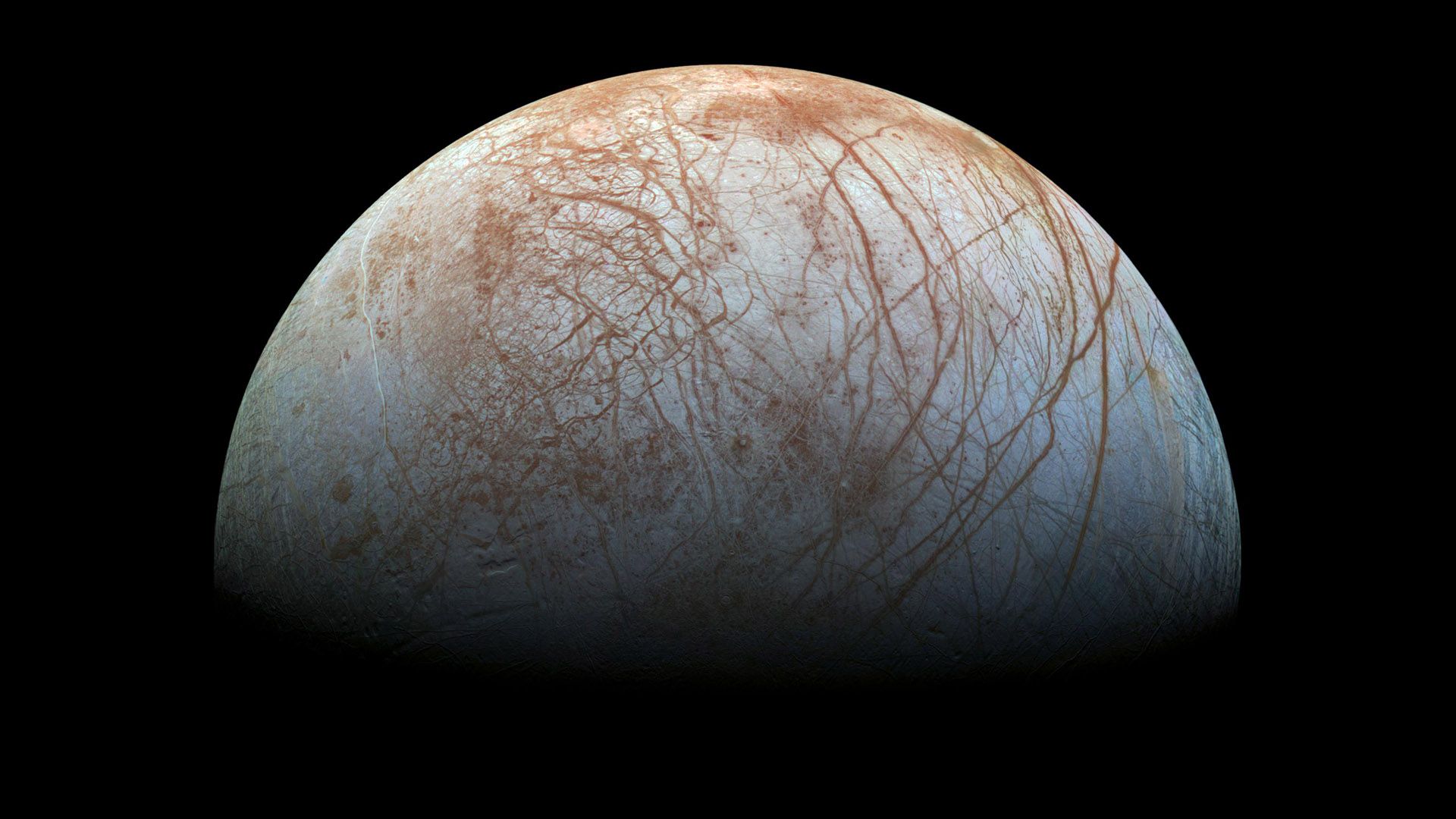
When the sun dies, could life survive on the Jupiter ocean moon Europa?
New research suggests there may be a narrow window of possibility for life to persist on the icy moons of the outer solar system.
Space
80 points · by amichail · 1y ago · 133 comments
A possible problem is that Jupiter itself could destabilize Earth's new orbit. Possibly putting Earth into orbit around Jupiter as an additional moon would be a solution, but if not, I think we could solve that problem by removing Jupiter. If we drop it into the Sun, we can gain all of its orbital energy in the process.
https://longnow.org/ideas/long-now-years-five-digit-dates-an...
Zager & Evans - In the Year 2525
https://www.youtube.com/watch?v=zKQfxi8V5FA
  Now it's been ten thousand years, man has cried a billion tears
  For what, he never knew, now man's reign is through
  But through eternal night, the twinkling of starlight
  So very far away, maybe it's only yesterday
Long before and after that religion became dominant, many people have used different calendar systems - and many still do. Rome was founded in 753 BCE, and the Western Roman Empire fell around 476 CE. That's over 1200 years.
It's more likely that another "year zero" event will happen in less than 8000 years. If the history survives that, we will probably just call the current era "Gregorian" or so.
But now we have a single global standard, I think there is a huge amount of inertia against changing it - it is baked into untold millions of computer systems and business processes now.
I think the most likely way it might change would be (a) if humanity collapsed back to a premodern civilisation, and later recovered; or (b) some new culture/religion became globally dominant which demanded the calendar be changed.
Personally, I’m sceptical (a) is going to happen in the next few thousand years. I think the most likely scenarios are (i) technological modernity survives, (ii) humanity goes extinct completely, (iii) a more moderate collapse in which things get very messy but don’t go all the way back to the premodern era. I think all three are more likely than the kind of complete and extended collapse then eventual recovery which would be most likely to reboot the calendar into a new and different global standard.
I don’t think odds of (b) are high-it would require not just a new dominant culture, but also one which felt very strongly about wiping out all traces of the old calendar. Suppose 1000 years from now, 99% of humans are devout Muslims-I personally think that’s rather unlikely to happen, but anything is possible-would that trigger the current year numbering to be replaced by the Islamic one? I’m sceptical-all Muslim majority countries currently heavily use the Gregorian calendar for business use, computer systems, etc, and they don’t have a theological issue with that, so I’m sceptical they’d feel the need to change even if Islam became the globally dominant culture. And this isn’t a new thing in history-many historical Islamic empires continued the use of pre-Islamic calendars in parallel with the Islamic, especially since the Islamic calendar, being purely lunar, was less than ideal for agricultural use.
However, smaller O'Neill-cylinder space stations are feasible even with just steel cables, and I look forward to a future where the vast majority of inhabited land area is in such contraptions. It will take at least 30 years, probably more like 300. The danger is that we collectively take a more destructive course.
I don't think there is a clear trend toward this goal at all.
Extrapolating current trends, we are fairly likely to peak in total population as a species long we become space-constrained on earth; more remote living space is pretty cheap in basically every industrialized country right now, and living in a conventional house in the boonies is like ten orders of magnitude easier than making anything extraterrestrial work (neither climate change nor even global nuclear war is enough to flip that).
Sure, people might like the concept of space colonization, but we're not seeing significant amounts of people living on boats in the Atlantic, so I would not expect to see people living on spaceships within the next centuries, either...
How did you come up with dropping Jupiter into the sun being a net energy producing operation? You have to cancel out around 10^35 J of kinetic energy to drop it from its orbit, and that is real work. How do you get that 10^35 J back? (Ignoring that from your own math, that E35J is around 100,000 years of the sun's total energy output).
Maybe you scoop up big balloons of gas, slingshot them to Mercury with a tether, catch them with another tether on the dark side of Mercury to decelerate them (thus generating electricity which you use to make some kind of fuel), and toss them Sunwards from there.
Or maybe you use an electromagnetic mass driver in the Asteroid Belt to launch an unbelievable number of small rocky masses to a gravitational slingshot around Jupiter back to the same mass driver again, but at a higher velocity, so they generate electric power when it catches them before launching them again. Each mass goes through this circuit tens of thousands of times.
There are lots of possibilities.
Only the part that illuminates the earth can do us any good.
Well, that's clearly the part that is the lowest-effort to access, but on the timeline involved for concern about the Earth's biosphere being incinerated by changes to the Sun's size and output, there is plenty of time to develop means of leveraging more than the easy part.
The article isn’t trying to make science-fiction predictions, it’s simply explaining how things are expected to go according to the workings of the Universe. The article also isn’t suggesting humans will go to Europa to survive, only that life could theoretically develop and persist there.
We can’t even let our fellow humans live. Hatred and division is growing, and we’re ever more worshipping and giving power to destructive, selfish, science-denying, power-hungry maniacs with access to world-destroying technology. And you think there’s any chance we’ll all agree and unite to move the whole planet? It would be nonsensical for the article to even hint at entertainment that scenario in any serious capacity, and it would have been rightly dismissed by most people if it did.
Undoubtedly, if there are still humans after a few hundred million years, they will disagree about exactly what orbit Earth should be in, but that doesn't mean it will stay in the same orbit until after its oceans boil dry.
Which is not my argument. At all. You’re talking about if we can, I’m talking about if we will. The article—again, rightly—explains what we predict is going to happen according to the information we have. It’s trying to be a scientific-minded article, not a science-fiction article. By your token, anyone could make up any technology to contradict the article, which is not a productive discussion.
> the kind of global agreement you're dismissing as unachievable.
I disagree it’s the same kind of agreement. The difference in magnitude and investment is gargantuan to the point it’s another category altogether. Like a group deciding where they’ll go out to dinner VS deciding which country they’ll all move to. Both require mutual agreement for the same group to advance, but that’s where the similarities end.
> Undoubtedly, if there are still humans after a few hundred million years
Which is a big if. You can’t in good faith flout “just move Earth further from the Sun” as if it was something routine without considering all the very real and very big obstacles which are in our way right now, billions of years before your proposed scenario.
The crux of my point is merely that your criticism of the article is unwarranted. Sure, phantasise about any any possible approaches to the problem you can think of, but acting like the article somehow failed to consider those options is what I’m disagreeing with.
It would be a shame to abandon her entirely, but don’t count on nostalgia to last for billions of years. We will have empires of people who never lived in Sol who think Good Riddance.
"We" is doing a lot over work over, what, five billion years? That's longer than the history of existing life. Literally unimaginable.
A handy reference for this topic
The idea of keeping bureaucracy alive much longer than our planet is human optimism at its best. Death and taxes, come Hell, high water, and the literal evaporation of Earth's oceans due to surface temperatures exceeding 1130 C.
250 million, owing to the expansion of the sun and formation of a supercontinent.
Not that I don't find that article interesting, of course. And I wouldn't underestimate our ability to (continue) to terraform the earth, intentionally sure, but much more certainly unintentionally.
Eg https://www.sciencedirect.com/science/article/abs/pii/S00319...
It'll be a while, though. There will certainly still be a long period of time where Earth is the most powerful by sheer inertia, no matter how fast space civilization develops.
I expect Earth will be viewed as we view Athens now. There's a lot of important history which happened there, and schoolchildren spend a lot of time studying it, but the center of the action has moved elsewhere.
Instead of "How often do men think about ancient Rome?", people will ask: "How often do men think about ancient Earth?"
Maybe that's because we don't have cultural traditions that identifiably connect us to that. (We probably do, but they're so deeply ingrained that we can't even identify them as "culture").
People of Italian extraction have a certain affinity for Italians, German-descendants for Germans, etc- Unless we just totally forget about Earth-That-Was I think it's reasonable to think we'd find it interesting in 1000 years.
People who speak Indo-European languages such as English, Hindi, and Portuguese descend from migrants from the Caspian steppe. Do they have strong Caspian steppe affinities? And that's only been about 4000 years.
https://en.wikipedia.org/wiki/Star_lifting#Stellar_husbandry
I mean we still put forever chemicals in our food containers. There’s a segment of the population that aggressively opposes efforts to save humanity from global warming (the earth abides but humanity is quite fragile). We’ve had at least six known near misses in nuclear annihilation. We’ve been utterly unable to stamp out obvious misinformation, lies and utter bullshit in public discourse (so we can’t even talk about the real problems with anything approaching consensus on facts)
The good news is we really don’t have to worry about the timeframes where the death of our star would cause problems.
I probably won't be around in 100 years, but I'd place the odds of human extinction in that time frame at approximately 0. 1 billion is right out though. If there are descendants, they almost certainly won't be homo sapiens.
This is not well-reasoned.
Climate change, even in its most hysterical worst case scenarios, could make large areas of the planet uninhabitable, and cause massive migrations, wars, and famines. But it won't kill everyone.
Forever chemicals, even if you believe they're responsible for reduced fertility, haven't sterilized humans. We're not in the Handmaid's Tale yet, and if we were, it's pretty clear there would be resulting cultural shifts to address fertility.
Nuclear annihilation is not possible with current arsenal levels. You would need millions of high yield detonations to accumulate lethal levels of radiation planet wide. Nobody has that many nukes. There's enough to make large areas uninhabitable, but it won't kill everyone. Nuclear winter could cause famines, but isolated groups can use existing technology for indoor farming.
There are some things that could kill us off entirely (asteroid), but none of the things you mentioned are going to do it.
How old are you?
0.1%? Probably. And that's probably the highest that number has been in millennia.
You did mention "the end of humanity in my lifetime" after all.
... Yes? Do you really, seriously think that eight billion people can so easily disappear within a couple of generations and there won't be anyone left for the population to start growing again?
A bazillion dollars to explore new worlds, to find this mold that won't come off.
Maybe it will talk to us.
You're writing as if watery moons around gas giants aren't something we look for.
The answer is yes, of course. Everyone on Europa is going to be fine.
Humanity is a virus
Does anybody know what is the timescale we are talking about here? From start of inflation of Sun's outer atmosphere to engulfing of earth?
If the red giant phase of the Sun (before its collapse) were to be just not quite hot enough to do more than scorch the surface of the earth and maybe heat the crust down only partially, microbial life would survive in deep fissures. Studies (link below) have shown that a whole ecosystem of life exists in wet cracks down to a depth of up to maybe 10 kilometers. Assuming the red giant phase of the sun only manages to cook the earth's surface, it's possible that the heat radiates down into the crust by a few hundred meters, or maybe a kilometer.
After all, though rock as a dense object in your hand isn't a good thermal insulator, the porous, cracked substrate of our crust is indeed wonderful at insulating (second link). If it weren't we'd have long since cooked from the enormous heat beneath us. The same process works in the opposite direction.
Thus IF, if the sun expands just enough to only scorch our world, once the sun collapses again and our planet enters its deep freeze, the microbes that survived far beneath its surface could live their strange existence indefinitely, close to magmatic heat sources in the delicately balanced equilibrium zones between these and the frozen world above.
Yes, the core of the earth will also eventually cool too, but the combination of residual heat from formation, compressive friction heat and radioactive decay is enough to keep that from happening for at least tens of billions of years.
It's a fascinating scenario to consider: the extreme limits of how tenacious life could stay alive on our world long after everything we consider sustaining is dead and gone.
https://en.wikipedia.org/wiki/Deep_biosphere
https://manoa.hawaii.edu/exploringourfluidearth/physical/oce...
Is the heat produced inside a planet, mostly from the radioactive decay of natural isotopes.
Volcanoes are not powered by the Sun. Of course this production will cease when all isotopes will be depleted, but that will take a very long time.