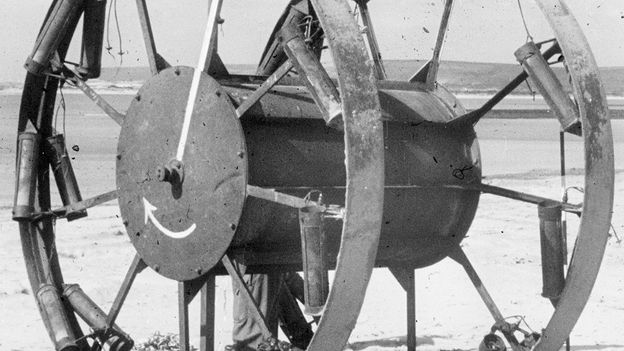
Panjandrum: The 'giant firework' built to break Hitler's Atlantic Wall
To make D-Day a success, the Allies thought they might have to break through formidable German defences. One unconventional idea was a "giant firework".
bbc.com
139 points · by rmason · 1y ago · 168 comments
I think the notion of odd, but brilliant, boffin is deeply embedded in British culture. Or was, until at least the 2000s. The Great Egg Race on TV being a fine example.
On the other hand i knew an old scientist who had quite a few interesting and amusing stories to share about his efforts in WW2. One of them was about his attempts to perfect a formala. Several factories exploded before they succeeded.
Indeed: https://en.wikipedia.org/wiki/British_declaration_of_war_on_.... Both Britain and France declared war on Germany because they made guarantees to Poland about it.
> ... in the event of any action which clearly threatened Polish independence, and which the Polish Government accordingly considered it vital to resist with their national forces, His Majesty's Government would feel themselves bound at once to lend the Polish Government all support in their power.
That is unambiguous and clear. They kept their word.
It is tragic in the end that after the war they handed Poland over to Stalin. Poland still had its independence threatened but after having supplied and helped Stalin all that time, it was awkward having to declare war against him as well.
WWII in Eastern Europe was a war for the survival of the Slavic peoples whom the Nazis declared to be the Untermensch[0] (Belorussians, Czechs, Poles, Russians, Serbs, Ukrainians – all of them) and were determined to fully exterminate them all following the extermination of the Jews and the Roma people.
The scale of extermination of the Slavs went far beyond the mass murdering of them in concentration camps, and included rounding up villages and burning them along with the villagers down with the use of flamethrowers, with no remorse because the Nazis considered the Slavs sub-humans[1][2][3][4].
Neither Czechoslovakia, nor Poland, nor the Kingdom of Yugoslavia had communism of any shape or flavour.
[0] https://en.wikipedia.org/wiki/Untermensch
[1] https://en.wikipedia.org/wiki/Khatyn_massacre
[2] https://en.wikipedia.org/wiki/Lidice_massacre
[3] https://en.wikipedia.org/wiki/Michni%C3%B3w_massacre
[4] https://en.wikipedia.org/wiki/Memorial_Centre_Lipa_Remembers...
The extent of the German and Japanese atrocities only became clear after the war and they were so great that even the Soviet Union were on the side of the angels.
I wouldn't say they were perfectly content. It was more that they were cowardly and apathetic.
https://en.wikipedia.org/wiki/Flame_fougasse
They speak to the particular combination of desperation, urgency, and ingenuity found in the UK at that time.
Yes the US fought in WWII with a lot of human investment, the amount of direct threats to American soil was much smaller than the UK and the memories of the war are those of the fights in the jungles and not of American children fleeing bombs in major cities
The more interesting question is always why America suddenly forgot all its usual rhetoric of freedom, democracy, and liberating random countries (sometimes against their will) in this particular case, and whether it has anything to do with propaganda and bribery operations.
You do not get a blank check to engage in nation building boondoggles until a "good one" comes along.
But his actions with Ukraine were unimpeachable. As a populist leader throwing immediate public support (I think he was the first foreign leader to go to Kyiv, certainly one of the first) it kneecapped the Useful Idiots like Farage.
People have this thinking nations have these widely shared opinions when they don't, the politics and visible leaders are the ones shaping public opinion.
An invasion of the Netherlands was never likely considering it is a swamp in which tanks cannot operate with rivers and canals every few kilometers. Ironically the very last place in Europe that was liberated because the Allies bypassed it in their drive to the Ruhr.
Fancy having a statue of yourself and never bother going to see it!
I was at a picnic recently that happened to be on VE day, it really struck me that now London is only about 35% or so English as the ww2 generation would've known it, almost no one has a particularly good reason to bother paying attention. I'm sure I was the only person there who knows who Barnes Wallis was.
And yes I miss the boffins. They do still sort of exist but that type of mind has been strangled by the last few decades drive towards left-brained processes where everything basically has to be nailed down before the work actually starts.
That latter point is one reason why we're struggling so much - we owe a great debt to the generations who built all the infrastructure and housing. We didn't pay it off, we now can't really do anything at scale other than extract rent. The victorians were building a HS2 every few years.
It also generates a quarter of the UK's GDP, so there's that.
Or even just the bizarre notion of having best part of half of zone 1 be social in the first place.
https://www.youtube.com/watch?v=GJCF-Ufapu8&t=8883s
The whole series is worth a watch, including episodes on radio location finding, radar and radar jamming, Jet engines, the V1/V2 rockets, and Ultra/Enigma etc. Many of the participants (both British and German) are interviewed - including Albert Speer.
https://historictech.com/a-secret-ww2-american-hi-fi-tape-re...
Of course, Germany booted out loads of Jewish scientists. Many of whom ended up doing important work for the Allies - not least on the atom bomb.
A Town Like Alice is probably the most popular in Australia, where he resided after the war. Also made into a good movie.
[0] https://en.wikipedia.org/wiki/Round_and_Round_Went_the_Great...
Also by the way the Normandy beaches were NOT fortified with bunkers very much at all (unlike what you might have seen in Saving Private Ryan), just trenches and sandbags. A large portion of Omaha beach casualties were inflicted by a single machine gun nest: https://en.wikipedia.org/wiki/Heinrich_Severloh
I'm not sure if you mean there were not many bunkers or they weren't very good fortifications, but there are quite a few bunkers, for example: https://www.normandybunkers.com/bunker-sites
The flaws in the design seem reasonably obvious - any imbalance in the thrust of the multiple rockets on each wheel causing an unwanted steering effect. Also the high centre of gravity and narrow track width seem poorly chosen when stability would surely be desirable.
A mobile Catherine Wheel seems more designed to attract as much attention as possible...
from Greenberg's Troubling the Waters about Black-Jewish relations.