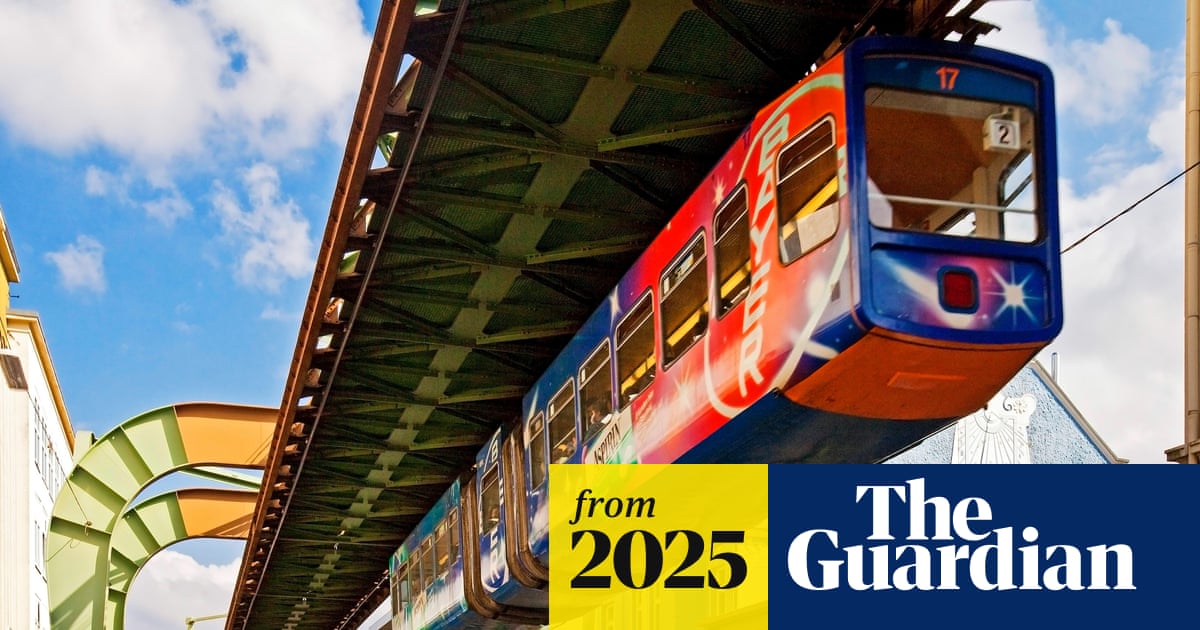
Riding high in Germany on the world’s oldest suspended railway
Still gliding above the town on an overhead track 125 years after it was built, the charming Schwebebahn in Wuppertal has lost none of its magic
the Guardian
195 points · by pseudolus · 1y ago · 108 comments
https://www.youtube.com/watch?v=7TqqdOcX4dc
As noted in the description, the 1902 video plays in real time, and the 2015 video has some cuts and framerate adjustments to keep them in sync.
Half of Wuppertal’s buildings were destroyed by the end of WW2. Some cities had the leeway to rebuild historical ornamented buildings, many others built as cheaply and quickly as possible because it was more important to create more shelter rather than prettier housing.
Edit: Though I very much agree on the ugliness of the excessive street furniture and car parking space!
Agree but who the fuck is gonna pay for it? Urban housing is already under massive price competition.
Maybe not entirely. Eye-tracking studies suggest that ornaments are what attracts people's attention.
A lot of old buildings are beautiful because the people making them beautiful were piss poor and paid accordingly.
Thing is, horse poop and straw is great for gardens, weed suppression, growing food and flowers.
Can't really say the same for tyre particles, fuel emissions, and while the bulk long term CO2 buildup beyond the established balance might make things "greener" it doesn't seem to advance nutritional returns of vegetation enough to offset the climate altering downsides.
Was a bit confused at this paragraph, as to why it would suddenly date the inception of the Schwebebahn in the 1930s when the same article began with the maiden voyage in 1901.
So to clarify this: The Schwebebahn really is older than the city of Wuppertal. The city only existed as a single municipality since 1929, so half the time the article talks about "Wuppertal", it really means Barmen and Elberfeld.
So if there was no municipality, who did plan, approve and fund the project? Both cities, in a joint planning commission.
https://en.m.wikipedia.org/wiki/Wuppertal_Schwebebahn#Histor...
Advantages:
keeps your electrical plant out of the weather
allows the track to be out of the road while allowing street level access to train. This one is a bit iffy as the dangle train will usually be put above street traffic.
Disadvantages:
look at how much steel it takes to make that box beam.
Every thing is in tension, leading to complicated structure to contain it, joints can be much simpler in compression.
Any how as a dangle-train connoisseur I leave you with two additional videos.
A dangle train in japan https://www.youtube.com/watch?v=ZGLrP5eawdY
The Tim Traveler (perhaps the best all around esoteric travel channel) https://www.youtube.com/watch?v=9Kwpj1UOrhs
Wikipedia has the (not very long) full list of every "dangle-train" ever built: https://en.wikipedia.org/wiki/Suspension_railway
For Wuppertal, where the town is pretty linear along a river valley, it works. (Even then, a straddle-beam monorail would probably be more cost-efficient if you were starting from scratch). For most places it doesn't.
even if you are only need a single isolated elevated line though monorail still loses just because there is no standard: when you need spare parts in 20 years it is questinable if you can get them.
It's rare to need much in the way of tunnels on an elevated line, by its very nature. And since the beam is narrower than the carriages, it doesn't actually increase the tunnel diameter (for a round cross section) that much.
> even if you are only need a single isolated elevated line though monorail still loses just because there is no standard: when you need spare parts in 20 years it is questinable if you can get them.
These days there are systems that have been built for decades by big name manufacturers, often the same manufacturers that make trains. Hitachi or Alstom-nee-Bombardier aren't going to disappear and leave their clients high and dry, if only because it would be bad for their broader rail businesses to do so.
I'm no fan of monorails - quite the opposite - but there are cases where they work.
For those travelling to Tokyo, go to Kamakura, take the famous Enoden to Enoshima, then take Shonan-Monorail to Ofuna and return to Tokyo.
https://youtube.com/@whatonearthisthisthing?si=OCSx2leuGaDSG...
The one that immediately comes to mind is the Tama monorail.
Yurikamome Is technically not a monorail, but it pretty close in terms of experience.
Tokyo Disney Resort Line is also an actual monorail.
I woke up early in the morning on a sleeper train to Düsseldorf. The train had stopped so I looked out the window: at A-frames straddling a river. My first thought was: "That's a weird-looking roller coaster".
An elephant once fell out of it and survived.
Most rails lines continue far enough to leave dense urban areas where this makes sense so they have to transition between elevated and ground level tracks which this can't do.
Expensive and impractical, but could be fun at a theme park.
A fictional example of this is the monorail on the Half-Life games, which transitions between straddle-beam and suspended.
I wish I'd jumped off and taken a ride... but I was on an Interrail ticket, and my seat cost me €50. If I'd given it up, I'd have had to buy another one...
I was very nearly thrown off. I tried to buy a reservation in the station; I was told it was full. I decided to take my chances.
It was well under 50% full, but the conductor tried to throw me off anyway. Only when I protested, a lot, did he concede that I although I would not want to I could buy a seat on the train, but it was €50. He was amazed I was willing to pay, but the alternative was paying less at the station and losing yet another hour -- maybe two.
Interrail is cheap, but the big international trains try to make it difficult for you to use it.
But I know, people on here like trains (lol), so I'll probably get down voted for stating my opinion.
And it's a better fate for the river than the concrete tubes many get stuck in.
https://www.hiddenhydrology.org/lost-creeks-of-the-bay-area-...
Bridges in old cities are very often much older than a century.
The ship lift in Niederfinow that connects the Oder-Havel Canal to the Oder river went into operation in 1936 - the canal that it serves dates back to 1743. https://de.m.wikipedia.org/wiki/Schiffshebewerk_Niederfinow
The Hoover hydroelectric dam is now 90 years old.
There's also the S1 line, large parts of which date back to 1874[0] or even 1838[1], depending on how you count: The train back in 1838 established most of the path today's S1 takes through southwestern Berlin. The S1 runs on a second pair of rails, constructed in 1874, that run in parallel to the 1838 line and diverge from it near the city border. The old 1838 line is set to be rebuilt by 2038.
[0]: https://en.m.wikipedia.org/wiki/Wannsee_Railway
[1]: https://en.m.wikipedia.org/wiki/Berlin%E2%80%93Magdeburg_rai...
https://en.wikipedia.org/wiki/Bombing_of_Wuppertal_in_World_...
(Obviously a bit of a railway of Theseus at this point, in that besides some of the bridges there's ~no part of it which is literally from 1832.)
This thing is kind of weird in that it's apparently basically been the same route since completion (most old railways ultimately become part of larger systems), but there are other examples; I'm fairly sure that the Glasgow Subway route is ~exactly what it was in 1896 today, say.
Ja, ja, all fun and games... until your danglies drop. :( [1]
1. [https://en.wikipedia.org/wiki/1999_Wuppertal_Schwebebahn_acc...]
Not to count the baby elephant that fell out of one car back in 1950.
Wuppertal is a wonderful ride for many thousands daily, millions for decades, and is a wonderful model of visual, sane, safe engineered public transport.
Heavens to Betsy! And the elephant lived... till 1989! :)
> Wuppertal is a wonderful ride for many thousands daily, millions for decades, and is a wonderful model of visual, sane, safe engineered public transport.
Is ja jut, ich kauf' den Tagespass.
Furthermore: https://de.wikipedia.org/wiki/Milchversorgung_Rheinland
cf.: https://duckduckgo.com/q=tuffi+milch&ia=images&iax=images
Muuuh...äh...Tröööt!
Seriously, who works on a railway until 6 in the morning? That’s like deploying on a Friday afternoon at 16:50…
A great many rail crews the world over .. night time being the best time for rolling maintainance and bed upgrades on largely daytime passenger lines.
The question that was asked during the investigation was more along the lines of "who does major work every night on rail lines and doesn't integrate end of shift safety checks (looking for still in place gear, unfinished work, etc)" ?