What is digital sovereignty – and how Microsoft sparked the trend. | Tuta
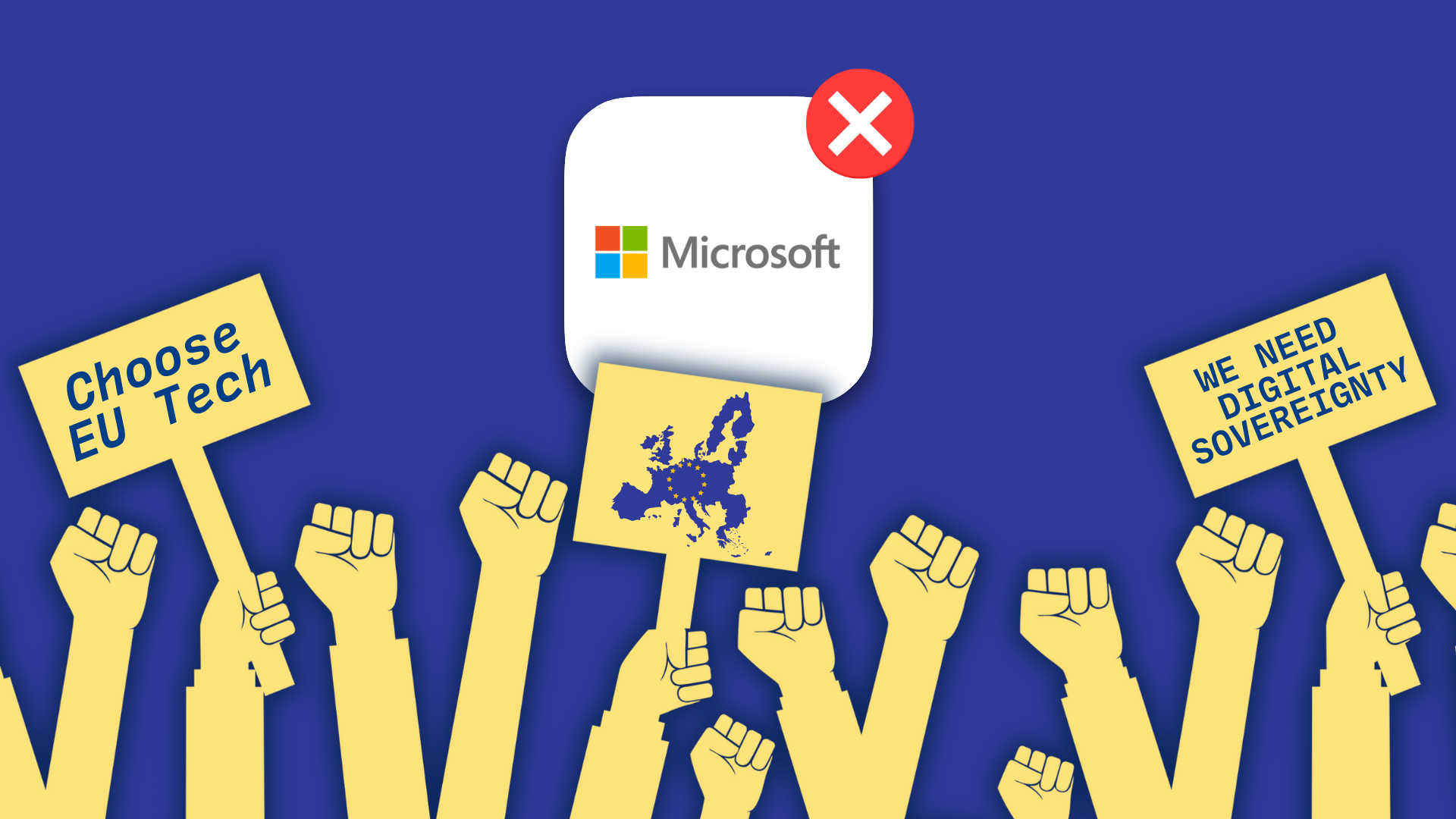
In the EU, digital sovereignty is trending. Businesses and authorities are starting to adopt sovereign solutions from Europe.
Tuta
261 points · by 01-_- · 1y ago · 224 comments
This is one of the reasons I think the mad king thinks that he can bully the rest of the world - because he can, by proxy, bully the rest of the world.
Much like the diving head first first into AI uptake, the whole cloud mania thing coming home to roost.
If calling a war criminal a war criminal results in sanctions, could sanctions be the new tariffs? I don't want to give him ideas...
This should scare pretty much any organisation outside of the US.
If there's no concentrated source of revenue, the people need to be involved and thus a more democratic path is likely.
With the internet and software, especially with platforms, you see this concentration of power effect. That then easily leads to certain kind of power dynamics. Ie just as a hypothetical example, if there's only a few closed conversation platforms, government can control them relatively easily.
I believe engineering in growing countries have completely different mindsets. They put the enterprise in enterprise and the results speak for themselves.
Of course you have to stay pragmatic here and not every battle is in the interest of a company. But engineers with the ability to pursue their craft, sensible knowledge management and training have become a rare sight. So R&D is just plainly better in other countries.
Problem is that this laziness of course empowers other players to grow to insane dimensions, like Microsoft did. Microsoft has many competent developers, but their success isn't due to software quality. Especially if you look at the latest cloud offerings. They are so large that they don't have to be good anymore.
He has even bigger levers to pull unfortunately. Sanctions are this giant hammer that can be dropped on anyone and the weight of the US ensures compliance. When the ICC chief prosecutor was sanctioned it wasn't just US companies who gave in, like Microsoft. His UK bank also blocked him. Sooner or later in the chain of dependencies there will be something based in the US or relying on something based in the US. Your MSP, the airline you travel with, anything will be used against you if sanctions are transmitted like a disease to anyone giving you assistance. No company or country wants to risk being buried to fight the US on this.
This is a 'funny' situation, and potentially telling as to who holds more power, given that the UK government has recently sanctioned two Israeli ministers: https://apnews.com/article/israel-palestinians-britain-settl...
Are UK Banks (maybe only this UK Bank) more beholden to the US than the UK?
Is / Would this UK Bank also block(ing) those two Israeli ministers?
and of the CIA, the NSA, the FBI, the SEC etc.
EU already does this:
https://berthub.eu/articles/posts/the-gigantic-unregulated-p...
https://berthub.eu/articles/posts/5g-elephant-in-the-room/
Bert Hubert is good at identifying problems like this, but his proposed approach is always to demand the EU pass new laws even when the problem is Europeans asking people in foreign jurisdictions to run everything for them because they can do it better, partly due to not being under EU control. The cause of the problem is presented as the solution.
The internet has a compressive effect on markets. Most markets can only sustain about 3-5 competitors before the number of choices becomes overwhelming and customers can no longer easily differentiate between them. If you offer your services over the internet, that means 3-5 competitors globally, and in turn that means hacking one of them can give you control over a huge chunk of the market. It also means it's easy to end up with all of those competitors being outside your jurisdiction if you aren't highly competitive.
The whole chips fab thing may be a bridge too far for now, but the basics really should be doable. The newly launched EU DNS is a good start. Rules like taxpayer money needs to only fund open software etc need to be pushed. The large hosting providers need to be incentivized to build out more complete offerings that don't have gaping product holes vs big cloud etc.
Both China and the US are aggressively pushing homegrown & favouring their own players. Time for the EU to do the same
> The whole chips fab thing may be a bridge too far for now
for this case, ASML, being Dutch, and crucial to essentially all cutting semiconductor production, gives Europe leverage.
That said, a bit like Biden & Trump banning the export of certain tech to China, it is a slippery slope. Past a certain point they're just forced to develop the tech themselves. Hopefully Europe won't be as short-sighted or wilfully-ignorant, and will capitalise on their advantage here- as you are very correct to point out the ultimate vulnerability.
Also, the machines are just one part of the equation. You need chip designs, you need actual foundries where these machines need to be installed and so on.
It doesn't.
Firstly, ASML's core EUV light source tech is licensed from the US who threatened to pull the plug if ASML sold EUV steppers to China. That's what actual leverage looks like.
Secondly, you also need cutting edge semi fabs, which EU lacks. If it were that easy ASML would open some fabs in its own back yard with its cutting edge machines and keep the highest profits for themselves instead of letting TSMC, Samsung and Intel have them, but it's not easy. EU semi fabs are behind Taiwan, the US, China and Japan in node sizes despite having ASML domestically which is a huge blow for domestic industry and leverage. That's like making the best hammers but having no idea how to use them effectively.
Thirdly, once you have the lithography machines and the fabs, you also need top IP to make cutting edge high margin chips with them, which the EU lacks. The highest grossing chips are all US IP: Nvidia, Apple, Qualcomm, AMD, Intel, Amazon, Ampere, while European chip companies are way down below the pecking order in profitability: Infineon, NXP, ST, making low margin chips the likes of Nvidia and AMD can't be bothered.
Fourthly(is that correct in English?), once you have your litho, fabs and high end chips, you can now put all those powerful chips into datacenters to create powerful cloud hyperscalers, which the EU lacks. EU has nothing close to AWS, GPC, Azure, Tencent, Alibaba.
This is what tech dominance looks like. And EU is third place behind the US and China.
That's not any leverage at all. The EU would instantly write a law invalidating those licenses on their territory. Paperwork like that is meaningless in geopolitical conflicts.
...but they're an outlier in a specific part of the chain, not an ecosystem.
The bridge is right there, the EU just needs to cross it.
> [Would we allow a situation where] a foreign power could force them anytime to cut Europe’s power?
We did just that with Russian gas imports. It took a massive effort to transition of these imports after Russia closed the tap.
We may have to mine coal, oil, and natural gas in specific places, but everywhere has access to the sun and wind.
Even before the war, the German subsidiary of Gazprom had already started deliberately lowering the amount of gas stored underground in Germany, at a time when it was usually being filled up for the next winter.
Examples, there are many articles from around that time: https://www.dw.com/en/eu-gas-russia-nord-stream-crisis/a-666... (it shows the timeline, the explosions were inconsequential, gas had already long stopped flowing)
September 2022: "Russia cuts off gas exports to Europe via Nord Stream indefinitely"-- https://edition.cnn.com/2022/09/02/energy/nord-stream-1-pipe...
August 2022: "Nord Stream 1: Russia switches off gas pipeline citing maintenance" -- https://www.theguardian.com/business/2022/aug/31/nord-stream...
It is amazing how objective reality and basic common sense go out the window when it comes to the Ukraine/Russia situation.
https://www.reuters.com/business/energy/gas-still-flows-russ...
Ironically, I have set up thunderbird as a client for my exchange email just for archival, and it does much better finding them.
Why does "digital sovereignty" have to rely on stuff like "FOSS email client"
Honestly, as much of FOSS has its importance, focusing exclusively on open source solutions is probably part of why things don't go ahead
Honestly Thunderbird was good 20 years ago. And even then...
Makeshift solutions with pieces duck-taped together and inconsistent UX are not going to win any friends
Many highly polished, widely-used pieces of software are also FOSS. Firefox, for instance.
FOSS can also be a software suite built by a well-funded international partnership for the specific purpose of making something that can replace Europe's current dependence on proprietary US-based software.
Yes, it's important to try to make sure Europe is in good shape with the software (and hardware) it depends on now, but a solid long-term strategy can—and, IMO, should—include building new packages from the ground up to fill niches not currently well-served by the independent, distributed FOSS community. It's likely to take years to truly come to fruition, but if done thoughtfully it will benefit everyone.
> FOSS != "makeshift solutions with pieces duck-taped together and inconsistent UX".
Sure. Firefox is good. The fact that it's FOSS is of second nature
But let's not kid ourselves, the majority of "User facing" FOSS apps has terrible UX.
And then it always goes back to "it sucks but it's free"
We should go for FOSS choices that are good, free/open shouldn't matter (if they are from European vendors)
> include building new packages from the ground up to fill niches not currently well-served by the independent, distributed FOSS community
Sure, who should do that? Pretty much all linux vendors went out of business, and managing those solutions is easier said than done, also it looks much cheaper than it actually is.
I don't think anyone is taking this seriously enough.
Management would rather depend on "Microsoft" than "that employee that talks a lot without saying anything useful / understandable". That's a huge bridge to cross. Even under the mad king, I think most Management would prefer to remain dependent on Microsoft and go out of their way to avoid the ire of the The Kingdom of Trumpistan than to migrate their "everything computer" to a lesser known, lesser proven entity.
this is a business/operations risk management question. compliance, legal liability, BCP, regulatory environment flux, and so on.
the case of the ICC obviously shows how little they cared about these things.
MS closed the account? where are the offsite/independent backups? etc.
obviously most IT/software/tech businesses - especially weighted by capital, impact, influence, pedigree, and other factors of visibility and sales pushiness - are US based, so there's no point in caring too much about picking non-US vendors.
and many European businesses are targeting the US market, so again not much they can do to escape the influence of Uncle Trump.
This used to be a huge complaint across African countries (because they had the same problem: African governments went pretty far in suppressing islamic insurgencies that threatened their existence. Of course the insurgencies committed 100x the human rights violations that those states did, but never got convicted)
That's a pretty crazy claim. 125 countries have joined the ICC. The OIC only has 57 members (not all of them even have a Muslim majority).
Of the three judges who issued the arrest warrants for Benjamin Netanyahu and Yoav Gallant, two are European (one is French, the other Slovenian).
The US has the same problem with the ICC as it does with the ICJ: the US government does not want to be subject to international law. The US is used to acting as a superpower, in whatever way it wants. It just fundamentally does not accept the premise that its actions should be in any way constrained by international law.
In this particular instance, the problem the US has with the ICC is that the US is Israel's primary backer. The US provides the money, weapons and diplomatic support that Israel needs to continue its war against the Palestinians and occupation of the Palestinian territories. The US itself is heavily implicated in the crimes that the ICC is prosecuting here.
In 2020, Israel killed 33 Palestinians. Compare that to Americans killing 19444 Afganis, drug lords killing 34512 Mexicans, Saudis killing 19056 Yemenis, Boko Haram killing 7300 Africans, etc. [2]
[1]: https://www.aljazeera.com/news/2020/12/24/un-condemns-israel...
[2]: https://en.wikipedia.org/wiki/List_of_armed_conflicts_in_202...
We can see China and the US developing AI tooling (and other tech) at a high speed. One of the reasons for this is the lack of regulation and even active deregulation. In the EU, we won't be able to keep up with this speed because we tend to want to regulate first and many of our regulations hinder gathering the insane amounts of data needed.
Falling behind on AI and not wanting to be dependent on tools from outside the EU will put us at a significant disadvantage in research and production of new technologies and we're already far behind in that aspect.
We also don't want to drop our values just to keep up. Which is partially because we're still in the luxury position of being very rich. I wonder, though, whether we can keep this going in the current state of the world. Things seem to have changed massively in our disadvantage over the past 5 or so years.
AI is inevitable, for better (open, transparent, self-hostable) or worse (closed, opaque, cloud-only).
Regulation is good, it keeps actors in line and prevent cheating, but then overregulation comes into the picture and shoots them in the foot while expecting them to compete on the world stage.
Think balance.
That's why I wrote that we don't want to do that. But not doing that comes with a risk that we need to be aware of. There's two sides to the coin and we need to look at both before we pick a side.
I don't have an opinion on which side to pick, since I think it's one of the hardest decisions of our time and I value our sovereignty and privacy. I just don't know if we can keep those in the long term if we start lagging behind on a global scale.
The reason the EU cannot compete in tech, is because its market is way too tight with the US market. Any founder has a choice (if you can raise this insane level of seed capital you have the choice). They could pick US, Canada, UK, France, Germany ...etc. Given that choice, they will pick the US every single time. It's strategically the best choice, simple because of its size and wealth.
Europe chose degrowth instead of abundance, now it reaps the whirlwind.
And renewables can only get you so far.
Wind/Solar/etc cannot produce fertilizer - arguably the most important use of fossil fuels.
And the EU's land does not produce enough food to support its population without fossil fuel derived fertilizers (requires lots of nat gas). Hence why the EU still imports $billions of Russian fertilizer despite publicly talking tough about Russia.
The EU leaves fossil fuel extraction to other countries and then imports the result while loudly shouting about their own "morality" and sustainability. It's child-like and pure silly-ness. Until the EU starts fracking they will never have independence over anything.
Through regulation. Regulation is more than just regulation of software. We're also at a disadvantage because of regulation on employee rights, wages and payments in stock options. In the US it's way easier to pay with theoretical money (like options) than actual money. So the start-up scene is way more interesting for young people who work hard and hope to become part of a unicorn to hit it big.
Oh, but the EU didn't just "tend to want to". They already did regulate AI in the most onerous possible way for AI users and producers. They even pride themselves on regulating before everyone else and before even knowing what they are regulating: https://www.europarl.europa.eu/topics/en/article/20230601STO...
But what about AI? Soon all of our email will be pre-handled by our OpenAI assistant while we will be driven around by Waymo and a good part of our work is done by a Tesla humanoid robot. How can Europe catch up and do that in a sovereign way?
For world-class AI, a country needs:
    1 Photolithography
    2 Wafers
    3 GPUs
    4 Software (SOTA Neural Networks)
    5 Energy
We already have AI in-house. Mistral is based in France, and their Le Chat platform hosted exclusively in the EU.
So keeping the company in USA is a favour they do to the country, not that they rely on it.
People will always want to use the best model. Like they use the best search engine.
How would Mistral catch up with US companies, who spend tens of billions of dollars per year on improving their models? As far as I know, Mistral raised something like $1B so far.
For personal assistant AI it seems to me that improvements in efficiency will make this a non-issue. We’re able to squeeze more and more out of smaller language models. Eventually the models that require 100s of GBs in GPUs and giant datacenters will not be able to provide enough additional capabilities to justify their cost. Most tasks will run on-device with 10s of GBs.
Don’t know if there’s hope of state of the art CPUs, GPUs and/or NPUs being designed and manufactured in Europe. It has a lot of the expertise. Imagination Technologies and ARM designs GPUs in Europe. But the scale is lacking
Europe, or the EU?
Because DeepMind, despite being owned by Google, was started in and still has HQ in the UK.
Also, given Musk burned his bridges with Brazil, most of Europe, then the US Dems, Canada, SA, and now the US Reps, I don't see him going anywhere any more. Even with his personality aside, Tesla would have an uphill battle getting people to trust that their Optimus won't get hacked and turn into Mr Stabby The 100% Deniable Robot Assassin.
Also plenty of software developers. And USA just hires indians and europeans, no reason europe can't hire indians too.
No time to enjoy said money
No time with your family
Extremely easy to get laid off
If you are laid off, all your savings can easily be used up if you need healthcare, sending you into permanent poverty.
If you consider that a better quality of life… sure… but not everyone likes betting their existence on the lottery.
edit: forgot to mention, if you get laid off you also get quickly deported.
If things continue on the trajectory they're currently on, you probably won't be allowed to go on living in the US as a foreign-born anything.
Europe is leading the world in Energy, by far.
https://ourworldindata.org/grapher/electricity-generation?ta...
Europe has severed itself from major sources of the fundamental driver of civilization, energy, it has bet on “renewable energy” in reckless ways, which was demonstrated by the small black swan event energy grid collapse just mere weeks ago. Germany has totally abandoned nuclear energy and has no real alternatives as it imports the majority of its energy and all its renewable energy sources are subpar, at best, and are unsustainable without massively distorting government command economy subsidies keeping afloat what is essentially a Ponzi scheme with decreasing real marginal returns. Germany, the engine of Europe, which keeps the whole EU boondoggle afloat has an avg of €0.44/kwh electricity prices.
That does not really indicate energy leadership.
Maybe Germany can get productive fusion energy online, but it also does not solve the deeper issue of a political system and control mechanism that is self-harming.
It’s the near future: Germany has successfully provided operational fusion energy. German politics and psychological control will all the sudden just give up on blaming, punishing, and hating its own people?
Everyone in Germany gets free AC and free unlimited heating? Free cars and free transportation because fusion basically nullifies the cost of energy? No, the German/EU political class loathes its own people and is recreating aristocracy, which for its own purposes relies on control and suppression of the masses. If anything the EU Lords would use that de facto unlimited energy to create unlimited AI surveillance and thought-crime robot armies to control the serfs.
Regarding 5 - Europeans are working on it
VW is the world's largest auto maker and it's German.
If it were an EU-based subsidiary that controlled the data about EU citizens, it would not be beholden to US executive orders, while still otherwise offering MS the ability to control global corporate strategy from its US HQ, right?
EDIT: fixed s/division/subsidiary/ in the second paragraph
All this talk of divisions is marketing window dressing as far as I can tell. If decisions are made from the US, it will be used as a weapon against our sovereignty.
Meanwhile turning away from the US means running into the arms of the Chinese for most things. And they are the much bigger threat to the EU economy given their superior manufacturing abilities -- which still today is the base of the EU's prosperity.
Once European industrial companies start losing to the Chinese, it's over for Europe's entire way of life and the social benefits systems all collapse. I'm sure they'll try USSR-style blanket protectionism before this happens, but will just lead to falling even further behind.
In the anti-money-laundering world for instance, this is very real. When a person gets sanctioned in parent company, you need to action it all the way down your subsidiaries. If that action is at the root of the company, then all subs get caught. The AML world is even weirder because of the overlapping jurisdictions of you and your banking/money-transmission partners (even if you, yourself, are a bank).
Going on-prem is probably the safest, but you're still at risk of physical search and seizure as well as being subject to pressure placed on your ISP to cut you off if someone really wants it done.
So reject the cloud and self-host!
1. Where and how is the data stored and retrieved? This can be made local by forcing all data users/services to use an EU data storage service that is locally owned and operated and under EU jurisdiction. Access to the data would only be to the service delivery operator and the appropriate EU legal authorities.
2. Where and how is the data accessed? The data needs to be accessed by the service provider (eg an email service) to handle incoming updates and requests. The access could be limited to the required updates and inquiries, or otherwise logged so that the service provider is held accountable for access.
3. Where and how is the service accessible to legal authorities? For example, police warrants for an email inbox. The service provider should be required to identify and reveal publicly what data is available and how it is legally accessible if required. Given encryption, it may be that the service provider is unable to provide that access to anyone except the end user (eg Protonmail, Signal).
4. What control does the end user have over their data and the associated meta-data maintained by the service provider? GDPR covers a lot of ground here, including the right to be forgotten.
Stealing from Wikipedia since frankly it's better articulated than I could do
"The CLOUD Act was introduced following difficulties that the Federal Bureau of Investigation (FBI) had with obtaining remote data through service providers through SCA warrants, as the SCA was written before cloud computing was a viable technology. The situation was highlighted from a 2013 drug trafficking investigation, during which the FBI issued an SCA warrant for emails that a U.S. citizen had stored on one of Microsoft's remote servers in Ireland, which Microsoft refused to provide."
US Companies can't simply say "well that's in Europe. That's outside *our control*". The US truly considers its data reach to be global in nature when it comes to US companies. it's absolutely terrifying to think about
Microsoft can do that by simply using the normal data retrieval API that data storage service makes available to all its customers. To the data storage service the API call Microsoft will make to get the data the FBI wants is no different than the thousands of other API calls Microsoft is making daily to store and retrieve data.
What using an EU owned and controlled data storage service gets you is that you don't have to worry about non-EU law enforcement getting your data by forcing the data storage service to give it up directly to them.
We've stacked on so many layers of abstraction to computing and every step of the way Europe missed the boat due to its underlying structural issues for investment and fragmented cultures/markets. It's quite frankly too late.
Here's a NYT article from 34 years ago with the exact same story as today: https://www.nytimes.com/1991/04/22/business/europe-stumbles-...
Europe missed the PC, the internet, the smartphone, and is currently burying its head in the sand over AI.
Dumping a bunch of money into building an inferior domestic version of Microsoft 365 just as it's about to be disrupted by AI-native paradigms would be the amusing cherry on top.
It'd be like Apple moving the final cardboard packaging step to US factories and claiming their entire supply chain is 'sovereign.' Sure, China can't affect that last packaging step. But every layer of (far more important) abstraction below it they still have power over.
Now, out of all alternative EU email providers they list only themselves as an alternative and expect alternative seekers to trust them?
1. https://tuta.com/blog/boycott-us-choose-european-products
>A Microsoft spokesperson said that it had been in contact with the court since February “throughout the process that resulted in the disconnection of its sanctioned official from Microsoft services.” The spokesperson added that “at no point did Microsoft cease or suspend its services to the ICC.”
The original news, and the claims by Tuta, are still correct: Microsoft cut off the ICC chief prosecutor's access to his email due to US sanctions.
The claim that it is "central to Europe’s commitment to human rights" to fluff their case is FUD basically to promote their products.
It's an issue of "this could happen to us".
You might say it is a little more complicated, but actually it isn't. Nobody wants any kind of change, so things stay as they are. Only the Americans can change things and change your Windows/Outlook/Azure, because then "it is like it is, we have to update"...
One line of functioning code?
But as always, most of it is pork for some cronies anyways.
One related thing that has been developed/packaged is the "sovereign cloud stack" https://scs.community/ . However, it didn't see much use yet, for the reasons mentioned.
Europe could easily have its own stack but I'm not sure taxpayer money would ever reach the right people to make it happen.
This is already happening. The European Commission funds thousands of open-source projects:
For instance, Stalwart is an open-source, Rust-based mail server and collaboration suite that has received grants from the EC:
So globalisation is actually not the answer here, the opposite has to happen.