500 points · by Gud · 1y ago · 583 comments
Exposing yourself to first-week speculation isn’t just unproductive, it’s often counterproductive since the actual findings can rhyme with the false speculation closely enough that you wind up muddling the two in your mind.
Flick through last weeks newspaper if you need reassurance.
If something is truly pressing, you’ll hear about it from friends or coworkers.
It might just be sensational and of course they repeat it, just like they'd send on a chain letter/email etc. back in the day.
Form your own opinion, based on multiple source plus your own judgement.
https://old.reddit.com/r/aviation/comments/1l9hqzp/air_india...
Heck, Spiegel does that with news on the same day. You get some background article without starting with the facts of what happened, as if everybody reads the news every two hours.
“news” detox is as important as a healthy or non existent interaction with social media.
This is one of those exceptions that prove the rule though, I think.
[0] I had this conversation with people multiple times so it must have been common
I stopped reading/watching/listening to the news about 2 years ago and I am blissfully unaware of what is going on in the world. I read hacker news every once in a while and even comment on some of the stories shown here but I select very strictly the topics I interact with.
News organizations these days are all pushing an agenda. Whether it is pro [insert-topic-of-choice-here] or against [insert-topic-of-choice-here] and that irks me when they represent themselves as impartial and unbiased.
If I want to read some propaganda, I know where to find it.
Unfortunately it doesn't appear to have a digital option?
In the end, I think the most accurate place to get your news from is a history book.
Most daily news is quite factual, assuming a reputable source. It doesn't require detective work the way plane crashes do.
And when it is incorrect or misleading, a week usually won't make a difference. It takes months or years or decades for the truth to come out, often in a book by a journalist or historian who frames it as a "tell-all", or a Pulitzer Prize-nominated series of newspapers articles, etc.
And that could itself be a tangent in the conversation, alternate theories. (Or might be a frustrating one if nobody is receptive)
Horrifying that it came down in a residential area with almost all its fuel still on board though. The aftermath is beyond belief.
Also as an engineer you can actually learn a lot about technical and social failures.
What I can't work out whether that's recency bias, or because I've been watching a lot of MentourPilot with our daughters so I'm simply more attuned to this kind of news, or if there really are more of them.
I certainly don't know if the rate of incidents per passenger mile flown is higher than usual.
I remember long ago he said he would not report on crashes but that's what people want so no blame..
Boy, you must be upset about pretty much everything on the internet. Except for hn. Paul Graham just runs this site out of his own benevolence, nothing else.
Media isn't free, especially well produced media that's taken it's time to research.
TBD on the cause, but loss of engines for some reason seems to be the case.
I do agree that a lot of info comes out first week that isn't all right. I'm just reciting what's been shown in videos.
Of unknown provenance, with unknown visual artefacts, et cetera. Even if completely legit, with context and thus chain of causation obscured to the point that discerning ultimate and proximate causes is impossible.
The city the incident took place in has a subreddit. Feel free to go take a look and judge for yourself. It's a bit NSFW at the moment.
We know it called mayday and then lost communication. It also stopped transmitting GPS data.
Looking at this it likely lost all electric power. The electric power comes from generators driven by the turbines.
If you lose both turbines you lose electricity. You also lose the hydraulic system so you can not get in the gear or change flaps.
Occam's razor checks out.
On the professional pilot forums the consensus guess is inadvertent flap retraction, instead of gear retraction, leading to inability to climb.
There is a dump fuel button if you're not in the middle of a populated city and you're far enough in the sky you've got a few minutes.
It's primarily needed for weight management in planes that can take off heavier than they can safely land. I.e. if the plane had enough control to abort the flight and return to the airport, then it might have been appropriate.
most planes can't dump fuel anymore. if it's a serious enough emergency you land overweight. If it's not then you fly long enough to burn it off and land below max landing weight.
They did this because they are parasites that value a few $$ over human life.
Everyone knows it after the MAX.
Everyone involved in MAX (including engineerings) should get a live in prison without pardon.
Sincerely, A fellow engineer
For example, when MH17 was shot down by the Russian-backed rebels, they posted celebratory posts to twitter (they thought it was a Ukrainian military transport). Also, pictures of the actual SAM battery were taken as it was rushed back to Russia in the coverup. A few hours later all that got deleted and the spin machine started. "No, there were no Russian SAMs there", "it was a Ukraine fighter jet that shot it down", etc. They even fabricated fake radar tracks. People saying it was a SAM were denounced as conspiracy theorists, stuff like that. Only a year or so later when the official investigation started finishing up, the truth was confirmed.
In that case (as the investigation later proved) the earliest information was the most accurate. This is especially the case when there are powerful interests that don't want the truth to come out. Even Boeing covered up the first 737MAX crash.
That's why I think it's not a bad idea to read all the speculation. But keeping in mind that there is no definitive answer until the official accident report comes out. Any of the speculation could be true. Or even none of it.
And really, getting it 100% accurate in my mind is not something that matters. I just read it as an aviation enthusiast (and ex-pilot). What matters is that the experts writing the report are accurate. And later admiral cloudberg who expertly translates all that into normal-people language :) Whether I have an accurate view of what exactly happened really does not matter in this world.
Also, in many cases it is already clear what happened, like that ATR recently that was in a flat spin. The part that isn't clear is how it got into that situation. But the "what happened" is also important and that is one of the things you can often read about early.
https://www.youtube.com/@pilot-debrief/videos https://www.youtube.com/@AirSafetyInstitute/videos
I'm reminded of the crane collapse in Seattle that had pictures afterward and the pins were no longer in it. The expert analysis I had seen discussing it had said the pins don't just come out in a crane collapse, and where the join the sections the crane would be at its strongest. He was, of course, lit up by those with possible agendas saying "you can't speculate". He was right in the end.
So with the crane collapse it was interesting to see it all play out, but it's a matter of keeping perspective. There were literal pictures of the pins not being in place. Explanation that those pins should not be removed until later in the disassembly of the crane. Then there was the other "side" hurling accusations at him. Finally the official report.
Keeping perspective to me is that yes, I want to know what caused it. But I'm also interested along the way that some people/companies/govts seem to have a vested interest in shaping the story. So I don't run with any of it, but I try to remember who said what, even though nobody ever seems to be responsible for being batshit crazy.
The game theory problem is probably that if everyone does it you have to do it too.
Like I strongly support equals chances, but if I e.g. get discriminated against for being a white heterosexual male -> it kinda forces me to vote against it
But jumping to conclusions serves a variety of human emotional needs. And in an attention economy, that means it also serves a large industry's economic needs.
One week ?
Wait until the damn official report comes out. That's how long you should wait.
The investigators have access to more than you or any other armchair investigator or journalist will ever do.
For public discourse, one week is fine. At that point you usually have ground facts established. A common official understanding of the known knowns and unknowns is available, together with a good profile of the leading conspiracy theories that one can filter out.
One has to wonder if this was a bird strike incident on both engines that maybe having 4 engines would have allowed the plane to circle back around.
(In that case they were at cruising altitude, so had time to handle the situation and relight the engines).
https://www.youtube.com/watch?v=z_ewa7R20MA
Lufthansa 747-8 after engine failure:
*We're not an emergency.*
It depends on what is causing the failure and how situation evolves. Let us take British Airways Flight 009 as example, the wiki says that all engines failed, all engines were restarted and engine number 2 surged again and was finally shut down. So even this awkward situation was relaxed a bit by the additional safety margin.Most airlines avoid nowadays the invest into maintenance of four engines airliners. Others have prefer the additional transport capacity and margins. Lufthansa has it's own maintenance branch "Lufthansa Technik" and doesn't need to handle extra costs. Emirates needs the huge capacities of the A380.
PS: The 747 can and does - if necessary - ferry flights without passengers and only three engines. Not possible with twin engine planes.
Aircraft can land (in right circumstances) by gliding in sans power .. the same cannot be said for take offs.
Aborting above V1 is heavily discouraged because usually there's a strong risk of running off the end of the runway. Of course, if you lose both engines above V1, you're really in trouble and left without much choice.
But we don't know what happened with this flight so nothing I've said here should be taken as indicative of whatever went wrong in this case. It's purely information.
[0] Which depends on many factors including the type of aircraft, loading, weather conditions, state of the runway surface - for example, wet, or iced - etc., and needs to be calculated afresh for every take off.
One a plane reaches v1 during takeoff, it can lose an engine and still takeoff.
It an engine was lost before v1, the takeoff would be aborted.
Here is an Airbus doing just that.
Any time after it’s too late to abort takeoff.
Pilots should be able to “regain full control of the aeroplane without attaining a dangerous flight condition in the event of a sudden and complete failure of the critical engine…at each take-off flap setting at the lowest speed recommended for initial steady climb with all engines operating after takeoff…” [1].
[1] https://www.easa.europa.eu/en/downloads/136694/en 25.143(b)(1)
It's _exactly_ the kind of comment that deserves to be downvoted here.
[Edit: yeah, yeah, forgot the Tom Hanks movie, sue me. I do wish folks would respond to the much more important point below, which isn't invalidated by a single data point though.]
Constructing solutions for multiple-mode failures like this is a bad engineering smell. Almost always the solution isn't actually helping anything, and often makes things worse in whatever metric you're looking at. In the example here, having four engines makes the chances of total thrust loss lower, but it doubles the chance of a single engine failure. And the literature is filled with incidents of theoretically-survivable single engine failures that led to hull loss as a proximate cause (generally by confusing or panicking the crew).
The most well known double-bird-strike incident is probably the one where Sully landed a plane on the Hudson River.
https://en.wikipedia.org/wiki/US_Airways_Flight_1549#Takeoff...
-edit: ok, everyone had the same thought, haha -
There certainly have been bird strikes that disabled all engines.
There was this very famous double bird strike https://en.m.wikipedia.org/wiki/US_Airways_Flight_1549
But in the video of the plane taking off and crashing, there's no clear, obvious, or tell-tale "poof" of bird turning into exhaust as there often is in bird strikes.
That doesn't rule it out.
Selection bias
The lower the barrier to entry of the subject matter the lower quality the people discussing it. This crap is like the Kardashians for white nerds with stem degrees.
The people with the requisite dozen brain cells to common sense realize these problems are complex and keep their mouths shut.
What? It happens multiple times a year. They made a movie about a famous incident (US Airways Flight 1549). There's even events with four engine strike (Eastern Air Lines Flight 375).
Clear skies, no LiveATC but reports of single Mayday call, gear out but no flaps and no control inputs visible in the grainy video. Something has to go really catastrophically wrong with a modern jetliner for that to happen, like the very dense flock of birds in Korea with the 737 a couple of months back.
The very short intersection takeoff seems like a good hint (and terrible practice), but all gears and engines look kinda OK from the outside. If they‘d scraped something on takeoff hard enough to take out both engines, there’d probably be some visible damage, or at least some gears sheared off.
EDIT:
Fully agree with the speculation in light of tragedy comments, but aviation is a bit of a special case. The reason it’s so safe is because an awful lot of people immediately start looking into potential reasons and then spend years getting to the bottom of it. The initial speculation is like an exercise: what could have happened? What if I’m in that situation, and need to act now, without knowing much of anything? If you do that a couple of dozen or hundred times throughout your life, it really builds a foundation for when an actual emergency ever happens to you.
It’s a bit like the reason most flight attendants in the emergency exit jump seat across from you won’t talk with you during the actual takeoff and landing: they‘re mentally walking through a potential emergency and what they‘d then need to do. Every single time. So if it ever happens, there‘s muscle memory, 10000x over.
EDIT 2: see the Flightradar24 comment below, it looks like they did backtrack and use the full runway.
That is normal and standard procedure if you're having issues lifting the plane, because retracting the gear means _increasing_ drag for a crucial 10/15 seconds as the doors open and thus slowing the plane further.
> but no flaps and no control inputs visible
Standard Dreamliner operating procedure, you take off at flaps 10 or 5, they are barely visible from the outside, see many random videos of 787s takeoffs on Youtube like this:
Oh fascinating! I would not have considered that but it totally makes sense.
Can't edit anymore, but the general gist of catastrophic failure needed to prevent a 787 from climbing out of this situation still holds.
> We are continuing to process data from receiver sources individually. Additional processing confirms #AI171 departed using the full length of Runway 23 at Ahmedabad. RWY 23 is 11,499 feet long. The aircraft backtracked to the end of the runway before beginning its take off roll.
That being said, in the video I saw, the aircraft was already going too slow to realistically recover. And all you would get at that point is just an extended duration of glide which at best would let you find a less populated area to crash into.
About all they could probably do was to try to get the engines going.
When you are taking off, you have a short portion of the runway which you can use to abort the takeoff depending on failures, but that portion can become even shorter depending on the length of the runway.
Usually the first part of takeoff you would abort for almost any reason, and the second part you would only abort in a serious emergency, once you reach a certain point you simply cannot afford to abort because you will not stop in time to crash into whatever is at the end of the runway at which point you must take-off even if you are going to immediately request an emergency landing afterwards.
So if you are heavily loaded, with a lot of people on board, and you do an intersection takeoff, you are taking a risk that if you made a mistake or something goes wrong you will not have the ability to safely recover. That's why it's a terrible practice in this case. All it does is save a little bit of time which would be spent taxiing to the actual start of the runway.
Large airports with heavy traffic sometimes have operational constraints to send a plane out ahead of another from some intersection, but if the ADSB data is correct, taking off from half the available runway in a fully loaded 787 isn’t a good idea. You just give up a ton of margin for errors.
Apparently the pilot radioed "Mayday…no thrust, losing power, unable to lift!” 11 secs after takeoff.
It would seem to fit with a bird strike on both engines. Or contaminated fuel I guess. The stuff about flaps seems irrelevant.
Quite likely this and Jeju Air crash in Korea and Sully landing in the Hudson were all caused by bird strike taking out both engines.
Initial ADS-B data from flight #AI171 shows that the aircraft reached a maximum barometric altitude of 625 feet (airport altitude is about 200 feet) and then it started to descend with an vertical speed of -475 feet per minute.
https://x.com/flightradar24/status/1933091913567285366?t=MhY...
This also means that the flight was fully fueled and it's sadly unlikely there will be any survivors. There are also casualties on the ground.
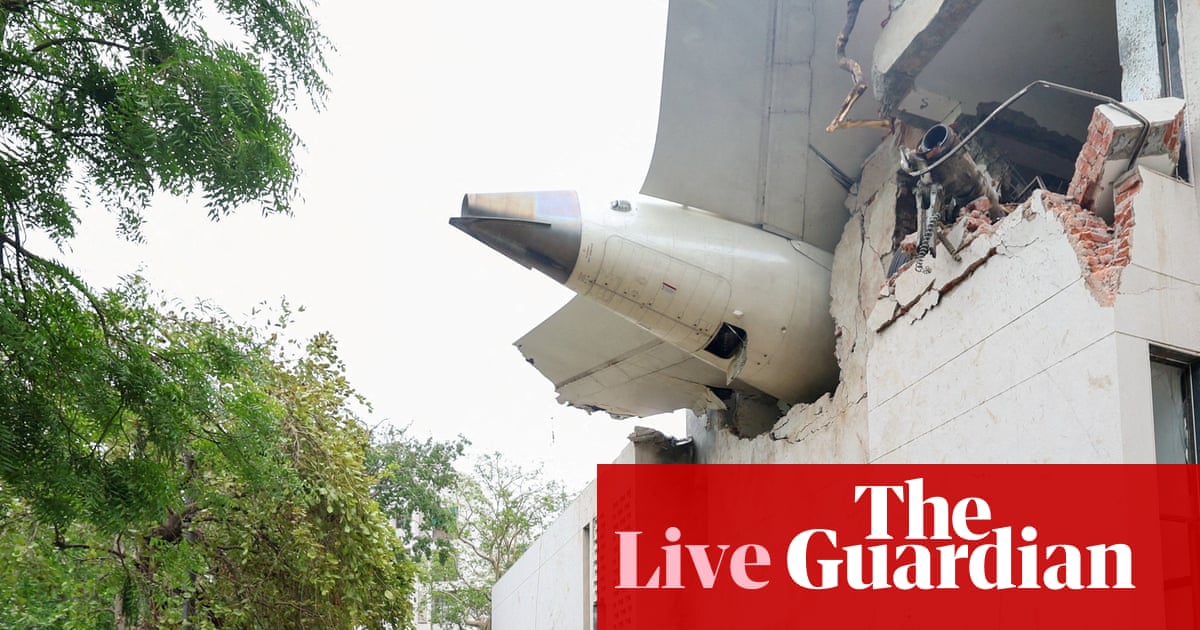
https://www.theguardian.com/world/live/2025/jun/12/air-india...
A plane at takeoff is pressurized, and that pressure holds the doors closed, as well as the physical locks. You cannot open it.
Don't believe random reddit comments. Average people know less than nothing about planes.
Speaking of random people knowing less than nothing: I believed that at takeoff and landing, planes were slightly overpressurized to increase airframe rigidity. I think I got that impression from a very old pilot, so either it used to be true or it was never true and I'm just wrong.
This person probably did not bail out of the plane in order to survive, but maybe you COULD open the doors at takeoff and landing, not that you want to.
Additional edit: I've actually flown a few times while running the barometer on my phone for funzies. I might be able to find a log of data to confirm or deny my mistaken belief! It's fun to do because you can see the pressurization increase signalling that the pilots are preparing for descent even before they tell you!
It is quite an intuition to decide to leave a plane in such a moment. He just escaped death and is now aggressively attacked for saying something potentially relevant.
(There may also be security rules like requiring continuing passengers to disembark with their hand luggage before reboarding. I don't know, it's 15+ years since I took a flight like this.)
I'm a system engineer - the hardware kind, not the more familiar network kind - and that is my job.
No. No no no. This is wrong, mistaken thinking.
A minimum standard of operations and attention to detail must be adhered to for high consequence / life critical endeavors and that behavior (culture?) must be enforced at all levels throughout the operation.
Ignore this heuristic at your peril - as either a consumer of these services or a provider who must demand high performance from your workforce.
Remember: flight attendants have (rarely exercised) critical health and life safety responsibilities. What messages do they internalize if this is the fourth flight in a row the coffee maker has been cracked and out of order ?
Airlines are large and heavily regulated organizations, and passenger amenities (once successfully certified) might just not be in the loop for mandatory maintenance cycles and certifications.
Maintenance of IFE units vs. avionics or the airframe itself might as well be performed by completely different contractors, maintenance crews etc.
Correlation just helps lead you to common causes.
Not a cause but and indicator.
You there to watch a old movie in 720p or to go somewhere?
He died of “suicide” suspiciously right after. I hope Boeing gets investigated for failure after failure after failure, and crashes it has caused recently.
https://www.theguardian.com/business/2024/apr/16/boeing-whis...
>Salehpour, who has worked at Boeing for more than a decade, says he faced retaliation, including threats and exclusion from meetings, after raising concerns over issues including a gap between parts of the fuselage of the 787.
That particular issue you quote, was only given as a single example
I mixed him with the other Boeing Whistleblower John Barnett Thanks !
Now whether he was driven to suicide by Boeing's unrelenting and unending persecution campaign against him as a whistleblower is another, perfectly valid question.
Sumeet Sabharwal – Captain - 8800+ flying hours Clive Kunder – First Officer 1 - 1100+ flying hours
Cabin Crew
Aparna Mahadik – Cabin Executive-1 Shradha Dhavan – Cabin Executive-2 Deepak Pathak Irfan Shaikh Lamnunthem Singson Maithili Patil Manisha Thapa
This was crew of AI171. Next time you're on a flight please take a moment to thank the pilots, CISF staff and cabin crew for all they do to keep us safe.
> Several injured passengers have been evacuated from the scene and transported to local hospitals.
Edit: The BBC is reporting local police as saying: "There appears to be no survivors" https://www.bbc.com/news/live/c8d1r3m8z92t?post=asset%3A8731...
Edit: Looks like 1 guy from the plane made it.
he must've been thrown out at just the right angle to not hit too much along the way...
Large jets can usually dump fuel but this is something that takes time. It's sometimes used in less urgent situations where the plane can still fly safely, like a landing gear malfunction or single engine failure.
Source: https://www.airliners.net/forum/viewtopic.php?t=1456931
Some aircraft allow fuel dumps but it is a slow process and done at higher elevation relative to the ground.
Any discussion about causes is going to be pure speculation right now. It's too early. But the Wiki article is pretty good to get an overview. Some interesting discussion on its talk page too: https://en.wikipedia.org/wiki/Talk:Air_India_Flight_171
Guessing it's either a foreign object ingested into both engines, probably a bird strike, or fuel starvation.
And here's a YouTube video showing a Ram Air Turbine (RAT) being deployed on a 787 for comparison: https://www.youtube.com/watch?v=oFBCGf50Trc&t=69s
Although TBH it also seems like a failure of city planning, aren't most major airports outside of the limits of the city they're associated with because of stuff like this? I know most of them don't have anywhere safe to attempt an emergency landing immediately after leaving the runway but at least there aren't a bunch of homes and office buildings.
https://en.wikipedia.org/wiki/List_of_the_busiest_airports_i....
I'm sure this is an airport most of the people on this site are familiar with but just in case you aren't, it's on reclaimed land in the San Francisco bay.
However, there are plenty of airports in major cities and built up areas (in both developed and developing countries), and I have never heard of avoiding building in areas due to the (remote) possibility of crashes.
Assuming this is accurate I would think this is a terrible idea in a large, heavy aircraft (and I realize they might not have been heavy for this flight).
When I was flying I would regularly hear airliners refuse intersection departures past a few hundred feet from the end of the runway due to company SOPs.
And hell, after the sexy beast they call the X-32 I can't see why you wouldn't want their designs: https://en.wikipedia.org/wiki/Boeing_X-32
Still wild speculation, but at least a high proportion of it informed.
Direct link: https://www.theguardian.com/world/live/2025/jun/12/air-india...
https://www.theguardian.com/world/live/2025/jun/12/air-india...
There's a large plume that looks like smoke to me looks like smoke (could be dust/sand being blown away but I wouldn't think you'd see that much from a busy runway) visible off the left side of the runway. The plane is obscured by that structure when it happens but it looks like it's created at the same time that the plane is leaving the ground.
It looks like the plane stops accelerating completely at that same moment without any change in orientation which, in my head, looks like both engines suffered total failure at the same time.
From my limited knowledge (mostly from Mentour Pilot YT videos), that seems consistent with what you'd see if the plane flew through a large flock of birds that are spread out enough that both engines would be hit at the same time.
Again, purely speculation on my part based solely on what I see in this 1 video.
Goes through the usual speculations. However it mentions interesting the region has a high number of bird strikes.
I guess he was just lucky to be in a bit sticking out rather than crushed?
Looking through the chart you linked, averages around 3 per year. Considering how many planes are currently in the sky at this very moment, this is a wildly useless statistic used to cause fear and panic.
I can read too. I added a comment with a number. You don't know my intent, this is your interpretation.
Besides, 2018/19 was a steep outlier with the 737 MAX crashes. This is why these got widespread attention and have been discussed down to the last detail for years.
[1] https://www.theguardian.com/business/2024/apr/16/boeing-whis...
I'm very disappointed that in India this aspect is being ignored. It should stimulate local/state/central govt to solve the slum, urban garbage etc kind of problems.
https://www.telegraph.co.uk/news/2025/06/12/whistleblower-ra...
The US flys significantly more than any country in the world and operates the most Boeing airplanes including the 737 and 737 Max, yet there hasn't been a single major accident like this and the Max crashes in the US.
Are these planes not maintained to the same standards, are the pilots not trained on these types of planes as much as in the US?
Not to say there isn't something there to dive into with data and some countries are safer than others to fly. And definitely some airlines than others.
Id rather look at it in the lens of "is this flight I am booking safe enough" over "US is safer than Non-US"
I suppose US Airways 1549 wasn't American, then. I wonder what the 'US' in the name was for, then. If the bird strike had happened earlier in the flight where the plane would've had less altitude and speed, a very similar result to AI171 could've happened.
Or more recently, I suppose DCA isn't in the US either, and PSA Airlines isn't American.
This comment is subliminal racism disguised as thoughtful 'are these pilots not maintained to the same standards, are the pilots not trained on these types of planes', when the corrupt cesspool that is the US somehow churned out the disaster of an aeroplane system that was MCAS.
What a bell-end of a commenter.
https://en.wikipedia.org/wiki/American_Airlines_Flight_191
> American Airlines Flight 191 crashed shortly after lifting off the runway at Chicago O'Hare Airport [...] The accident was attributed to improper maintenance procedures. The crash resulted in the deaths of all 271 passengers and crew on board, as well as two people on the ground.
https://en.wikipedia.org/wiki/American_Airlines_Flight_587
> American Airlines Flight 587 crashed in the Belle Harbor neighborhood of Queens, New York, just after departing John F. Kennedy International Airport bound for Las Américas International Airport, Santo Domingo. The first officer's overuse of the rudder in response to wake turbulence from a Japan Airlines 747 was cited as cause. All 260 people on board, as well as five people on the ground, died from the crash
I'm going to downvote you now.
The second, in 2001, remains the last major accident in the US.
That's not how planes work, that's not how aviation safety is advanced. There have been hundreds of accidents and there's no value in cherry-picking specific timeframes (while not actually stating you were cherry-picking until challenged on it), nor specific categories of accident (fatal accidents with hull loss only).
This is not the right way to view it: https://www.statista.com/statistics/262867/fatal-civil-airli...
THIS is the right way to view it: https://www.panish.law/wp-content/uploads/2024/06/PSBR-Aviat...
So is this: https://accidentstats.airbus.com/wp-content/uploads/2025/02/...
And this (page 8): https://www.boeing.com/content/dam/boeing/boeingdotcom/compa...
(and if you want to apportion geographic blame - for Boeing airframes only - check out pages 17-24)
When there are accidents, the right thing to do is to analyse how it happened, come up with findings that might reduce the likelyhood of it happening again, or eliminate it, and push all people in aviation to adopt those findings - whether it be manufacturer, ATC, airline, or pilot, and regardless of country.
And why is it always Boeing planes?